Pale Leaves on Monstera Deliciosa: Causes, Checks & Fixes
Quick answer
Pale leaves on Monstera deliciosa usually mean too little light for chlorophyll production, or root stress limiting nutrient uptake-not a random color change. First step: assess light at canopy height-if stems stretch toward a dim window and new leaves open small without splits, move to bright indirect light before fertilizing.
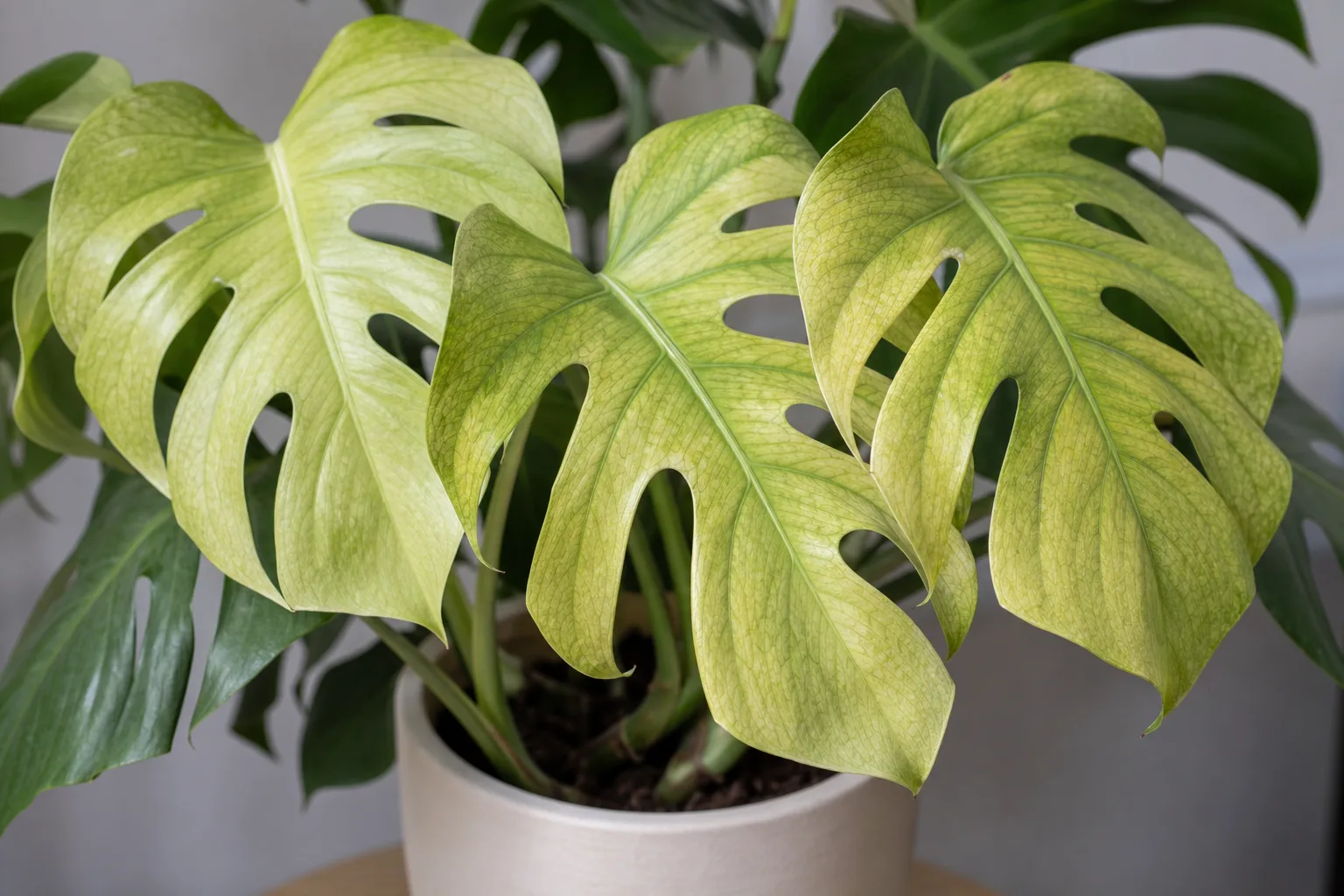
Pale Leaves on Monstera Deliciosa: Causes, Checks & Fixes
This guide covers pale leaves on Monstera Deliciosa. See also the general Pale Leaves guide, watering, and light pages for this plant.
Pale Leaves on Monstera Deliciosa: Causes, Checks & Fixes
Quick answer
Pale leaves on Monstera deliciosa (Monstera deliciosa) mean foliage has lost its characteristic deep, glossy green-blades look washed out, yellow-green, or thin instead of rich forest green. On this architectural climber, pale color almost always traces to light at the wrong level or roots that cannot support full chlorophyll production, not mysterious aging. For general chlorosis mechanics, see our pale leaves guide. On Monstera deliciosa, pale new leaves without fenestrations and long gaps between nodes on a moss pole are the signature low-light pattern.
First step: read the window from the plant’s position at midday. If you cannot see a defined shadow on the foliage, the spot is likely too dim. If pale leaves coincide with wet soil for weeks and soft lower petioles, inspect roots before adding fertilizer.
What pale leaves look like on Monstera Deliciosa
Healthy Monstera deliciosa shows broad, dark green fenestrated blades on moderately spaced nodes along a climbing vine. Pale foliage breaks that pattern:
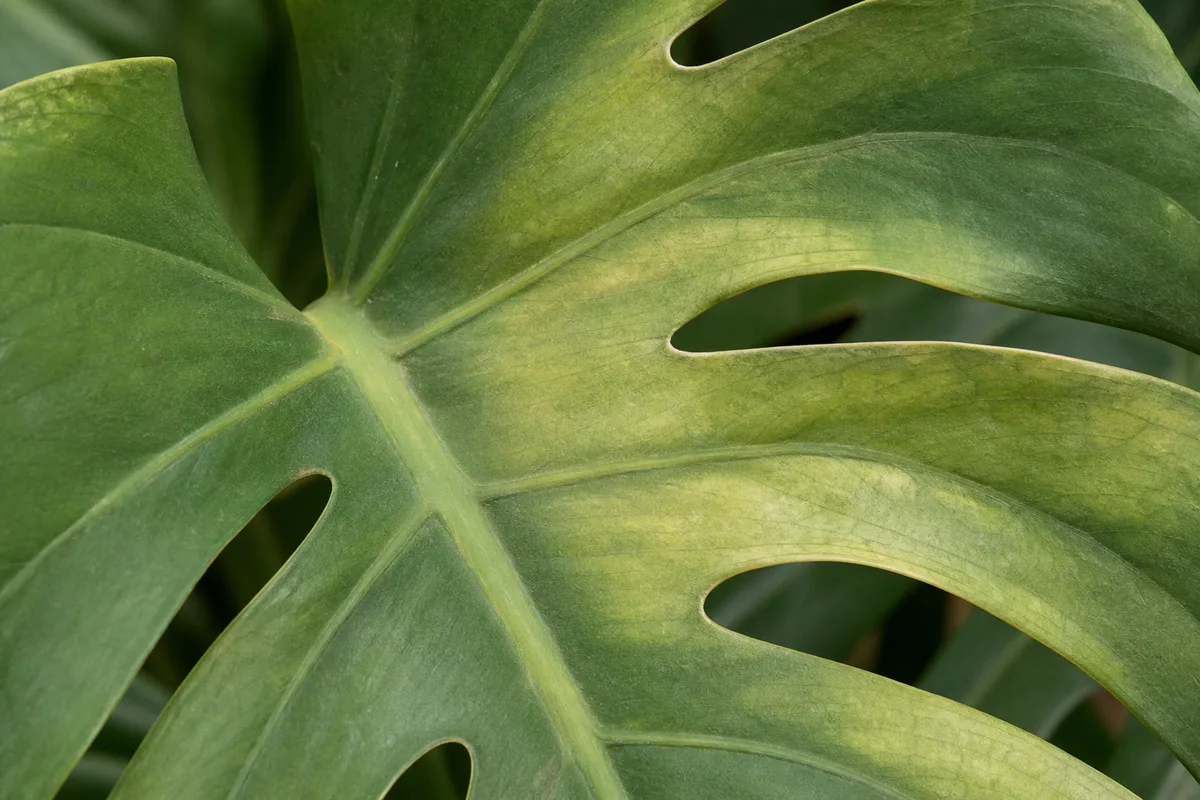
Pale Leaves symptoms on Monstera Deliciosa - compare with healthy tissue on the same plant.
Low-light pale
- Uniform washed-out green across several leaves-not isolated spots
- New leaves open small, thin, and mostly solid without splits and holes
- Long internodes; the vine leans toward the brightest window
- Growth slows; unfurling may lag while color stays lime-green
Root-stress pale
- Lower leaves fade yellow-green while soil stays wet for extended periods
- Petioles may soften slightly; sometimes paired with yellowing
- Upper new growth may also pale if uptake is failing-not just lower senescence
Nutrient-related pale (after ruling out light and moisture)
- Older leaves pale first while veins stay greener on some species; on Monstera, general washed-out lower canopy during active growth in very old depleted mix
- Often follows years without repot or chronic underfeeding in otherwise bright conditions
Normal lighter new growth
- A newly unfurling leaf is temporarily lighter for days before hardening-that is growth, not chlorosis
Compare with faded leaves when the issue is dullness from sun bleach versus insufficient light.
Why Monstera Deliciosa gets pale leaves
Insufficient light
Monstera deliciosa prefers moderate brightness without direct sunlight. In a dim corner, the plant produces less chlorophyll. Leaves turn uniform pale yellow-green; petioles stretch as the vine reaches toward glass. Metabolism slows, so owners often keep watering on a summer schedule while mix stays wet-combining light stress with moisture problems.
Mature fenestrations require age, support, and adequate light. A pale Monstera that has not split new leaves in a year is often a light problem, not a fertilizer problem.
Overwatering and root uptake failure
Saturated mix reduces root function. Yellowing from overwatering can read as pale yellow-green rather than butter-yellow. Wet soil with pale limp lower leaves needs dry-down and possible root inspection-not more light alone.
Natural new-leaf color
Emerging leaves are lighter until they harden. Do not treat a single rolled pale leaf at the tip as chlorosis if mature foliage below is deep green.
Nutrient deficiency (confirmed only after light and roots check)
Chlorosis can follow nutrient imbalance when roots are healthy and light is adequate. On Monstera, this is less common than low light indoors. Nitrogen deficiency often affects older leaves first; magnesium may show interveinal patterns on some plants. Never assume deficiency in a dim room.
How to confirm the cause
- Light test - At midday, stand where the pot sits. Weak diffuse light or no shadow on leaves supports low light.
- Internode length - Long bare gaps between leaves on the moss pole = stretching for light.
- New leaf size and fenestrations - Small solid pale new leaves = light. Normal size with only temporary pale roll = growth.
- Soil moisture at 3–5 cm - Wet and heavy with pale limp lowers = root stress. Appropriately dry with pale stretch = light.
- Which leaves pale - Whole canopy uniformly washed out = light. Lower leaves only on wet soil = moisture or roots.
- Repot and feed history - Years in same depleted mix in bright light raises nutrient possibility last.
First fix for Monstera Deliciosa
Assess light at canopy height-move to bright indirect light if the plant stretches, leans, or produces small solid pale new leaves.
That is the correct first fix for the majority of indoor pale Monstera cases-not fertilizer.
- If dim: Move within 1–3 feet of an east window or filtered south/west glass, or add a grow light 10–12 hours daily.
- If wet soil with pale limp lowers: Stop watering until top quarter to one-third of mix dries; inspect roots if color worsens.
- If light is already strong and roots healthy: Consider diluted balanced fertilizer only during active growth after two weeks of stable new green leaves.
Do not repot and fertilize simultaneously on a stressed pale plant.
Step-by-step recovery
Low-light recovery
- Relocate to bright indirect light.
- Rotate pot weekly for even exposure.
- Adjust watering to faster dry-down in the brighter spot.
- Judge recovery by next two new leaves opening darker and larger with developing splits-not old blades re-greening.
Wet-root recovery
- Dry-down protocol per overwatering guide.
- Trim mushy roots if yellowing spreads after appropriate dry-down.
- Repot into fresh chunky mix if needed.
- Hold fertilizer until new growth firms and greens.
Nutrient recovery (last resort, confirmed context)
- Flush salts if overfeeding history exists.
- Apply dilute balanced liquid feed monthly in spring and summer only.
- Read nitrogen deficiency if lower leaves pale in bright light with healthy roots.
Recovery timeline
Low light corrected: Color improvement on new leaves within two to four weeks; fenestration on subsequent growth may take a full season.
Root stress corrected: Pale spread should stop within one to two weeks after proper dry-down; new green unfurling within three to four weeks.
Existing pale blades: Generally do not darken; focus on apical new growth.
Lookalike symptoms
| Pattern | Likely cause | Page |
|---|---|---|
| Washed-out green, leggy stems | Not enough light | Light guide |
| Dull bleached window-facing patches | Faded leaves | Sun vs shade |
| Yellow lower leaves, wet soil | Overwatering | Moisture |
| Temporary light green unfurling | Normal growth | Monitor |
| Lower pale in bright old pot | Nutrient deficiency | Nitrogen deficiency |
What not to do
Do not fertilize a pale Monstera in a dim corner-salts on weak roots worsen the look.
Do not assume every pale leaf needs repotting without checking moisture and light first.
Do not confuse brief new-leaf lightness with whole-plant chlorosis.
Do not move instantly from deep shade to hot direct sun-acclimate over one to two weeks.
How to prevent pale leaves next time
Keep Monstera deliciosa in bright filtered light year-round. Provide a moss pole so growth stays vertical toward the window, not sprawled into shade. Water when top 3–5 cm dries. Repot every two to three years in spring when roots fill the pot. Supplement with grow lights in north-facing rooms before foliage washes out.
When to worry
Urgent if pale leaves coincide with soft stems and sour wet soil, or new growth stays tiny and pale for multiple cycles despite bright light (possible systemic root failure). Slow uniform pale in an obvious dim spot is fixable with relocation.
When to use this page vs sibling guides
| Your question | Best page |
|---|---|
| Washed-out pale green, leggy vine | This page |
| No fenestrations, stretching | Not enough light |
| Bleached sun-facing patches | Faded leaves |
| Butter-yellow on wet soil | Yellow leaves |
Related Monstera deliciosa guides
- Monstera deliciosa overview
- Light guide
- Not enough light
- Faded leaves
- Yellow leaves
- Nitrogen deficiency
- Problems hub
Conclusion
Pale leaves on Monstera deliciosa look worrying on large architectural foliage, but the fix is usually more usable light, not a nutrient miracle. Read the window, check internodes and new leaf size on the moss pole, rule out wet-root stress, then judge recovery by richer green unfurling at the vine tip-not by old washed-out blades regaining depth.