Nitrogen Deficiency on Monstera Deliciosa: Causes, Checks &
Quick answer
Nitrogen deficiency on Monstera deliciosa shows as pale or yellowing older split leaves while new fenestrated foliage stays small or slow on otherwise firm climbing stems. First step: confirm yellowing starts on lower, older leaves—not new unfurling tips—and review whether you have fed during the past growing season.
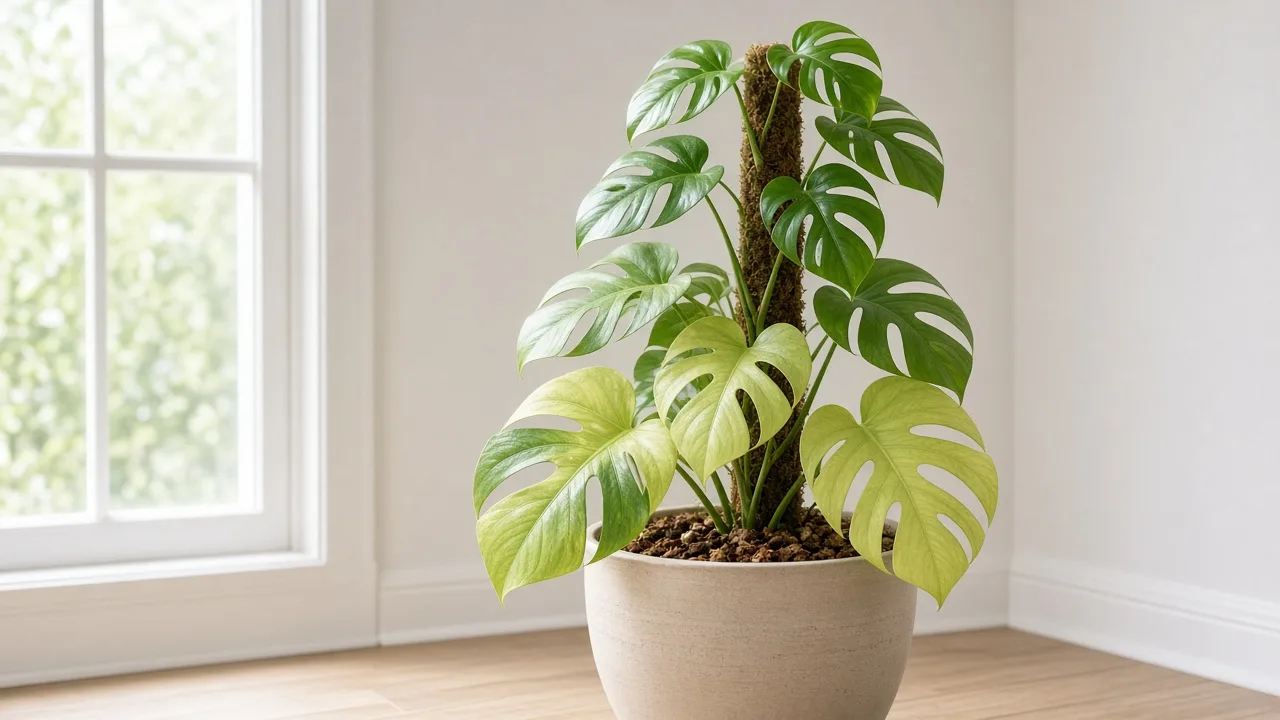
Nitrogen Deficiency on Monstera Deliciosa: Causes, Checks & Fixes
This guide covers nitrogen deficiency on Monstera Deliciosa. See also the general Nitrogen Deficiency guide, watering, and light pages for this plant.
Nitrogen Deficiency on Monstera Deliciosa: Causes, Checks & Fixes
Quick answer
Nitrogen deficiency on Monstera deliciosa shows as pale green to yellow older split leaves on lower canopy sections while new fenestrated foliage at the moss-pole tip stays small or slow. Nitrogen is mobile—the plant dismantles chlorophyll in old tissue and ships nitrogen upward to fund new splits when soil reserves run low. RHS notes nitrogen deficiency causes general yellowing of older leaves first, often with lack of vigour. For universal nutrient mechanics, see our nitrogen deficiency guide. On Monstera deliciosa, watch the oldest lowest splits on the main vine first—they pale before the unfurling tip leaf if nitrogen is the issue.
First step: confirm older leaves pale first, then review feeding history on a large actively growing floor plant.
When to use this page vs other Monstera guides
| Pattern | Read next |
|---|---|
| Old lower splits pale first, new leaves small | Nitrogen deficiency (this page) |
| New splits yellow with green veins at moss pole | Iron deficiency |
| All leaves yellow on wet heavy pot | Overwatering |
| Washed-out green, long internodes, tiny solid new leaves | Not enough light or pale leaves |
| Multiple yellow causes at once | Yellow leaves |
What nitrogen deficiency looks like on Monstera deliciosa
Healthy Monstera deliciosa holds glossy deep-green fenestrated blades on stiff petioles along a climbing apical vine. Nitrogen stress breaks that pattern from the bottom of the canopy upward, not from the moss-pole tip down.
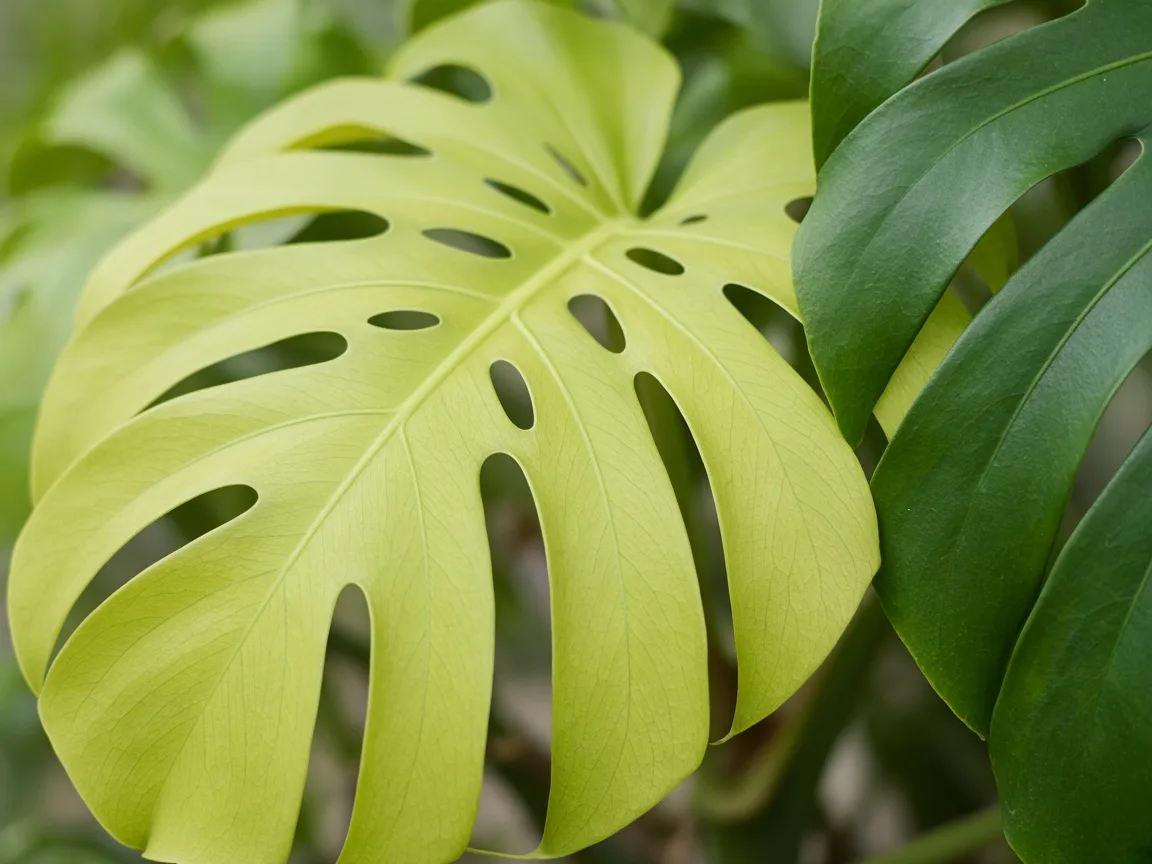
Uniform pale yellowing on an older Monstera deliciosa split—veins and blade tissue fade together, unlike iron chlorosis on new tips.
Typical signs:
- Uniform pale green or yellow on oldest lower splits—veins and tissue lose color together
- Smaller new fenestrated leaves at the tip despite bright indirect light
- Short internodes on an otherwise firm climbing vine
- Light green cast across several lower leaves before yellowing spreads upward
- Firm stems unlike mushy overwatered Monstera on soggy mix
Not nitrogen deficiency:
- Yellow new splits with dark green veins—iron deficiency (iron is immobile and affects youngest leaves first)
- Brown crispy edges without overall pale lower canopy—brown tips
- All leaves yellow at once on persistently wet soil—overwatering or root rot
- One bottom leaf yellow while a large green split unfurls above—often normal senescence; see yellow leaves
Why Monstera deliciosa gets nitrogen deficiency
Monstera deliciosa is a large climbing aroid that consumes nitrogen quickly when producing big new splits in bright indirect light. Years without fertilizer, exhausted potting mix in an oversized root-bound floor pot, or nitrogen leaching from frequent thorough watering depletes reserves faster than owners expect on a plant that still looks structurally healthy.
Monstera-specific causes:
- Big leaf demand—Each new fenestrated split is a large nitrogen sink compared with small-leaved houseplants.
- Slow repot cycle on floor plants—Heavy specimens stay in the same chunky mix two seasons too long while the vine mass doubles.
- Skipped feeds during active growth—Owners under-feed large monsteras fearing burn after one brown tip scare.
- Leaching in airy mix—Chunky aroid bark drains well; nitrogen washes out with every deep watering if you never replace what leaches.
- Root uptake failure—Chronic wet mix or salt crust blocks absorption; pale leaves then mimic deficiency even when fertilizer sits unused.
Do not diagnose nitrogen deficiency on sour wet soil with soft stems at the base—that is root failure from overwatering until you confirm mostly white firm roots.
Big splits, big appetite: nitrogen on deliciosa
Monstera deliciosa allocates nitrogen to each large new fenestrated leaf—a single mature split can dwarf an entire pothos vine in biomass. A floor plant on a moss pole in a bright room outpaces small-container nutrient reserves faster than a juvenile tabletop specimen—indoor deliciosa commonly reaches 6 to 8 feet with sturdy support.
Match feeding to active split production, not calendar guilt after years of skipping fertilizer. A vine pushing monthly fenestrations in summer needs more nitrogen than the same genetics sitting dormant in a dim corner—but both still need half-strength doses, not full-label pours on dry shocked roots.
Floor pots and depleted chunky mix
The diagnostic trap on large deliciosa is the heavy decorative pot that never gets repotted. Surface bark looks fine while the root core has consumed every available nitrogen ion in two-year-old mix.
Floor-pot dry-down illusion: Top 3–5 cm may dry on schedule while a massive root ball in an undersized or unchanged mix starves below. Pale lower splits with firm stems and normal watering rhythm often mean depleted mix, not thirst.
Chunky mix breakdown: Perlite and orchid bark that started airy become a water-holding sponge as they compost. Roots stay alive but cannot access fresh nitrogen until you refresh soil per the Monstera soil guide at repotting.
Oversized cachepots: A floor Monstera in a pot far larger than its root mass dilutes what little fertilizer you apply across too much inactive mix—pale lower leaves follow even when you feed occasionally.
Fenestration slowdown at the moss pole
Nitrogen deficiency on deliciosa often shows as stunted new splits while older blades pale below. The unfurling tip leaf may open, but each successive fenestration is smaller, thinner, or slower than the leaf two nodes down—a pattern that would not appear on a non-climbing rosette plant.
Watch the size comparison between the three newest splits. Healthy deliciosa in good light usually produces progressively larger fenestrated leaves as the vine matures. When new splits shrink for three cycles while lower leaves wash out yellow-green, nitrogen starvation is more likely than a temporary unfurl stall.
Normal juvenile color still matters: a brand-new split is briefly lime green for days, then deepens. Worry when every new leaf stays pale and undersized for weeks while multiple lower splits yellow uniformly—not when one aging bottom leaf senesces alone.
Lookalike symptoms
| Pattern | Check | Likely cause |
|---|---|---|
| Old splits pale first, new leaves small | Feeding history, mix age | Nitrogen deficiency (this page) |
| New yellow splits, green veins | Wet mix, salt crust | Iron deficiency |
| All yellow, wet heavy pot | Root smell, stem softness | Overwatering |
| Washed-out green, long internodes | Window shadow at midday | Not enough light |
| Interveinal yellow mid-canopy | Complete fertilizer used? | Magnesium deficiency |
| One bottom leaf only | New tip green and large | Normal aging—yellow leaves |
How to confirm
- Leaf age pattern—Lower old splits pale first; tip leaves stay greener but may be small.
- Feeding history—No balanced feed for months during spring and summer growth?
- Root check—White firm roots support feeding; brown mush needs drainage first.
- Soil age and pot size relative to vine mass on floor specimens.
- Moisture cross-check—Wet core in a heavy pot rules out simple starvation until roots recover.
- Light cross-check—Not enough light compounds pale stunted growth; fix placement before doubling fertilizer.
- Iron vs nitrogen—Green veins on new tips point to iron, not this page.
First fix for Monstera deliciosa
One dilute balanced liquid fertilizer at half label strength on already-moist soil—only after confirming healthy roots and normal soil moisture.
Follow the Monstera fertilizer guide—Penn State Extension recommends balanced houseplant fertilizer during the growing season. One measured feed—not repotting plus double fertilizer the same week.
Do not feed a waterlogged floor specimen, a plant you repotted within the last month, or a vine with active pest damage on new splits. Fix the limiting stress first, then resume half-strength feeding during active growth.
Step-by-step recovery
- Apply half-strength balanced feed once on moist chunky mix; repeat monthly through active growth if new splits respond.
- Flush salts if white crust rings the pot rim—leach before stacking more fertilizer.
- Adjust watering so top 3–5 cm dry between drinks per Monstera watering—uptake fails in chronic wet mix.
- Repot into fresh chunky aroid mix if roots fill the pot and pale leaves persist after two measured feeds—see Monstera repotting.
- Trim fully yellow older splits only when they pull away easily; do not strip half the canopy at once.
- Monitor the next two fenestrations at the moss pole for size and deeper green color.
Mistakes to avoid
- Full-strength feed on dry roots—Always water normally first, then fertilize moist mix at half label rate.
- Nitrogen before drainage—Fertilizer on waterlogged roots worsens stress and can burn tissue.
- Repot + feed + prune same week—Stack one change at a time on a large stressed vine.
- Confusing iron and nitrogen—New-tip green veins mean iron page, not this one.
- Feeding a dim corner plant—Pale stunted solid new leaves with long internodes need light before nitrogen.
- Ignoring leaching—Chunky mix plus frequent flushing without replacement feed depletes nitrogen silently.
Recovery timeline
Correct feeding on healthy roots shows greener, larger new splits within two to four weeks. Older pale blades rarely re-green; the plant replaces them slowly as the vine grows.
Full canopy refresh on a large floor specimen may take one growing season. Judge success by fenestration size and color on fresh growth, not by old yellow splits darkening again. If three successive new leaves stay small and pale after two monthly half-strength feeds with firm roots, reassess mix compaction, light, and overlapping pale leaves causes.
Prevention
- Feed lightly with balanced fertilizer spring through early fall per the Monstera fertilizer guide—pause in winter unless strong grow lights keep new splits coming.
- Refresh depleted chunky mix every one to two years on heavy floor plants at repotting.
- Flush salts mid-season if you use hard tap water or feed frequently in bright light.
- Match feed frequency to split production—a moss-pole climber in a sunny room uses more nitrogen than a slow juvenile.
- Track whether lower leaves pale before new tips shrink; early pale lower splits are easier to correct than a fully stunted vine.
Related Monstera Deliciosa guides
- Monstera overview
- Monstera fertilizer
- Monstera watering
- Monstera soil
- Iron deficiency
- Monstera problems hub
Conclusion
Pale older Monstera splits with small new fenestrations are a nitrogen signal—confirm the pattern starts on lower leaves, rule out wet roots, then feed once at half strength on moist soil.