Scale Insects on Pilea Peperomioides: How to Identify
Quick answer
First isolate your Pilea Peperomioides from nearby plants. Then check the stems, petiole joints, and leaf undersides for fixed oval bumps; sticky honeydew supports soft scale, while some armored scales leave no honeydew.
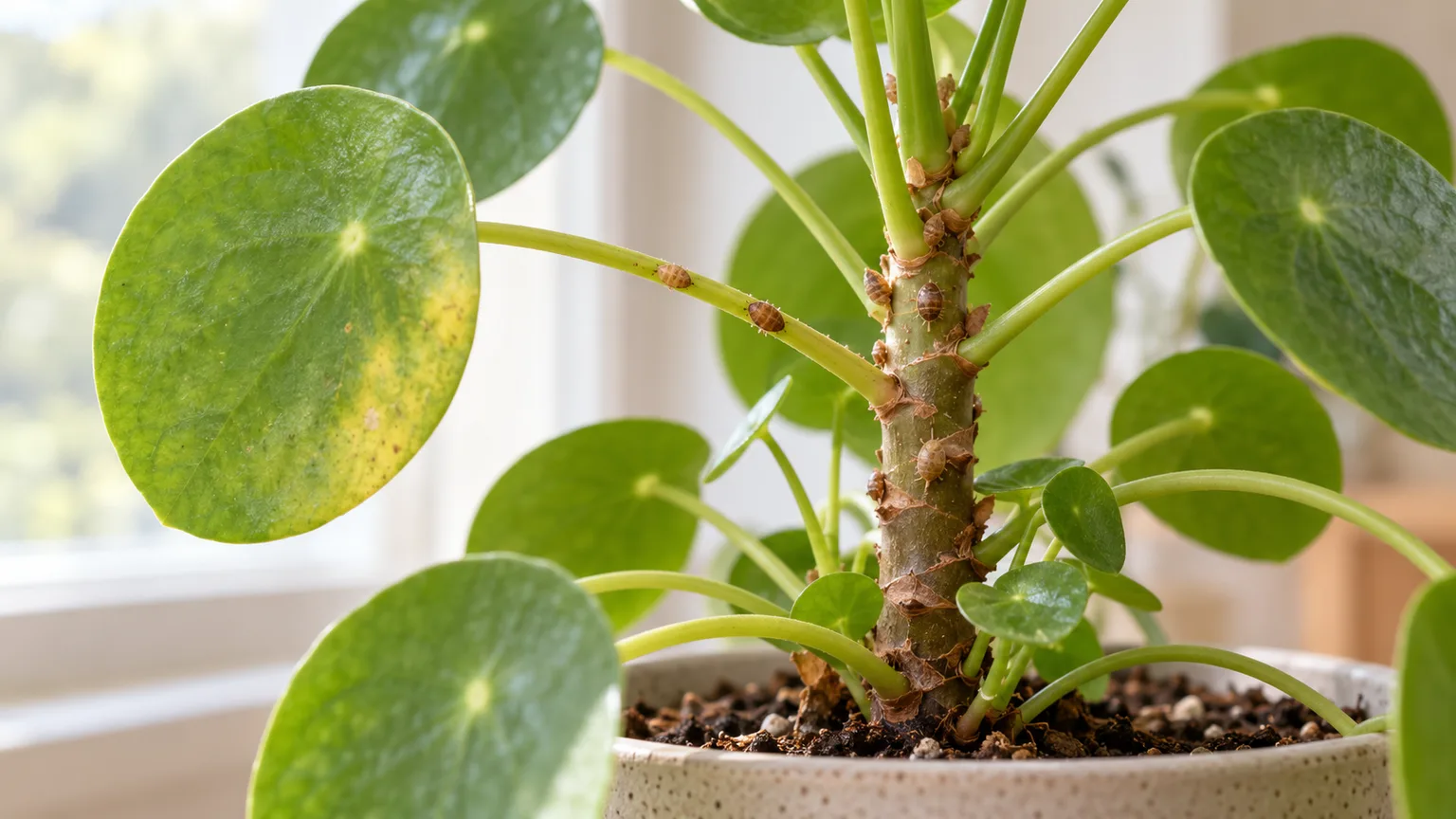
Scale Insects on Pilea Peperomioides: How to Identify and Treat Them
This guide covers scale insects on Pilea Peperomioides. See also the general Scale Insects guide, watering, and light pages for this plant.
Scale Insects on Pilea Peperomioides: How to Identify and Treat Them
Quick answer
First isolate your Pilea Peperomioides from nearby plants. Then inspect the central stem, petiole joints, and leaf undersides for small, fixed oval bumps. Sticky honeydew can point to soft scale, but some armored scales do not make it, so the plant should be checked even when the leaves are not sticky. Scale insects feed by sucking plant sap and can contribute to yellowing, slow growth, leaf drop, or sooty mold when honeydew is present (UC IPM describes these signs and the difference between scale groups).
Pilea’s round leaves on long petioles make it easy to overlook small colonies where a petiole joins the central stem; inspect those junctions as well as the leaf faces (The Spruce describes the plant’s coin-shaped leaves and petioles). Take a close look before spraying: one brown mark is not enough to confirm an insect, and treatments that miss the pest or burn the foliage add stress without solving the cause.
What scale insects look like on Pilea Peperomioides
On this plant, scale often looks like tan, gray, or brown bumps attached to the stem, petioles, or underside of a leaf. Adult females stay in one place beneath a waxy or shell-like covering, while young crawlers are the mobile stage and may look yellowish or orange before settling down (UC IPM’s scale identification guide).
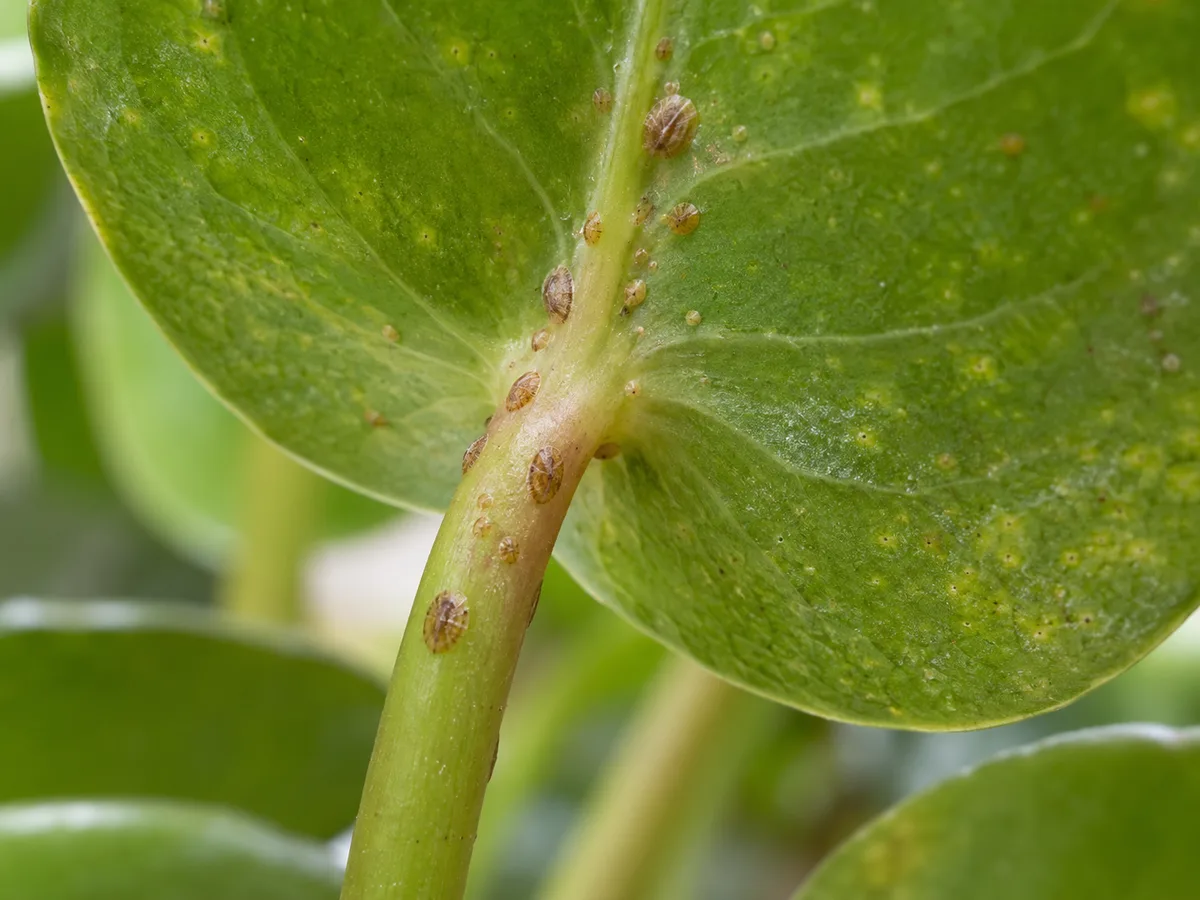
Check the petiole and leaf underside for fixed bumps; a few scales can be present before the rest of the plant looks unwell.
Some scales leave a clear, sticky film called honeydew. Soft scales commonly produce it, and the residue can collect on lower leaves or nearby surfaces; armored scales generally do not, so the absence of honeydew does not rule scale out (UC IPM’s comparison of armored and soft scales). A dark coating may be sooty mold growing on honeydew rather than a separate leaf disease.
How to confirm scale before treating
Move the plant to a bright place and examine it with a hand lens. Check both leaf surfaces, the petiole bases, the central stem, and the small crevices where leaves attach. Look for repeated bumps that remain fixed when the leaf moves, not just isolated spots in the leaf tissue.
Use the same inspection route each time so you can tell whether the colony is spreading. Start with the uppermost leaves, turn each round blade over, trace its petiole back to the central stem, and finish by checking the lower stem and the pot rim. If you find sticky residue, follow it upward: honeydew can land below the feeding insect, so the surface that feels sticky is not necessarily where the colony sits. A single smooth tan patch on a leaf is less convincing than several raised bumps in protected joints.
Use a damp cotton swab to gently test one bump. A scale may lift as a small covering and reveal an insect body; do not scrape hard enough to gouge the petiole or leaf. If you see several fixed bumps together, inspect the plant directly above a sticky patch. A clear sticky film supports soft scale, while hard, flattened covers without honeydew can fit armored scale (UW–Madison Extension explains these differences and typical feeding sites).
You can also hold a clean sheet of white paper beneath a leaf and tap the petiole lightly. If tiny mobile crawlers fall, that is useful evidence of an active life stage; the lack of movement does not clear the plant, because settled adult scales are usually stationary (UW–Madison Extension describes the mobile crawler stage and immobile adults). Avoid pressing sticky tape directly onto Pilea leaves or petioles, where removing it could tear the thin surface. If the bump does not lift easily or you cannot tell whether it is an insect, photograph it beside a ruler and ask a local extension service to identify it before escalating treatment.
Compare the pattern before choosing a treatment. Mealybugs tend to show white, cottony wax rather than a firm separate scale cover, while spider mites are more likely to leave fine webbing and pale stippling than fixed shells (Gardening Know How on mealybug appearance, The Spruce on spider mites and Pilea pests). Pilea is susceptible to common houseplant pests, including scale, so identify what is actually present rather than treating every discoloration as scale (The Spruce’s Pilea care guide).
| What you notice | What it may indicate | Next check |
|---|---|---|
| Fixed tan or brown bumps on a stem or petiole | Scale insects | Inspect nearby leaf undersides and check whether a covering lifts gently |
| Sticky clear residue under the plant | Possible soft scale or another honeydew-producing pest | Look above the residue for live insects; some armored scales do not make honeydew |
| White cottony clusters | Mealybugs may be a closer match | Check sheltered stem joints and leaf bases |
| Fine webbing with pale stippling | Spider mites may fit better | Inspect leaf undersides for moving specks |
The cover can help distinguish the two main scale groups, but you do not need to name the exact species before isolating the plant. A soft scale tends to look rounded or dome-shaped, with the cover attached to the insect; it can produce honeydew. An armored scale is flatter and has a separate protective cover over the insect body, and it typically does not leave honeydew (UC IPM’s scale comparison). These signs are enough for a practical scale diagnosis; a precise species identification is a separate step and may require help from a local extension service.
Why scale can establish itself on an indoor Pilea
Scale is not proof that a Pilea was badly cared for. Pilea peperomioides can host common indoor pests, and a scale colony may arrive on a newly purchased plant or one that has spent time outdoors. Montana State University Extension lists new plants and plants brought back indoors among routes for houseplant pest problems and recommends quarantine when pests are found (MSU Extension’s houseplant pest guidance).
Once settled, adult scales are easy to miss because they resemble small bumps rather than active insects. The young crawlers move to new feeding sites before losing their legs and becoming immobile, so the colony may spread while the adults appear unchanged (UC IPM on scale life stages). On a Pilea, inspect the petiole-to-stem junctions as carefully as the visible leaf faces.
Yellowing or leaf drop alone is not proof of scale. If you find no insects, compare the plant’s root-zone moisture and light before treating: Pilea grows best in bright indirect light and a well-draining mix, and excess water can also cause leaf decline (The Spruce’s Pilea care guide). Use the Pilea watering guide and soil guide to check those conditions without changing several things at once.
First fix: isolate the Pilea
Place the plant apart from other houseplants before removing pests or applying anything. Keep its leaves from touching neighboring plants, and inspect the nearest plants for sticky residue or fixed bumps. This separation reduces the chance of carrying crawlers to other pots while you work; extension guidance also recommends moving infested houseplants away from healthy ones (MSU Extension, Gardening Know How).
If you cannot move the plant to a separate room, put it on a washable tray or table with a gap between it and neighboring foliage. Do not carry an infested Pilea past other plants with its leaves brushing them, and avoid setting removed leaves or swabs on a shared potting bench. Keep a separate damp cloth and cotton swabs beside the plant, then discard them after inspection. These steps make the quarantine useful even in a small home and reduce accidental transfer while you work through each petiole.
Do not repot a healthy-rooted Pilea just because scale is on its leaves. Keep watering and light steady while you assess the pest. If the soil is staying wet or drainage has failed, use the separate Pilea soil guide to decide whether the root zone needs attention.
Treat an early infestation carefully
For a few accessible scales, start by lifting them off with a damp cotton swab or soft cloth. Work slowly around the central stem and petiole bases so you do not tear Pilea’s leaf tissue. Manual removal and alcohol swabs are described for small infestations by Gardening Know How, but alcohol can injure foliage, so do not apply it broadly or skip a small-area test (Gardening Know How’s scale control guidance).
Work from one side of the plant to the other rather than wiping all over the canopy. After each leaf or petiole, check the swab and replace it if it has picked up insects or sticky material; a clean swab keeps you from dragging residue across the next leaf. Recheck the same junctions from the back side, where a tight petiole angle can hide a second bump. If a leaf is heavily covered and can no longer be inspected or cleaned without damaging neighboring growth, you may remove that single leaf with clean scissors, bag it, and discard it. Keep as much healthy foliage as possible, because removing many leaves at once adds stress and makes the recovery signal harder to read.
If live scales remain or new crawlers appear, choose an insecticidal soap or horticultural oil only if its label permits use on indoor ornamental plants and scale. Follow the product label exactly, including dilution, coverage, repeat interval, and precautions for people and pets. Test a small part of one leaf first and wait for a reaction before treating the whole Pilea; Montana State Extension advises testing contact products because they can damage plant tissue (MSU Extension).
Coverage matters because these products must reach the insects. Check leaf undersides, petioles, and the stem, and repeat only at the label interval if live scales or crawlers remain. UC IPM notes that timing sprays when crawlers are active can improve control, while routine insecticide use is unnecessary when the infestation is not causing unacceptable damage (UC IPM management guidance). Avoid homemade detergent mixtures and do not combine several pesticides or oils on the same day.
Do not judge a treatment by whether an adult shell disappears overnight. The protected covering can make a scale difficult to reach, and some products work better when young crawlers are moving than when the insects are settled. Inspect the plant again at the product’s stated repeat interval, and use the same leaf-by-leaf route so the comparison is fair. If there are no live insects or fresh crawlers, pause rather than applying extra product “just in case”; repeated unscheduled sprays can damage foliage without improving control. For a broad infestation, confirm the product is labeled for indoor ornamental plants and follow its directions for room ventilation, re-entry, and disposal.
Track recovery and know when to escalate
Dead scales may stay attached after treatment, so the number of visible shells alone is not a reliable progress measure. Gently check selected bumps for a live body and watch for newly moving crawlers, fresh honeydew, or new yellowing. UC IPM explains that dead scales can remain on a plant and should be checked rather than assumed to be alive or dead by appearance alone (UC IPM).
Use three checkpoints instead of expecting an instant visual reset. First, after manual cleaning, note which petioles still carry bumps and wipe away old honeydew so you can detect new residue. Second, before the next label-directed treatment, check those same spots for a moist body, fresh crawlers, or renewed stickiness. Third, over the following several weeks, watch the newest leaves and stem tip for continued growth without additional colonies. The interval depends on the product directions and how quickly the Pilea is growing, so there is no reliable one-day test that proves the infestation is gone.
Judge recovery by new Pilea leaves that emerge without fresh pest signs, less sticky residue, and no new spread to nearby plants. Yellowed or scarred older leaves may remain marked; removing them is optional unless they are mostly damaged or make inspection difficult. If the colony keeps returning after careful, label-directed treatment, or many leaves and petioles are covered, ask a local extension office to help identify the scale type before escalating. A severely declining plant may need to be discarded in a sealed bag rather than kept beside healthy plants.
If old leaves keep yellowing but your repeated checks find no live scales, reassess the root zone rather than increasing pesticide use. Pilea peperomioides should be allowed to approach dryness between waterings and grown in a draining mix; persistently wet mix can create a separate source of leaf decline (The Spruce’s Pilea care guidance). Check whether the pot is still heavy, whether water drains freely, and whether the central stem remains firm. Use the Pilea yellow-leaves guide when the discoloration pattern continues without visible pest signs.
Prevent another scale outbreak
Inspect new plants before they join your collection and keep a questionable plant separated while you check it. Look at the stem, petiole joints, and both sides of leaves rather than scanning only the top of the canopy. Montana State Extension recommends examining plants for pests before bringing them indoors and quarantining infested plants (MSU Extension).
When a new Pilea arrives, check it under bright light before placing it on a crowded shelf. Look along the central stem and beneath each leaf, especially where the petiole meets the blade; those are quick, repeatable places to review because the plant’s leaves sit on distinct petioles. If the plant has spent summer outdoors, inspect it again as you bring it inside. One clean inspection does not guarantee that no crawler will appear later, so keep the plant easy to reach and add scale checks to your normal care routine for the first several weeks (MSU Extension on pests brought indoors).
Continue routine checks after treatment because crawlers are mobile even when adult scales are not. Keep the Pilea where its normal care is manageable: bright indirect light, a draining pot, and watering based on how quickly the mix dries. The Pilea overview covers its broader care, while the Pilea light guide helps rule out a placement change when leaves yellow or growth slows.
During treatment, resist correcting every care variable at once. A Pilea that is moved from low light, repotted, watered more often, and sprayed in the same week may respond in ways that are hard to interpret. Keep its established bright-indirect-light position if it is appropriate, let the mix drain, and adjust only a clearly faulty condition. The Spruce’s care guide recommends bright indirect light and soil that drains well for Pilea peperomioides (The Spruce); the goal here is to keep the plant stable while you determine whether scale activity has stopped, not to use fertilizer or extra water as a pest treatment.
Related Pilea Peperomioides guides
Use this page when you find fixed, shell-like bumps or honeydew that points to scale. If yellowing continues but you cannot find pests, compare the pattern with the Pilea yellow-leaves guide; for broader routing, visit the Pilea problems hub. The global scale insects guide covers the pest across houseplants, while the Pilea overview and its watering, soil, and light guides cover the conditions to keep steady during recovery.
Related tool
Use the Pest Identifier Tool to compare visible pests before applying a treatment.