Pale Leaves on Pothos: Causes, Checks & Fixes
Quick answer
Pale leaves on pothos usually mean too little light for full chlorophyll production, root stress on wet soil, or—on variegated cultivars—a fade toward plain green. First step: look at the newest unfurling leaf and the gap to the leaf below; washed-out color with internodes over 2 inches means move to bright indirect light before fertilizing.
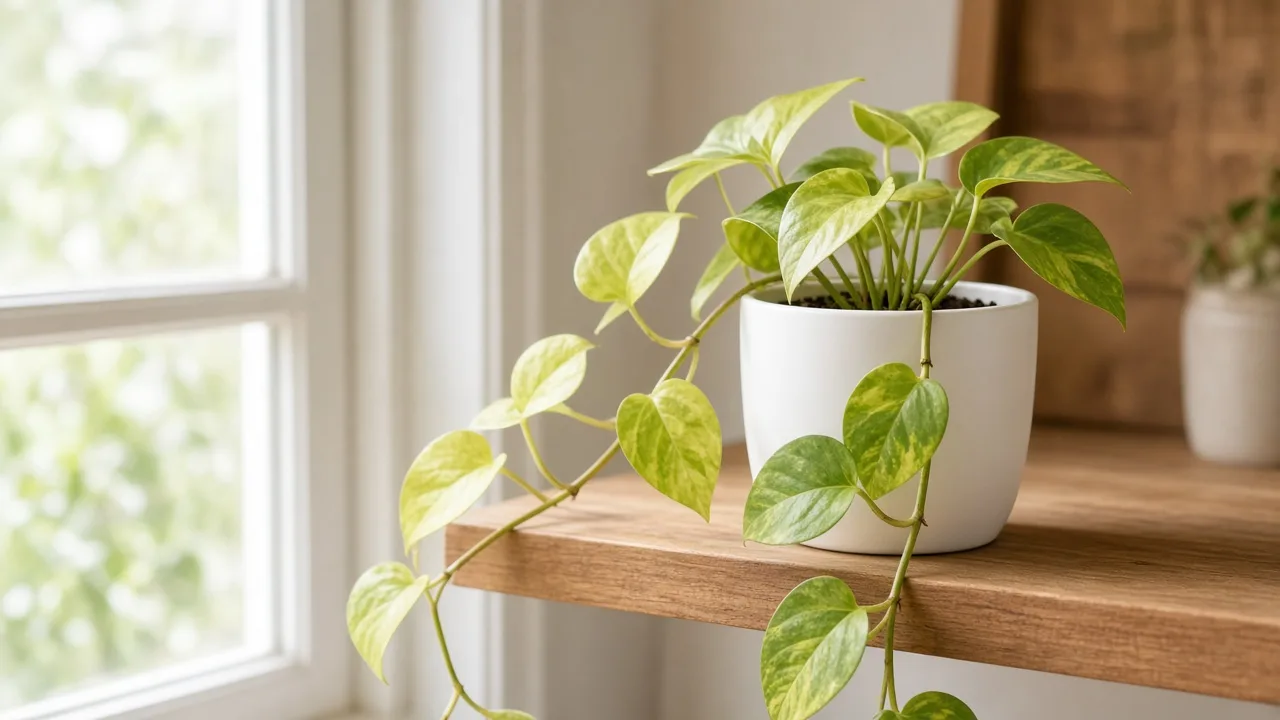
Pale Leaves on Pothos: Causes, Checks & Fixes
This guide covers pale leaves on Pothos. See also the general Pale Leaves guide, watering, and light pages for this plant.
Pale Leaves on Pothos: Causes, Checks & Fixes
Quick answer
Pale leaves on pothos (Epipremnum aureum) look washed-out, yellow-green, or dull instead of the glossy deep green—or bright chartreuse on Neon types—that healthy vines show in good light. For general chlorosis mechanics, see our pale leaves guide. On pothos, the combination of pale new heart-shaped leaves and long internode gaps on a trailing vine is the signature low-light pattern.
First step: inspect the newest unfurling leaf at the vine tip and measure the gap to the leaf below. If color is faded and internodes stretch beyond about 2 inches (5 cm), move the pot to bright indirect light before you change watering or feed. If pale lower leaves sit on soil wet 2 inches down for many days, stop watering and check roots instead.
Pothos tolerates lower lighting conditions but prefers bright, indirect light. Survival in a dim hall is not the same as thriving—pale foliage is how the plant tells you photosynthesis is falling behind.
When to use this page vs other Pothos guides
- Not enough light — long bare stems, leaning vines, variegation reverting to solid green
- Yellow leaves — soft yellow on wet soil or crisp yellow on dry mix
- Overwatering — heavy pot, sour smell, pale limp lowers on saturated mix
- Sunburn — bleached or brown patches on sun-facing leaves, not uniform washout
- Leggy growth — stretch-focused entry when pale color is secondary
- Spider mites — stippled pale speckling with webbing, not uniform chlorosis
- Nitrogen deficiency — oldest leaves pale first in bright light with firm roots
What pale leaves look like on Pothos
Healthy pothos shows glossy heart-shaped leaves on moderately spaced nodes along trailing or climbing stems. Pale foliage breaks that pattern in recognizable ways depending on cause.
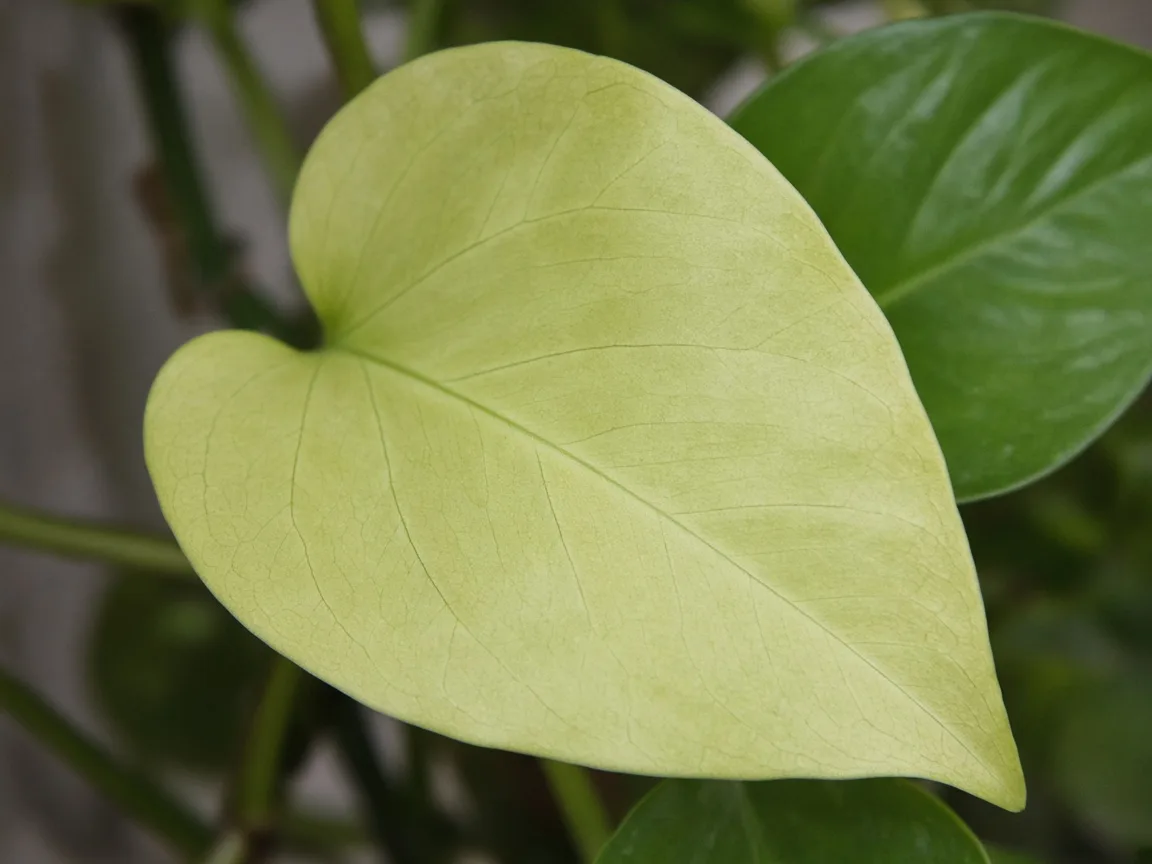
Pale Leaves symptoms on Pothos - compare with healthy tissue on the same plant.
Low-light chlorosis (most common indoors)
- Uniform washed-out yellow-green across several leaves on the same vine section—not isolated spots
- New leaves open smaller and thinner than mature blades a few nodes back
- Internodes stretch to 3 inches (8 cm) or more as the vine reaches toward a window
- Variegation fades on Golden, Marble Queen, and Pearls and Jade—lower light may cause variegated varieties to lose coloring
- Vines lean toward the brightest direction; hanging baskets look full only on the window-facing side
Root-stress pale (wet soil)
- Lower leaves fade yellow-green while mix stays damp 2 inches (5 cm) down for 10+ days
- Stems stay firm at first, but growth stalls; sometimes paired with yellowing
- Upper tips may also pale if root uptake is failing—not just natural lower-leaf aging
- Pot feels heavy; fungus gnats may hover when soil never dries
Sun-bleach pale (too much direct sun)
- Pale or whitish patches on leaves facing south or west glass—not uniform canopy washout
- Tissue may turn crisp brown at edges after sudden exposure
- Opposite problem from dim-room chlorosis; see sunburn on pothos
Pest stippling (looks pale from a distance)
- Fine yellow speckles across leaf surface with possible webbing on undersides
- Pattern is scattered, not evenly washed-out green
- Common in dry winter rooms—confirm with spider mites on pothos before treating light
Cultivar baseline (not a problem)
- Neon pothos is supposed to look chartreuse—that is healthy pigment, not chlorosis
- Snow Queen and Marble Queen carry large white sectors that read as pale by design; worry when new leaves open mostly green with no marbling
Why trailing pothos fades before it yellows
Pothos is an understory climber that reaches brighter canopy light using aerial roots. Indoors, a vine in a dim hallway still grows toward photons—but with less chlorophyll per leaf. The plant spaces leaves farther apart (etiolation) and opens smaller, paler blades rather than stopping growth entirely.
That is why pale leaves often appear before widespread yellowing. Metabolism slows in weak light, so owners who water on a summer calendar keep mix damp while the plant uses little water. The compound trap—pale tips plus wet soil—is a common path to root rot on pothos even when you are not obviously overwatering.
Variegation and the light budget
White and cream sectors on variegated pothos contain no chlorophyll. RHS notes that too little light may cause foliage to lose variegation—the plant prioritizes photosynthetic green tissue in new growth. Marble Queen and Snow Queen need brighter placement than Golden or solid-green Jade types per Clemson cultivar guidance. A Snow Queen reverting to plain green in a north room is a light problem, not a separate disease.
When pale means roots, not windows
Saturated mix reduces root function and limits nutrient uptake. Pale yellow-green lower leaves on chronically wet soil can look like chlorosis from deficiency when the real issue is oxygen loss at roots. The wilt-on-wet-soil pattern—limp pale foliage despite damp mix—belongs on the overwatering branch, not the light branch.
Nutrient pale (last diagnosis)
Chlorosis can follow nutrient imbalance when light is adequate and roots are healthy. On pothos, nitrogen deficiency often affects older leaves first during active growth in depleted mix. Never assume deficiency in a dim corner—fix placement and moisture before any feed.
How to confirm the cause
Work through these checks in order:
- Vine-tip color and node spacing — Pale small new leaf plus internodes over 2 inches (5 cm) = low light. Rich color with tight nodes = light is probably fine.
- Shadow test at the pot — At midday, a soft defined shadow on foliage means moderate light; faint or absent shadow means too dim for healthy color on most cultivars per extension lighting guidance.
- Cultivar check — Is this Neon (naturally lime)? Is variegation reverting to all-green on Marble Queen? Match expectations to type.
- Soil moisture at 2 inches — Wet and heavy with pale limp lowers = root stress. Appropriately dry with pale stretch = light.
- Which leaves pale — Whole vine section uniformly dull = light. Lower leaves only on wet soil = moisture. Speckled pattern = pests.
- Recent moves — Sudden bleach after a window change = sun, not chlorosis. Gradual fade over months in same spot = chronic low light.
If you move to brighter indirect light for two weeks and the next two leaves open greener with shorter internodes, light was the primary issue.
First fix for Pothos
Inspect the newest leaf at the growing tip. If it is washed-out with long internode gaps, relocate the pot to bright indirect light within a few feet of an east window or filtered south or west glass.
That is the correct first fix for most indoor pale pothos cases—not fertilizer, not repotting.
- If dim: Move per the pothos light guide, or add a full-spectrum grow light 12–18 inches above the canopy for 12–14 hours daily. Acclimate over one to two weeks if the plant lived in deep shade.
- If wet soil with pale limp lowers: Stop watering until the top 2 inches of mix dry; see watering guide and inspect roots if color worsens.
- If already in strong light with firm roots and only old-leaf pale: Consider diluted balanced fertilizer during active growth after two weeks of stable new green leaves.
Make one change first. Wait two weeks before stacking prune, repot, and feed.
Step-by-step recovery
After the first fix:
- Monitor the next two to four new leaves — Look for deeper green, restored variegation, and internodes under 1 inch (2.5 cm). That confirms recovery.
- Adjust watering to match light — Brighter spots dry faster. Recheck the top 2 inches before every watering instead of following an old calendar.
- Prune stretched bare sections — Cut leggy pale vines back to just above a node. Pothos sprouts side shoots from nodes below the cut in better light.
- Wipe leaves monthly — Dust blocks light on broad pothos blades. A damp cloth is enough; skip leaf shine products.
- Match cultivar to placement — Keep Snow Queen and Marble Queen in the brightest spot you have; Golden and Jade tolerate moderate indirect light better.
- Rotate the pot weekly — Plants stretch toward one light direction; rotation keeps color even on hanging baskets.
Recovery timeline
Expect visible improvement in new growth within two to four weeks of corrected light. The next two or three leaves should open with richer color before older pale blades look different.
Existing faded leaves rarely darken fully—judge success by new foliage, not by old tissue re-greening. Bare stem between existing nodes stays unless you prune and wait for shoots from lower nodes.
If pale color spreads on wet soil despite a light move, unpot and inspect roots within a week. Soft brown roots need the root rot workflow, not more light alone.
Lookalike symptoms to rule out
| What you see | Likely cause | Where to go |
|---|---|---|
| Uniform dull yellow-green, long internodes, small new leaves | Low light chlorosis | This page; not enough light |
| Soft yellow lowers on wet soil, sour smell | Overwatering / root stress | Overwatering |
| Crisp yellow with brown edges, light dry pot | Underwatering | Underwatering |
| Bleached white patches on sun-facing leaves | Sunburn | Sunburn |
| Fine speckles, webbing on undersides | Spider mites | Spider mites |
| Oldest leaves pale first, bright light, firm roots | Nitrogen loss | Nitrogen deficiency |
| One pale leaf at oldest node on long firm vine | Normal aging | No fix needed if tips stay healthy |
Mistakes to avoid
Do not fertilize a pale pothos in a dim corner to “green it up.” Slow growth plus unused salts stresses roots.
Do not confuse healthy Neon chartreuse with chlorosis—compare new leaf size and node spacing, not hue alone.
Do not move instantly from a dark bathroom to unfiltered south glass. Acclimate over one to two weeks or you risk sun-bleach pale patches.
Do not ignore wet soil because the plant “only looks pale.” Pale plus chronic dampness is the setup for root failure.
Do not expect variegation to return on old plain-green Marble Queen leaves—only new growth regains pattern in better light.
Pothos care cross-check
Pale color interacts with every other variable on Epipremnum aureum:
- Watering — Water when the top 2 inches of soil are dry. Low light slows use; bright recovery speeds drying.
- Soil — Use light, well-draining mix with perlite. Dense mix in dim corners stays wet longer and deepens pale-yellow root stress.
- Temperature — Pothos prefers 60°F to 85°F (15–29°C). Cold drafts near winter windows can stall new leaf color even when light is adequate.
- Humidity — Average home humidity (40–60%) is fine. Misting does not fix low-light chlorosis.
How to prevent pale leaves on pothos
Place new pothos within a few feet of appropriate windows from day one. Choose cultivars that match your light—Neon and Jade for moderate indirect; Marble Queen and Snow Queen only for bright spots.
Rotate hanging baskets weekly so trailing tips do not become the only green section while the hall end stays pale.
Use grow lights in offices and north rooms during short winter days. Twelve to fourteen hours of supplemental light prevents seasonal fade.
Prune stretched pale vines once or twice a year so baskets stay dense instead of running toward the nearest window indefinitely.
When to worry
Pale leaves alone rarely kill pothos—it is one of the most shade-tolerant houseplants. Act within days when pale color pairs with:
- Wet soil for weeks and spreading soft yellow leaves
- Stems softening at the soil line or sour-smelling mix
- Complete stall in new growth for two months despite corrected light
- Speckling and webbing that worsens after a rinse
In those cases, inspect roots or pests before assuming more light solves everything.
Related Pothos guides
- Pothos overview — species baseline and care hub
- Pothos light — placement and foot-candle targets by cultivar
- Pothos watering — dry-down checks that pair with light recovery
- Pothos soil — drainage mix that prevents wet-soil pale-yellow stress
- Pothos problems — full symptom index for this species
- Not enough light — when stretch and revert dominate over washout
- Yellow leaves — moisture-first diagnosis when color shifts to butter-yellow
- Root rot — when pale limp foliage sits on saturated mix
Related tool
Use the Plant Problem Diagnosis Tool to narrow causes for pale leaves on this plant before changing multiple variables at once.