Rotala H'ra Care: Aquarium Light, Color, and Propagation
Rotala sp. 'H'ra' (often sold as Rotala rotundifolia 'H'ra')
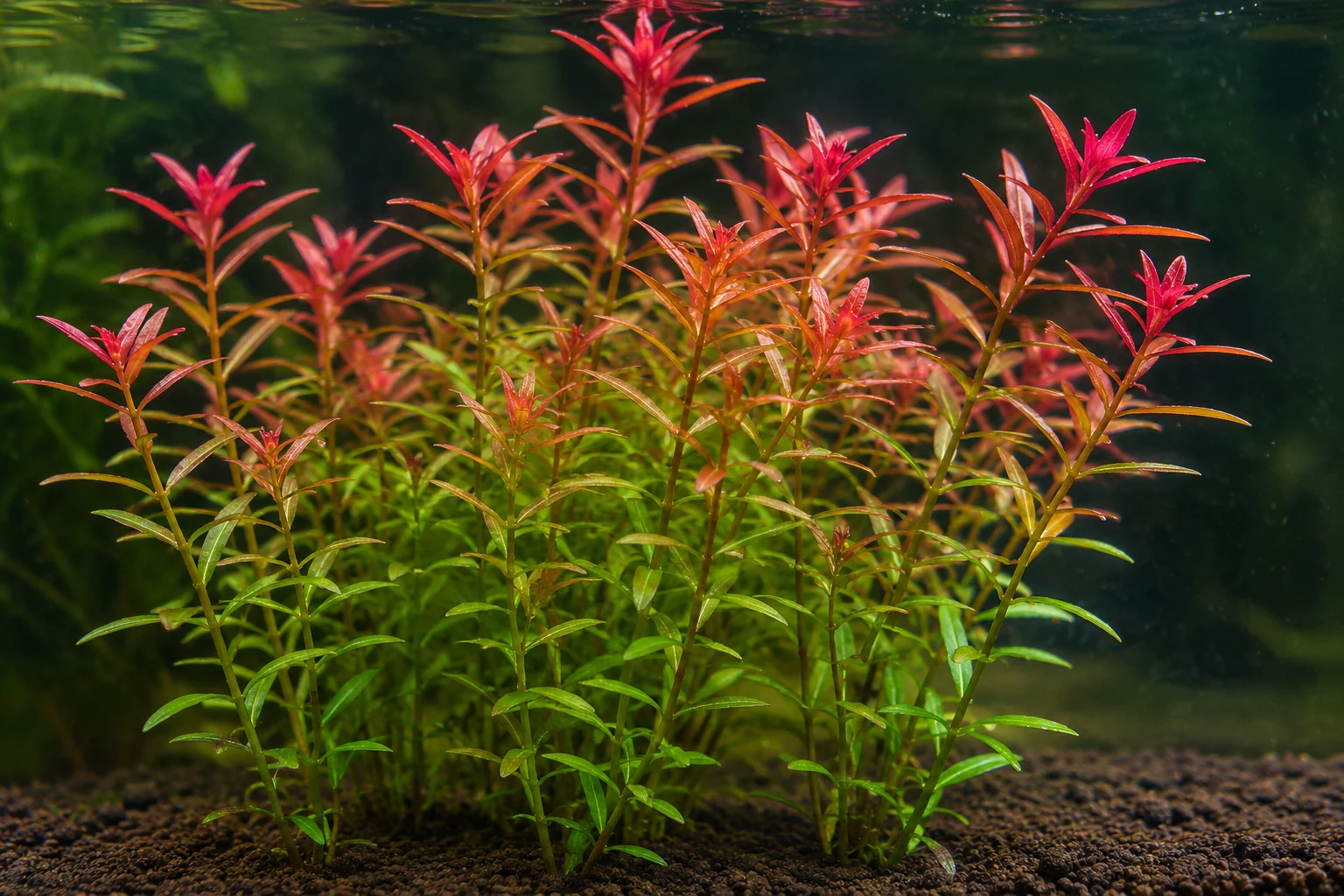
Grow Rotala H'ra fully submerged in aquarium-safe substrate under medium to high light. CO₂ can support denser branching but is not required for basic growth. Top healthy stems and replant the cuttings; color varies by trade form and conditions, so keep nutrients balanced for the whole aquarium.
Rotala H'ra Aquarium Care Guide
Start with wateringThe most common care mistake for Rotala H'raView watering and tank care →Rotala H'ra care essentials
Light
Medium to high aquarium light for compact growth and stronger orange-red color
Water
Grow Rotala H'ra submerged in a freshwater aquarium; it has no separate terrestrial watering routine. Keep the tank filled and stable, and manage top-offs and water changes for the aquarium's livestock and measured water conditions. New plants sold with emersed-grown leaves may shed those leaves while adjusting to underwater growth.
Soil
Anchor individual stems in aquarium-safe planted substrate or fine gravel. A nutrient-bearing substrate can support rooted growth, while balanced, aquarium-safe water-column fertilizer supplies nutrients. Do not use ordinary houseplant soil or terrestrial fertilizer in the aquarium.
Humidity
Temperature
Aquarium retailer guidance places H'ra around 22–28 °C (72–82 °F); the broader Rotala rotundifolia species is reported across a wider range. Keep temperature stable and appropriate for the fish and invertebrates sharing the aquarium.
Fertilizer
Use a balanced aquarium plant fertilizer according to its label. Rotala uses nutrients from the water column, and planted substrate can also support its roots. Supplemental CO₂ is not essential for basic growth, but steadier carbon and nutrition can help produce denser branching and stronger color.
About Rotala H'ra
Rotala H'ra is native to Aquarium references associate the H'ra trade form with Vietnam. Its exact botanical identity is not settled: Tropica describes it as probably a variation of Rotala rotundifolia, while aquarium sellers commonly place it under that species name. The accepted species Rotala rotundifolia is native across parts of South and Southeast Asia., typically reaches Aquarium stems commonly reach about 20–50 cm, depending on tank depth, growing conditions, and trimming. Keep the tops below the water surface if you want a fully submerged stand. indoors, with fast in a stable, adequately lit planted aquarium growth. Rotala H'ra has a a fast growing freshwater stem plant, usually grown upright in the midground or background. submerged growth has narrow leaves; under strong light and good growth conditions, stems may arch or creep across the aquascape. growth habit and part of the Lythraceae family. It is also known as Rotala sp. 'H'ra', Rotala Vietnam H'ra, and Rotala rotundifolia 'H'ra' (aquarium trade label).
| Detail | Information |
|---|---|
| Also known as | Rotala sp. 'H'ra', Rotala Vietnam H'ra, Rotala rotundifolia 'H'ra' (aquarium trade label) |
| Native region | Aquarium references associate the H'ra trade form with Vietnam. Its exact botanical identity is not settled: Tropica describes it as probably a variation of Rotala rotundifolia, while aquarium sellers commonly place it under that species name. The accepted species Rotala rotundifolia is native across parts of South and Southeast Asia. |
| Mature size | Aquarium stems commonly reach about 20–50 cm, depending on tank depth, growing conditions, and trimming. Keep the tops below the water surface if you want a fully submerged stand. |
| Growth rate | Fast in a stable, adequately lit planted aquarium |
| Growth habit | A Fast Growing Freshwater Stem Plant, Usually Grown Upright In The Midground Or Background. Submerged Growth Has Narrow Leaves; Under Strong Light And Good Growth Conditions, Stems May Arch Or Creep Across The Aquascape. |
| Scientific name | Rotala sp. 'H'ra' (often sold as Rotala rotundifolia 'H'ra') |
| Family | Lythraceae |
How to care for Rotala H'ra?
How much light does Rotala H'ra need?
Medium to high aquarium light for compact growth and stronger orange-red color. Moderate aquarium light for slower, greener, more open growth. Lower-tech tanks if you are comfortable with less compact growth and less intense color
- Medium to high aquarium light for compact growth and stronger orange-red color - Medium to high aquarium light for compact growth and stronger orange-red color.
- Moderate aquarium light for slower, greener, more open growth - Moderate aquarium light for slower, greener, more open growth.
- Lower-tech tanks if you are comfortable with less compact growth and less intense color - Lower-tech tanks if you are comfortable with less compact growth and less intense color.
When should you water Rotala H'ra?
Grow Rotala H'ra submerged in a freshwater aquarium; it has no separate terrestrial watering routine. Keep the tank filled and stable, and manage top-offs and water changes for the aquarium's livestock and measured water conditions. New plants sold with emersed-grown leaves may shed those leaves while adjusting to underwater growth.
- Watch new stem growth - New plants sold with emersed-grown leaves may shed those leaves while adjusting to underwater growth.
- lower leaves - New plants sold with emersed-grown leaves may shed those leaves while adjusting to underwater growth.
- water clarity - Grow Rotala H'ra submerged in a freshwater aquarium; it has no separate terrestrial watering routine.
- and aquarium test results. Sparse or pale growth can have several causes - Keep the tank filled and stable, and manage top-offs and water changes for the aquarium's livestock and measured water conditions.
- so review light - New plants sold with emersed-grown leaves may shed those leaves while adjusting to underwater growth.
- carbon
- nutrients
- and shading before making a large change to one factor - Keep the tank filled and stable, and manage top-offs and water changes for the aquarium's livestock and measured water conditions.
- Drain excess water - Grow Rotala H'ra submerged in a freshwater aquarium; it has no separate terrestrial watering routine.
What soil works best for Rotala H'ra?
Anchor individual stems in aquarium-safe planted substrate or fine gravel. A nutrient-bearing substrate can support rooted growth, while balanced, aquarium-safe water-column fertilizer supplies nutrients. Do not use ordinary houseplant soil or terrestrial fertilizer in the aquarium.
- Aquarium-safe planted substrate for rooted stem plants - Anchor individual stems in aquarium-safe planted substrate or fine gravel.
- Fine aquarium gravel with balanced aquarium-safe water-column fertilizer - A nutrient-bearing substrate can support rooted growth, while balanced, aquarium-safe water-column fertilizer supplies nutrients.
- Space stems so light and water can reach the lower growth - A nutrient-bearing substrate can support rooted growth, while balanced, aquarium-safe water-column fertilizer supplies nutrients.
How to propagate Rotala H'ra?
Propagate H'ra with healthy stem cuttings. Cut a vigorous top and plant the cut end in the substrate; the remaining stem can send out new shoots from its nodes. Space replanted tops so the lower leaves receive light and the new stems have room to branch.
See propagation stepsGrower notes for Rotala H'ra
Treat H'ra as an aquarium trade form
Aquarium Co-Op sells it as Rotala 'H'ra' or Rotala rotundifolia 'H'ra', and Tropica says it is probably a variation of R. rotundifolia. That wording leaves room for uncertainty, so this hub uses the trade name without presenting H'ra as a formally settled botanical variety.
Do not use Ceylon as a synonym
2Hr Aquarist lists H'ra and Ceylon as separate red-capable Rotala forms. Confirm the seller's label instead of treating the two names as interchangeable or assuming every R. rotundifolia has H'ra's leaf shape and color response.
Expect a submerged leaf change
Aquarium Co-Op notes that nursery-grown H'ra may arrive with round, coin-like emersed leaves. Those older leaves can melt as the plant adjusts, while new underwater growth is much narrower. Look for healthy new shoots before deciding that the whole plant is failing.
Give the stems even light
Aquarium Co-Op recommends medium to high light for H'ra, and Tropica links good light with its warm color and creeping habit. Moderate light can still support growth, but weak light or a shaded canopy may leave stems more open and lower leaves sparse.
Keep color goals compatible with a balanced tank
H'ra can show orange or red tones, but the result depends on the trade form and growing conditions. 2Hr Aquarist says vivid red in H'ra is associated with limiting water-column nitrate as well as strong light; do not sharply restrict nutrients just to recolor one plant, since that can affect the rest of the aquarium.
Top and replant before the stand gets crowded
H'ra grows as a stem plant and responds to topping. Cut healthy upper growth and replant it with space between stems; the cut base may branch, while thinning the canopy helps light reach lower leaves.
Rotala H'ra pet safety
Species-specific veterinary safety information for Rotala H'ra was not found in the ASPCA and Pet Poison Helpline plant resources checked. A missing directory entry is not proof that a plant is safe or toxic. Keep the plant and aquarium products away from pets that may chew them, and contact a veterinarian or poison-control service if a pet eats it.
Aquarium use does not establish food safety for pets. The ASPCA and Pet Poison Helpline plant resources reviewed did not provide a Rotala H'ra classification; treat toxicity as unknown rather than interpreting the absence of a listing as clearance.
Watering Rotala H'ra
For Rotala H'ra, watch new stem growth, lower leaves, water clarity, and aquarium test results. Sparse or pale growth can have several causes, so review light, carbon, nutrients, and shading before making a large change to one factor. and water there is no plant-only watering schedule while the stems are underwater. Maintain stable aquarium water and follow a water-change routine suited to the tank rather than changing water on a calendar for this plant alone. An indoor aquarium has no garden-style watering season. Growth may slow when temperature, lighting, or the aquarium routine changes; keep conditions stable and adjust care to the needs of the whole tank.
| Detail | Information |
|---|---|
| How often | There is no plant-only watering schedule while the stems are underwater. Maintain stable aquarium water and follow a water-change routine suited to the tank rather than changing water on a calendar for this plant alone. |
| How to check | Watch new stem growth, lower leaves, water clarity, and aquarium test results. Sparse or pale growth can have several causes, so review light, carbon, nutrients, and shading before making a large change to one factor. |
| Seasonal changes | An indoor aquarium has no garden-style watering season. Growth may slow when temperature, lighting, or the aquarium routine changes; keep conditions stable and adjust care to the needs of the whole tank. |
Signs of overwatering
- Not applicable while the plant remains submerged in a filled aquarium.
- Softening or decaying stems should prompt checks for damage, unstable conditions, and poor circulation.
Signs of underwatering
- Not applicable while the stems remain submerged.
- Growth above the waterline can form emersed leaves, which may dry if removed from the tank's humid environment.
Soil & potting for Rotala H'ra
Use a mix of Aquarium-safe planted substrate for rooted stem plants, Fine aquarium gravel with balanced aquarium-safe water-column fertilizer, Space stems so light and water can reach the lower growth for Rotala H'ra. Drainage holes are not relevant to submerged aquarium culture. Plant the stem base in stable substrate and avoid repeatedly disturbing new cuttings. Repot rotala H'ra is not normally grown in a terrestrial pot. Thin or replant the stand when it becomes crowded, lower growth is shaded, or you want to reset the layout., ideally in replant healthy stems when the aquarium is stable and the plant is actively growing. Avoid combining a major planting reset with abrupt changes to lighting or carbon supply.
| Detail | Information |
|---|---|
| Recommended mix | Aquarium-safe planted substrate for rooted stem plants, Fine aquarium gravel with balanced aquarium-safe water-column fertilizer, Space stems so light and water can reach the lower growth |
| Drainage | Drainage holes are not relevant to submerged aquarium culture. Plant the stem base in stable substrate and avoid repeatedly disturbing new cuttings. |
| Repotting frequency | Rotala H'ra is not normally grown in a terrestrial pot. Thin or replant the stand when it becomes crowded, lower growth is shaded, or you want to reset the layout. |
| Best season to repot | Replant healthy stems when the aquarium is stable and the plant is actively growing. Avoid combining a major planting reset with abrupt changes to lighting or carbon supply. |
Signs it needs repotting
- Stems are crowded and new shoots have little room to branch.
- Dense top growth shades the lower leaves and leaves the base sparse.
- Healthy tops are available to replant in place of bare or aging stems.
Humidity & temperature for Rotala H'ra
Keep temperatures around aquarium retailer guidance places H'ra around 22–28 °C (72–82 °F); the broader Rotala rotundifolia species is reported across a wider range. Keep temperature stable and appropriate for the fish and invertebrates sharing the aquarium.
| Detail | Information |
|---|---|
| Ideal temperature | Aquarium retailer guidance places H'ra around 22–28 °C (72–82 °F); the broader Rotala rotundifolia species is reported across a wider range. Keep temperature stable and appropriate for the fish and invertebrates sharing the aquarium. |
Fertilizer & pruning for Rotala H'ra
Use use a balanced aquarium plant fertilizer according to its label. Rotala uses nutrients from the water column, and planted substrate can also support its roots. Supplemental CO₂ is not essential for basic growth, but steadier carbon and nutrition can help produce denser branching and stronger color. for Rotala H'ra.
| Detail | Information |
|---|---|
| Fertilizer type | Use a balanced aquarium plant fertilizer according to its label. Rotala uses nutrients from the water column, and planted substrate can also support its roots. Supplemental CO₂ is not essential for basic growth, but steadier carbon and nutrition can help produce denser branching and stronger color. |