Sansevieria Fernwood Light Needs: Best Window & Sun Guide
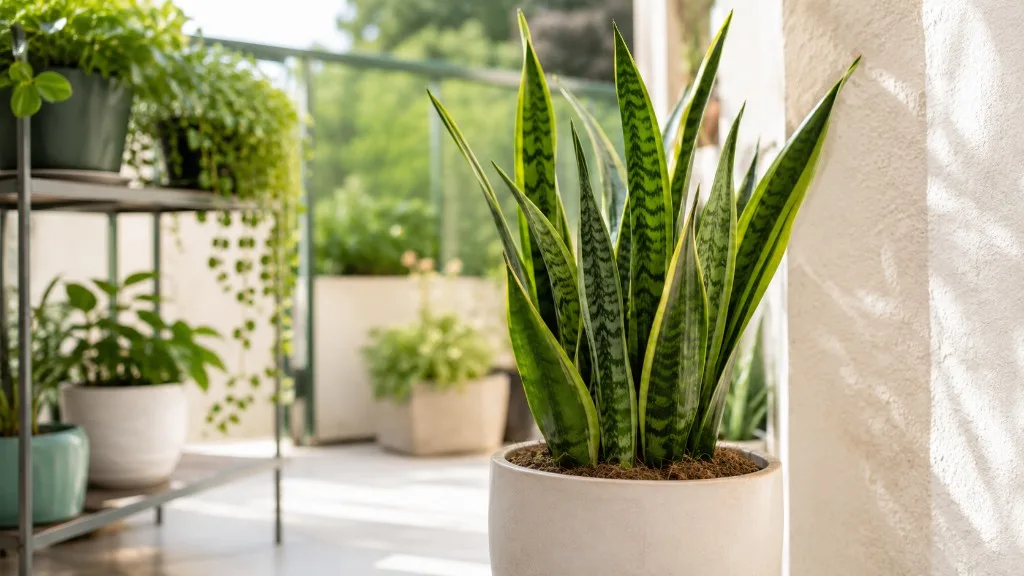
Sansevieria Fernwood Light Needs: Best Window & Sun Guide
Sansevieria Fernwood Light Needs: Best Window & Sun Guide
Dracaena ‘Fernwood’ — sold as Sansevieria Fernwood or Fernwood Mikado — packs dozens of narrow, cylindrical leaves into a tight upright fountain. That shape makes light placement different from a flat sword-leaf snake plant. The outer spears shade the inner ones, moisture lingers longer in the center of the clump, and banding contrast fades quickly when brightness drops. Fernwood tolerates low light longer than most tropical foliage plants, but it grows best in bright, filtered or indirect light — the same range the RHS lists for Fernwood Mikado: tolerant of deep shade, with strongest growth in bright filtered or indirect exposure.
The practical goal is not to find the dimmest corner where the clump refuses to die. The goal is to place the pot where new cylindrical spears emerge firm, banded, and upright without bleaching, tip burn, or the slow stall that happens when a drought-adapted plant survives on stored reserves instead of active photosynthesis. NC State Extension recommends placing cylindrical dracaenas in a brightly lit window indoors, with partial shade — direct sun only part of the day, roughly two to six hours — matching how these plants behave in bright but not baking exposures.
This guide covers window placement for Fernwood Mikado, direct sun tolerance, honest low-light limits, grow-light setups, and the warning signs that tell you to move the pot before cosmetic damage becomes mushy spear bases trapped in wet soil.
How Much Light Sansevieria Fernwood Actually Needs
Sansevieria Fernwood sits in the same practical light band as other drought-adapted dracaenas: bright indirect light indoors, with tolerance for lower brightness and some direct sun when acclimated. It is not a deep-shade fern and not a full-sun outdoor succulent. The RHS sansevieria genus guide notes these plants are happy from full sun to light shade in pots of free-draining compost — a wide range that reflects real-world flexibility, not an invitation to treat Fernwood like a closet plant.
Indoors, aim for bright filtered or indirect light — the range RHS recommends for Fernwood Mikado — without prolonged harsh beams through south or west glass in summer. Place the clump two to four feet from an unobstructed east window, or several feet back from filtered south or west glass, so outer spears catch strong ambient brightness with a soft hand shadow near the foliage. In dim corners the plant tolerates deep shade per RHS, but new growth slows or stops and banding dulls inside the tight clump.
Surviving vs Thriving in a Cylindrical Clump
Marketing copy calls snake plants “low-light plants” because they survive conditions that kill faster-growing tropicals. Fernwood exposes why that shortcut fails in a dense fountain. In insufficient light, thick leaf tissue and rhizome reserves let the clump enter metabolic stasis — outer spears stay green while pups stop forming, banding dulls, and soil inside the tight clump dries slowly. Neither state looks like sudden death, which is why light problems hide for months behind “unkillable” reputation.
In bright filtered light, the same plant shifts to active growth: new cylindrical leaves emerge on a seasonal rhythm, offsets appear at the base, and the light-and-dark green bands stay pronounced. Judge light by new spears and pups, not by whether old leaves remain upright. Old foliage tells you what happened last year; the newest cylinder tells you whether today’s placement works.
What Bright Indirect Light Means for Fernwood Mikado
“Bright indirect light” is accurate horticultural language and vague room advice at the same time. Translate it with a simple field test. On a clear day, hold your hand between the plant and the window. A soft, readable shadow with defined edges usually means bright indirect — the range Fernwood prefers. A faint or absent shadow means low light: survivable, not ideal. If leaf surfaces feel hot within an hour of direct sun, you are in exposure that may need filtering or distance.
Duration matters as much as a moment of sunbeams. Fernwood benefits from roughly 8 to 10 hours of useful ambient brightness across the day. A spot with gentle morning direct sun plus bright ambient light for the rest of the day often outperforms a spot that receives only a harsh afternoon blast. Re-check placement in late winter if growth stalls without any other care changes — sun angle and day length shift the effective brightness at the same window.
Why Sansevieria Fernwood Is Not a True Shade Plant
Fernwood is a hybrid cultivar, not a wild species with one fixed habitat profile. Still, its parentage sits in the African drought-adapted dracaena group that evolved in hot, dry, brightly lit environments — open scrub, rocky edges, and sparse woodland gaps rather than deep forest floor shade. The RHS sansevieria growing guide describes these houseplants as originating from hot dry habitats in Africa, drought-tolerant with fleshy leaves that store water. Light is part of that package.
Botany also matters: like other snake plants, Fernwood uses CAM photosynthesis — stomata open at night to reduce water loss in dry conditions. UF/IFAS Extension notes this adaptation for Sansevieria trifasciata; the same physiology applies across the genus group Fernwood belongs to. CAM helps with drought and heat, not with perpetual shade. The plant still needs light to build tissue; it simply uses water and carbon differently than a typical foliage houseplant.
Hybrid Origins and African Drought-Adapted Biology
Do not confuse Dracaena ‘Fernwood’ with flat sword-leaf D. trifasciata or with S. bacularis ‘Mikado’, a different cylindrical species sometimes sold under similar names. Fernwood’s dozens of narrow cylinders in one pot behave like a compact cylindrical dracaena — closer to NC State’s guidance for D. angolensis (African spear) than to broad-leaf cultivars. That means bright window culture, cautious direct sun, and excellent drainage matter together.
Calling Fernwood a shade lover sends people toward interior rooms with no window path, where even drought-tolerant plants eventually decline without artificial light. Fernwood is an excellent candidate for a grow-light office desk. It is not a candidate for a windowless corner unless you add a lamp.
How the Tight Leaf Fountain Changes Light Response
Flat snake plant rosettes catch light from multiple angles. Fernwood’s upright fountain creates self-shade: outer spears intercept most photons while inner spears sit in a dimmer microclimate. In already-low rooms, the center of the clump can sit near the survival threshold even when outer leaves look acceptable. That geometry also traps moisture — paired with weak light, wet soil persists longer and mushy spear bases become more likely than on an open rosette.
If you rotate the pot a quarter turn every two to three weeks, outer and inner spears share exposure more evenly and growth stays symmetrical. Leaning toward the glass is normal directional growth, not a crisis — rotation prevents one side from aging faster than the other.
Best Window Placement for Sansevieria Fernwood
Window direction is a starting point, not the whole answer. Obstructions, overhangs, neighboring buildings, tree shade outside, glass tint, and pot distance all change the light that reaches the leaf surface. Still, compass orientation gives a reliable first guess in the northern hemisphere.
Place Fernwood where it receives strong plant-facing light for most of the day, not where the room looks bright to your eyes. Human vision adapts to dim interiors; plants do not. A pot on a bookshelf across from a window is decorative. A pot within a few feet of the glass on an appropriate exposure is horticulture.
East, South, West, and North Windows Compared
An east-facing window is the default sweet spot for many Fernwood pots indoors. Morning sun tends to be bright but cooler than late-day sun. Two to three feet from an unobstructed east pane often delivers steady bright indirect growth without frequent scorch scares. Clemson Extension lists bright indirect light as ideal for snake plants, with low light tolerated but slower growth.
A south-facing window delivers the highest total daily light, especially in winter at mid and high latitudes. That intensity is an asset with distance or diffusion. Place the pot roughly 4 to 6 feet back from the glass, or use a sheer curtain to soften direct beams. In summer, watch for bleached or crisp patches on sun-facing spears — a sign to pull back or filter afternoon heat load.
A west-facing window can work well in spring and fall and become risky in midsummer when late-afternoon sun carries heat through the pane. Treat west like south with extra caution, not like east with bonus sun.
A north-facing window provides gentle indirect light all day but often lands in the low to moderate range, especially in winter. Fernwood survives north windows more reliably than most houseplants, but growth and pup production slow. If you choose north, reduce watering frequency to match slower metabolism — see the Sansevieria Fernwood watering guide — and accept that banding may soften over time.
Distance From the Glass Matters
Direction labels fail when distance is wrong. A south window six feet away on an open floor may deliver less usable light at the leaf than an east window two feet away with a light-colored wall reflecting brightness behind the plant.
Use distance as a dimmer switch. Closer increases intensity and heat; farther softens direct sun but may drop below the growth threshold if you move too far. Practical starting points: 2 to 3 feet from east or filtered west panes; 4 to 6 feet from unobstructed south panes; as close as possible to north panes if that is your only option, with expectations adjusted for slow growth. Move the pot closer in winter when sun angle drops and slightly back in midsummer if leaf surfaces heat up.
Can Sansevieria Fernwood Take Direct Sun?
Yes — with conditions. Fernwood handles some direct sun, especially gentle morning exposure on an east windowsill or filtered direct light through sheer fabric. NC State Extension advises that if cylindrical dracaenas go outdoors in summer, give morning sun only to avoid sunburn — a rule that translates indoors to hot afternoon beams through glass.
Problems start when intensity jumps faster than the plant can adjust. A Fernwood grown for months under fluorescent store lighting and then placed on a south windowsill in July may develop permanent bleached or sunken patches on exposed spears within days. Direct sun through glass also concentrates heat at the leaf surface. CAM physiology helps with drought, not with photobleaching or thermal damage on cylindrical leaves that have less surface area to shed heat than broad blades.
Morning Sun vs Harsh Afternoon Rays
Morning direct sun differs from afternoon direct sun in both intensity and heat load. East exposure gives Fernwood a manageable direct period followed by bright indirect day length. Afternoon sun through west or south glass can exceed what the same clump tolerates, especially when outdoor temperatures are high and the pot sits on a heat-radiating sill.
If you want direct sun benefits — slightly tighter spears, faster pup production on some clumps — east morning sun is the safest entry point. South and west direct sun can work for established plants with acclimated foliage and diffusion from curtains or blinds. Sunburn on Fernwood spears is permanent; damaged tissue does not green up again.
Acclimating Store-Bought Plants to Brighter Light
Acclimation is non-negotiable when upgrading light. Move a low-light plant to brighter exposure in stages over two to three weeks, not in one afternoon. Week one: place the pot in the new room but several feet back from the target window. Week two: move halfway to the final distance. Week three: settle at the intended spot unless you see stress on newest spears.
Watch for bleaching, large brown patches, or softening tissue — signs you moved too fast. Store-bought Fernwood often arrives from low-light retail displays. Give it a week in moderate indirect light before pushing toward your brightest window. Combining immediate repotting, fertilizing, and a major light jump stacks stress unnecessarily. Change light first; let new growth confirm success before other interventions.
Low-Light Limits: How Dark Is Too Dark?
Sansevieria Fernwood can survive surprisingly dim conditions — dim hallways, north rooms, offices with distant windows — longer than most tropical foliage plants. Survival has limits. Zero light is not survivable long term. A room with no window and no grow light will eventually exhaust stored reserves.
The more common failure mode is slow decline masked by drought tolerance. Soil stays wet inside the clump. Roots lose oxygen. Pups stop forming. Banding fades. Outer spears stay rigid while the plant quietly stops replacing tissue — until watering mistakes catch up and rot appears. Beginners blame water alone and miss the light root cause.
How dark is too dark for a plant you actually want to grow? If no new spear has emerged in 12 or more months and banding has noticeably dulled, you are below the growth threshold. If the pot takes more than three weeks to dry in a normal indoor temperature range, light is likely too low for safe watering rhythms alongside the soil and drainage setup you use.
Signs Your Fernwood Is in Survival Mode
Survival mode has a symptom profile distinct from healthy slow growth. In survival mode, existing spears stay firm but new growth is absent or rare, pups do not appear, and light-and-dark banding softens as the plant maximizes photosynthetic area. Spears may look darker green than when you bought the plant — counterintuitively, darker can mean less light, not more health.
Soil biology changes too. Without enough light to drive transpiration, water use drops sharply inside the tight clump. The top inch may look dry while the center stays moist for weeks. That pattern increases anaerobic root stress in heavy mixes. Fixing water alone without improving light treats the symptom, not the throttle.
If you must keep Fernwood in a low-light office, commit to a grow light rather than hoping tolerance equals preference.
Grow Lights When Natural Light Falls Short
When windows cannot deliver enough daily brightness — windowless rooms, deep interior offices, north-only exposures in winter, or shelves far from glass — full-spectrum LED grow lights are the most reliable fix. Fernwood responds well to supplementation because it does not need extreme PAR levels compared with flowering crops. Moderate, consistent artificial light often beats a mediocre natural placement.
Choose a fixture labeled for plants, seedlings, or houseplants, not a standard room bulb optimized for human lumens. Full-spectrum white LEDs in the roughly 4000K to 6500K range work for foliage maintenance and steady growth.
Fixture Choice, Distance, and Daily Hours
Position the light 12 to 18 inches (30 to 45 cm) above the tallest spear tip as a starting point. If spears pale or lean toward the lamp, lower slightly or extend duration. If tips crisp only under the lamp, raise the fixture or reduce hours. Run lights 8 to 12 hours daily on a timer to mimic natural day length; consistency matters more than chasing exact photoperiod science at home.
Coverage beats pinpoint intensity. A single bulb over the center of a wide clump leaves outer spears in shadow. Use a bar or panel that spans the pot, or rotate the plant every few days under a smaller clip-on lamp. When you add a lamp, adjust watering after two weeks — brighter total daily light increases dry-down rate even if the window did not change.
Warning Signs of the Wrong Light
Fernwood communicates light stress quietly. It rarely wilts dramatically like a thirsty fern. Instead, spear color, banding, texture, and growth pace shift over weeks. Learning to read those shifts saves you from misdiagnosing sunburn as fungus, or rot as “normal snake plant toughness.”
Use a two-week observation window after any placement change. Old damage is historical. New spears and pups after the move tell you whether the current light is acceptable.
Too Little Light vs Too Much Sun on Cylindrical Spears
Too little light typically shows as absent or very slow new growth, smaller new spears, fading band contrast, looser fountain shape as spears elongate searching for brightness, and soil that stays moist too long inside the clump. Pests like fungus gnats become more common when root zones stay wet in dim, cool conditions — light and moisture interact.
Too much light or heat shows as bleached white or yellow patches, crisp brown tips on the sun-facing side, sunken scorched zones that feel thin or papery, sudden spear collapse after an unacclimated move to strong south or west glass, and repeated curling during the brightest hours. Unlike low-light darkening, sunburn creates permanent cosmetic damage on affected tissue.
When both problems seem possible — a plant near hot glass in a dim winter room — prioritize heat and direct beam removal first. Scorch can happen in a week; low-light stasis takes months.
How Light Affects Watering in a Dense Fernwood Clump
Light is the throttle on Fernwood metabolism even though watering gets blamed first. Brighter light increases photosynthesis and transpiration; dim light slows both. A watering routine that worked on a bright windowsill will overwater the same clump in a dim corner because the root zone — especially the center of the fountain — stays saturated longer.
After any light increase, check soil moisture more frequently for the first month, but still wait until the mix is fully dry deep in the pot before watering. After a light decrease, extend dry intervals and pause fertilizer until new growth confirms the plant is still active. Do not fertilize a plant in obvious survival mode; you cannot feed your way out of insufficient light.
Growth pace expectations should match light level. In bright indirect light, a few new spears per year and occasional pups is normal — Fernwood is not pothos. In low light, zero visible growth for a year may still mean the plant is alive. Light also influences propagation success: division pups and leaf cuttings root more predictably when parent plants and rooting stations receive moderate to bright indirect light.
Conclusion
Sansevieria Fernwood light needs come down to a distinction beginners skip: tolerance is not preference. Dracaena ‘Fernwood’ will endure low light longer than most houseplants, but it grows, bands, divides, and tolerates watering mistakes best in bright filtered or indirect light — the range the RHS recommends for Fernwood Mikado, and the brightly lit window culture NC State advises for cylindrical dracaenas.
Place the pot where new spears prove the light works, not where the room looks nice. Use morning direct sun cautiously after acclimation; avoid unfiltered afternoon beams through west and south panes in heat. Treat north windows and interior desks as survival or grow-light placements, not as optimal homes for showpiece clumps. When natural light falls short, a simple full-spectrum LED on an 8–12 hour timer closes the gap more reliably than myths about unkillable snake plants.
If something looks wrong, read the newest spear and adjust one variable at a time. Step light changes gradually, link watering to dry-down speed inside the fountain, and remember that old scorch scars never heal — but the right placement today still produces clean new cylinders tomorrow.
When to use this page vs other Sansevieria Fernwood guides
- Sansevieria Fernwood overview — Start here for whole-plant context, toxicity, and a care map before deep-diving light placement.
- Sansevieria Fernwood watering — Use when soil moisture, dry-down timing, or mushy spear bases need diagnosis; light and watering interact tightly in dense clumps.
- Sansevieria Fernwood soil — Use when drainage, mix composition, or pot choice may be slowing dry-down in a dim placement.
- Sansevieria Fernwood propagation — Use when dividing pups or rooting cuttings; both need adequate light at the parent and propagation station.