Leaf Miners on Stromanthe Triostar: How to Confirm
Quick answer
On Stromanthe Triostar, treat a pale mark as a possible leaf mine only if it forms a winding or blotched channel within the leaf tissue. First inspect the marked area in bright light with a hand lens; if you confirm an active mine, isolate the plant and remove only the affected leaf rather than spraying the whole plant. A mine must be confirmed because pale marks can also be normal variegation or other leaf damage.

Leaf Miners on Stromanthe Triostar: Confirm the Tunnels Before Treating
This guide covers leaf miners on Stromanthe Triostar. See also the general Leaf Miners guide, watering, and light pages for this plant.
Leaf Miners on Stromanthe Triostar: Confirm the Tunnels Before Treating
First step: confirm a tunnel before treating
If a Stromanthe Triostar has a pale mark, inspect that leaf before pruning or spraying. First shine a light across the surface and use a hand lens to see whether the mark is a winding channel or an irregular blotch inside the tissue. A leaf miner is a larva feeding within a leaf; different leaf-mining insects make serpentine trails or blotches, so color alone cannot identify the cause, as described by Colorado State Extension.
The Gardener’s Supply leafminer guide also describes pale, squiggling trails made by larvae feeding between leaf layers. Its host examples are vegetables, so they help describe the mark but do not establish Stromanthe as a host.
On this cultivar, that confirmation matters because cream, pink, and green sections are part of its normal variegation. Those colors can look like pale injury when viewed in isolation, but a normal color section follows the leaf’s pattern rather than forming a hollow track. Hold the suspect leaf against a bright background and compare it with an undamaged leaf on the same plant before deciding it is mined.
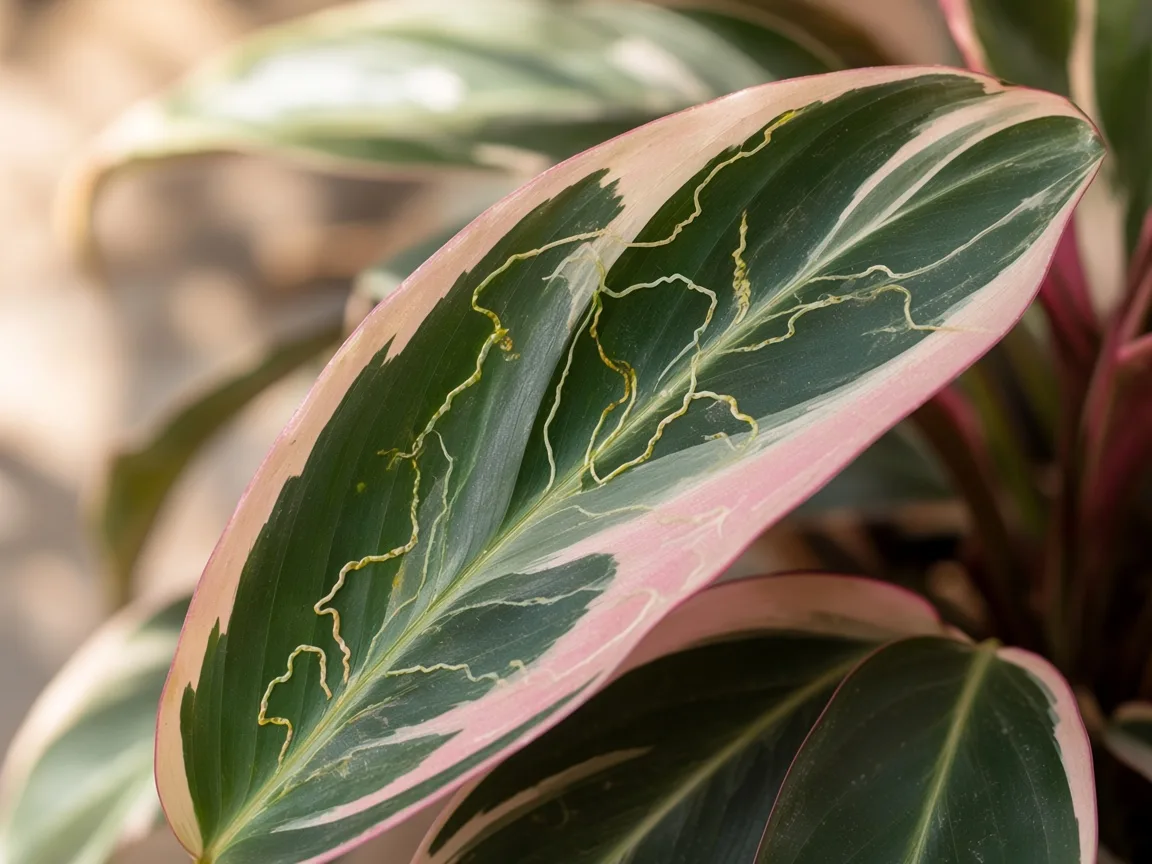
Use the close-up to compare a possible tunnel with the leaf’s natural color pattern. A photograph cannot confirm a larva; inspect the actual leaf in good light.
What confirms leaf miners on Stromanthe Triostar
Look for a continuous pale or translucent channel that wanders through the leaf, widens in places, or ends in a larger mined patch. Some leaf miners feed between the upper and lower leaf surfaces, and the gallery can lengthen as the larva feeds, as described by UC IPM. If the tissue can be gently separated at an already damaged edge, a hollow space, frass, or a larva supports the diagnosis; do not cut open several healthy leaves just to search for one.
A leaf with a true mine may dry or collapse within the track. Leaf-spot damage can look similar from above, but it does not create an internal tunnel; Colorado State Extension explains this distinction. If you see separate dots, expanding dark spots, holes, or broad yellowing without a channel, compare the Stromanthe guides for black spots, holes in leaves, or yellow leaves before treating for leaf miners.
The North Carolina Extension profile for Stromanthe thalia notes the variegated ‘Triostar’ cultivar and lists aphids, mealybugs, and spider mites among problems to monitor; it does not identify leaf miners as a routine pest. That profile is not an exhaustive pest survey, so it cannot rule leaf miners out. The plant’s name alone is not confirmation: look for the characteristic internal gallery. See NC State’s Stromanthe profile.
Why they may appear, and what the evidence does not show
Leaf miners are an insect diagnosis, not a result of overwatering, low humidity, or poor light. A pale mark alone cannot identify which leaf-miner species, if any, is involved on this plant. If you see a confirmed gallery, note whether the plant was recently outdoors, came from a nursery, or sits near other foliage; those observations may help an extension diagnostician, but they do not identify the insect by themselves.
Keep the plant’s regular care stable while you investigate. Stromanthe prefers partial to dappled shade, moist but well-drained soil, and high humidity; direct sun can scorch its foliage and dry soil is not a suitable response to a suspected leaf miner. These needs are summarized in NC State’s Stromanthe profile. If the mark is a scorch or ordinary variegation rather than a tunnel, changing water or humidity to target an insect will not correct the actual cause.
First response after you confirm an active mine
Move the Triostar away from nearby plants while you assess whether fresh mines are appearing. If you can see an active larva or a new tunnel, remove only the affected leaf at its petiole with clean scissors, place it directly in a sealed bag, and discard it in household waste. This is a cautious sanitation step, not a treatment proven specifically for Stromanthe; Colorado State Extension provides crop-specific guidance for destroying actively mined spinach leaves, a different host and leaf-miner context. Avoid stripping healthy leaves or putting a mined leaf on the soil where any larva still in it could finish developing.
Do not reach first for a general insecticide, neem oil, or a soap spray. A larva feeding within the leaf is protected by the leaf tissue, and the correct control depends on which insect is making the mine. Broad sprays may miss larvae inside mines and can disrupt natural controls, a caution in Colorado State Extension guidance; UC IPM describes parasitoids that suppress some leaf-miner populations. If fresh mines continue after sanitation, photograph the leaf and get a local identification before choosing any product. Follow a product label and local rules if a professional recommends treatment.
If you see other insect clues instead of an internal gallery, use the relevant Stromanthe guide: thrips for suspected surface-feeding damage or aphids when you find visible soft-bodied insects. Neither link replaces checking the tissue itself; overlapping leaf marks can have different causes.
Recovery and when to escalate
The mined section will not become normal pink, cream, or green tissue again. Colorado State Extension notes that mined areas die and dry; leave a lightly marked leaf in place if it is still mostly intact, and remove a badly damaged leaf only if its appearance or continued active mining warrants it.
Check the plant weekly for fresh galleries and look at the next leaves as they unfurl. A stable plant with no new mines and clean new growth is a better recovery sign than an old leaf looking perfect. Seek diagnostic help if fresh mines spread to several leaves, the suspect insect is not visible, or other plants develop similar tracks. Avoid using lifecycle timing reported for a vegetable crop as a Stromanthe treatment calendar; the species and growing conditions differ.
Prevent a repeat without changing Stromanthe care
Inspect both sides of new leaves during routine watering and after bringing home another plant. Keep a dated photo of each suspect mark so you can tell whether the gallery is expanding or whether a stable variegated patch simply looks different from one angle. If the plant lives outdoors for part of the year, check it again before bringing it back near indoor plants.
Maintain the Triostar’s normal moist, well-drained mix and indirect-to-dappled light. The Stromanthe watering guide and soil guide can help keep care-related leaf stress from complicating the diagnosis; neither is a leaf-miner treatment. For other likely pest clues, use the whiteflies guide or spider mites guide when those insects, rather than internal mines, fit what you see.
Related Stromanthe Triostar guides
- Thrips — use this when the damage looks like surface scarring and you suspect a visible pest rather than a tunnel.
- Black spots — use this when the marks are discrete spots without a hollow gallery.
- Whiteflies — use this when small flying insects are more evident than leaf-internal damage.
- Spider mites — use this for suspected mites or webbing rather than a winding mine.
- The general leaf-miner guide — use this for broader identification and compare it with the plant-specific limits on this page.
Related tool
If the marks do not clearly form a tunnel, use the Plant Problem Diagnosis Tool to compare possible causes before changing several care conditions at once.