Triangle Palm Care Guide - Sun, Water, Size, and Safety
Chrysalidocarpus decaryi
Triangle Palm is a full-sun outdoor palm that tolerates drought after establishment. Plan for a warm, well-drained site and a mature plant about 20–35 feet tall; protect it from freezes and keep pet safety unverified.
Triangle Palm Care Guide - Sun, Water, Size, and Safety
Start with wateringThe most common care mistake for Triangle PalmWatering guide →Triangle Palm care essentials
Light
Full sun for strongest growth; acclimate container-grown plants gradually to direct outdoor sun.
Water
Water young palms deeply while they establish. Established plants tolerate dry spells, though UF/IFAS notes that regular watering and richer soil can improve growth. Let the soil begin to dry between waterings and do not keep the root zone saturated.
Soil
Use freely draining soil. Triangle Palm tolerates poor, dry soils, while UF/IFAS notes that nutrient-rich soil and regular watering can improve growth. GardenGuides describes its preference as close to neutral pH.
Humidity
Temperature
Fertilizer
About Triangle Palm
Triangle Palm is native to Southeastern Madagascar, typically reaches About 20–35 ft (6–11 m) tall and 12–15 ft (3.7–4.6 m) across outdoors. UF/IFAS reports 25–35 ft tall with a crown spread near 15 ft; GardenGuides gives a shorter estimate of about 20 ft with a 12–15 ft spread. indoors, with slow-growing; good light, regular water, and nutrition support stronger growth. growth. Triangle Palm has a solitary, upright palm growth habit and part of the Arecaceae family. It is also known as Dypsis decaryi and Neodypsis decaryi.
| Detail | Information |
|---|---|
| Also known as | Dypsis decaryi, Neodypsis decaryi |
| Native region | Southeastern Madagascar |
| Mature size | About 20–35 ft (6–11 m) tall and 12–15 ft (3.7–4.6 m) across outdoors. UF/IFAS reports 25–35 ft tall with a crown spread near 15 ft; GardenGuides gives a shorter estimate of about 20 ft with a 12–15 ft spread. |
| Growth rate | Slow-growing; good light, regular water, and nutrition support stronger growth. |
| Growth habit | Solitary, Upright Palm |
| Scientific name | Chrysalidocarpus decaryi |
| Family | Arecaceae |
How to care for Triangle Palm?
How much light does Triangle Palm need?
Full sun for strongest growth; acclimate container-grown plants gradually to direct outdoor sun.. Partial shade. direct sun
- Full sun for strongest growth - Full sun for strongest growth; acclimate container-grown plants gradually to direct outdoor sun..
- acclimate container-grown plants gradually to direct outdoor sun - Full sun for strongest growth; acclimate container-grown plants gradually to direct outdoor sun..
- Partial shade - Partial shade.
- direct sun - direct sun.
When should you water Triangle Palm?
Water young palms deeply while they establish. Established plants tolerate dry spells, though UF/IFAS notes that regular watering and richer soil can improve growth. Let the soil begin to dry between waterings and do not keep the root zone saturated.
- Check the soil below the surface and account for recent rain - Let the soil begin to dry between waterings and do not keep the root zone saturated.
- water deeply when it has begun to dry - Water young palms deeply while they establish.
- Drain excess water - Water young palms deeply while they establish.
What soil works best for Triangle Palm?
Use freely draining soil. Triangle Palm tolerates poor, dry soils, while UF/IFAS notes that nutrient-rich soil and regular watering can improve growth. GardenGuides describes its preference as close to neutral pH.
- For containers
- use a palm mix amended with coarse perlite or pumice in a pot with open drainage holes - Use freely draining soil.
Grower notes for Triangle Palm
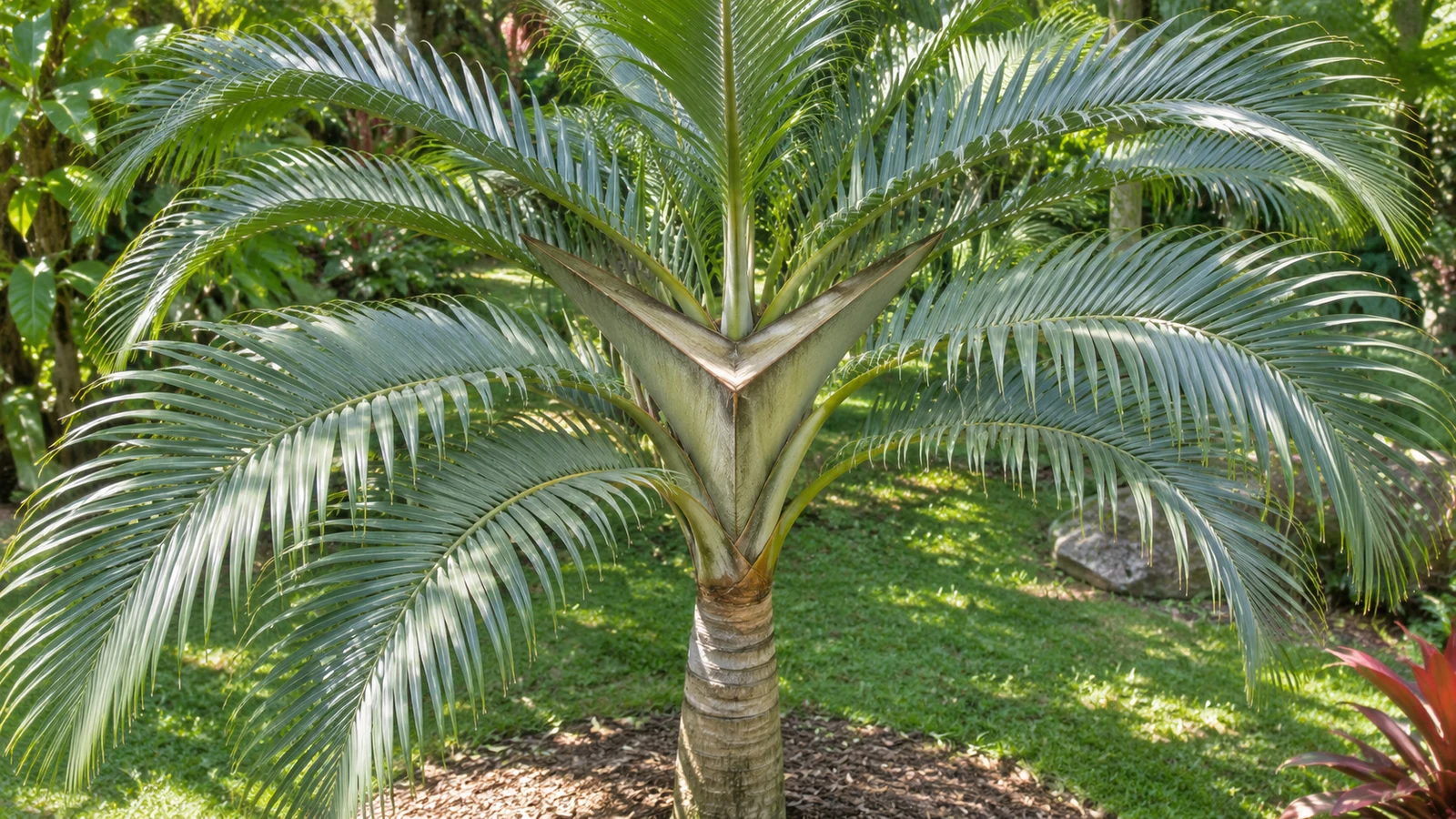
The triangle is made by the leaf bases
Triangle Palm is a single-trunk palm with feather-like, pinnate leaves, not the rounded fan blades of a true fan palm. Three stacked ranks of fronds and their leaf bases create the triangular outline. Check the arrangement of the fronds when distinguishing it from other palms with fan-shaped crowns.
Give it a sunny outdoor position
UF/IFAS describes full sun as best and partial shade as tolerated. This is a warm-climate landscape palm rather than a low-light room plant. If a young plant has been kept under cover, acclimate it gradually before placing it in strong outdoor sun.
Water consistently while it establishes
Water a newly planted palm deeply while its roots settle in. Once established, it tolerates drought and poor, dry soil, but regular water and better soil can support stronger growth. Let the soil begin to dry before watering again; drought tolerance is not a reason to keep a pot waterlogged.
Leave room for its mature footprint
UF/IFAS reports 25–35 feet of height and a crown spread near 15 feet; GardenGuides gives a shorter estimate of about 20 feet tall and 12–15 feet wide. It can be grown in a container, but its mature scale and full sun needs make it a large patio specimen rather than a compact indoor palm. That container limit is a practical inference from its outdoor size.
Treat cold and pet safety conservatively
GardenGuides places Triangle Palm in USDA zones 10–11 and warns of freeze damage, so protect container plants when a freeze threatens. A species- specific pet toxicity classification was not verified in the sources reviewed. ASPCA says its plant list is not all-inclusive; keep pets from chewing the plant and ask a veterinarian about ingestion.
Is Triangle Palm safe for pets?
A species-specific cat or dog toxicity classification for Triangle Palm was not verified in the sources reviewed. ASPCA says its plant list is not all-inclusive and that chewing any plant may cause stomach upset. Keep pets from chewing its leaves, fruit, or fallen plant material, and contact a veterinarian or ASPCA Poison Control if ingestion occurs.
Do not label Triangle Palm pet-safe based on another palm's listing. The available ASPCA page describes the limits of its plant list but does not establish a species-specific classification in the material reviewed.
Watering Triangle Palm
For Triangle Palm, check the soil below the surface and account for recent rain; water deeply when it has begun to dry. and water gardenGuides gives weekly deep watering as a starting point for young palms and every other week for older landscape plants. Adjust for rain, heat, soil, and pot size rather than following a fixed calendar. Reduce watering during cool winter weather. GardenGuides recommends cutting back in early winter where freezes are a concern; avoid leaving cold soil wet.
| Detail | Information |
|---|---|
| How often | GardenGuides gives weekly deep watering as a starting point for young palms and every other week for older landscape plants. Adjust for rain, heat, soil, and pot size rather than following a fixed calendar. |
| How to check | Check the soil below the surface and account for recent rain; water deeply when it has begun to dry. |
| Seasonal changes | Reduce watering during cool winter weather. GardenGuides recommends cutting back in early winter where freezes are a concern; avoid leaving cold soil wet. |
Signs of overwatering
- Soil that stays wet long after watering is a reason to pause and improve drainage. Yellowing alone does not confirm overwatering; UF/IFAS also notes that potassium deficiency can yellow the fronds.
Signs of underwatering
- Young palms need more consistent water during establishment. Mature plants handle dry periods, but extended drought can slow growth and dry foliage.
Soil & potting for Triangle Palm
Use a mix of For containers, use a palm mix amended with coarse perlite or pumice in a pot with open drainage holes. for Triangle Palm. Fast-draining; do not leave the root ball standing in water. Target soil pH around Near neutral, according to GardenGuides. Repot repot when roots crowd the container or the plant becomes unstable; its slow growth does not call for annual repotting., ideally in repot in warm spring weather, after cold conditions have passed.
| Detail | Information |
|---|---|
| Recommended mix | For containers, use a palm mix amended with coarse perlite or pumice in a pot with open drainage holes. |
| Drainage | Fast-draining; do not leave the root ball standing in water. |
| Soil pH | Near neutral, according to GardenGuides. |
| Repotting frequency | Repot when roots crowd the container or the plant becomes unstable; its slow growth does not call for annual repotting. |
| Best season to repot | Repot in warm spring weather, after cold conditions have passed. |
Signs it needs repotting
- Roots circle the pot or emerge from drainage holes, the plant becomes top-heavy, or the mix stops draining freely.