Low Humidity on Water Lettuce: Air Exposure, Checks & Fixes
Quick answer
Low humidity on floating Water Lettuce is usually a misread-ambient room air rarely limits healthy Pistia stratiotes on open water. Dry, tan leaf edges more often trace to cold water, filter splash, shipping air gaps, or rosettes stranded above the waterline. First step: confirm water temperature is 70–85°F and every rosette floats fully on clean water with roots submerged.
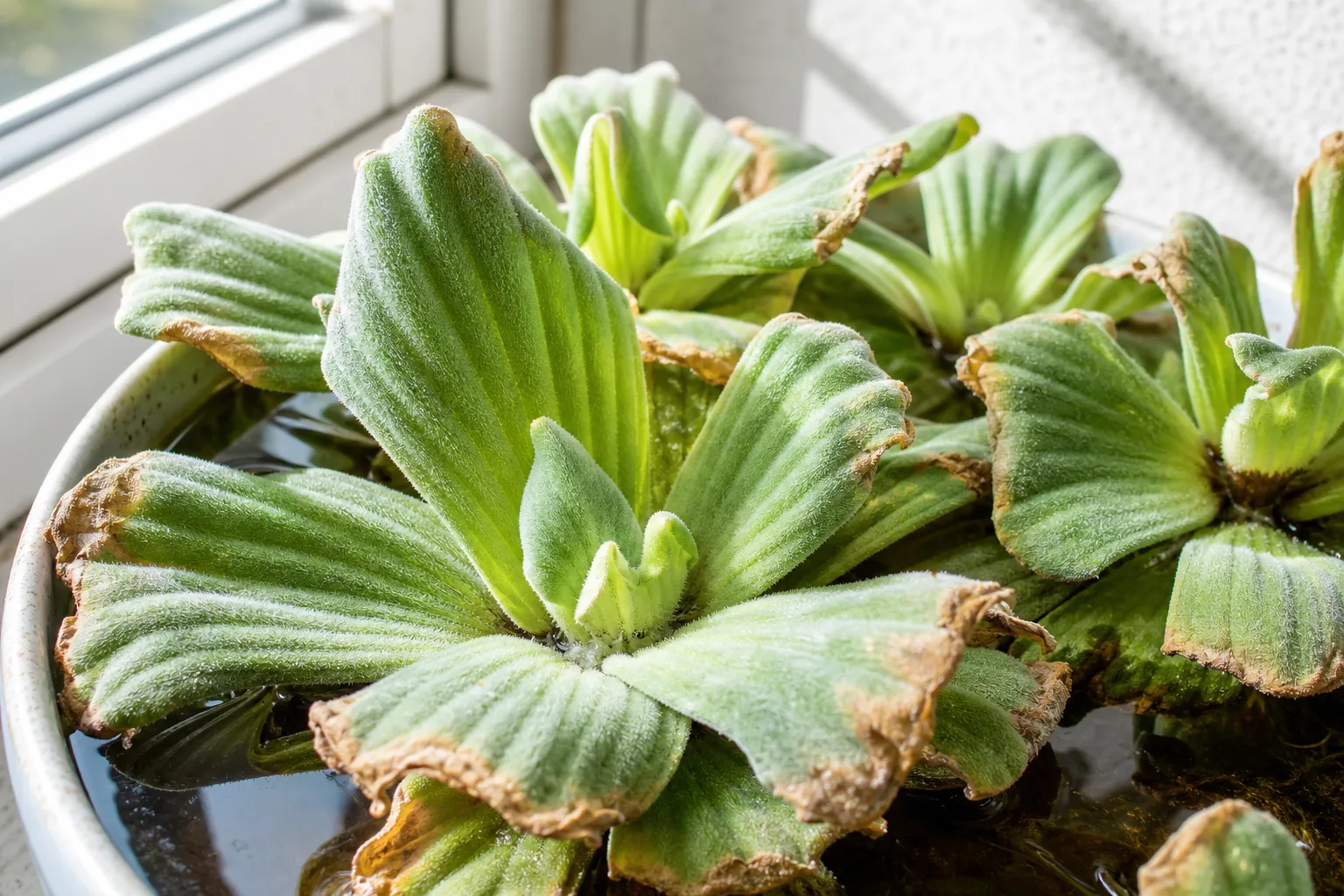
Low Humidity on Water Lettuce: Air Exposure, Checks & Fixes
This guide covers low humidity on Water Lettuce. See also the general Low Humidity guide, watering, and light pages for this plant.
Low Humidity on Water Lettuce: Air Exposure, Checks & Fixes
Quick answer
If you searched “low humidity on water lettuce,” you are probably seeing dry, tan, or brittle leaf edges on floating rosettes and wondering whether your living room is too dry. For healthy floating Pistia stratiotes, ambient room humidity is rarely the limiting factor. This free-floating aquatic herb absorbs moisture and nutrients through feathery roots in the water column-not through soil and not from a pebble tray on the windowsill.
Dry edges on aquarium or pond water lettuce more often trace to cold water, filter outflow splashing, rosettes stranded above the waterline, shipping air gaps, or harsh unacclimated sun-the same stressors covered in the water lettuce overview. Pebble trays, plant grouping, and keeping pots away from heating vents are houseplant fixes that do not apply to floating culture.
First step: read water temperature with a thermometer and confirm it sits in the 70–85°F (21–29°C) band where extension guidance places active growth. Then verify every rosette floats fully on clean dechlorinated water with roots submerged several inches below the surface.
Why aquarists confuse surface damage with “low humidity”
Houseplant advice trains growers to blame dry winter air when leaf margins brown. That logic fits potted ferns and calatheas whose roots sit in soil and whose leaves exchange moisture with room air. Water lettuce breaks that model entirely.
Each rosette sits at the air-water interface-leaves touch humid air directly above open water, while roots hang in the tank or pond below. UF/IFAS describes thick, hair-covered floating rosettes designed to repel surface water and trap a thin air layer for buoyancy. In a normal aquarium or pond, the microclimate at the water surface is already moist. A humidifier in the room does not change what happens on that surface the way it changes conditions around a pot on a saucer.
Searchers who land on “low humidity” pages are usually describing one of three real scenarios:
- Shipping or maintenance air exposure - rosettes dried in a bag, on a dry tub edge, or piled above the waterline during cleaning
- Environmental stress mislabeled as humidity - cold water melt, sun scorch, or filter spray that dries velvety leaf hairs
- Open-top aquarium edge cases - very dry room air plus strong surface lighting can crisp leaf tips on open tanks, but water temperature and placement still come first
This page keeps the “low humidity” search intent honest: it explains when dry air actually matters for Pistia and what to check instead when it does not.
What dry, crisp edges look like on floating rosettes
Healthy water lettuce forms a compact rosette of soft, velvety, light green leaves with wavy margins and short hairs that repel surface water. Damage tied to air exposure and misread “humidity” stress shows up in predictable patterns:
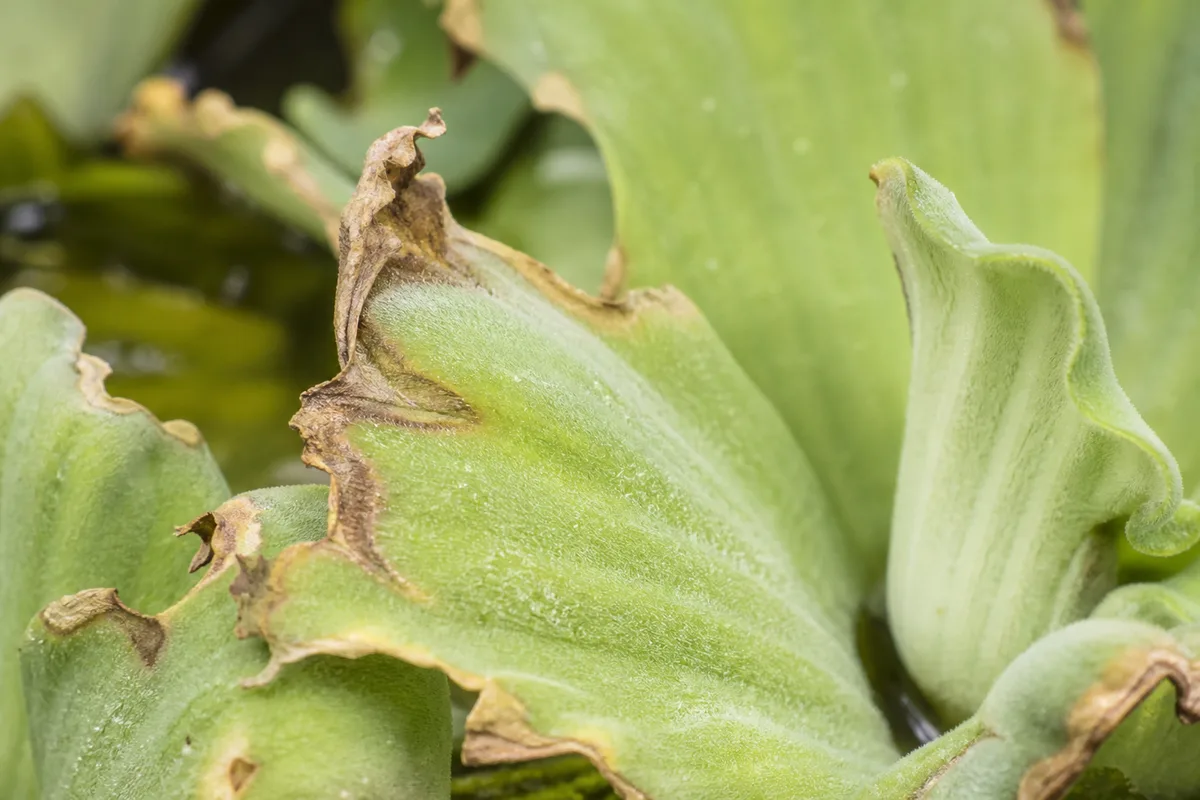
Low Humidity symptoms on Water Lettuce - compare with healthy tissue on the same plant.
- Dry, papery tan or brown margins on rosette edges that crumble when touched-not soft, slimy, or black
- Shipping-bag desiccation - outer leaves flat and brittle on arrival while inner tissue still looks green
- One-sided edge burn on the filter-outflow or afternoon-sun side of a mat while the sheltered half stays green
- Rosettes wilted flat on a dry rim after tank maintenance, with root tips visible above the water
- Bleached tan patches after moving indoor plants to harsh outdoor sun without acclimation
What this does not look like: yellow wet melt through crowns on stagnant water, mushy tissue with foul odor, holes with insect residue, or fine webbing under leaves. Those patterns point to rot, poor water quality, or pests-see yellow leaves and crispy leaves for overlapping edge-damage guides with different lead diagnoses.
Floating culture vs. when dry air actually matters
Healthy floating culture (room humidity irrelevant)
In aquariums and ponds, rosettes float on open water with roots submerged. Wisconsin Extension states plainly that water lettuce obtains all moisture from surrounding water and that roots should stay covered with several inches of water below each rosette. As long as water level, temperature, and light are in range, your home’s winter humidity percentage does not govern plant health.
Do not mist the aquarium surface expecting humidity fixes. Do not add pebble trays beside the tank. Do not group water lettuce with houseplants to “raise local humidity”-floating rosettes are not in that microclimate.
Narrow cases where air exposure matters
Dry air does damage water lettuce when tissue loses water contact or sits in harsh air without acclimation:
- Shipping bags - plants packed with air gaps or dry paper toweling desiccate in transit; edges crisp before you float them
- Maintenance stranding - rosettes left on a dry aquarium rim, net, or filter shelf overnight
- Low tank level - evaporation exposes dangling roots to air while crowns still appear to float
- Filter outflow spray - constant micro-spray dries velvety hairs on one side of a mat
- Open-top tank + intense lighting - in very dry rooms, bright LEDs close to the surface can crisp margins even when PAR is moderate; fixing temperature and reducing direct spray usually matters more than a room humidifier
For pond plants shipped in summer heat, floating rosettes in shaded shallow water for several days before full sun prevents the rapid surface drying that growers often mislabel as humidity failure-Wisconsin Extension notes the plant obtains all moisture from surrounding water once roots are submerged.
Real causes to check before blaming room air
Work through these causes in priority order-they explain most “dry water lettuce” reports on floating plants:
Cold water and temperature shock
Temperature is the primary environmental variable for Pistia stratiotes. USGS documentation notes the species tolerates a broad range but hobby success clusters around 68–86°F (20–30°C). Growth slows sharply below about 65°F (18°C); freezing temperatures kill tissue in the northern portion of its range. Cold damage often produces brittle tan edges and yellowing melt that newcomers attribute to dry air. A reliable aquarium heater matters more than any humidity device-see the watering guide for temperature targets.
Insufficient light (small, pale rosettes)
Weak surface light produces small, flat, pale rosettes that may yellow at margins over time. That is a light deficit, not low room humidity. Increase usable PAR at the water surface before chasing humidity.
Sun scorch and unacclimated full sun
Outdoor and patio culture in harsh afternoon sun can bleach and crisp velvety leaves in a single hot day-especially on plants moved straight from indoor tanks. Missouri Botanical Garden recommends full sun to part shade outdoors, with afternoon shade in hot regions. Acclimate mats in partial shade before full exposure.
Filter splash and surface agitation
Return flow that pins mats under spray or churns the top few centimeters shreds leaves and dries exposed tissue. Mississippi State Extension and aquarium references consistently note that calm surface water suits floating Pistia better than barrage at the air-water interface. Deflect outflow, use a floating ring, or move mats to calmer surface zones.
Shipping stress and air gaps
Water lettuce ships poorly when bags overheat, freeze, or leave rosettes pressed against dry plastic. Dry edges on arrival are normal shipping desiccation-not proof your fish room needs a humidifier. Float plants in temperature-matched, dechlorinated water in indirect light for several days before judging recovery.
How to confirm the cause
Inspect in this order before stacking fixes:
- Water temperature - Thermometer reading in tank or pond; is it 70–85°F for active growth?
- Water level and root submersion - Are roots fully underwater several inches below each rosette, or are tips air-dried?
- Rosette placement - Any plants on a dry rim, net, or filter bracket instead of floating freely?
- Recent shipping or moves - Did plants arrive in the last week, or did you relocate tubs to full sun?
- Pattern on the mat - One-sided crisping implicates filter spray or directional sun; uniform edge burn after a level drop implicates evaporation or stranding.
- Light intensity - Bleached patches after outdoor placement suggest scorch; small flat pale rosettes suggest low PAR.
- Crown firmness and smell - Mushy crowns with foul odor mean rot, not dry-air cosmetic damage.
If temperature is warm, water level is full, roots are submerged, and damage is localized to one sun- or spray-facing side, light or flow stress is the lead diagnosis-not ambient room humidity.
First fix for water lettuce
Confirm water temperature is 70–85°F (21–29°C) and float every rosette fully on clean dechlorinated water with roots submerged several inches below the surface.
If a heater was off or a cold water change just dropped the tank into the low 60s°F, restoring stable warmth is the single highest-impact correction. Top up evaporated water to your normal full mark with treated, temperature-matched water. Move mats off dry rims and away from filter spray that dries one side of the rosette.
Do not add pebble trays, room humidifiers, or houseplant misting routines before these aquatic checks. Do not fertilize stressed rosettes until water temperature, level, and placement are corrected.
Step-by-step recovery
Once warmth and water contact are restored:
- Remove fully desiccated rosettes that crumble or no longer float cleanly-daughter plants need space and light.
- Partial water change if quality is poor - Replace 25–30% with dechlorinated, temperature-matched water if the tank smelled stagnant before damage appeared.
- Thin overcrowded mats - Dense piles trap heat at the surface and block gas exchange; outer edge rosettes crisp while inner plants stay green.
- Shade acutely sun-hit mats - Move outdoor tubs to partial shade for one to two weeks before gradual re-exposure.
- Adjust filter output - Deflect return flow so mats drift in calmer water rather than sitting under constant spray.
- Acclimate shipped plants - Float newcomers in indirect light for several days; mild edge crisping on arrival often resolves once water contact and warmth stabilize.
Monitor daughter rosettes forming on horizontal stolons-new compact growth is your recovery signal, not repaired old margins.
Recovery timeline
Existing dry, tan tissue will not turn green again. Improvement shows up as new daughter rosettes with firm velvety leaves and white feathery roots without dry tips.
Under corrected temperature and surface placement in warm water, expect cleaner new growth within one to three weeks. Cool water or winter light slows recovery to a month or more. One older rosette with trimmed dry edges can remain if the crown is firm and offsets appear steadily.
Watch for buoyant rosettes, submerged roots, and damage that stays tan rather than spreading soft yellow melt-that means your fix is working.
Lookalike symptoms
| What you see | Likely cause | What to do |
|---|---|---|
| Dry margins after tank level dropped | Low water / stranded rosettes | Top up; refloat all plants - see crispy leaves |
| Crisping on one side of mat only | Filter spray or outflow | Redirect flow; move mat |
| Tan brittle patches after moving outdoors | Sun scorch | Partial shade; acclimate slowly |
| Dry brittle leaves after cold snap | Cold injury | Heat water; replace dead rosettes |
| Dry edges on arrival in mail | Shipping air exposure | Float in shaded water; wait for daughters |
| Yellow wet melt through crown | Rot / poor water quality | Partial change; remove mushy plants |
| Brown tips in very dry room + strong LED | Open-top edge desiccation | Reduce spray; check temp first; see brown tips |
Mistakes to avoid
- Using pebble trays or grouping with houseplants - These do not affect floating aquarium rosettes on open water.
- Misting rosettes instead of fixing water level - Surface mist does not rehydrate roots hanging in air after evaporation.
- Blaming heating vents - Floating tank rosettes are not positioned like a windowsill fern; vents rarely explain edge damage on open water.
- Adding fertilizer before correcting temperature - Stressed Pistia in cold water will not respond to nutrients; warmth comes first.
- Increasing light when sun scorch caused drying - Less harsh exposure heals; more direct sun worsens burn.
- Leaving plants on a dry rim during cleaning - Overnight stranding is enough to crisp velvety margins.
- Releasing trimmings to outdoor waterways - Water lettuce is an invasive aquatic weed in many regions; dispose in household trash per the overview.
How to prevent dry-edge damage next time
Match prevention to floating freshwater culture-not houseplant humidity routines:
- Temperature: Keep water in the 70–85°F band with a reliable heater in indoor tanks; move outdoor tubs indoors before frost.
- Water level: Top up for evaporation every two to four days in hot weather; keep roots submerged per watering guidance.
- Placement: Float freely; never store rosettes on dry surfaces during maintenance.
- Light: Moderate to bright surface lighting; acclimate before full summer sun on patio tubs - see light guide.
- Flow: Position filter returns so mats do not sit under constant surface spray.
- Shipping: Acclimate new plants in shaded, temperature-matched water for several days before full sun or high-intensity LEDs.
- Mat density: Thin fast-spreading colonies so outer rosettes do not bake at crowded pile edges.
When to worry
Dry margins alone on firm, floating water lettuce are usually reversible once water temperature and contact return. The species spreads quickly from daughter plants when conditions stabilize.
Escalate when:
- Crowns turn mushy with foul-smelling water-humidity fixes will not address rot
- Entire mats sink and dissolve within days on stagnant water
- Yellow wet melt spreads through wet rosettes while level stays full
- No new daughter plants appear after three weeks of stable warm water and adequate light
If only outer leaves on a few rosettes are dry and new offsets form cleanly, the colony is stable. Trim dried tissue for appearance and keep thinning excess growth responsibly.
Conclusion
Low humidity on floating water lettuce is usually a category error. Ambient room air rarely limits healthy Pistia stratiotes on open aquarium or pond water-pebble trays and heating-vent advice from houseplant guides do not apply. Dry, crisp leaf edges more often trace to cold water, filter splash, low tank level, shipping air exposure, or unacclimated sun on velvety floating rosettes.
Check water temperature first, refloat every plant with roots submerged, and correct surface placement before misting, humidifying, or fertilizing. Old dry tissue will not green up again; watch daughter rosettes for proof your aquatic fix worked. For broader care context, start with the water lettuce overview and sibling guides on crispy leaves, brown tips, and yellow leaves.
When to use this page vs other Water Lettuce guides
- Water Lettuce watering guide - Use for routine moisture checks before assuming low humidity is the main issue.
- Water Lettuce problems hub - Browse all 3 common issues on this species.