Table of Contents
What Monstera Fenestration Actually Means
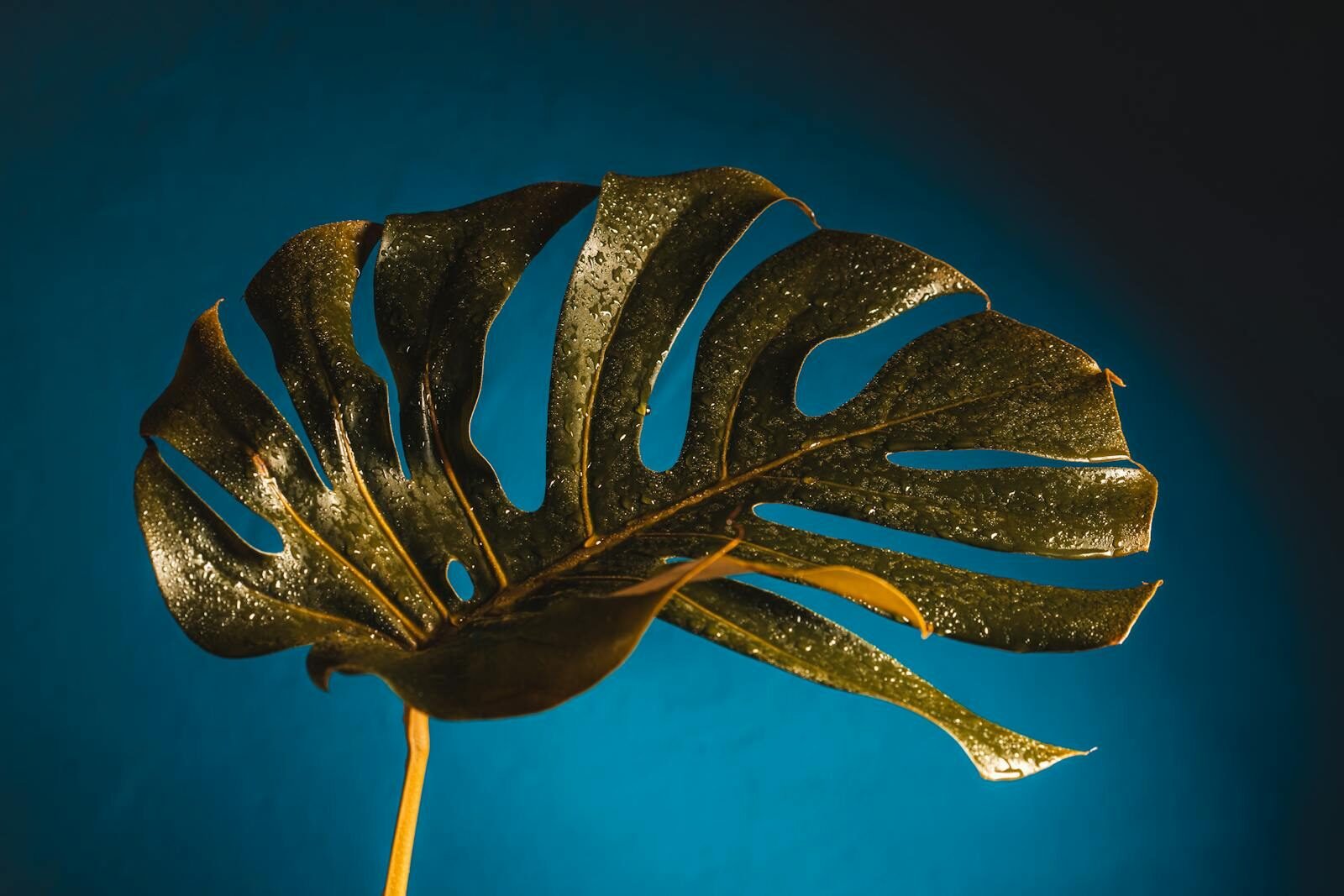
Monstera fenestration is the natural development of holes, slits, and deep cuts in the leaves of mature Monstera plants. It is not leaf damage. It is not a disease. It is not a random cosmetic trick. It is a normal part of development in many Monstera species, especially Monstera deliciosa, the plant most people mean when they say “Monstera” or “Swiss cheese plant.” Botanical and horticultural sources describe the species as a climbing tropical aroid with large leaves that become deeply cut and perforated as they mature. (Home and Garden Education Center)
That distinction matters because a lot of bad advice starts with the wrong assumption. If you think fenestration is something you “unlock” with one trick, you’ll chase shortcuts. If you understand it as the visible result of maturity plus the right growing conditions, your care decisions get much better. The current SERP reflects that exact search intent: the pages ranking around this topic focus on why leaves split, when splitting starts, and how to encourage it indoors, not on novelty or décor language. (The Spruce)
Why Monstera Leaves Have Holes in the First Place
The cleanest answer is this: fenestrations are an adaptive leaf form, not a design accident. Monsteras are climbing vines native to wet tropical regions from southern Mexico into Guatemala, where they grow as lianas and secondary hemiepiphytes in forest environments. That background explains why they behave the way they do indoors. They are built to climb, reach stronger light, and change leaf form as they mature. (Plants of the World Online)
Researchers have proposed several reasons for those holes and splits. The most widely discussed explanation is that fenestrated leaves help a climbing Monstera make better use of patchy forest light while expanding leaf area efficiently. Other ideas focus on airflow, water movement, or reduced physical stress on big leaves. None of that changes your practical takeaway: a Monstera makes more dramatic leaves when it has the conditions to behave like a climbing tropical vine instead of a struggling potted plant in a dim corner. (PubMed)
The light-capture theory
A 2013 paper by Christopher D. Muir argued that adult leaf fenestration may help Monsteras deal with a stochastic light environment, where brief sunflecks contribute a meaningful share of photosynthesis in the understory. In plain English: holes may help the plant spread leaf area and handle uneven rainforest light more efficiently. That theory also lines up with what growers see in practice—low-light plants stay juvenile-looking longer, while plants with stronger usable light move toward larger, more split leaves. (PubMed)
This is why “bright indirect light” needs to be understood, not repeated like a slogan. People hear that phrase and stick a Monstera across a dark room, then wonder why it stays all heart-shaped and sparse. The plant is not confused. It is responding exactly as a light-limited vine would respond: smaller leaves, slower growth, longer internodes, and weaker maturation signals. Good fenestration is not a styling choice. It is a growth outcome. (The Spruce)
Other theories: wind, water, and leaf efficiency
Light is not the only theory in the conversation. Some explanations suggest that holes and splits may reduce drag on large leaves or change how rain and air move across the leaf surface. A field study testing adaptive function in Monstera reported support for improved water uptake efficiency, while not finding strong support for every older assumption about reduced damage or herbivory. That matters because it shows the science is more nuanced than the internet cliché of “the holes are just for wind.” (digitalcommons.usf.edu)
There is also developmental science behind the look itself. Research on Monstera obliqua found that its perforations arise through programmed cell death during leaf development. That is another reminder that fenestration is built into plant development. Leaves do not wait around hoping to tear themselves artistically later. The pattern is determined as the leaf forms. (researchgate.net)
When Monsteras Start Fenestrating
Most Monsteras do not start with dramatic holes. They start with smaller, solid, juvenile leaves. Fenestration increases as leaf size progresses and the plant matures. University of Connecticut’s extension notes that fenestrations form at the midrib and radiate outward, increasing as leaf size increases. That pattern is exactly what home growers see: first bigger solid leaves, then shallow splits, then deeper cuts and interior holes as the plant gets older and stronger. (Home and Garden Education Center)
So when do Monstera leaves split? There is no universal birthday when the plant suddenly decides it is an adult. Timing depends on species, plant age, light, support, root health, and growth rate. A juvenile Monstera deliciosa in weak light can stay juvenile-looking for a long time. A plant with strong light and a proper support can start producing increasingly fenestrated leaves much sooner. The key idea is simple: fenestration shows up on new leaves as the plant matures. It is not retroactive. (The Spruce)
Juvenile leaves vs mature leaves
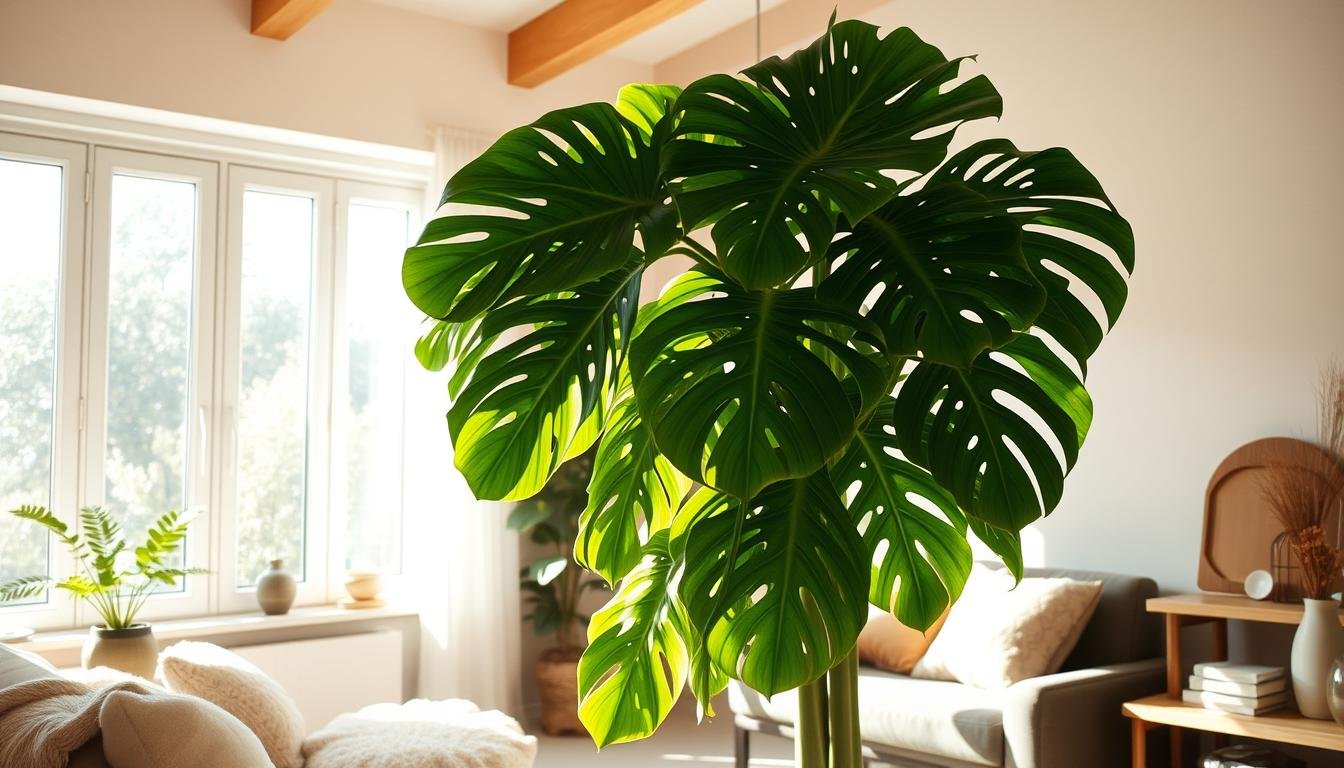
This is the most important mindset shift for frustrated owners. Juvenile leaves and mature leaves are not supposed to look the same. Juvenile foliage tends to be smaller, more heart-shaped, and either uncut or lightly split. Mature foliage becomes broader, more deeply lobed, and more perforated. That is normal morphology, not a sign that your plant is “broken.” (Home and Garden Education Center)
The second important point is harsher, but useful: old leaves do not develop new fenestrations later. If a leaf unfurled whole, it stays whole. What changes is the next leaf, assuming the plant has enough resources and the right environment. That one fact can save months of confusion, because it forces you to judge progress by new growth, not by staring at leaves that already finished forming. (Facebook)
The Biggest Indoor Drivers of Fenestration
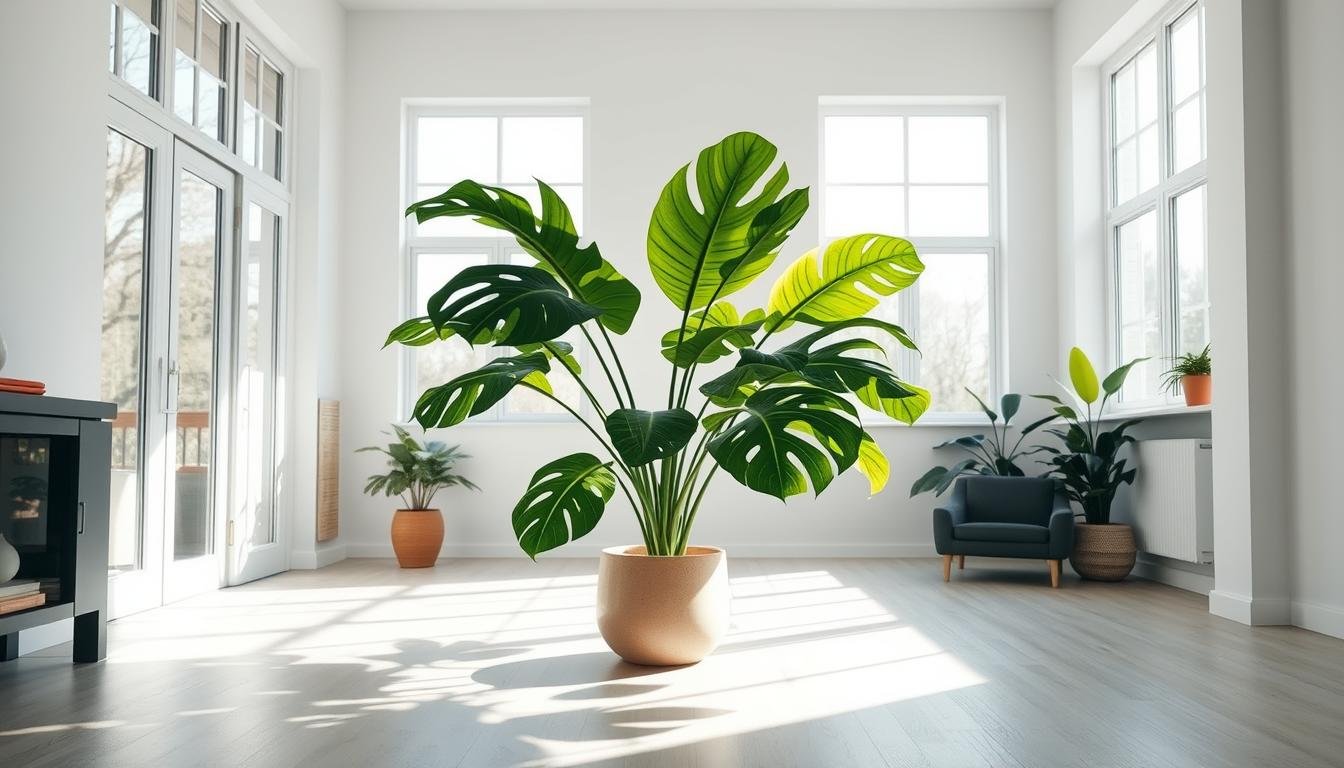
If you want a punchy version, here it is: light grows the engine, support matures the vine, and healthy roots bankroll the leaf. Everything else is secondary. Humidity helps. Fertilizer helps. Good soil helps. But the plant will not fake maturity just because you misted it or bought an expensive pot. The major care guides ranking for this topic keep returning to the same cluster of factors: brighter usable light, steady watering, regular feeding, and a climbing support like a moss pole or stake. (The Spruce)
That does not mean you need “perfect” conditions. It means you need conditions that consistently push the plant forward instead of keeping it in survival mode. Fenestration is the output. Strong growth is the input. If your Monstera is putting out tiny leaves, stretching toward a window, drying too hard between waterings, or sitting in dense wet soil, you have a growth problem first and a fenestration problem second. (Penn State Extension)
Light is the main lever
If you change one thing, change light. Indoors, low light is the most common reason a Monstera stays juvenile-looking. Multiple care sources note that inadequate light leads to smaller leaves, legginess, and poor or delayed splitting, while brighter indirect light supports larger, more fenestrated growth. RHS recommends a bright position away from harsh direct sun, while Penn State and The Spruce also point to bright indirect light as core care. (RHS Plants)
The practical translation is this: put the plant close enough to a strong light source that it actually grows, not just survives. East windows, bright north in very sunny climates, or slightly set-back south/west exposure often work well if you avoid scorching afternoon blast on tender leaves. If your room is naturally dim, a grow light is not cheating. It is compensation. The Spruce explicitly recommends a grow light as one of the best ways to encourage splitting when natural light is lacking. (The Spruce)
A helpful self-test: look at the last three leaves. Are they getting larger? Are internodes getting tighter instead of longer? Is the newest leaf more cut than the last one? If yes, your light is probably at least good enough to move the plant toward maturity. If the opposite is happening, stop obsessing over humidity gadgets and fix the light first. (The Spruce)
Climbing support changes leaf size and maturity
A moss pole, plank, or trellis does more than keep the plant upright. Monsteras are climbers by nature. When you give the stem something to climb, you encourage the plant to behave more like it would in habitat, and that often translates into bigger leaves and better fenestration. The Spruce’s moss pole guidance says support encourages larger leaves with more fenestrations, while UConn describes Monstera as a climbing vine that can be grown on a pole or stake. (The Spruce)
This is one of the biggest gaps in weak content on the topic. Many articles talk about light and watering but treat support like an accessory. It is not. A Monstera grown trailing, flopping, or constantly pruned back for size may still live just fine, but it is less likely to produce the dramatic mature leaves people want. Support gives the plant a directional job: climb up, increase leaf size, anchor with aerial roots, and transition into more mature growth. (The Spruce)
That does not mean a moss pole is magic. A support cannot override terrible light. But in good light, it can be the difference between a lanky decorative plant and one that starts producing serious foliage. Think of it like strength training for the growth habit: the plant uses the structure to express what it is already biologically wired to do. (The Spruce)
Water, roots, and nutrients support the process
Fenestration is a growth signal, but growth still needs raw materials. Monstera care guides consistently recommend watering when the top layer of soil has dried rather than keeping the mix constantly wet, and they warn that overwatering can lead to yellowing and root problems. Penn State recommends balanced fertilizer through the growing season, and RHS advises warm, bright conditions with good care rather than extremes. (Penn State Extension)
Here is the practical version: healthy roots help produce larger leaves, and larger leaves are where stronger fenestration shows up. If roots are rotting, cramped, or chronically stressed, the plant will not invest in elaborate mature foliage. It will conserve. That is why a Monstera that looks “alive enough” can still refuse to level up. The plant may not be dying. It may just be under-resourced. (The Guardian)
Humidity sits in the same category. It supports healthier growth, especially in dry indoor air, but it is not the main switch. RHS says Swiss cheese plants appreciate humid conditions and warmth around 18–25°C (65–77°F). Useful? Absolutely. The decisive factor for fenestration? Usually not on its own. Good humidity helps a strong plant get stronger. It does not rescue a light-starved one. (RHS)
What Will Not Create Fenestration
This section saves people the most time. Misting alone will not create fenestration. Staring at old leaves will not create fenestration. Repotting into a larger pot without fixing light will not create fenestration. Buying “Monstera fertilizer” without improving growth conditions will not create fenestration. Those things may help around the edges, but none of them replace maturity, adequate light, support, and healthy roots. The pages currently ranking on this topic do not present a legitimate shortcut, because there is not one. (The Spruce)
Another myth worth killing: damage is not fenestration. Torn leaves from rough handling, shipping stress, dry unfurling, or pest damage are just damaged leaves. Real fenestrations are symmetrical developmental features that form as the leaf develops. If a leaf ripped later, that is not your plant “finally splitting.” It is just a ripped leaf. (researchgate.net)
How to Troubleshoot a Monstera With No Holes
If your Monstera has no holes, run this mental checklist in order. First: is it actually Monstera deliciosa, or did you buy a young plant that was marketed loosely? Second: is it still juvenile? Third: is it getting enough usable light to produce progressively larger leaves? Fourth: is it climbing, or just sprawling? Fifth: are the roots healthy, the soil airy, and the watering steady enough to support active growth? Troubleshooting gets easier when you stop asking “Why no holes?” and start asking “Why no maturity?” (missouribotanicalgarden.org)
That framing matters because the symptom is visual, but the cause is often structural. A Monstera can look green and still be underperforming. It may be in a pot that stays wet too long. It may be ten feet from the only real window. It may have multiple crowded stems competing for light in a decorative nursery pot. All of those conditions slow the plant’s march toward bigger, more fenestrated leaves. (The Guardian)
Small leaves, leggy growth, and stalled maturity
Small leaves with long spaces between them usually point to insufficient light. That is the classic leggy look: the plant stretches, the leaves stay undersized, and fenestration stalls. The Spruce and other care guides link inadequate light with small leaves and weak splitting, which makes sense biologically. The plant is not going to build a huge architecturally complex leaf when it cannot even power strong basic growth. (The Spruce)
There is also a patience problem here. People often buy a juvenile plant, keep it alive for a few months, and expect mature leaves immediately. But growth is cumulative. The plant has to build stronger stems, larger root mass, and more energy reserves before the leaf shape really changes. When someone says, “My Monstera is healthy but not fenestrating,” what they often mean is, “My Monstera is surviving, but not maturing fast enough to match my expectations.” Those are not the same thing. (Home and Garden Education Center)
Why a plant can revert to less fenestrated leaves
Yes, a Monstera can start producing less fenestrated leaves after previously making good ones. That usually means the plant’s conditions got worse, not that it forgot how to be a Monstera. Lower light, broken support, root stress, environmental shock, or a reset in a younger side shoot can all reduce leaf size and complexity. Grower discussions reflect this clearly, and current care guidance also notes that a loss of fenestration can be a clue that the plant needs more light. (Reddit)
One overlooked cause is new juvenile shoots. If a fresh offshoot or lower vine starts growing, its leaves may look less mature even on an older plant. That is not always a crisis. It may simply be a younger growth point behaving its age. The fix is not panic-pruning. The fix is evaluating whether that shoot has enough light, support, and time to progress. (Reddit)
Monstera Deliciosa vs Other Monstera Species
A lot of confusion comes from lumping every holey plant into one category. Monstera deliciosa usually starts with solid juvenile leaves and develops larger splits and inner perforations as it matures. Monstera adansonii often shows holes much earlier and keeps a different, smaller, more perforated leaf style. Species like Monstera obliqua are a different story entirely and are not a realistic benchmark for typical home growers. (The Spruce)
That matters because many people think their deliciosa is “failing” when it simply is not supposed to look like an adansonii. Deliciosa is about size, maturity, and structural drama. Adansonii is about lighter, smaller leaves with earlier holes. If you compare the wrong species, you will misdiagnose a healthy plant. The better question is not “Why doesn’t my Monstera look like that Instagram plant?” The better question is “What does maturity look like for this species under my conditions?” (The Spruce)
The Best Setup for Faster, Bigger, More Dramatic Splits
If the goal is faster fenestration, the best setup is surprisingly simple. Put Monstera deliciosa in strong bright indirect light, keep it warm, use an airy mix with drainage, water before it stays bone dry for too long but after the top layer dries, feed during active growth, and train the stem up a moss pole or similar support. That setup aligns with the most reliable horticultural guidance on the plant and with how the species grows in nature as a climbing tropical vine. (RHS)
If you want the shortest possible action plan, use this:
- Move it closer to better light.
- Give it vertical support.
- Make sure the roots are healthy and not sitting in soggy mix.
- Feed during the growing season.
- Judge progress only by the next few leaves, not the current ones. (The Spruce)
That is the real secret people keep looking for. There is no hidden tonic. There is no viral “hack.” There is just a plant that responds predictably when you help it act like a climbing aroid instead of a decorative tabletop ornament. Do that consistently, and fenestration becomes much less mysterious. (Home and Garden Education Center)
One more practical note: if you share your home with pets, remember that Monstera is toxic to cats and dogs because it contains insoluble calcium oxalates. If you are moving the plant to a brighter, more accessible spot for better growth, make sure that spot is still safely out of reach. Better fenestration is not worth an emergency vet visit. (ASPCA)
Common Fenestration Mistakes to Avoid
The first mistake is underestimating light. This is the big one. A Monstera that merely “sees daylight” is not necessarily getting enough light to mature well. The second is treating support like an optional aesthetic extra when it is actually part of how the plant expresses mature growth. The third is overwatering in the name of “tropical care,” which can quietly damage roots and suppress the very growth you want. (The Spruce)
Another common mistake is changing too many variables at once. People move the plant, repot it, fertilize harder, prune it, and add a grow light all in the same week, then cannot tell what helped or hurt. Monstera responds over time. Make smart changes, then watch the next leaf and the one after that. That is how you diagnose cause and effect instead of guessing. (Penn State Extension)
The last mistake is chasing aesthetics over biology. Fenestration is beautiful, but the plant does not care about your Pinterest board. It cares about resource availability and growth habit. Once you start managing those fundamentals well, the appearance follows. That is true for Monsteras more than almost any other trendy houseplant, because their most desirable look is literally a sign of maturity. (Home and Garden Education Center)
Conclusion
If you want the truth in one sentence, here it is: Monstera fenestration is not a trick to force—it is a maturity signal you earn by giving the plant enough light, support, and stable growth conditions. That is the thread connecting both the science and the practical care advice. Monsteras are climbing tropical vines. When they can grow like climbing tropical vines, they make bigger, more dramatic leaves. When they cannot, they stay juvenile-looking. (Plants of the World Online)
So stop asking whether your current leaf will split. It will not. Ask whether your next leaf has a reason to be larger, stronger, and more mature than the last one. Put the plant where it can actually grow. Give it something to climb. Keep the roots healthy. Then give it time. That is not a sexy answer. It is the answer that works. (Facebook)
FAQs
What is Monstera fenestration?
Monstera fenestration is the natural formation of holes, slits, and deep cuts in mature leaves. It is a normal developmental feature of many Monstera species, especially Monstera deliciosa, and typically increases as leaves get larger and the plant matures. (Home and Garden Education Center)
Why does my Monstera still have no holes?
The most common reasons are juvenile age, insufficient light, lack of climbing support, or stalled growth from root or watering issues. A green plant can still be underpowered. If new leaves stay small and solid, the plant usually needs better growth conditions before it can produce mature foliage. (The Spruce)
Can old Monstera leaves split later?
No. Once a leaf has unfurled and finished developing, it will not suddenly gain true fenestrations later. Improvement shows up on future leaves, not on the current one. Real fenestration is part of how the leaf forms during development. (Facebook)
Does a moss pole really help Monstera fenestration?
Yes, often significantly. A moss pole or other support encourages the plant to grow as a climber, which is how Monstera behaves in nature. That can lead to larger leaves and more pronounced fenestration, especially when paired with strong light. (The Spruce)
Is Monstera safe around cats and dogs?
No. The ASPCA lists Swiss cheese plant (Monstera deliciosa) as toxic to cats and dogs because it contains insoluble calcium oxalates, which can cause oral irritation, drooling, vomiting, and difficulty swallowing. Keep it out of reach if you have pets. (ASPCA)