Distorted Leaves on African Violet: Mite & Water Checks
Quick answer
Distorted leaves on African Violet—crinkled, twisted, bunched center growth, or pale ring scars—often mean cyclamen mites, cold-water injury, or excess fertilizer—not generic houseplant stress. First step: isolate the plant and magnify the center crown where new leaves emerge.
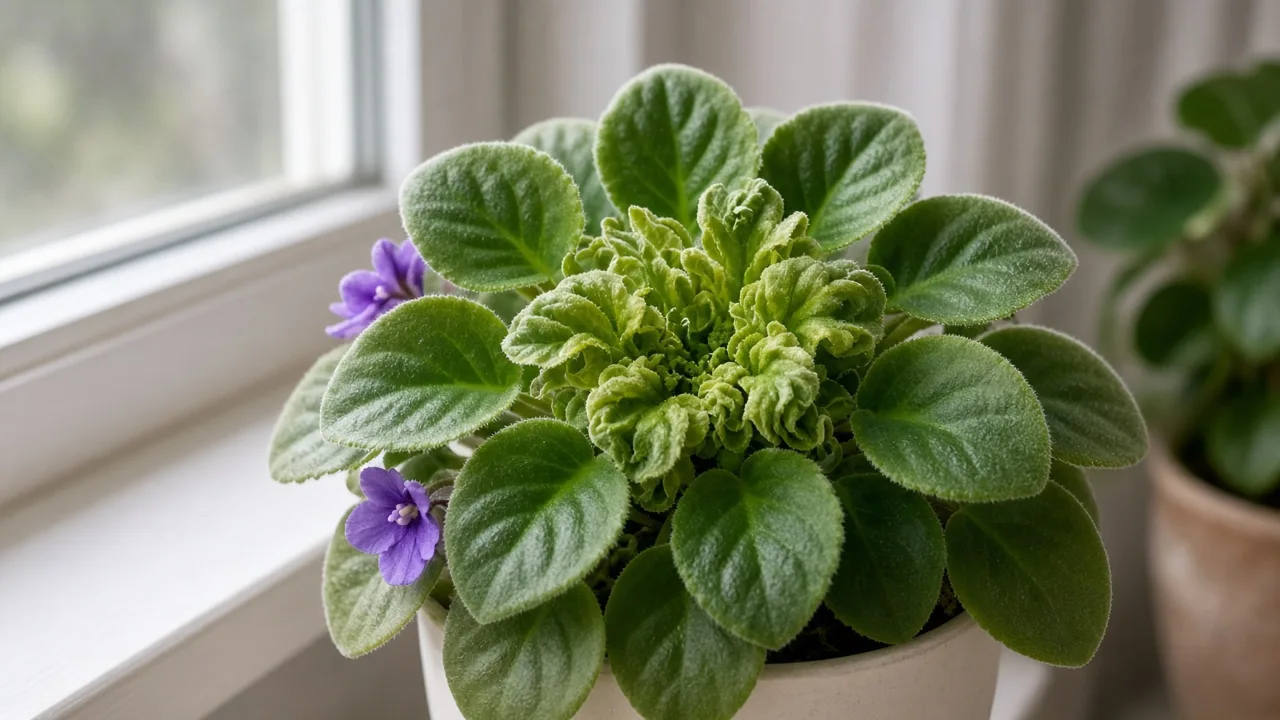
Distorted Leaves on African Violet: Causes, Checks & Fixes
This guide covers distorted leaves on African Violet. See also the general Distorted Leaves guide, watering, and light pages for this plant.
Distorted Leaves on African Violet: Causes, Checks & Fixes
Quick answer
Distorted leaves on African Violet (Saintpaulia) look crinkled, twisted, undersized, or scarred with pale rings in the center rosette. For how leaf distortion works in general, see our distorted leaves guide. On African violets, the crown is the diagnostic zone—cyclamen mites and cold-water injury both attack new velvety growth before outer leaves show trouble.
First step: isolate the plant and inspect the center crown with a 10× magnifier.
When to use this page vs other African Violet guides
| Pattern | Read next |
|---|---|
| Peanut-shaped black spots on lower leaves | Black spots |
| Inward cup on dry, light pot | Curling leaves |
| Pale rings after cold splash only | Cold damage |
| Tiny tight center, whole plant small | Stunted growth |
| Mottled light-and-dark patches on new leaves | Mosaic virus |
| Bunched, hairy, stunted center | Cyclamen mites—this page |
What distorted leaves look like on African Violet
Read the newest center leaves, not the mature display ring. Healthy African violets hold a flat, symmetrical rosette when culture is correct. Distortion means something is interfering with how each new leaf unfurls from the crown.
Classic distortion patterns on velvety rosettes:
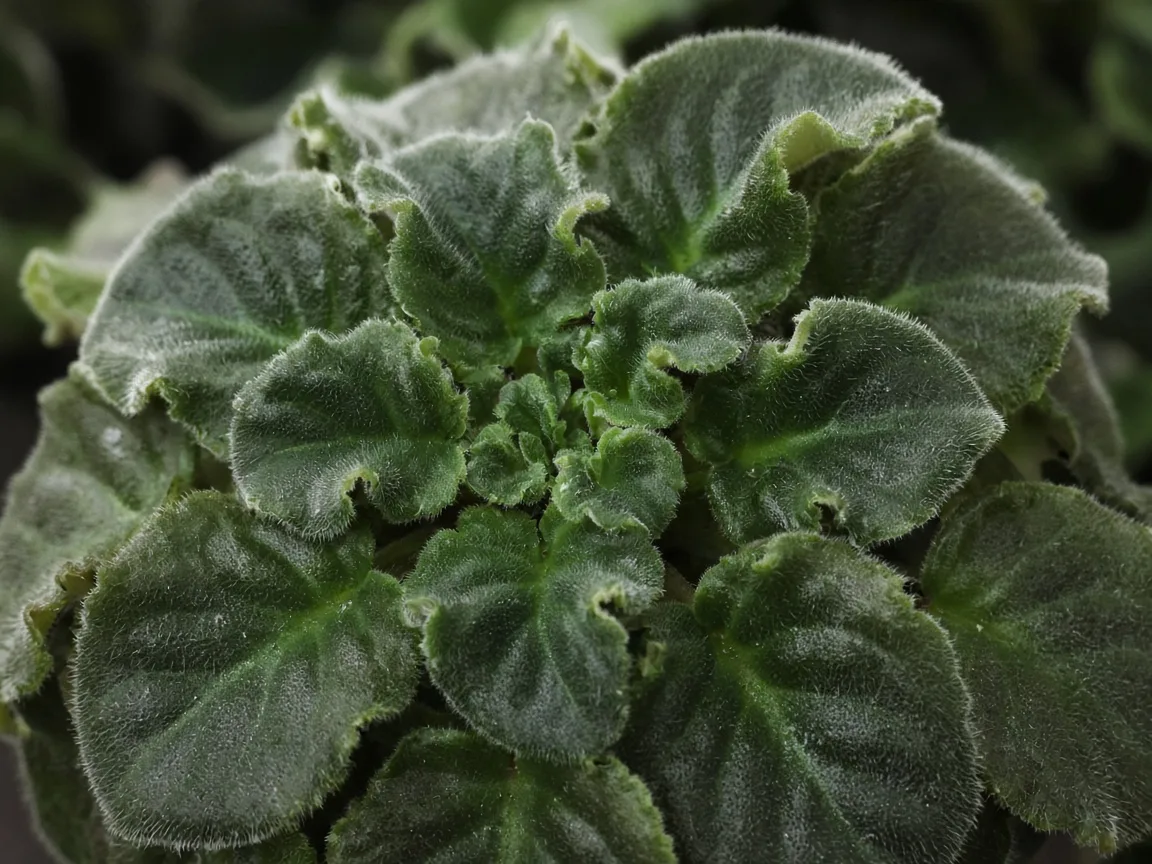
Distorted leaves on African violet—compare bunched twisted center growth with normal outer rosette leaves.
- Bunched, hairy, stunted center leaves — The hallmark of cyclamen mites on African violets: new foliage stays tiny, twisted, and crowded while outer leaves may still look normal for weeks.
- Pale rings, arcs, or bleached lines on the upper leaf surface — Cold-water or splash injury on fuzzy leaves; permanent scars that do not spread inward on every new leaf.
- Crinkled or puckered new leaves after top-watering — Temperature shock on the leaf surface, sometimes with slight downward curl at the petiole.
- Uneven puckering after heavy feeding — Salt or fertilizer injury at roots; margins may crisp while the crown still produces leaves—see overfertilization.
- Soft, water-soaked center with gray fuzz — Botrytis blight in a crowded wet crown; overlaps with black spots when tissue darkens.
Compare to flat symmetrical siblings on the same shelf. Localized distortion on one pot suggests pests or a watering error, not room humidity alone. When every violet on a tray shows the same tight hairy center, suspect a collection-wide mite outbreak before adjusting fertilizer.
Crown magnification protocol
Rosette-only diagnosis is what separates African violet troubleshooting from smooth-leaved houseplants. Mites and cold injury both strike the growing point; outer leaves can mask the problem.
- Look straight down into the crown — not at the side profile. New leaves emerge from the center; that is where distortion starts.
- Use 10× magnification minimum — Cyclamen mites are microscopic and hide in tight folds where petioles meet the stem. You may not see the pest itself; you are looking for texture: excessive hairiness, dull gray cast, tight downward curl, brittle feel.
- Take a phone macro photo — Compare center leaves to leaves produced two months ago. Progressive shrinkage and twist point to mites; a single ring on one splashed leaf points to cold water.
- Check whether outer leaves look fine — Crown-only distortion with normal outer foliage is strong mite suspicion. Even distortion across the whole rosette fits salts, light, or root stress better than mites alone.
- Handle suspect plants last — Mites spread on hands, tools, and touching leaves between pots on a crowded shelf.
If the center is already destroyed—black, mushy, or collapsed—stop magnifying for mites and assess crown rot on wet soil before any heat treatment.
Why African Violet gets distorted leaves
Cyclamen mites (most serious crown cause)
Cyclamen mites are among the most serious pests of African violets and are often the primary mite damaging this species. They feed on new growth and inject a toxin that disrupts normal leaf development, producing stunted, curled, brittle center leaves and distorted flowers. They favor high humidity and cool temperatures near 60 °F—conditions common on indoor shelves—and spread when leaves touch neighboring pots or when you groom an infested plant before a healthy one.
Broad mites cause similar crown twisting on gesneriads. Their toxic saliva distorts growing points and can mimic herbicide or nutrient damage. Treat them the same way: isolate, consider heat dip or labeled miticide, discard hopeless cases.
This is why bunched center distortion on an otherwise normal outer ring is the signature mite pattern—not generic “my plant is unhappy.”
Cold-water and splash injury
African violet leaves are covered in fine hairs that hold water against the surface. Splashing water much colder than the leaf causes ring spot and water spot—pale rings, arcs, or lines that permanently warp tissue. Extension guidance recommends bottom-watering to keep foliage dry; any return to overhead watering with cold tap water on warm leaves reopens this problem quickly.
Cold injury is localized to splashed leaves and does not march inward on every consecutive new leaf the way virus or progressive mite damage can.
Overfertilization and salt stress
African violets in small pots accumulate salts quickly, especially when growers bottom-water and minerals concentrate at the rim. Heavy feeding or hard tap water can pucker new leaves and crisp margins while the crown still tries to produce foliage. This overlaps with fertilizer burn and salt buildup when a white crust rings the pot.
Do not feed to “fix” distortion until mites and water method are ruled out—extra fertilizer on a mite-infested or salt-stressed plant often worsens puckering.
Botrytis in crowded crowns
Dense rosettes with fading flowers or yellowing lower leaves trapped in the center create a humid microclimate. Botrytis blight can distort and soften crown tissue before leaves show discrete black spots. Wet, mushy distortion on saturated mix is rot or blight—not mites. See black spots when peanut-shaped lesions appear on lower foliage.
Mosaic virus lookalike
INSV and other viruses can distort center leaves with mottled color. The key difference from mites: irregular light-and-dark green patches on consecutive new center leaves over weeks, often with thrips present. Tight hairy center without mottling points to mites. When mottling persists after care correction, see mosaic virus and isolate immediately.
How to confirm the cause
Work through this checklist in order. Stop when one cause fits clearly.
- Crown vs. splashed leaves — Is distortion limited to the center with normal outer leaves? Strong mite suspicion. Are rings confined to leaves you recently top-watered? Cold-water injury.
- Magnifier pass — Excessive hairiness, tight curl, brittle texture in leaf folds without webbing points to cyclamen mites. Fine webbing on undersides points to spider mites, not cyclamen mites.
- Watering history — Did you top-water, mist, or splash cold tap water in the last 48 hours? Ring patterns appearing hours later fit cold injury.
- Salt crust test — White grit on the pot rim that returns after drying supports fertilizer or salt stress—not isolated crown twist alone.
- Soil moisture and crown firmness — Soft black center on wet soil is crown rot, not mites. Firm crown with distorted new leaves keeps mite suspicion alive.
- Neighbor check — Multiple violets with tight hairy centers on one shelf suggests collection spread; one pot with rings on two splashed leaves suggests a watering mistake.
If the crown is distorted and salts, light, and roots look normal, treat for mites before repotting or fertilizing. Repotting a mite-infested plant without isolation spreads pests through your collection.
First fix for African Violet
Stop top-watering immediately; switch to room-temperature bottom-water only.
Move the pot to a tray of water at room temperature for about 30 minutes, then drain fully—per the African Violet watering guide. This single step stops new cold-water ring spots and keeps velvety foliage dry while you diagnose.
Then, based on what you find:
If mites are likely (tight hairy center, normal outer leaves):
- Isolate the plant away from neighbors so leaves do not touch.
- Decide save vs. discard — Badly infested plants are often best discarded to protect a collection. Salvage only plants you will monitor closely.
- Heat dip (valuable plants only) — Cyclamen mites are heat-sensitive; immersion of the whole plant and pot in water held at about 110 °F for 30 minutes can kill them. Use a kitchen thermometer and never guess—water hotter than about 111 °F can scorch crowns. Skip heat if the crown is soft or wilted.
- Trim heavily distorted center growth before dipping so water reaches hidden folds.
- Labeled miticide option — Clemson HGIC recommends houseplant-labeled miticides such as insecticidal soap applied to reach crown folds, with repeat applications per label. Hairy leaves protect mites—spray must contact the center.
If cold-water rings are likely (localized scars, no hairy center):
- Continue bottom-watering only. Do not remove spotted leaves unless mushy—they still photosynthesize. Judge recovery by new flat center leaves over two to four weeks.
If salt or fertilizer puckering is likely:
- Stop feeding. Leach the mix once with room-temperature water until runoff flows from drainage holes. Resume normal watering only after the top inch dries.
Remove only mushy or dead center tissue with a sterile blade—do not tear velvety leaves by hand.
Recovery timeline
Cold-injury and mite-damaged leaves do not heal cosmetically. Ring spots and twisted tissue stay as they are; recovery means new center leaves open flat and full-sized.
After fixing water temperature alone, expect clean new growth within two to four weeks if warmth and light are steady. Mite recovery is slower and uncertain once the crown is bunched—normal appearance requires time and gradual pruning of distorted leaves, often months as you trim the worst center foliage.
Signs you are winning: each new leaf is larger than the last distorted one, petioles lengthen normally, and flower buds form without twist. Signs the problem is worsening: distortion on every new center leaf for two or more weeks, spread to neighboring pots, or a softening crown on wet soil.
Many growers restart from leaf cuttings taken from clean outer foliage when the crown is too damaged to salvage—only from plants confirmed mite-free.
Lookalike symptoms to rule out
| Pattern | Distortion type | Likely cause | First action |
|---|---|---|---|
| Tight hairy center, normal outer ring | Twist, shrink, bunch | Cyclamen mites | Isolate; magnify; treat or discard |
| Pale rings on splashed leaves only | Warp, scar | Cold-water injury | Bottom-water warm; see cold damage |
| Inward cup on dry light pot | Curl, not twist | Thirst | Bottom-water; see curling leaves |
| Mottled patches on each new center leaf | Distort + color | Virus suspicion | Isolate; see mosaic virus |
| Whole plant pale, small, no hairy crown | General shrink | Light or roots | See not enough light or root-bound |
| Soft mushy center on wet soil | Collapse | Crown rot | Stop water; see overwatering |
What not to do
Do not fertilize a distorted African violet to “push” flat leaves when mites or salts may be present—extra feed worsens puckering and burn.
Do not mist velvety leaves or top-water with cold tap water while diagnosing crown distortion.
Do not handle infested plants before healthy ones; mites travel on fingers and tools.
Do not assume webbing means cyclamen mites—webbing points to spider mites. Cyclamen mites hide in folds without obvious silk.
Do not repot on day one when mites are suspected without isolating first.
Do not return a treated plant to a shared shelf until several weeks of normal new center growth appear.
How to prevent distorted leaves next time
Examine newly purchased plants and reject them if tips are curled or deformed—signs that may indicate mites before you ever see the pest. Quarantine new violets for two to three weeks and inspect center growth weekly.
Bottom-water from a tray of room-temperature water and drain fully after each session. Maintain 40–60% humidity with space between pots so air moves across crowns.
Space pots so leaves do not touch—mites cross on contact. Disinfect scissors between plants when removing leaves. Leach salts monthly if you bottom-water with hard tap water.
Review the African Violet overview for light, watering, and feeding baselines so cultural stress does not mask an emerging mite problem in the crown.
When to worry
Treat as urgent when distortion spreads to every new center leaf for two or more weeks, multiple violets on one shelf show tight hairy centers, or the crown softens on wet soil. A collection-wide mite outbreak requires isolating every plant and discarding hopeless cases before mites reach show cultivars.
A single pale ring on one leaf after a watering mistake is manageable once you switch to warm bottom-watering. A plant that continues producing twisted center leaves despite dry foliage, isolation, and treatment is unlikely to recover cosmetically and should be discarded before infecting neighbors.
Related African Violet guides
Conclusion
Distorted African violet leaves are crown-level emergencies—magnify center growth, bottom-water warm, and isolate before cyclamen mites reach the whole shelf. Old twisted tissue will not flatten; success is flat new leaves from the heart of the rosette.