Aglaonema Lady Valentine Light Requirements: A Complete
Aglaonema Lady Valentine Light Requirements: A Complete Care Guide
Aglaonema Lady Valentine Light Requirements: A Complete Care Guide
Aglaonema ‘Lady Valentine’ is sold as an easy Chinese evergreen, then loses its signature pink within a season when parked in a dim hallway. The genus is famously low-light tolerant, but Lady Valentine’s broad rose-pink leaf centers carry far less chlorophyll than green cultivars like Aglaonema Maria. Your placement goal is bright, filtered indirect light — enough photons to drive anthocyanin in new leaves, never sustained direct sun on the foliage. NC State Extension describes Aglaonema as needing bright indirect light and intolerant of direct sunlight, which matches the rainforest-floor biology behind Lady Valentine’s pigment response.
What Makes Lady Valentine Different from Other Chinese Evergreens
The Cultivar’s Background and Anthocyanin Science
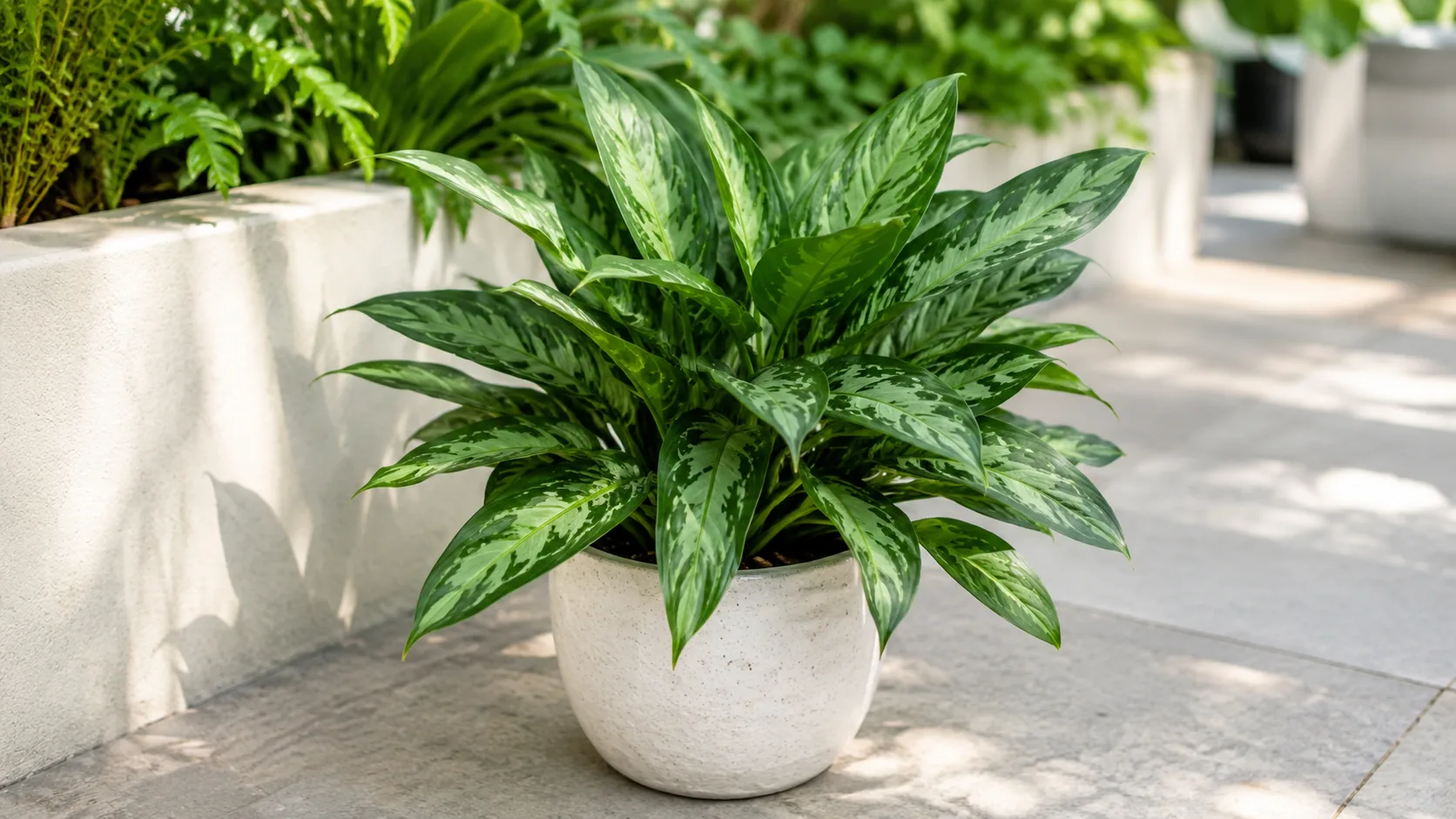
Aglaonema Lady Valentine is a tissue-cultured Thai hybrid of Aglaonema commutatum, the species commonly called Chinese Evergreen. It emerged from Southeast Asian breeding programs that crossed silver- and green-leafed Aglaonema species with red-veined ancestors to push pink and red pigment onto the leaf blades. Costa Farms popularized pink Aglaonemas in North America alongside cultivars like ‘Siam Aurora’, ‘Pink Dalmatian’, and ‘Super White’, each expressing anthocyanin in a different pattern. Lady Valentine’s defining look is broad, glossy leaves with green margins framing a generous center of salmon-pink, rose-pink, or cherry-red variegation. New leaves often open with a cooler pink blush and mature toward deeper red with green speckling — a slightly softer pink cast than many ‘Red Valentine’ specimens at the same stage, though retail labels routinely swap the two names.
That is what separates Lady Valentine from a green-leafed Aglaonema like ‘Silver Bay’ or ‘Maria’. A green cultivar can survive in a dim hallway for years because every cell is loaded with chlorophyll. Lady Valentine has large patches of leaf tissue that lack chlorophyll entirely. Those pink cells cannot photosynthesize efficiently, which means the plant has to push harder on the cells that can — and it has to be placed where the photons actually reach.
The red and pink in Lady Valentine is anthocyanin, a flavonoid pigment that absorbs green and blue light and reflects red wavelengths. Research on A. commutatum red-leaf cultivars shows light intensity strongly upregulates anthocyanin biosynthesis genes (PAL, DFR, ANS) while dark-grown leaves lose pigment. A 2022 Frontiers in Plant Science study on ‘Lady Valentine’ reported 11.2-fold higher anthocyanin in light-grown versus dark-grown seedlings — direct evidence that this cultivar’s color is light-regulated at the gene level. The same MDPI Genes study found anthocyanin content under moderate intensity was 1.14 to 3.72 times higher than under the highest intensity, meaning excess light can suppress pigment. The takeaway is that there is a sweet spot, and pushing past it either does nothing or breaks the pigment system down.
Light Intensity in Numbers: Foot-Candles, Lux, and PPFD
Growers use three different units to talk about light, and they all describe the same physical quantity from different angles. Foot-candles (fc) measure illuminance as perceived by the human eye, with a clear noon outdoors running 8,000–10,000 fc and a bright office hitting 200–300 fc. Lux is the metric equivalent (1 fc ≈ 10.76 lux), used on most smartphone light meter apps. PPFD (photosynthetic photon flux density) measures the number of photosynthetically active photons hitting a square meter per second, in µmol·m⁻²·s⁻¹, and is what plant physiologists care about because it counts only the wavelengths the plant can actually use. For white LED and natural light, the rough conversion is PPFD ≈ 0.2 × fc, so 200 fc at the leaf ≈ 40 µmol·m⁻²·s⁻¹.
A practical framework for Lady Valentine:
Clemson Extension classifies medium light as a minimum of 100 to 150 foot-candles, with 200 to 500 preferred for good growth, and notes the interior of a well-lighted home is often less than 100 foot-candles. Clemson HGIC’s Chinese evergreen factsheet places solid green cultivars in low light and variegated types in low to moderate indirect light — never direct sun on the foliage.
- Compensation / survival floor: ~10 fc (~110 lux / ~2 µmol·m⁻²·s⁻¹). The University of Arkansas Extension Service places Aglaonema’s light compensation point — where photosynthesis just matches respiration — at about 10 fc. Below this, the plant stops growing and slowly draws down reserves.
- Clemson genus floor (medium/low-light tolerant): 100–150 fc (~1,100–1,600 lux / ~20–30 µmol·m⁻²·s⁻¹). This is the minimum band Clemson cites for medium-light foliage plants and the practical floor for keeping a Chinese evergreen in acceptable condition indoors. Lady Valentine may hold on here, but pink will dull on new growth.
- Healthy growth and strong pink: 150–300 fc (~1,600–3,200 lux / ~30–60 µmol·m⁻²·s⁻¹). This is the color target range. Aglaonema should be grown in 75% to 90% shade (3,000 to 1,250 foot candles) in commercial production, and variegated or red-leaf cultivars need the higher end of any indoor range to keep their color. New leaves unfurl with strong pink, stems stay compact, and the plant pushes a new leaf roughly every 6–8 weeks during active growth.
- Strong color and active growth: 300–500 fc (~3,200–5,400 lux / ~60–100 µmol·m⁻²·s⁻¹). Achievable in a well-lit east window or with supplemental LED. Upper end of safe for a well-acclimated plant.
- Stress threshold: 1,000+ fc sustained (~10,800 lux / ~200+ µmol·m⁻²·s⁻¹). Bleaching, leaf curl, and tip burn start to appear, especially on the sun-facing side of the plant.
Most homes deliver 50–300 fc a few feet back from a window. Right at a south-facing glass on a sunny afternoon, the reading can spike past 2,000 fc, which is well into burn territory for any Aglaonema, not just a variegated one. The MDPI study found that the highest PPFD treatment (1,125–1,267 µmol·m⁻²·s⁻¹) actually reduced anthocyanin content in some red-leaf cultivars compared to moderate light, which is the practical restatement of the same principle: the relationship between brightness and pink is a curve, not a line.
How Light Affects Pink Coloration in Lady Valentine
The Chlorophyll Compensation Trap
The pink sections of a Lady Valentine leaf have very little chlorophyll. In low light, the plant is not getting enough energy from the few green cells it has, so it starts producing more chlorophyll in every cell it can — including the pink ones. Slowly, leaf by leaf, the pink zones turn green as chloroplasts flood back into areas that were once anthocyanin-dominated. This is not a disease and it is not a sign of aging. It is a survival response. The plant is choosing calories over color.
Reverse the conditions, and the same process runs backward. New leaves that emerge after a move to brighter light will produce more anthocyanin and less chlorophyll, pushing the pink back. Most growers misjudge Lady Valentine’s color response because they look at the wrong leaves. If you move a faded plant to a brighter window, the existing canopy will still look dull. Wait for the next flush of new growth. The first two or three new leaves will be a useful indicator, but the real color shift usually shows up on the third or fourth new leaf, once the plant has fully committed to the new light environment. If the new leaves emerge with stronger pink, brighter red margins, and tighter growth habit, the placement is right. If they emerge with a washed-out, pale pink, or with bleached patches and crispy edges, the plant is over-lit and needs to be pulled back. Use the new growth as your instrument panel.
Can Faded Pink Come Back?
No, not on the same leaf. Once a leaf has lost its anthocyanin dominance and gone green, that leaf is finished as a colorful leaf. It will continue to photosynthesize and feed the plant, but it will never revert. The good news is that the plant will usually keep pushing new leaves from the central growth point, and each new leaf is a fresh chance to express the cultivar’s true color.
Some growers prune back heavily after a long low-light stretch to force a clean flush of new growth that shows the cultivar’s actual color potential. This is optional and not necessary for plant health, but it does make the plant look more vibrant faster than waiting for natural replacement.
Best Window Direction and Placement
East- and North-Facing Windows (Best)
An east-facing window delivers the gentlest direct light of the day, from sunrise to about 11 a.m., with peak morning intensities in the 200–600 fc range. For Lady Valentine, this is the sweet spot. The plant gets enough photon energy to drive anthocyanin production but the sun is too low in the sky and the ambient temperature is too cool to scorch leaf tissue. Place the plant within 2–4 feet of an east window, or right on the sill if a sheer curtain filters the strongest morning rays during summer. The morning-sun timing also matches Lady Valentine’s natural rhythm. Tropical understory plants evolved to receive the most usable light in the first half of the day, when the canopy above is still wet with dew and the leaves transpire freely. Afternoon light, by contrast, hits hot and dry, which is why an east window outperforms a west one even when the west window technically has more total hours of brightness.
A north-facing window (in the Northern Hemisphere) delivers 50–150 fc year-round, with very little seasonal swing. That sits at Clemson’s 100–150 foot-candle genus floor — enough to keep the plant alive but on the low edge for pink color, especially in winter at latitudes above 40°N, where day length and sun angle both collapse. If your brightest natural light comes from a north window, plan on adding a full-spectrum LED panel on a timer for at least 4–6 hours during the darkest months. Lady Valentine will tolerate a north window alone during summer, but expect duller pink in winter. The plant will not die, but the color will not sell itself either.
South- and West-Facing Windows, Glass, and Sheer Curtains
A south-facing window in summer delivers 800–3,000+ fc right at the glass, peaking around solar noon. Even with a sheer curtain reducing that by 65–75%, the plant ends up in a useful range. Without a curtain, the plant burns. A west-facing window delivers 400–1,500 fc in the afternoon, but the bigger problem is the heat: leaf surface temperatures can climb 8–12°F above ambient, disrupting stomatal function and accelerating water loss even before visible burn appears. For south- and west-facing windows, follow these placement rules: South in summer: 3–5 feet back from the glass, or directly behind a sheer curtain that reduces light by at least 60%. South in winter: A spot 2–3 feet back, or right on the sill if shaded. West: Position at least 4–6 feet back, or use a thermal-insulated blind in addition to a sheer layer. The Royal Horticultural Society specifically warns that “low-light tolerant” houseplants are often the first to scorch from sudden direct exposure.
Window glass is not neutral. It blocks some UV-B, but it magnifies the UV-A and infrared that pass through, and it can raise leaf-surface temperatures 3–5°F above the room reading on a sunny day. This is why the same plant burns on a windowsill but thrives 3 feet back from the same window. The other trap is the seasonal shift: a spot that is perfect in March becomes a burn zone in July as the sun climbs higher and the light intensity at any given window rises 30–50%. Reassess placement at the solstices and adjust by 1–2 feet if needed. A quick rule of thumb: if you can feel noticeable warmth on the back of your hand held where the leaves are, the light is too direct and the heat is adding stress. Pull the plant back until the spot feels ambient.
Sunburn Signs and Treatment
Stages, Symptoms, and Sun Stress vs. underwatering on Aglaonema Lady Valentine
Sun damage on Lady Valentine follows a recognizable progression. Catching it early means the difference between trimming a few leaf tips and losing an entire flush of growth.
- Stage 1 - Subtle bleaching: Pink sections turn pale, almost translucent. The deep cherry-red loses its saturation. The green margins may look faded or yellowish. This is the plant’s pigments breaking down before tissue is actually killed.
- Stage 2 - Leaf curl and cupping: The leaf curls upward or inward at the margins, reducing the surface area exposed to the incoming light. This is a stress response, not a sign of thirst. The plant is trying to shade itself.
- Stage 3 - Tan or white papery patches: These appear first on the most exposed parts of the leaf, usually the tip, the edge, or a section facing the window. The tissue is dead and will not recover.
- Stage 4 - Brown, crispy margins and holes: The burned areas dry out, become brittle, and may eventually fall out, leaving ragged holes. Secondary fungal infection is a risk at this stage.
- Stage 5 - Premature leaf drop: The plant sheds the most damaged leaves to protect the rest of the canopy.
If you see Stage 1 or 2, you have time. Move the plant back from the window, filter the light, and the next flush should come in clean. If you see Stage 3 or worse, trim off the worst leaves to prevent pathogen entry, and accept that the damage is permanent.
Sun stress and underwatering look similar at a glance but show up differently on close inspection.
| Clue | Sun stress | Underwatering |
|---|---|---|
| Location of damage | Tips, edges, or sun-facing patches | Margins moving inward, often symmetric |
| Texture | Papery, bleached, crispy | Dry, brittle, sometimes leathery |
| Color | Faded pink, washed-out green, or white | Yellowing to brown, sometimes with curling |
| Leaf posture | Cupped upward to shade itself | Drooping, soft, limp |
| Soil | May be wet or dry | Dry, sometimes pulling from the pot edge |
| New growth | Stunted, pale, or deformed | Slow or absent, but existing leaves unchanged |
| Timing | Appears within hours to days of a sun event | Builds over a week of missed waterings |
If both are present, fix the sun first. A sun-stressed plant in dry soil recovers faster if you rehydrate it, but it will not recover if it stays in the same hot window.
How to Treat a Sunburned Lady Valentine
- Relocate immediately to a spot with bright, indirect light only. No direct sunbeams.
- Hold off on fertilizer for 4–6 weeks. A stressed plant cannot use the extra nitrogen and salt buildup at the roots makes recovery harder.
- Maintain even soil moisture. Do not overwater to compensate for lost leaves, but do not let the pot dry out completely either. The plant is transpiring less now, so adjust your usual watering schedule downward by about 20%.
- Trim only the most damaged tissue. Leaves that are more than 50% scorched can come off. Leaves with minor tip burn should stay — they are still photosynthesizing and the plant will struggle to replace them while recovering.
- Boost humidity to 55–65% if possible. Higher ambient moisture reduces further stress on the remaining leaf tissue.
- Wait for new growth before doing anything else. The first clean, fully-formed new leaf is your sign that the plant has stabilized.
Grow Lights: Spectrum, Intensity, Distance, and Schedule
Choosing the Right Spectrum, Hanging Height, and Photoperiod
Lady Valentine responds best to full-spectrum white LEDs in the 3,000K–4,000K color temperature range, with a Color Rendering Index (CRI) above 90. The reason is that anthocyanin synthesis is driven primarily by blue light (peaks around 450 nm) and modulated by red and far-red light (peaks around 660 nm and 730 nm). A balanced white LED with strong blue and red peaks hits all of these targets. A “blurple” light (pure blue and red diodes) works, but the spectrum is narrow and the plant often looks purple-stressed under it. Cool-white fluorescents (5,000K+) lack the red wavelengths the plant uses to drive pigment synthesis and tend to produce leggy, weak growth on variegated cultivars. A simple rule: if the light looks like soft daylight to your eyes, it is probably right for the plant. If it looks purple, pinkish, or harsh blue, it is not the right spectrum.
For most 20–40 watt full-spectrum LED panels, the right hanging height is 12–18 inches above the canopy. At 12 inches, intensity at the leaf is roughly 200–300 fc; at 18 inches, it drops to 100–200 fc — near Clemson’s 100–150 fc genus floor at the upper end of that range. For a single bulb-style grow light (a 9–15W A19 replacement), 18–24 inches above the plant is the safer range. Photoperiod matters as much as intensity. Aglaonema is a tropical understory plant, so it does not need the 16–18 hour photoperiod of a high-light crop. A 10–12 hour daily cycle is plenty. Running the light 14–16 hours does not produce more growth; it stresses the plant and shortens the lifespan of the bulb. Put the light on a timer.
Practical Setup and Best Grow Light Picks
A practical setup for a windowsill or small shelf includes one full-spectrum LED panel (20–30W) mounted 12–18 inches above the plant on a 10–12 hour timer, a thermometer and hygrometer nearby to monitor ambient conditions, and a smartphone lux meter app for spot checks at the leaf surface. Specific products that work well for a single Lady Valentine include the Sansi 12W LED Grow Light Bulb (full-spectrum, 4,000K) as a good single-bulb option that reaches 200–250 fc at 18 inches, the budget-friendly GE GrowLED A19 9W bulb for supplementing a north window during winter, the Soltech Aspect (20W or 40W) premium panel designed to look like furniture for visible living spaces, and the Mars Hydro TS 600 for running a mixed shelf of tropicals. The bulb should be replaced every 12 months even if it still works. LED output degrades by about 25% per year, and a panel that delivered 250 fc last winter may be giving you 180 fc this winter without you noticing.
Acclimating Lady Valentine to Brighter Light
Acclimation Schedule and Risks of Sudden Light Increases
Shade-adapted plants build their photosynthetic machinery for low light. The chloroplasts are large, the grana thylakoid stacks are deep, and the protective compounds (carotenoids, anthocyanins, UV-absorbing flavonoids) are present in modest amounts. Move the plant into bright light suddenly, and those protective systems are overwhelmed. The excess photon energy damages Photosystem II, breaks down chlorophyll, and produces reactive oxygen species that kill leaf cells. The result is the bleaching and crispy patches you see in early sunburn. Acclimation works because the plant can rebuild its photosynthetic machinery if given time. Over 10–14 days, it upregulates protective pigments, adjusts the ratio of Photosystem I to Photosystem II, and rebuilds thicker cuticles. By the end of the acclimation period, the same light intensity that would have scorched the plant on day one is now safe.
For a plant moving from a darker spot to a brighter one, or from indoors to a shaded patio, follow this schedule: Day 1–3: Place the plant in the new spot for 2–3 hours of morning light only, then return it to the original location for the rest of the day. Day 4–6: Extend the bright exposure to 5–6 hours, still in the gentler morning window. Day 7–10: Leave the plant in the new location for the full day, but check leaves daily for bleaching, curl, or fade. Day 11–14: Full-time residence in the new spot. By now, the plant has built enough protective pigment to handle the light level. If you see damage, drop back one step and hold for another week. For a plant moving from a brighter spot to a dimmer one, the process is much more forgiving. Aglaonema tolerates downward light transitions easily. The only adjustment needed is to water less, since the plant is now transpiring more slowly.
Common Light Mistakes and How to Avoid Them
- Putting Lady Valentine directly on a south-facing windowsill in summer. Even with a sheer curtain, leaf-surface temperatures climb fast. Pull the plant back 3–5 feet, or move it to an east window for July and August.
- Using only a cool-white bulb. Cool-white LEDs and most office fluorescents lack the red wavelengths the plant needs to drive anthocyanin production. The plant stays alive but never colors up. Switch to a full-spectrum 3,000K–4,000K bulb.
- Moving the plant to “fix” the color and then panicking at the first sign of stress. A move to brighter light takes 4–6 weeks to show in the new leaves. The first one or two new leaves may look weird as the plant adjusts. Wait for the third leaf before judging.
- Treating Lady Valentine like a green Aglaonema. A green ‘Silver Bay’ can sit in a dim hallway for a year and look fine. A Lady Valentine in the same hallway will lose most of its pink within 3–4 months. Treat it as a medium-light plant, not a low-light plant.
- Skipping the rotation. Lady Valentine grows toward the light source. Without a quarter turn every 2–3 weeks, the plant develops a lopsided canopy and the shaded side reverts to green. Rotate consistently.
- Ignoring seasonal change. The spot that was perfect in October may be a scorch zone in April. Reassess at each solstice and adjust distance by 1–2 feet, or add a sheer curtain for the brighter months.
- Leaving the grow light on 24/7. More hours do not equal more growth. A 10–12 hour photoperiod with full intensity beats 18 hours of dim light. Use a timer.
- Assuming faded leaves will recover. They will not. Focus on the new growth. If the new growth is colorful, the lighting is right. If it is green, the lighting is wrong.
Conclusion
Lady Valentine’s light needs sit in a well-defined band: bright, indirect, 150–300 foot-candles at the leaf surface for strong pink, built on Clemson’s 100–150 foot-candle minimum for medium/low-light tolerant foliage plants, achieved through an east-facing window, a shaded south-facing window, or a full-spectrum LED on a 10–12 hour timer. Below the Clemson floor, the plant survives but pink dulls as chlorophyll floods back into the variegated cells. Above 1,000 foot-candles of sustained direct exposure, the leaves bleach, curl, and burn, and the pigment system starts to break down rather than ramp up.
The cultivar’s color is driven by anthocyanin, a pigment whose synthesis is light-regulated at the gene level. New leaves unfurled under the right light conditions will be pink; new leaves unfurled under the wrong light will be green or pale. Existing leaves cannot re-pigment, so the only true measure of success is what the new growth looks like.
Treat Lady Valentine as a medium-light plant, not a low-light one, and protect it from direct sun. Rotate it, monitor the new growth, and adjust placement with the seasons. Done well, the plant pushes a steady flush of deeply colored leaves that justify the price tag and the reputation. Done poorly, the pink fades to green within a season and the plant becomes an expensive lesson in light intensity.
When to use this page vs other Aglaonema Lady Valentine guides
- Aglaonema Lady Valentine overview - Start here for whole-plant context before deep-diving this topic.
- Aglaonema Lady Valentine problems hub - Jump to symptom-specific fix guides when this care topic does not resolve the issue.
- Not Enough Light on Aglaonema Lady Valentine - Escalate here when light adjustments are not enough.
- Leggy Growth on Aglaonema Lady Valentine - Escalate here when light adjustments are not enough.
Related Aglaonema Lady Valentine guides
- Aglaonema Lady Valentine overview
- Aglaonema Lady Valentine watering
- Aglaonema Lady Valentine soil
- Aglaonema Lady Valentine propagation
- Aglaonema Lady Valentine fertilizer
- Aglaonema Lady Valentine repotting
- Not Enough Light on Aglaonema Lady Valentine
- Leggy Growth on Aglaonema Lady Valentine
- Aglaonema Lady Valentine problems