Aglaonema Lady Valentine Fertilizer: A Complete Feeding
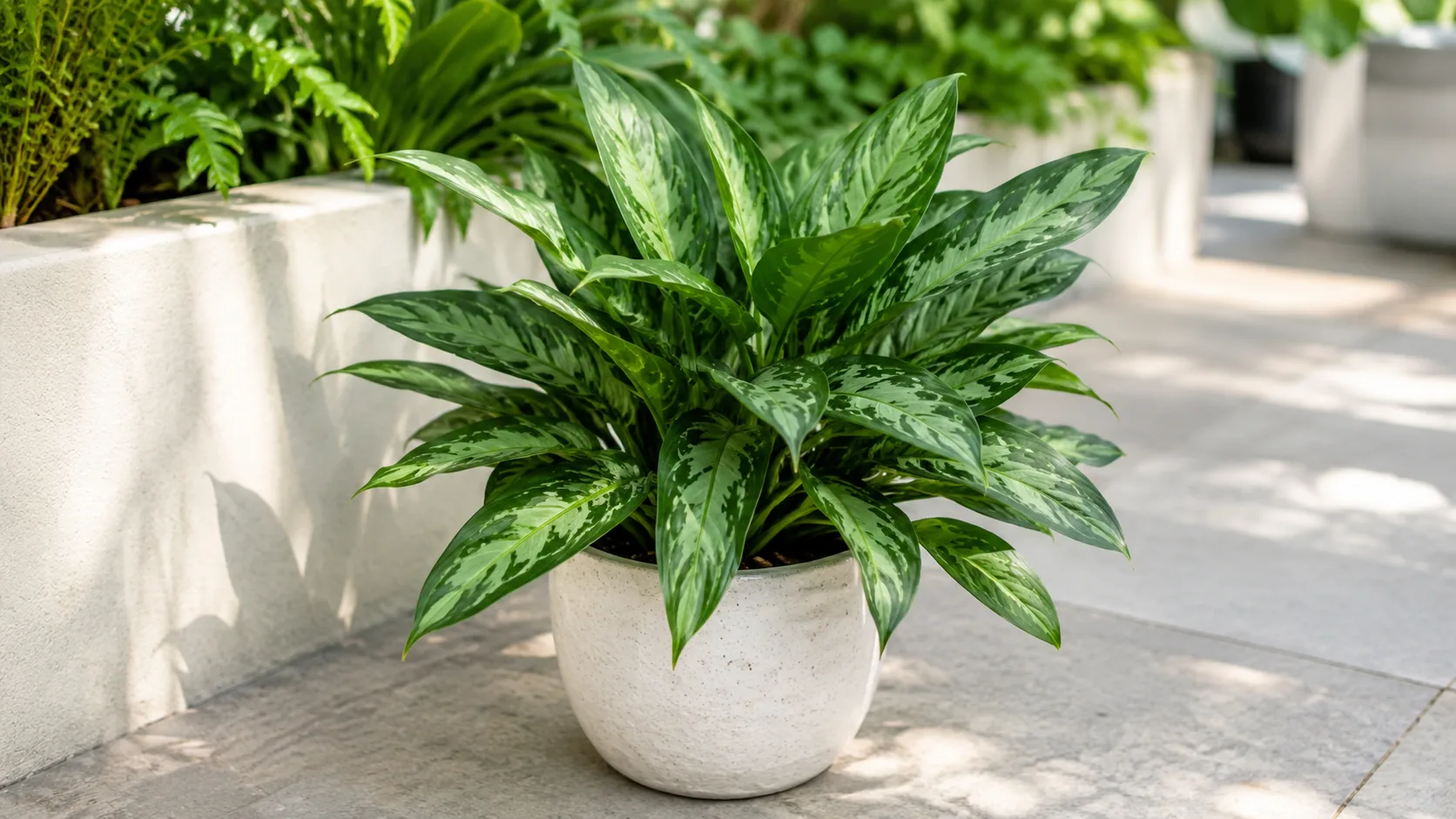
Aglaonema Lady Valentine Fertilizer: A Complete Feeding Guide
Aglaonema Lady Valentine Fertilizer: A Complete Feeding Guide
Aglaonema ‘Lady Valentine’ is the tissue-cultured Thai hybrid that put blush-pink Chinese Evergreen on every houseplant shelf. New leaves open soft rose-pink with green margins, then mature into deeper green blades with a pink midrib and scattered pink flecks. That color arc is why people buy the plant, and it is also what disappears first when feeding goes wrong. Lady Valentine is not a heavy feeder like a fast-growing Monstera, but it is more sensitive to nitrogen than green cultivars such as ‘Maria’ or ‘Silver Bay’ because large pink zones on each leaf lack chlorophyll entirely. Nutrition is one of the strongest levers for keeping new growth pink, and one of the easiest to misuse. This guide covers what to feed, how often, how to read deficiency and burn signals, and how to recover when salt builds up.
Why Fertilizer Matters for Aglaonema Lady Valentine
In tropical Asia, Aglaonema commutatum grows as an understory perennial in the Philippines and Sulawesi, drawing a modest stream of minerals from decomposing leaf litter and rain. Indoors, the plant sits in a finite peat-based mix that leaches nutrients every time you water. A light, steady replacement schedule keeps new leaves firm and properly sized; skipping feed entirely produces a slow pale decline, while heavy feeding causes tip burn within weeks. The same bottle applied at full label strength, on dry soil, or through winter dormancy will damage roots faster than doing nothing.
What Lady Valentine Actually Needs From a Feed
Lady Valentine is a slow, compact grower that typically reaches 50 to 60 cm indoors, with broad lance-shaped leaves that can exceed 25 cm on a mature specimen. Because it pushes leaves one at a time from a central crown rather than building a thick canopy, its nitrogen demand is moderate. The University of Florida’s Apopka foliage program recommends a 3:1:2 N-P-K ratio for foliage plants in soilless mixes because it supplies enough nitrogen for leaf production while keeping total soluble salts lower than a 1:1:1 formula. For Lady Valentine, that translates to a balanced or moderately nitrogen-forward liquid at half or quarter label strength, timed to active growth rather than a rigid calendar. A root-filled pot in bright filtered light at 150–300 foot-candles uses nutrients faster than the same plant in a dim corner with empty soil around the root ball.
How Soft-Pink Variegation Reacts to Nutrition
The blush on Lady Valentine is anthocyanin pigment, not a lack of nutrients. Pink and red cells are flavonoid-rich, and a 2022 transcriptomic study of Aglaonema commutatum ‘Lady Valentine’ in BMC Genomics mapped the anthocyanin biosynthesis pathway in this cultivar, confirming that MYB-bHLH-WD40 regulatory genes control how much red appears in each leaf. Excess nitrogen pushes the plant to over-produce chlorophyll, which visually masks anthocyanin in the same tissue. That is why Lady Valentine often greens out faster than solid-green types when someone applies a high-nitrogen “green growth” booster in spring. A lean-to-moderate feed keeps chlorophyll and anthocyanin in balance, but bright indirect light still drives color more than fertilizer does. Fix placement before you chase a specialty NPK blend.
The Right Fertilizer Type for Aglaonema Lady Valentine
Three product families cover most indoor scenarios for Aglaonema Lady Valentine overview: balanced liquids, 3-1-2 foliage formulas, and slow-release granules. Trade-offs matter more here than on a generic foliage plant because Lady Valentine grows slowly and punishes salt buildup on pale leaf tissue.
Balanced Liquid and 3-1-2 Foliage Formulas
A balanced water-soluble such as 10-10-10 or 20-20-20 is familiar, inexpensive, and defensible for Lady Valentine when diluted to half strength on already moist soil every four to six weeks through the growing season. The drawback is that a 1:1:1 ratio delivers more phosphorus and potassium per feeding than an understory tropical typically uses, which can raise substrate salt levels over months. Production ratios like 9-3-6 validated at UF’s Apopka Research Center stay closer to actual foliage demand. A practical indoor example is a urea-free 9-3-6 complete liquid with calcium and magnesium included; urea-based nitrogen in cheaper products can burn root tips in soilless media because urea is not immediately plant-available in peat mixes. Miracle-Gro Indoor Plant Food at half the labeled rate works if you commit to a monthly plain-water flush.
Slow-Release Granules and Spikes
Osmocote-style coated granules and organic spikes release over two to six months depending on temperature and moisture. They are convenient but hard to pause in winter, and a small indoor pot can accumulate salts if the release curve overshoots demand. If you use slow-release on Lady Valentine, apply at half the label rate in early spring only and watch new leaves for tip burn through summer. Worm castings and composted bark top-dresses act more as soil conditioners than primary feeds.
Best NPK Ratio for Aglaonema Lady Valentine
For most home growers, the answer is a 3:1:2 ratio such as 9-3-6 at quarter to half strength during active growth. A balanced 1:1:1 such as 20-20-20 also works with the same dilution discipline and a monthly flush. The two diverge in long-term salt behavior: 1:1:1 at half strength still adds surplus phosphorus and potassium, while 3:1:2 at the same dilution tracks closer to what the plant uses. High-nitrogen tropical formulas in the 30-10-10 range are a poor match for Lady Valentine because they push green chlorophyll, suppress pink anthocyanin expression, and load nitrogen that a slow understory grower cannot metabolize quickly.
How Often to Fertilize Aglaonema Lady Valentine
Frequency beats product choice. A modest fertilizer on a steady cadence outperforms a strong one applied sporadically. Lady Valentine in bright filtered light near an east or south window with a sheer curtain uses nitrogen faster than a plant in a dim office, because more light drives more photosynthesis and more demand for the magnesium and nitrogen behind it. Tune the schedule by watching new-leaf size and pink stability, not by counting days on a calendar.
Spring and Summer Schedule
From the first new leaf in early spring through early fall, feed once every four to six weeks at half-strength liquid, or every two to four weeks if diluted to quarter strength. Slow-release granules go down once in spring, with a possible light mid-summer top-up only if the plant is still pushing leaves and the soil is warm. The faster interval suits a root-filled pot in bright light above 21°C; the slower interval suits a dim corner, cool room, or pot with unused soil volume. A simple rule: feed at the first new leaf in spring, repeat every four weeks through July, then taper in August as days shorten.
Fall and Winter Schedule
Stop feeding in late autumn when new growth stalls. A semi-dormant Aglaonema in a heated home with short days cannot use incoming nitrogen, and unused mineral salts accumulate in the pot. Missouri Botanical Garden guidance notes that while Chinese evergreen does not require full winter dormancy indoors, it appreciates a rest period with reduced watering from early fall to late winter; fertilizer should pause with that rest. Resume only when an active new leaf unfurls in spring. Plants under grow lights on a 12-hour timer can stay on a four-to-six-week cadence year-round because they are not truly dormant.
How to Apply Fertilizer Without Burning the Roots
Fertilizer goes on moist soil, never on dry. A dry root mass exposed to concentrated salts loses water through osmosis, which is the mechanism behind fertilizer burn and leaf edge injury. Dilute to half strength as the default; quarter strength lets you feed more often without salt loading. Water through after granular applications, and do not feed a wilted, freshly repotted, or cold-stressed plant.
The practical sequence: water normally the day before, mix fertilizer at half label strength with room-temperature water the next day, pour slowly over the entire soil surface until drainage begins, and empty the saucer after ten minutes. A plain-water pass a few days later leaches salts that did not get taken up. After Aglaonema Lady Valentine repotting into unfertilized mix, wait two to four weeks before the first half-strength feed. If the new mix contains controlled-release fertilizer, follow its stated duration and skip liquid feeds on top. For propagated divisions, wait until a clearly new leaf appears, start at quarter strength, and graduate to half strength only after a successful month.
Organic vs Synthetic Options
Synthetic fertilizers deliver ions fast and predictably. Organic options depend on microbial breakdown, which is gentler but slower. Both work on Lady Valentine; the real question is gentle versus aggressive, and gentle usually wins in a small indoor pot.
Worm Castings
Worm castings are roughly 1-0-0 with calcium, magnesium, and beneficial biology. Top-dress one to two tablespoons on the soil surface every two to three months, or blend a similar amount into mix at repotting. They will not force a strong color response alone, but they support soil biology and reduce hydrophobic dry spots in peat-based Aglaonema Lady Valentine soil. They are also the least smelly organic option for enclosed rooms.
Fish Emulsion and Kelp
Fish emulsion is a fast 5-1-1 organic liquid, high in nitrogen and trace minerals, but it smells strongly for a day and suits ventilated rooms or outdoor summer placement. Dilute to half or quarter strength monthly during active growth. Kelp extracts supply potassium, micronutrients, and cytokinins useful after repotting or a light change; use at labeled foliar rates as a supplement, not a primary feed. For indoor Lady Valentine, worm castings plus a mild synthetic usually beats fish-and-kelp routines on smell alone.
Common Nutrient Deficiencies in Aglaonema Lady Valentine
Deficiencies show on oldest or newest leaves depending on nutrient mobility. They are less common than over-fertilization indoors, but they appear in plants that have sat in the same peat mix for two or more years without repotting.
Nitrogen Deficiency
Nitrogen is mobile. Low N pulls color from oldest leaves first, leaving them uniformly pale green to yellow while new leaves stay small. Resume a half-strength balanced or 3-1-2 feed on the standard four-to-six-week interval; the next flush of leaves should size up normally. Older pale leaves will not green again and can be removed once recovery is confirmed. The same pattern can follow root rot that blocks uptake, so inspect roots before simply feeding more.
Magnesium and Calcium Deficiency
Magnesium deficiency appears as interveinal chlorosis on older leaves: yellow tissue between green veins. Magnesium is the core of every chlorophyll molecule and relocates to new growth when supply runs short. A monthly Epsom-salt drench at one teaspoon per gallon corrects mild shortages. Calcium is immobile and shows first on distorted or tip-burned new leaves; a complete fertilizer with calcium, or calcium nitrate at labeled rates, is the long-term fix. Avoid stacking Epsom salt on top of an already calcium-rich feed without checking whether the problem is magnesium, calcium, or both.
Over-Fertilizing, Salt Buildup, and Recovery
The most common feeding mistake on Lady Valentine is too much of the right product. Symptoms include brown crispy tips and margins, white or yellow salt crust on the soil surface, sudden wilt despite damp mix, and stunted new growth. UF/IFAS notes that over-fertilization indoors causes soluble salt buildup leading to leaf margin or tip injury; the crust you see is only a fraction of the salt load in pore water pulling water out of roots.
Stop feeding immediately. Scrape visible granular product and the top 1 to 2 cm of soil if needed. Flush by running room-temperature water slowly through the pot for three to five minutes with free drainage; repeat twice more over 48 hours. In severe cases with leaf drop or persistent wilt, repot into fresh unfertilized mix in the same size pot and withhold feed for four to six weeks. Judge recovery by the next new leaf, not by burned older foliage, which will not heal.
The best preventive is a monthly plain-water flush through the active season, especially with hard tap water that adds calcium carbonate to the salt load. Alternate one fertilizer watering with one plain watering, then plain water only through the dormant window. That habit lets you use whichever brand you prefer without the salt accumulation that ends many indoor Chinese Evergreens early.
Conclusion
Aglaonema Lady Valentine is a quiet feeder with a loud color response. A balanced or 3:1:2 fertilizer at half or quarter strength, applied to moist soil every four to six weeks during active growth and paused through the cooler, dimmer months, keeps new leaves the right size with the right blush-to-green balance. NC State Extension classifies Aglaonema as low-maintenance foliage; Lady Valentine earns that label only when feeding stays gentle. Watch the plant more than the calendar, flush monthly with plain water, improve light before adding nitrogen when pink fades, and protect pale pink tissue from high-nitrogen boosters. With that discipline, the cultivar’s signature blush holds for years instead of reverting to plain green.
When to use this page vs other Aglaonema Lady Valentine guides
- Aglaonema Lady Valentine overview — Start here for whole-plant context before deep-diving this topic.
- Aglaonema Lady Valentine light — Use when pink fades on new leaves; light drives color more than fertilizer.
- Aglaonema Lady Valentine problems hub — Jump to symptom-specific fix guides when feeding adjustments do not resolve the issue.