Aglaonema Snow White Fertilizer: A Complete Feeding Guide
Aglaonema Snow White Fertilizer: A Complete Feeding Guide
Aglaonema Snow White Fertilizer: A Complete Feeding Guide
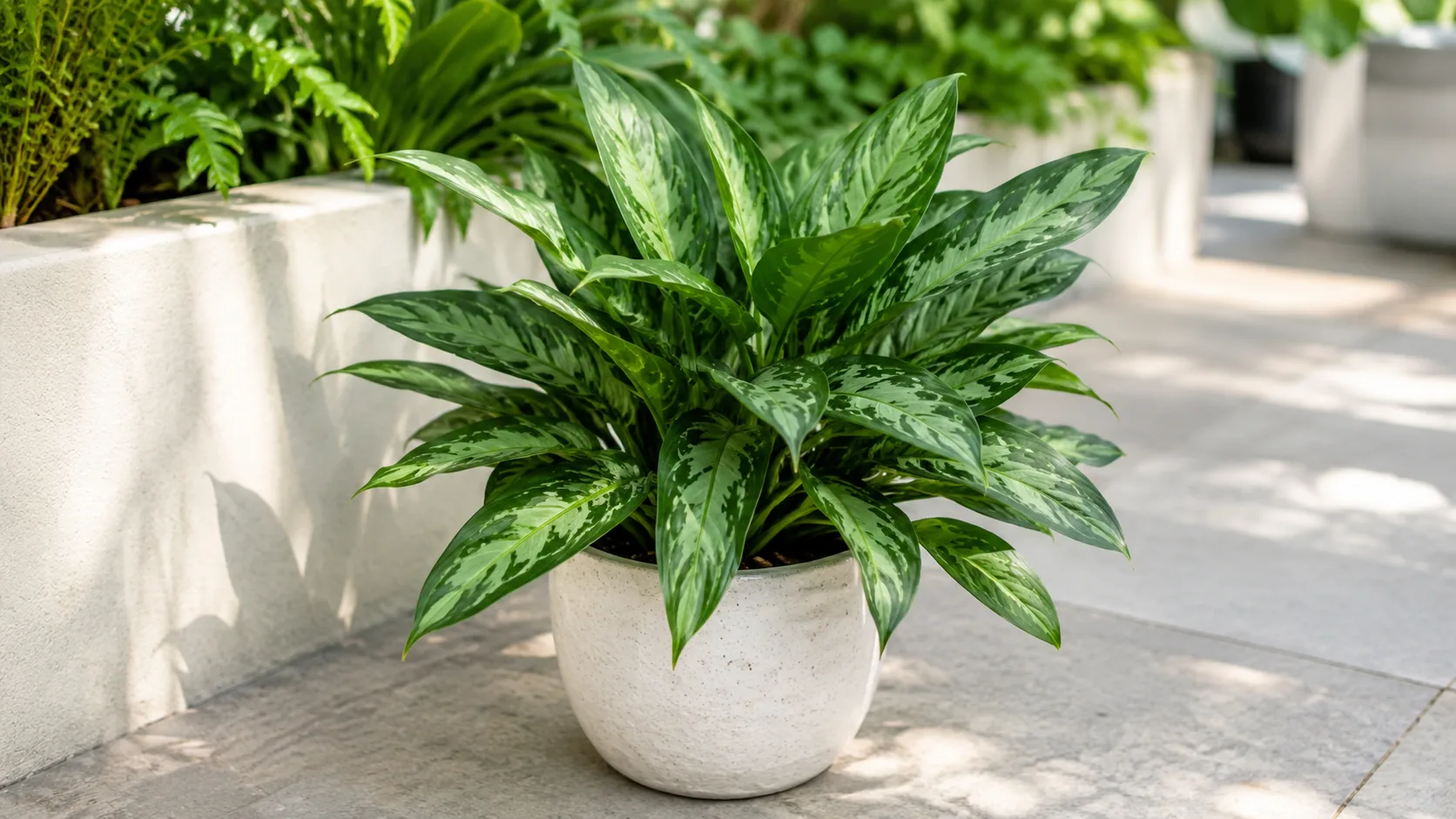
Aglaonema ‘Snow White’ is the cultivar of Chinese Evergreen that has made rose-white foliage fashionable in low-light interiors. New leaves emerge almost entirely blush, then settle into a deep green leaf with a white midrib and a few scattered white flecks as they mature. That color shift is the whole reason people buy the plant, and it is also the part most often lost after a few months indoors. Nutrition is one of the strongest levers a grower can pull to keep the white strong, and it is the lever most often pulled in the wrong direction. This guide explains exactly how to fertilize an Aglaonema Snow White, what products work, how often to feed, how to read the plant’s signals, and how to fix problems when things go sideways.
Why Fertilizer Matters for Aglaonema Snow White
In its native range across tropical Asia, Aglaonema commutatum lives as an understory perennial in the Philippines and Sulawesi, drawing a steady but modest diet of dissolved minerals from leaf litter and rain. Indoors, the plant sits in a finite volume of peat-based mix that loses nutrients with every watering. A regular, light replacement schedule is what keeps new growth coming and keeps the leaves from going pale, papery, or streaked with deficiencies. Skipping fertilizer entirely is a slow decline; overdoing it is a fast one. The same product applied at the wrong rate, at the wrong time of year, or to a stressed plant will do more harm than the alternative of doing nothing.
What This Cultivar Actually Needs From a Feed
Snow White is a slow to moderately compact grower that reaches roughly 50 to 60 cm indoors, with broad, lance-shaped leaves that can exceed 25 cm on a mature plant. Because the plant is not pushing a thick canopy like a Monstera or a Ficus, its nitrogen demand is moderate, not heavy. The University of Florida’s Mid-Florida Research and Education Center at Apopka, the long-time reference for tropical foliage production, recommends a 3:1:2 N-P-K ratio for foliage plants grown in soilless mixes because it cuts total soluble salts while still supplying enough phosphorus and potassium for steady growth. For a small, color-driven Aglaonema, that translates into a balanced or moderately N-forward fertilizer at half or quarter strength, applied in line with the plant’s own pace. A pot-bound specimen in a bright filtered window consumes nutrients noticeably faster than the same plant in a 20 cm pot with empty soil around the root ball, so the schedule should respond to the plant, not the calendar.
How White Variegation Reacts to Nutrition
The white color on Snow White is not a pigment deficiency; it is the opposite. White and red cells in this cultivar are anthocyanin-rich, and anthocyanin is a flavonoid pigment that protects photosynthetic tissue from excess light and stress. A 2022 transcriptomic study of Aglaonema commutatum ‘Snow White’ published in BMC Genomics mapped the anthocyanin biosynthesis pathway in this exact cultivar and confirmed that the genes responsible for red pigmentation, working through the MYB-bHLH-WD40 transcription factor complex, regulate how much red is expressed in each leaf. Excess nitrogen pushes the plant to over-produce chlorophyll, which masks anthocyanin in the same leaf. A lean-to-moderate, balanced feed keeps chlorophyll and anthocyanin in balance, so the white stays visible against the green. Combined with bright, indirect light, that is the single biggest nutritional lever for maintaining the cultivar’s signature color, and it is the lever most often broken by well-meaning growers who push high-nitrogen “green up” feeds in spring.
The Right Fertilizer Type for Aglaonema Snow White
Three product families cover almost every indoor feeding scenario for Aglaonema Snow White overview: balanced liquid fertilizers, 3-1-2 foliage formulas, and slow-release granules or spikes. Each has trade-offs that matter more for this cultivar than for a generic tropical foliage plant, because Snow White is both slow-growing and color-sensitive.
Balanced Liquid and 3-1-2 Foliage Formulas
A balanced water-soluble fertilizer such as 10-10-10, 20-20-20, or a similar 1:1:1 ratio is the most familiar option and a perfectly defensible choice for a Snow White. Products in this category are inexpensive, easy to dose, and widely available. They work best when applied at half the label-recommended strength on already moist soil, every four to six weeks through the growing season. The risk is that a 1:1:1 ratio supplies more phosphorus and potassium than an understory tropical really needs, and over months it can push the substrate’s salt load higher than the plant uses. Formulas like 9-3-6 or 18-6-12 are the ratios Conover and Poole validated at the Apopka Research Center for foliage production. A practical indoor version of this is Dyna-Gro Foliage-Pro 9-3-6, a complete liquid that includes all sixteen essential plant nutrients, with calcium and magnesium in a roughly 4:1 ratio, and no urea. Urea-based nitrogen sources are common in cheaper fertilizers and can burn root tips in container culture because urea is not immediately available to roots in soilless media. Urea-free 3:1:2 formulas are a strong match for Snow White because they deliver enough nitrogen for new leaf color without overloading the substrate with phosphorus and potassium, and they keep the salt load down. Miracle-Gro Indoor Plant Food, used at half the labeled rate, is also a reasonable choice for a grower who is already familiar with the product; just commit to a monthly plain-water flush.
Slow-Release Granules and Spikes
Osmocote-style coated granules and Jobe’s-style organic spikes release nutrients over two to six months, depending on temperature and moisture. They are convenient and forgiving, but in a small indoor pot the release curve is harder to control, and you cannot easily pause feeding in winter. If you use a slow-release product in a Snow White, apply it at half the label rate in early spring only, and assume that any new growth pushing in autumn is on you to interpret, not the plant. Granular organic options like worm castings or composted bark are gentler still and act more as a soil conditioner than a fertilizer.
Best NPK Ratio for Aglaonema Snow White
For most indoor growers, the answer is a 3:1:2 ratio, such as 9-3-6, at quarter to half strength during active growth. A balanced 1:1:1 such as 20-20-20 also works if the same dilution discipline is applied. The two ratios diverge in long-term salt behavior: a 1:1:1 at half strength still adds more phosphorus and potassium per feeding than the plant uses, while a 3:1:2 at the same dilution stays closer to actual demand. The 3:1:2 is the safer long-term choice for a slow-growing, color-sensitive cultivar; the 1:1:1 is the better choice for a grower who already knows the product well and flushes the pot every month or two. High-nitrogen “miracle” formulas marketed for tropical foliage, often in the 30-10-10 range, are not appropriate for Snow White: they push green chlorophyll, suppress the white anthocyanin expression, and load the substrate with nitrogen that a slow-growing understory plant cannot use.
How Often to Fertilize Aglaonema Snow White
Frequency matters more than product. A modest fertilizer at a steady cadence beats a strong fertilizer at an inconsistent one. A Snow White in bright filtered light near an east or south window with a sheer curtain will use incoming nitrogen faster than a plant in a dim office corner, because more light means more photosynthesis and more demand for the magnesium and nitrogen that drive it. The schedule below is the starting point; tune it by observing new-leaf size and color, not by counting days.
Spring and Summer Schedule
From the first new leaf in early spring through early fall, feed Snow White once every four to six weeks with a half-strength liquid fertilizer, or once every two to four weeks if you have diluted to a quarter strength. Slow-release granules are typically applied once in spring, with a possible light top-up in mid-summer only if the plant is still pushing leaves and the soil is warm. The faster schedule is appropriate for a plant in bright filtered light, in a warm room above 21°C, and in a pot it has filled with roots. The slower schedule is correct for a plant in a dim corner, in a cool room, or in a pot that still has room to grow. A simple in-room rule is to start with one feed at the first sign of a new leaf in early spring, repeat every four weeks through the end of July, and begin tapering in August as days shorten.
Fall and Winter Schedule
Stop feeding in late autumn when days shorten and new growth stalls. A semi-dormant Aglaonema in a heated home with low light cannot use incoming nitrogen, and the mineral salt it does not use accumulates in the pot. Resume feeding only when you see an active new leaf unfurling in spring, usually around the time outdoor nighttime temperatures stay consistently above 13°C. One light half-strength application in early fall, before full dormancy, is acceptable in warmer homes if the plant is still producing leaves. During the dormant window, monitor for any white or yellow salt crust on the soil surface and do a plain-water flush if needed, but do not resume fertilizer on a fixed date. For plants under grow lights on a 12-hour timer, the schedule can stay close to the standard four-to-six-week cadence year-round, because the plant is not actually entering dormancy.
How to Apply Fertilizer Without Burning the Roots
The single most important rule is that fertilizer goes on moist soil, not on dry soil. A dry root mass exposed to a salt solution loses water through reverse osmosis, which is the textbook mechanism behind fertilizer burn. The second rule is to dilute. Half strength is the standard indoor recommendation for Aglaonema; quarter strength is the conservative option that lets you feed more often without salt loading. Third, water through the pot after a granular application to wash the nutrients off the surface and into the root zone. Fourth, do not feed a plant that is wilted, freshly repotted, root-bound against a blocked drainage hole, or sitting in a cold draft. Those plants cannot move the new minerals where they need them to go.
The practical sequence is: water the plant the day before as you normally would, then the next day mix a fresh batch of fertilizer at half the label strength with room-temperature water, pour it slowly over the entire soil surface until it begins to drain from the bottom, and let it drain fully. Empty the saucer after ten minutes. Do not let the pot sit in fertilizer solution. After the feed, do a single plain-water pass through the pot a few days later to leach any salts that did not get taken up. For a recently repotted plant, wait two to four weeks after Aglaonema Snow White repotting guide into an unfertilized mix before resuming a half-strength feed. If the new mix contains a controlled-release fertilizer, follow the package’s stated duration, typically three to six months, and do not add a liquid feed on top. For propagated divisions or stem cuttings, the rule is even stricter: wait until the new plant is putting out a clearly new leaf, then start at quarter strength and only graduate to half strength after a successful month.
Organic vs Synthetic Options
Synthetic fertilizers are salts that deliver nutrients in ionic form, fast and predictably. Organic fertilizers depend on microbial activity to break down into plant-available ions, which is gentler but slower and less precise. Both work on Snow White. The honest answer is that the question is not really organic versus synthetic but rather gentle versus aggressive. For an indoor plant sitting in a relatively small volume of mix, “gentle” usually wins.
Worm Castings
Worm castings are the safest indoor option for a Snow White. They are roughly 1-0-0 in NPK, with high levels of calcium, magnesium, and beneficial microbiology. Top-dress one to two tablespoons onto the soil surface once every two to three months, or blend a similar amount into the potting mix at repotting. Worm castings will not push a strong color response on their own, but they support the soil biology that helps synthetic feeds work better and reduce the chance of hydrophobic dry spots in peat-based mixes. They are also the easiest organic option to apply without smell, which matters in an enclosed room.
Fish Emulsion and Kelp
Fish emulsion is a fast-acting 5-1-1 organic liquid, high in nitrogen and rich in trace minerals, but it smells strongly for the first day and is best used in a well-ventilated room or during outdoor summer placement. Dilute to half or quarter strength and apply once a month during active growth. Kelp and seaweed extracts are low-NPK but excellent sources of potassium, micronutrients, and natural cytokinins that help with stress recovery. Use kelp at the labeled foliar rate as a monthly supplement rather than a primary feed, especially after a repotting or a move to a new light environment. Pairing fish emulsion with kelp is a common organic routine for foliage plants, but for an indoor Aglaonema, the smell-to-reward ratio usually tilts the choice toward worm castings plus a mild synthetic.
Common Nutrient Deficiencies in Aglaonema Snow White
A Snow White running short of any one nutrient will show it first on either the oldest leaves or the newest, depending on whether the nutrient is mobile or immobile in the plant. Diagnosing which side of the plant is yellowing is the fastest way to narrow the cause. Deficiencies are far less common than over-fertilization in indoor Snow Whites, but they do appear, especially in plants that have sat in the same peat-based mix for two or more years without repotting.
Nitrogen Deficiency
Nitrogen is highly mobile. A Snow White running low on N will pull it out of the oldest, lowest leaves to feed the new growth, leaving the older leaves uniformly pale green to yellow, sometimes with a slight whiteish wash as chlorophyll breaks down. New leaves will be smaller than expected. The fix is straightforward: resume a half-strength balanced or 3-1-2 feed at the standard four-to-six-week interval, and the next flush of new leaves will come in at the right size. Severely pale older leaves will not green up again and can be removed once new growth confirms recovery. The same pattern can be triggered by root rot on Aglaonema Snow White that prevents nitrogen uptake, so check the root zone before simply feeding more.
Magnesium and Calcium Deficiency
Magnesium is the central atom in every chlorophyll molecule, so a deficiency shows up as interveinal chlorosis on older leaves, with the tissue between the veins turning yellow while the veins stay green. The pattern starts on the lowest leaves because magnesium is mobile and gets relocated to new growth. A 2018 e-GRO research bulletin on lower-leaf interveinal chlorosis in ornamentals recommends targeting a 4:2:1 ratio of potassium, calcium, and magnesium in the substrate to prevent these antagonisms. For a home grower, a monthly dose of Epsom salt at one teaspoon per gallon of water, applied as a soil drench, will correct a mild magnesium shortage. Calcium is immobile, so a calcium shortage shows up first in distorted, crinkled, or tip-burned new leaves. A soluble source like calcium nitrate applied at the labeled rate, or a switch to a complete fertilizer that includes calcium (Dyna-Gro Foliage-Pro is one example), is the long-term fix. Because magnesium and calcium compete for uptake, avoid stacking Epsom salt on top of an already calcium-rich feed without first diagnosing with a pour-through EC test or a tissue analysis.
Over-Fertilizing, Salt Buildup, and Recovery
The most common feeding mistake with Aglaonema Snow White is not the wrong product but too much of the right one. Symptoms of fertilizer burn are highly recognizable: brown, crispy leaf tips and margins, a yellowish-white crust forming on the soil surface or around the pot rim, a sudden wilt even when the soil is damp, and stunted new growth. Below the surface, the fine root tips that absorb water and minerals turn brown and die back. The visible crust is only a small fraction of the total salt load dissolved in the substrate pore water; the rest is creating an osmotic gradient that pulls water out of the roots rather than into them, which is the reverse-osmosis mechanism that makes high salt levels toxic to container plants.
Stop feeding immediately. If a granular product is visible on the surface, scrape off the top 1 to 2 cm of soil. Then flush the root zone by running room-temperature water slowly through the pot for three to five minutes, allowing it to drain freely. Repeat this flush two more times over the next 48 hours. The goal is to leach accumulated salts below the root zone. In severe cases with significant leaf drop or persistent wilting, repot into fresh, unfertilized mix in the same size pot, and do not feed again for four to six weeks. Recovery is judged by the next new leaf, not by the recovery of burned older leaves, which will not heal.
The single best preventive for salt buildup is a monthly plain-water flush. After the fertilizer feed, water the pot through once or twice with plain, room-temperature water to wash residual salts out of the substrate. This is especially important if your tap water is hard, because hard water adds calcium carbonate that compounds the salt load over time. A practical in-room rule is to alternate one fertilizer watering with one plain watering through the active season, then go to plain water only during the dormant window. That single habit prevents most of the over-fertilization problems that cut an indoor Aglaonema’s life short, and it lets you use whichever fertilizer brand you prefer without worrying about salt accumulation.
Snow White feeding notes for high-white variegation
Snow White opens a large proportion of white tissue on each new leaf, and that pale tissue scorches or browns when salts accumulate at the root zone. Keep feeds at half strength or lower, flush monthly, and pause entirely if lower white sections crisp while the pot still feels moist—that pattern often means salt stress rather than underwatering. UF/IFAS Gardening Solutions notes that over-fertilizing variegated Chinese evergreens can trigger leaf edge burn; Snow White shows that damage on white margins first. Bright filtered light supports color without forcing heavy nitrogen; feed the plant you see, not a generic monthly calendar.
Organic options such as diluted fish emulsion or worm-casting tea work if you halve the rate again and flush salts afterward. White-heavy leaves have less photosynthetic backup when something goes wrong, so err on the side of under-feeding through winter even if the room still feels warm to you.
If you move Snow White to a brighter window in spring, increase check frequency before increasing fertilizer—more light raises water use and can make feeds feel stronger even at the same dilution.
Conclusion
Aglaonema Snow White is a quiet feeder with a loud color response. A balanced or 3:1:2 fertilizer at half or quarter strength, applied to moist soil every four to six weeks during active growth and paused through the cooler, dimmer months, is the routine that keeps new leaves coming in the right size, with the right white-to-green balance, and without the salt buildup that ends so many indoor Chinese Evergreens. Watch the plant more than the calendar, flush the pot monthly with plain water, keep feeding gentle rather than frequent, and protect the white variegated tissue from being overwhelmed by excess nitrogen. With that discipline, the cultivar’s signature white-green foliage holds for years rather than fading into generic green.
Snow White fertilizer checklist
- Confirm soil is moist before every liquid feed.
- Use half or quarter strength; never full label rate indoors.
- Flush with plain water monthly during the growing season.
- Pause feeds after repotting until new growth is firm.
- If white sectors brown on new leaves, flush salts before feeding again.
When to use this page vs other Aglaonema Snow White guides
- Aglaonema Snow White overview - Start here for whole-plant context before deep-diving this topic.
- Aglaonema Snow White problems hub - Jump to symptom-specific fix guides when this care topic does not resolve the issue.