Potassium Deficiency on Ajwain Plant (Indian Borage)
Quick answer
Potassium deficiency on ajwain (Indian borage, Plectranthus amboinicus) shows as yellowing or brown scorched margins on older fuzzy leaves, sometimes with weak square stems that droop after monsoon rain. First step: confirm marginal scorch on lower harvest-zone foliage—not thirst crisp on dry soil alone.
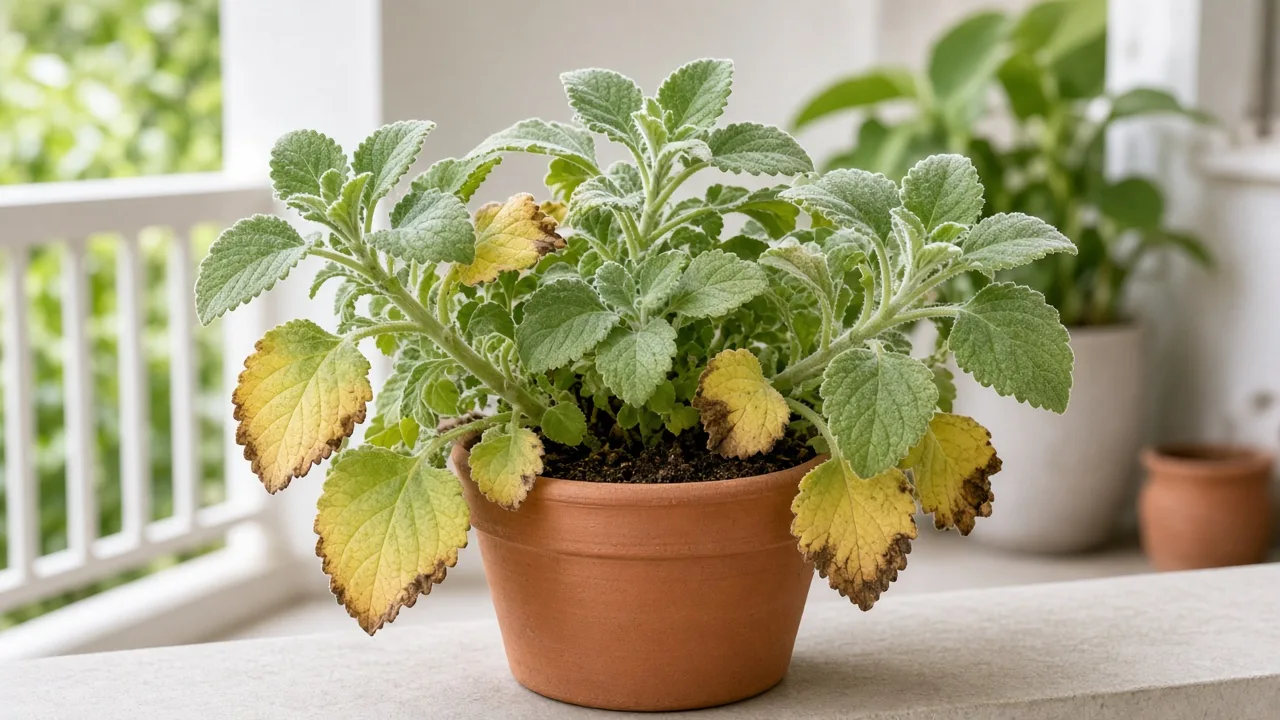
Potassium Deficiency on Ajwain Plant: Causes, Checks & Fixes
This guide covers potassium deficiency on Ajwain Plant. See also the general Potassium Deficiency guide, watering, and light pages for this plant.
Potassium Deficiency on Ajwain Plant: Causes, Checks & Fixes
Quick answer
Potassium deficiency on ajwain (Indian borage, Cuban oregano, Plectranthus amboinicus) shows as yellowing or brown scorched margins on older fuzzy leaves, sometimes with weak square stems that droop after monsoon rain or irrigation. Potassium regulates stomatal function and stem strength in plants—deficiency typically appears first on mature foliage as marginal scorch progressing from leaf edges inward.
See our potassium deficiency guide. On heavily harvested ajwain in leached balcony pots, inspect outer margins of older lower fuzzy leaves—edge scorch there points to potassium depletion, not midday wilt that recovers within hours of watering.
First step: confirm marginal scorch on older lower leaves, not uniform pale washout or thirst crisp on bone-dry soil.
When to use this page vs other Ajwain Plant guides
| Pattern | Read next |
|---|---|
| Old leaf margins scorched, weak sprawling stems | Potassium deficiency (this page) |
| Uniform pale lower leaves, soft watery growth | Nitrogen deficiency |
| Yellow between veins on old leaves | Magnesium deficiency |
| New top leaves pale with green veins | Iron deficiency |
| New shoot tips distorted or cupped | Calcium deficiency |
| Wet soil, yellow lower leaves, sour smell | Overwatering or root rot |
| Midday droop on dry soil that recovers fast | Underwatering or wilting |
| Dry tan tips without margin halos | Brown tips |
This page covers marginal scorch and weak stems from potassium lack. If the whole plant is washed-out pale, start with pale leaves and yellow leaves. If growth has stalled without margin burn, see slow growth.
What potassium deficiency looks like on ajwain
On ajwain, potassium stress shows clearly along the outer margins of oldest lower fuzzy leaves—edges turn yellow, then brown and crisp, while the thick leaf center may stay gray-green longer. Deficiency symptoms first occur on older leaves before climbing toward newer growth on fast-sprawling stems.
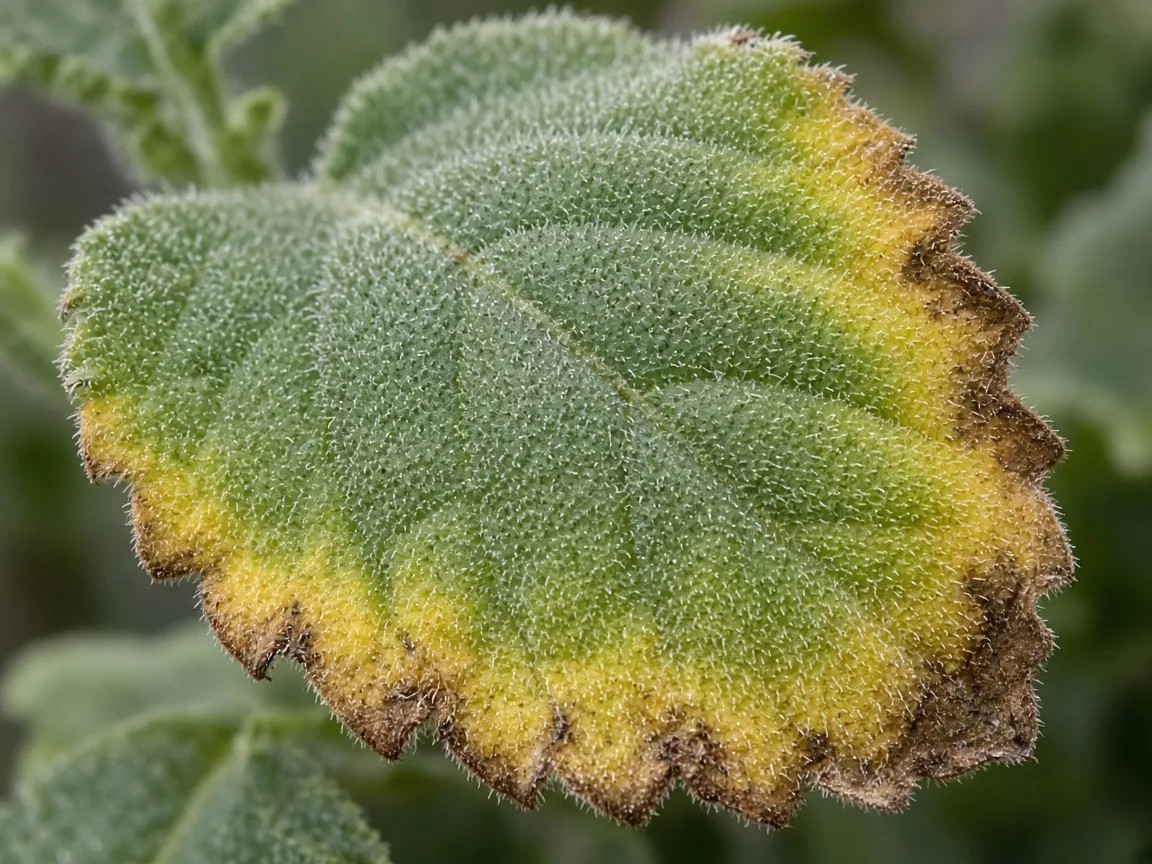
Marginal scorch on an older ajwain leaf—yellowing and browning along the fuzzy outer edge while center tissue may still look relatively green.
Typical signs:
- Yellowing or browning along margins of older lower leaves (marginal scorch is the hallmark potassium pattern)
- Scorched or crisp brown edges on mature harvest-zone foliage—the thick, velvety blades along sprawling lower stems
- Mottled yellow patches on lower leaves before margins die completely
- Weak square stems that bend or lodge easily after watering or monsoon rain
- New tip shoots may look normal until deficiency advances through the mound
- Scorched margins persist even when soil is moist—unlike thirst crisp that follows dry-down
Not potassium deficiency:
- Midday droop on dry soil that recovers with water — drooping leaves or underwatering
- Uniform pale lower leaves without margin focus — nitrogen deficiency
- Yellow between veins on old leaves — magnesium deficiency
- Soft square stems, sour soil, blackening base — root rot or overwatering
- New top leaf distortion — calcium deficiency
Why ajwain gets potassium deficiency
Ajwain is a frost-tender tropical herb with thick fuzzy leaves and a semi-succulent habit that stores water in foliage. It prefers a hot bright location with good drainage and tolerates only occasional irrigation—yet Indian balcony growers often combine heavy monsoon watering, continuous harvest, and modest feeding, which depletes mobile potassium faster than this plant’s lean native soils would.
Ajwain-specific causes:
- Harvest export from fuzzy leaf picking — Every kitchen harvest removes potassium from the system. Ajwain grown for daily tempering and kadha use can strip lower leaves repeatedly without potassium replacement.
- Monsoon leaching in perlite-heavy pots — Well-draining mix prevents rot but washes mobile potassium with every heavy rain drink. Balcony pots that drain fast during monsoon are high-risk by mid-season.
- Incomplete fertilizer — Nitrogen-heavy feeds push soft, bland leaf growth without stem strength. See the ajwain fertilizer guide for balanced 10-10-10 at half strength.
- Depleted same-pot culture — Ajwain roots easily and often stays in the same container 12–18 months. Old mix loses available potassium even when NPK numbers on the bag look fine.
- Blocked uptake from overwatering — NC State notes wet soils intolerance. Anaerobic roots on soggy monsoon mix cannot absorb potassium present in soil.
- Low light stretch — Weak stems on leggy growth in dim corners mimic potassium weakness, but margin scorch on older fuzzy leaves confirms nutrient lack.
Fuzzy-leaf margin scorch on harvest-zone ajwain
Ajwain’s velvety scalloped blades make potassium stress easy to spot along outer edges of lower sprawling leaves—the same zone you harvest for kitchen use. Unlike smooth basil, the thick fuzzy surface holds scorched margin tissue visibly: a yellow band along the edge, then dry brown papery necrosis, while the leaf center stays relatively green.
This pattern differs from underwatering crisp, which usually affects leaf tips and softens the whole thick leaf (firm when hydrated, slightly soft when thirsty per the watering guide). Potassium scorch hits margins on multiple older leaves at once and persists when you stick a finger 2–3 cm into moist mix.
Monsoon balcony leaching and the mid-season crash
Ajwain on Indian home balconies often sits in fast-draining mix with daily monsoon splash and overhead rain. Potassium is mobile and leaches from sandy, well-drained containers with every deep drink. Owners who feed lightly—or skip weeks during wet weather—see a split plant: healthy-looking new tip shoots above scorched lower margins on the sprawling base.
The crash often appears after three to four weeks of heavy pinching without complete fertilizer, especially when the same small pot has carried the plant through one full warm season. Pair correction with light review: ajwain in too much shade grows weak stems that lodge even when potassium is adequate.
Weak square stems after heavy harvest
Ajwain’s square Lamiaceae stems should stay sturdy enough to hold trailing growth after irrigation. Potassium supports stem strength and water regulation—deficient plants flop along pot edges after rain while showing margin burn on older leaves. This combination is an ajwain-specific clue because the species sprawls horizontally rather than growing upright like basil.
Firm square stems at the soil line with only one or two scorched bottom leaves may be old-leaf ageing. Widespread margin scorch plus limp stems across the harvest zone points to potassium.
How to confirm the cause
Work through these checks before feeding:
- Margin scorch pattern — Outer edge burn on multiple older lower fuzzy leaves, not tip-only on one leaf.
- Stem strength — Weak lodging square stems vs firm green stems on healthy ajwain.
- Fertilizer completeness — Potassium listed on label; not nitrogen-only products through harvest season.
- Watering adequate — Scorched margins despite moist soil points to potassium, not thirst.
- Container leaching — Small perlite-heavy pot with monsoon watering or daily balcony irrigation.
- Harvest history — Weeks of heavy leaf picking without complete feed.
- Root health — Firm white roots vs brown mush blocking uptake. Soft malodorous base means root rot first.
If most checks align with margin burn on older fuzzy leaves, weak sprawling stems, and depleted or leached container culture, potassium deficiency is the working diagnosis.
The first fix to try
One half-strength application of complete balanced fertilizer containing potassium, after confirming firm roots and appropriate moisture.
Do not heavy-feed waterlogged ajwain. Per the ajwain fertilizer guide, one measured correction on already-moist soil is enough to read the response. Container herbs need complete feeds, not nitrogen alone, when marginal scorch appears mid-season.
Wait one week before a second application. Ajwain’s semi-succulent roots are sensitive to salt shock—half strength matters.
Step-by-step recovery
Once roots are firm and moisture is appropriate:
- Feed every 4–6 weeks with complete balanced fertilizer at half strength through the growing season per the fertilizer guide.
- Top-dress compost lightly if mix is older than a year—organic matter slows leaching without waterlogging.
- Refresh or up-pot if roots fill the container and scorch persists after two complete feeds. Use well-draining mix per species tolerance.
- Correct overwatering if stem base is soft—potassium uptake requires healthy roots. Let the top 2–3 cm dry between waterings.
- Pinch for airflow after new growth stabilizes—see pruning for bushier regrowth without stripping every potassium-starved lower leaf at once.
- Monitor new tip shoots weekly for clean margins without scorch over the next one to two flushes.
Salvage with cuttings if needed. Ajwain roots easily from firm 10–15 cm tip cuttings in moist mix. If lower stems are too weak but upper growth is clean, start fresh clones rather than fighting advanced deficiency on a sprawling base.
Do not repot on day one unless soil is waterlogged and smelling sour. Fix moisture and feed once; repot in spring or monsoon onset only if drainage is clearly failing.
Recovery timeline
| Phase | What to expect |
|---|---|
| Days 3–7 | Marginal spread on lower leaves should stop. Existing scorched edges stay brown. |
| Week 1–2 | New tip shoots emerge without margin burn—main success signal. Square stems feel firmer after irrigation. |
| Week 2–3 | Clean replacement growth along sprawling stems. Old scorched lower leaves can be harvested or left until you pinch for shape. |
| Month 2+ | Normal warm-season growth if light and dry-down watering hold. |
Old burned margins on fuzzy harvest-zone leaves do not heal. Success means clean new ajwain shoots with firm square stems.
Lookalike symptoms
| Symptom pattern | Likely cause | Key differentiator on ajwain |
|---|---|---|
| Old leaf margins scorched, weak stems | Potassium deficiency (this page) | Margin burn on moist soil; stems lodge after rain |
| Midday droop, very dry soil | Underwatering | Whole leaf softens; recovers within hours of water |
| Uniform pale lower leaves | Nitrogen deficiency | Whole-leaf washout, not margin-only scorch |
| Yellow between veins | Magnesium deficiency | Interveinal banding on fuzzy blades |
| Crispy tan tips after harsh sun move | Brown tips or sun scorch | Follows sudden light increase, not harvest season |
| Soft stems, sour wet soil | Root rot | Base tissue fails; margin scorch secondary |
| Flat aroma, salt crust on soil | Over-fertilization | See fertilizer guide—flush before more feed |
Mistakes to avoid
- Confusing thirst with potassium scorch. Ajwain thick leaves soften when dry; margin burn on multiple older leaves on moist soil is different.
- Using nitrogen-only fertilizer through harvest season. Fast fuzzy leaf growth without potassium replacement causes margin scorch and weak stems.
- Heavy feeding on waterlogged monsoon roots. Fix drainage and dry-down rhythm before repeated fertilizer.
- Expecting scorched fuzzy margins to heal. Judge the next tip flush, not old tissue.
- Skipping feed because monsoon keeps soil wet. Leaching removes potassium even when you are not watering manually.
- Stacking repot, prune, feed, and pesticide on one day. One correction at a time on this semi-succulent herb.
How to prevent potassium deficiency next time
- Use complete balanced fertilizer at half strength every 4–6 weeks March through October per the fertilizer guide
- Refresh leached container mix after a year of heavy harvest in the same small pot
- Top-dress compost on balcony pots to slow nutrient loss without trapping moisture
- Match watering to soil drainage without chronic waterlogging
- Track feeding dates through monsoon—daily rain leaches potassium within weeks
- Grow in bright indirect to partial sun per the light guide so stems stay sturdy
- Avoid nitrogen-heavy products without potassium balance when harvesting weekly
For full species context, see the Ajwain Plant overview and problems hub.
When to worry
Treat potassium deficiency as urgent if:
- Square stems soften or smell unpleasant at the soil line—shift to root rot protocol.
- Every new leaf shows margin scorch within days despite two complete half-strength feeds and firm roots.
- The plant loses most lower foliage during peak growth and shows no clean replacement shoots after a month.
- Sprawling stems collapse completely after light irrigation while soil stays soggy—uptake is blocked; fix roots before more fertilizer.
Margin scorch alone on firm ajwain stems is manageable and common in leached harvest pots. The combination of wet soil and weak base stems is what turns a nutrient issue into a rot emergency.