Black Spots on Alocasia Dragon Scale: Scale-Texture Checks
Quick answer
Black spots on Alocasia Dragon Scale are usually fungal or bacterial leaf spot after thick, scale-textured leaves stay wet from misting, overhead watering, or stagnant cabinet air—not the normal silver sheen on a young unfurling spear. First step: stop wetting foliage, water at soil level only, and check whether spots are dry circles with yellow halos or soft black petioles on wet mix.
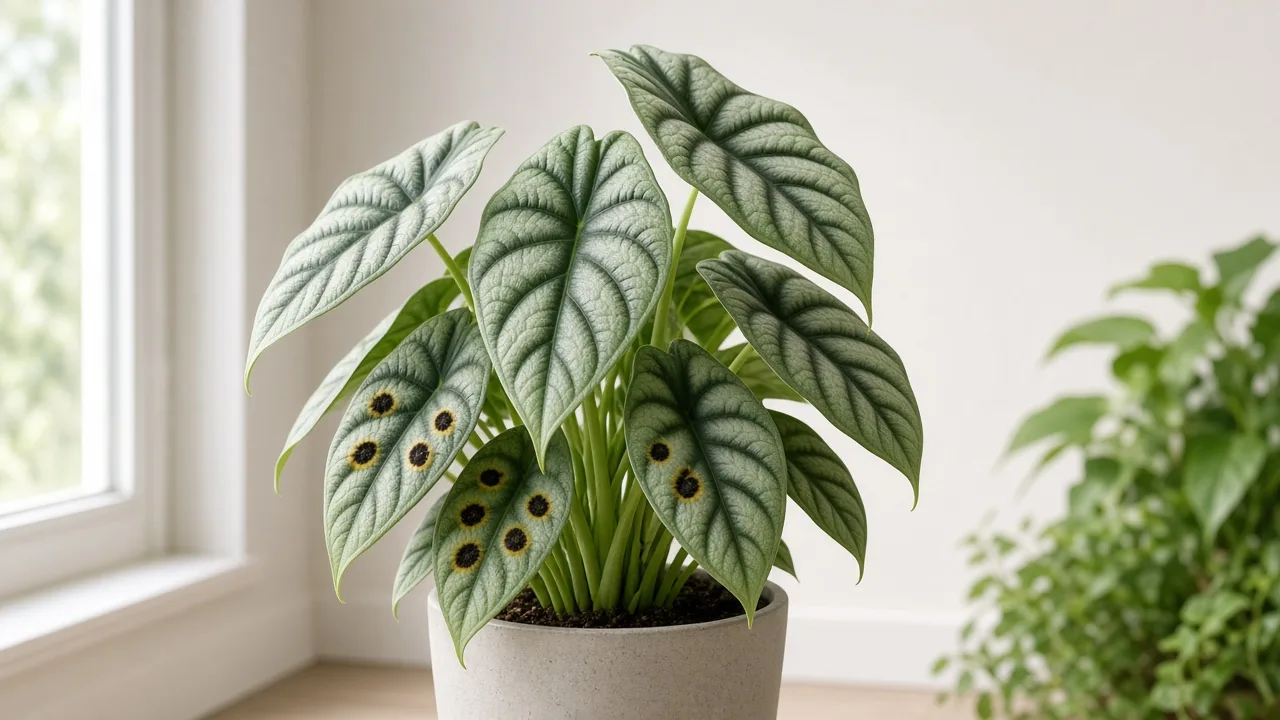
Black Spots on Alocasia Dragon Scale: Causes, Checks & Fixes
This guide covers black spots on Alocasia Dragon Scale. See also the general Black Spots guide, watering, and light pages for this plant.
Black Spots on Alocasia Dragon Scale: Causes, Checks & Fixes
Quick answer
Black spots on Alocasia Dragon Scale (Alocasia baginda ‘Dragon Scale’) are usually fungal or bacterial leaf spot after the plant’s thick, scale-textured silvery-green leaves stay wet in humid, stagnant air—not a mysterious jewel-alocasia-only disease. Dragon Scale overview is a compact corm-based jewel alocasia with thick, textured, arrow-shaped silvery-green leaves and dark green veins; the raised scale cuticle that makes this cultivar iconic also holds mist, splash water, and cabinet condensation in its grooves longer than smooth-leaved alocasias. See our black spots guide for general symptom science; on Dragon Scale, spots often follow misting, shower rinses, overhead watering, or droplets trapped on textured tissue overnight.
First step: stop wetting foliage immediately. Move the pot to brighter airflow, confirm the underground corm and petiole bases are still firm, and check whether spots are dry circles with yellow halos (leaf spot) or soft black petioles on wet mix (overwatering or root rot).
When to use this page vs other Alocasia Dragon Scale guides
| Pattern | Read next |
|---|---|
| Wet soil, yellow lower leaves, limp on heavy pot | Overwatering |
| Soft petioles, sour smell, mushy corm | Root rot |
| Dry crispy edges, no distinct round spots | Brown tips or low humidity |
| Fine webbing, stippling on textured blades | Spider mites |
| Sticky dull patches, ants on pot rim | Aphids — sooty mold can mimic black spots |
| Dry bumps along veins | Scale insects |
| Uniform silver sheen on new spear, no lesions | Normal juvenile colour — not disease |
| Uniform yellow then brown, wet soil, no spot halos | Yellow leaves |
This page covers dark spot lesions on scale-textured silvery-green foliage. If the whole plant is yellowing from wet soil, start with watering triage. If only edges are crisp without round spots, humidity and salt buildup are more likely than pathogen spotting.
What black spots look like on Alocasia Dragon Scale
On Dragon Scale, leaf spot starts as small dark brown to black dots on the silvery-green scale-textured upper surface—often on lower blades where overlapping foliage blocks airflow. As infection advances, spots enlarge into irregular black patches, sometimes with faint yellow halos around the lesion edge. Multiple spots on one thick blade may merge before the leaf yellows and drops.
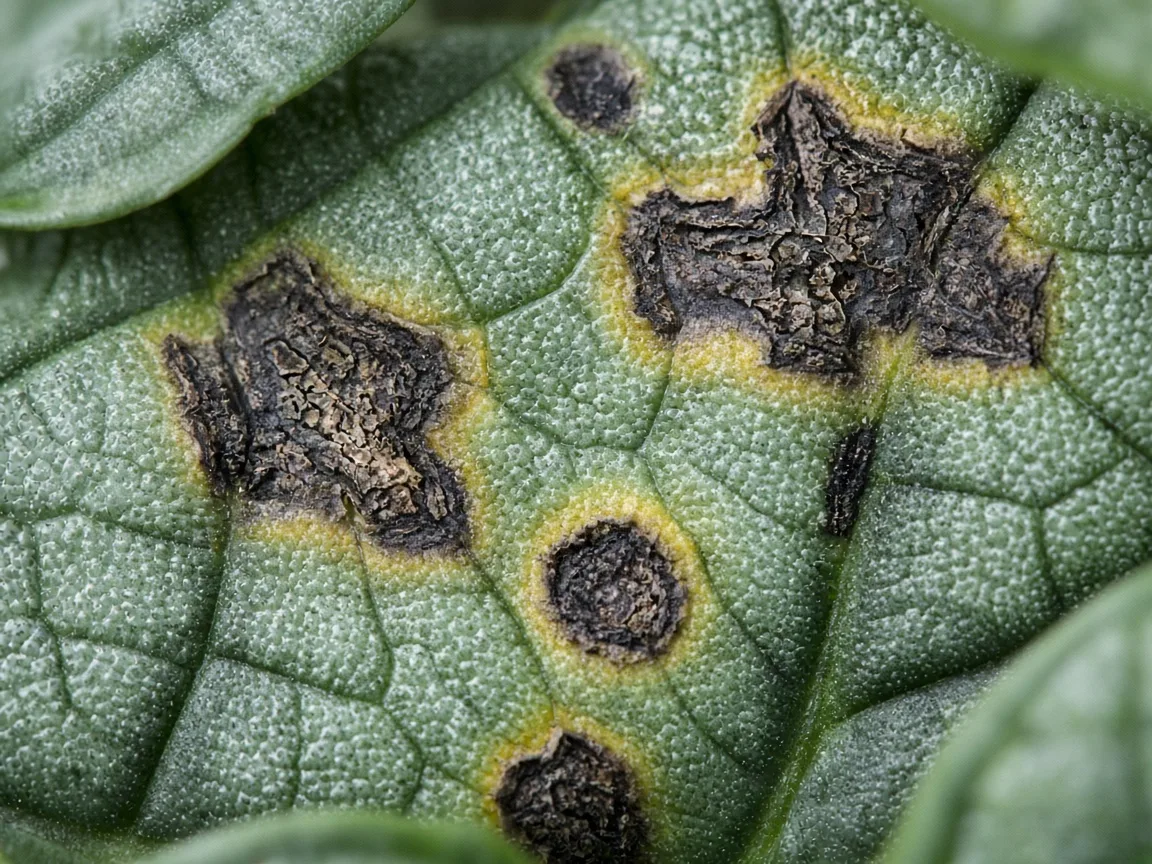
Fungal leaf spot on Dragon Scale—note dry papery lesions on raised scale-textured foliage, not mushy water-soaked petiole rot.
Details that help separate true leaf spot from lookalikes:
- Texture: spots are dry and papery, not water-soaked or mushy (mushy black tissue at the petiole base suggests bacterial issues or advancing root rot).
- Location: lower leaves and crowded axils first, where dew and splash collect in raised scale grooves on the silvery cuticle.
- Corm check: the underground corm stays firm during pure leaf spot. Soft, blackening petioles at the soil line mean switch to rot protocol.
- Spread: new spots on fresh unfurling spears over several days confirm active disease; one static old spot on a bottom leaf may be leftover damage after you fixed moisture.
- Contrast on metallic foliage: lesions can look like dull charcoal blotches against silvery-green scales before the dark underside yellows around the margin.
Dragon Scale often carries only one or two textured blades at a time in good light. Spots on a single leaf represent a larger share of the plant’s photosynthetic surface than on a bushy monstera—treat spreading lesions on new growth as urgent.
Silver sheen vs black spot on new growth
A common Dragon Scale-specific mistake is treating normal young colour as disease. New spears emerge with a silvery sheen over dark green veining; the scale texture hardens and deepens as the leaf opens. Even, metallic silver-green across an unfurling blade with no discrete lesions is healthy development—not this page.
Leaf spot on a new spear looks different:
- Irregular black patches within the silver flush, often with yellow halos at the margin
- Dry papery necrosis that does not follow the even silver-to-green gradient of healthy development
- Spread to adjacent tissue over several days while the spear is still unfurling
- Water droplets or mist residue visible in scale grooves when you inspect in morning light
If sticky residue dulls the silver finish without round halos, check aphids or scale insects for honeydew and sooty mold first.
The scale-texture humidity paradox
Dragon Scale needs 70–80% humidity to avoid brown crispy edges—higher than many houseplants. Yet the same raised scale surface that demands atmospheric moisture must not receive direct mist or splash water. Scale grooves trap droplets against the cuticle for hours; in a warm bathroom or glass cabinet, that stagnant film is ideal for fungal leaf spot pathogens that become active during wet periods.
The fix is humidity in the air, dryness on the blade: humidifier, pebble tray, or grouped plants—not foliar misting. The RHS Alocasia guide lists misting among humidity options for alocasias generally, but on Dragon Scale’s textured cuticle, misting is the most common trigger for the black spots growers then try to cure with more misting. Wipe dusty leaves gently with a barely damp microfiber cloth in morning, supporting the blade from underneath, so surfaces dry before evening.
Why Alocasia Dragon Scale gets black spots
Several factors stack on this slow-growing jewel alocasia:
Misting and overhead watering. Shower rinses, spray bottles, and watering cans that wet scale-textured foliage leave water in raised grooves overnight. Poor air circulation around wet silvery blades invites infection even when watering rhythm at the corm is technically correct.
Glass cabinet and terrarium condensation. Enclosed displays raise humidity well but let droplets form on blades and drip leaf to leaf. Without a small fan or daily wipe-down, inner leaves stay damp while the corm zone stays appropriately moist—spot risk rises even when mix dry-down is correct.
Overwatering overlap. NC State Extension notes that leaf spots can occur from overwatering on alocasias, alongside root rot. Chronic wet chunky aroid mix in an oversized pot weakens tissue and invites both fungus gnats and foliar pathogens. Overwatering and leaf spot can share wet conditions but need different first fixes; firm corm and firm lower petioles favor leaf-focused drying first.
Winter dormancy plus wet culture. Dragon Scale may drop every leaf in cool months while the corm stays alive below the surface. Continuing summer watering while the plant is semi-dormant keeps mix soggy—overwatering while dormant invites spot and corm rot together. Spots on the last remaining textured blade during dormancy often trace to unchanged watering, not a new exotic pathogen.
Crowded jewel-alocasia shelves. Dragon Scale’s compact textured blades sit close on short petioles. Pots packed on a windowsill overlap leaves; inner surfaces never dry. Space pots so scale-textured blades do not touch neighbors.
Honeydew sooty mold. Aphids and scale insects leave sticky residue that can grow black sooty mold on scale grooves—dry specks with bumps underneath are pest-related, not enlarging water-soaked halos.
How to confirm the cause
Work through these checks before treating. The goal is to confirm fungal or bacterial leaf spot—not rot, normal silver spear colour, pests, or mechanical damage.
- Spot texture — Wet, greasy margins suggest active bacterial or advanced fungal disease. Dry, calloused black marks suggest old mechanical damage.
- Halo presence — Yellow ring around a dark center fits typical leaf spot patterns.
- Spread rate — New spots weekly on multiple leaves or on unfurling spears = disease. One mark stable for months = mechanical.
- Watering habits — Recent misting, shower rinses, or wet leaves at night raise disease probability.
- Underside inspection — Webbing and stippling point to spider mites; uniform lesions differ from pest feeding scars.
- Corm and petiole base — Soft black tissue at the soil line on sour mix is not leaf spot—isolate and inspect roots per root rot.
First fix for Alocasia Dragon Scale
Stop wetting foliage and improve airflow—then remove the worst spotted leaves with clean tools.
That single environmental correction slows most leaf-spot spread before you reach for fungicides. Missouri Botanical Garden notes that avoiding overhead watering and increasing air circulation are the primary controls for ornamental leaf spot.
- Switch to soil-level watering only with a narrow spout; water early in the day so incidental splash dries quickly.
- Space the plant away from walls and crowded collections; run a fan on low if air is stagnant in a cabinet.
- Prune heavily spotted leaves you can spare into a sealed bag—remember Dragon Scale may only have one or two textured blades.
- Avoid misting until at least two weeks pass with no new spots on emerging spears.
- Raise humidity with a humidifier, not foliar water.
Do not fertilize spotted, stressed foliage on day one.
Step-by-step recovery
Active leaf spot (spreading wet or dry lesions)
- Isolate from other jewel alocasias if your collection is dense.
- Remove worst affected textured blades; keep partially green leaves if spots are few and stable.
- Water at soil line per the watering guide; empty saucers.
- Wipe dust from remaining leaves with a barely damp cloth in morning; let surfaces dry fully.
- Monitor new unfurling spears weekly—they should open without fresh spots within two to three weeks.
- If spread continues, use a species-safe fungicide per label after removing infected tissue.
Mechanical or single-spot damage
- No fungicide needed if the mark is dry and unchanged for weeks.
- Trim edge of damage if cosmetically bothersome—each Dragon Scale blade is visually important.
- Adjust placement so petioles do not scrape shelves or glass.
Pest-related darkening
- If sticky residue, ants, or raised bumps accompany spots, treat aphids, scale insects, or thrips instead of assuming fungus.
Recovery timeline
Environmental correction alone: New spot formation should slow within seven to ten days; clean new spears opening to silvery-green within two to three weeks during active growth.
After pruning plus dry foliage culture: Existing black tissue remains visible permanently on scale-textured blades.
Worsening: Spots on every new spear within a week, soft petioles, or sour soil mean layered root problems—escalate beyond leaf-spot protocol to root rot.
Lookalike symptoms
| Pattern | Likely cause | Page |
|---|---|---|
| Round spots with yellow halos, spreading on wet foliage | Fungal or bacterial leaf spot | This page |
| Dry crispy margins, no round halos | Low humidity or salt stress | Humidity triage |
| Uniform yellow then brown, wet soil | Overwatering | Moisture triage |
| Stippling, fine webbing on textured blades | Spider mites | Pest ID |
| Sticky dull patches, soot without halos | Aphids or scale | Pest ID |
| Uniform silver sheen on new spear, no lesions | Normal colour development | Monitor only |
| Single dry mark, stable months | Mechanical damage | Monitor only |
| Black soft petiole base, sour mix | Root rot | Corm inspection |
What not to do
Do not mist heavily to “help humidity” while spots are spreading.
Do not compost infected Dragon Scale leaves indoors—bag and discard.
Do not share unclean pruners between jewel alocasias in a collection.
Do not assume fungicide alone fixes chronically wet scale-textured leaves without changing watering habits.
Do not repot and prune heavily on the same day unless corm rot is confirmed—stressed Dragon Scale recovers slowly from stacked interventions.
Do not discard the pot during winter dormancy because the last spotted leaf dropped—the corm below may still be firm and ready to flush clean spears in spring.
How to prevent black spots next time
Water at soil level; avoid getting above-ground parts wet when possible. Keep Dragon Scale in bright indirect light with good air movement. Use a humidifier instead of foliar misting for dry winter air. Remove fallen leaf debris from the pot surface. Quarantine new plants before placing them beside a prized scale specimen. Match pot size to the slow root system—oversized containers hold moisture that weakens defenses. Reduce watering sharply during dormancy per the watering guide.
When to worry
Urgent when spots appear on most new spears within days, lesions merge across half a thick blade, or petioles blacken at the soil line on wet mix. A single stable mark on one lower leaf is low urgency on a plant with firm corm and clean new growth.
Related Alocasia Dragon Scale guides
- Alocasia Dragon Scale overview
- Watering guide
- Soil and drainage
- Brown tips
- Spider mites
- Overwatering
- Problems hub
Conclusion
Black spots on Alocasia Dragon Scale are manageable when you keep scale-textured silvery-green leaves dry, raise humidity in the air—not on the blade—and improve airflow around a compact crown. Old black tissue will not revert; success is measured by clean new spears unfurling from the firm corm. Match mechanical marks with monitoring, pathogen spots with sanitation, pest soot with the right treatment—not a generic “more water” or “more mist” response.