Alocasia Silver Dragon Light Needs: Windows & Grow Lights
Alocasia Silver Dragon Light Needs: Windows & Grow Lights
Alocasia Silver Dragon Light Needs: Windows & Grow Lights
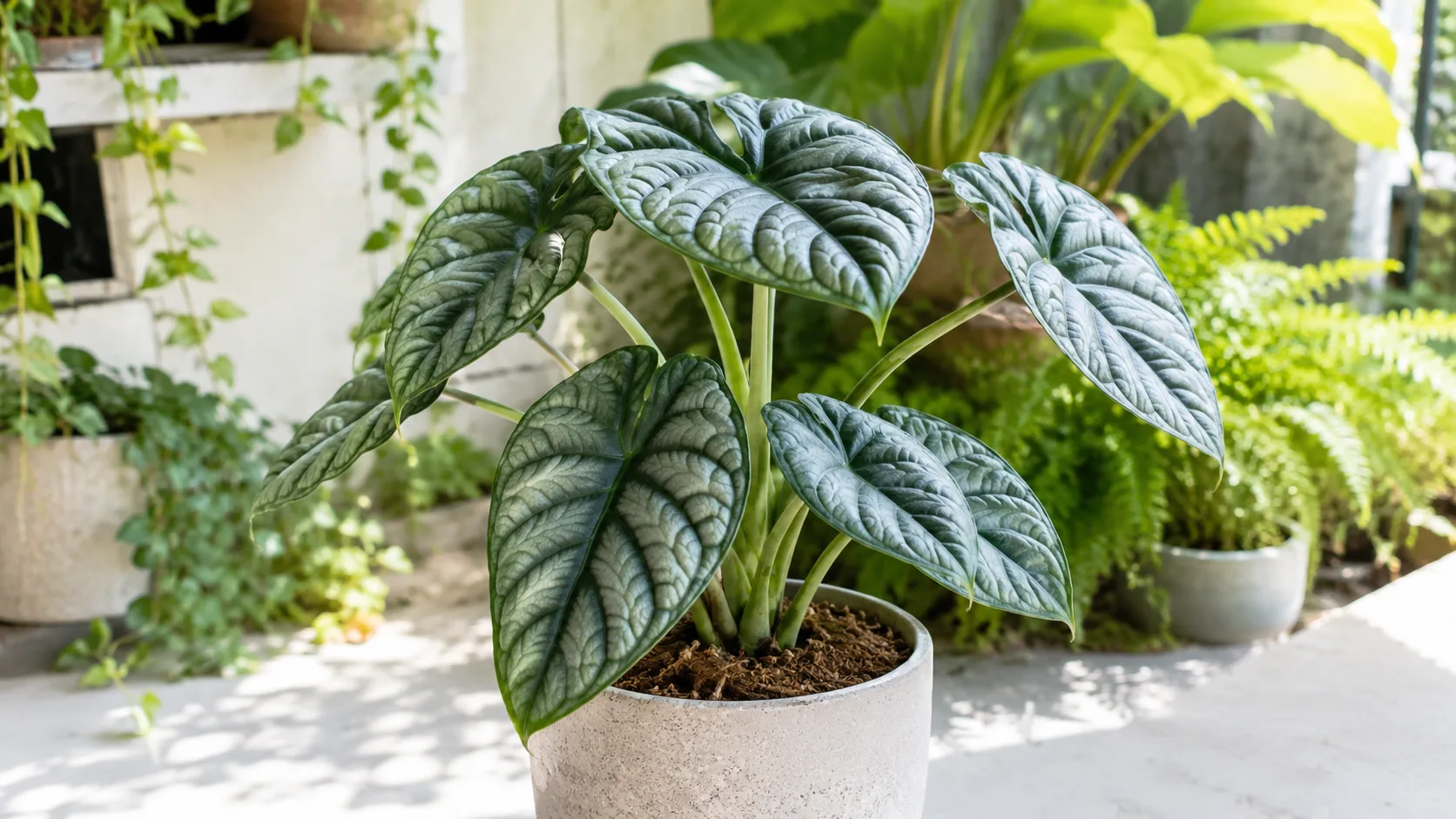
The fastest way to know whether your Alocasia Silver Dragon is getting the right light is not a meter reading — it is the metallic contrast between the dark green leaf field and the silvery veins. When light is correct, those veins look embossed, almost reptilian. When light is too low, the sheen washes out and petioles stretch. When light is too strong, the same dark blades bleach on the sun-facing side. That vein pattern is your scoreboard, and this guide shows you how to keep it sharp year-round.
Reviewed by the LeafyPixels Review Board. Recommendations are checked against botanical and extension references, LeafyPixels plant-care data, and practical indoor growing constraints before publication.
If you are new to this cultivar — Alocasia baginda ‘Silver Dragon’, one of the jewel alocasias — start with the Alocasia Silver Dragon overview for naming, toxicity, and baseline care. This page is the proactive placement guide: where to put the pot, how bright the spot should be, and how to fix light before problems show up. For reactive diagnosis when leaves are already dull or stretched, see the not-enough-light guide and leggy-growth guide. Light and watering move together on this species — the watering guide explains how brighter placement speeds soil drying.
Why Silver Dragon Light Starts in the Borneo Understory
Alocasia Silver Dragon is not a pothos. It is a slow-growing jewel alocasia whose thick, bullate leaves evolved under a Bornean rainforest canopy, and it punishes both dim corners and unfiltered south glass faster than most beginners expect. Understanding where the species comes from is the fastest way to stop translating “tropical” as “lots of direct sun.”
Kurniawan & Boyce and Baginda Ecology
Alocasia baginda ‘Silver Dragon’ was formally described in 2011 from cultivated material originally collected in eastern Kalimantan, Indonesian Borneo (Kurniawan & Boyce 2011). The botanical paper placed it among Bornean alocasias associated with equatorial lowland humid forest, alongside close relatives like Alocasia melo and Alocasia reginula that are often linked to limestone or ultramafic substrates. The exact wild collection site of A. baginda remains unspecified in the literature, so indoor light targets are built from the habitat profile those relatives share — filtered brightness under a high canopy, not open-field sun.
Silver Dragon’s quilted, deeply channeled leaves are built to harvest the green and far-red wavelengths that penetrate a canopy, not the searing direct photons of a clearing. That biology is why the plant looks wrong in a dim hallway and wrong on an unshaded west sill: both placements violate the understory contract it evolved under.
Understory Light Profile Indoors
In a Bornean lowland rainforest, Silver Dragon lives in the understory beneath dipterocarps, figs, and palms. The canopy diffuses rays, filters intense wavelengths, and drops peak midday intensity by an order of magnitude compared with full sun. The plant receives dappled, shifting light most of the day, with brief sun flecks when wind moves the canopy. Day length stays near twelve hours year-round at the equator.
Indoors, the right light copies that profile: bright, ambient, consistent, and rarely a direct beam on the leaf surface. NC State Extension describes genus-level alocasia light as dappled sunlight or partial shade — direct sun only part of the day, roughly two to six hours. The RHS Alocasia growing guide frames the same idea: alocasias evolved large leaves to capture filtered canopy light and grow best in bright but indirect exposure; strong direct sun scorches foliage while deep shade stalls growth.
A useful mental model: the sun Silver Dragon evolved with is a bulb behind frosted glass. Aim for that quality indoors — the room looks bright, but no hot beam sits on the blade for hours.
Pet and child placement note: Every part of Alocasia Silver Dragon is toxic to cats and dogs if chewed, with calcium oxalate crystals that irritate mouth tissue. A sunny south windowsill at pet height is a double risk — bright light plus easy access. Keep floor pots and low shelves out of reach; the overview toxicity section covers ASPCA guidance in full.
What Bright Indirect Light Means in Numbers
“Bright indirect light” is accurate horticultural language and vague room advice at the same time. Silver Dragon owners need numbers because the plant’s metallic sheen responds to small shifts in intensity that human eyes barely notice.
FC, Lux, PPFD, and the Shadow Test
The Missouri Botanical Garden indoor light factsheet classifies typical indoor light into three bands: low at 25–100 foot-candles, medium at 100–300 foot-candles, and high at 300–1,000+ foot-candles. Bright indirect sits at the upper end of medium and the lower end of high.
Three units appear on meters, phone apps, and grow-light spec sheets:
- Foot-candles (fc): The unit US extension services use most often. Aim for roughly 200–400 fc at the leaf surface for Silver Dragon active growth — within the upper medium band per Missouri Botanical Garden indoor light guidance. Some specialist aroid growers report success between 200 and 500 fc for baginda cultivars, with 300–400 fc as the sweet spot for maintaining metallic sheen without bleaching.
- Lux: The metric cousin. Multiply fc by 10.76 (or divide lux by 10.76 for fc). 200–400 fc is roughly 2,150–4,300 lux. Free phone apps using the camera sensor usually land within about 20% of a dedicated meter in most rooms. Foliage Factory recommends 10,000–20,000 lux for bright filtered light on this species — at the higher end of the range when the plant is well acclimated.
- PPFD (µmol/m²/s): Photosynthetic photon flux density — the unit grow-light manufacturers publish. The MOBG factsheet does not publish PPFD tables, but extension guidance on bright indirect light near windows commonly converts to roughly 150–350 µmol/m²/s at the leaf canopy in practical indoor measurement. This aligns with data from multiple aroid-focused sources recommending 100–250 µmol/m²/s for general alocasia growth and up to 300 µmol/m²/s for established baginda cultivars with good acclimation. Treat these values as guidance verified with a phone PAR app rather than a species-specific published constant.
If you do not have a meter, use the shadow test. Hold your hand about 30 cm above the leaf at midday. A soft, blurred-edged shadow is bright indirect. A sharp, hard-edged shadow is direct sun — too much for unacclimated Silver Dragon. No visible shadow is too dim for sustained growth.
Target Range and Meter Caveats
For everyday growers who want one rule: place the pot where it sits in bright ambient room light with a sky view from the window, no direct midday beam on the leaves, and rotate the pot a quarter turn weekly. Judge success on new growth, not old leaves. If the newest leaf unfurls with strong contrast between the dark green field and lighter veins, the light is right. Dull sheen means more light. Bleach or crisp edges mean less.
Phone lux apps and inexpensive PAR meters are useful for comparison between spots in your home, not for absolute lab-grade readings. Screen brightness, case tint, and sensor calibration all shift results. Use the same app in the same way each time — hold the phone at leaf height, point the sensor toward the window, read at noon on a clear day — and compare placements relative to each other. The shadow test plus new-leaf quality still outrank any single number.
On the Silver Dragon vs. Alocasia × amazonica comparison: Silver Dragon and Alocasia × amazonica (often sold as Polly) are frequently compared, but their relative PPFD tolerance is not settled in published literature. In our observations, baginda shows signs of photobleaching at lower PPFD than Alocasia × amazonica, possibly because its thicker bullate cuticle and slower growth cadence mean it requires fewer photons to saturate photosynthesis. However, some experienced growers report the opposite — that Silver Dragon’s thicker leaves handle slightly more light than the paper-thin leaves of Amazonica. The safest approach is to treat 300–350 µmol/m²/s at the canopy as a conservative upper bound for baginda, and acclimate slowly if you want to test a brighter spot. Start lower and increase in small steps — the plant’s newest leaf will tell you if the dose is right.
Winter DLI and Supplemental Light
Daily light integral (DLI) — total photons over a full photoperiod, measured in mol/m²/day — explains why Silver Dragon drops leaves every December in temperate homes even when the thermostat stays warm. Active leaf production needs adequate DLI across the day, not just a bright moment at noon. Virginia Tech Extension provides authoritative guidance on DLI measurement and emphasizes that PPFD (not foot-candles or lux) is the correct metric for quantifying plant-usable light in horticulture.
A north window in a northern winter may deliver under 3–5 mol/m²/day from natural light alone from November through February — an estimate based on typical indoor winter readings and consistent with Iowa State Extension guidance showing that even south-facing windows rarely clear 5 mol/m²/day in winter. When DLI falls, the plant enters the natural winter dormancy the RHS describes for alocasias: cooler, drier conditions, reduced watering, and foliage loss while the corm rests — not because the plant is dying, but because light no longer supports a full canopy. Note that actual DLI varies by latitude, local weather, window efficiency, and outdoor obstructions — a south window in Phoenix will outperform the same window in Seattle by a significant margin even on clear days.
The math fix is straightforward. A full-spectrum LED delivering roughly 150–250 µmol/m²/s at the leaf for 10–12 hours produces approximately 5–8 mol/m²/day (DLI ≈ PPFD × photoperiod hours × 0.0036, per the Iowa State formula) — enough to hold many jewel alocasias in active growth through winter. Without that supplement, reduce watering to barely moist per the watering guide, stop fertilizing, and wait for spring.
Best Window Placement for Silver Dragon
Window direction is the single biggest lever you control. Cardinal exposures behave predictably, and the right answer is the spot where a phone reading at the leaf hits 200–400 fc at midday without direct sunbeams on the blade.
Northern Hemisphere Window Scorecard
| Exposure | Typical midday FC at glass | Silver Dragon suitability | Default placement |
|---|---|---|---|
| East | 300–600 fc (morning sun, then indirect) | Best default — cool morning rays, strong indirect rest of day | Within 30–90 cm of glass; sheer only if summer morning sun is intense |
| West | 400–800+ fc (hot afternoon sun) | Good with diffusion — higher scorch risk than east | 1.5–3 m back or sheer curtain on afternoon sun |
| South | 600–1,000+ fc in summer | Filter required — too intense unfiltered at glass | 2–3 m back or sheer; recheck at solstices |
| North | 50–200 fc in most homes | Supplement required for long-term growth | Pair with full-spectrum LED 10–12 h/day |
Southern Hemisphere readers should mirror the table: swap north and south seasonal intensity patterns while keeping east-west morning-vs-afternoon logic the same.
East and West Windows
An east-facing window is the default best placement for Silver Dragon in the Northern Hemisphere. It delivers two to four hours of gentle morning sun, then bright indirect light for the rest of the day. Morning sun is cooler than afternoon sun, and the plant has all day to recover before nightfall. The Missouri Botanical Garden factsheet description of indirect exposures receiving 100–300 foot-candles for two to five hours maps closely onto an east window. Set the plant 30–90 cm from the glass so leaves sit in the bright zone without pressing against cold winter glass.
A west-facing window is the mirror image and harder to manage. It offers little useful light in the morning, then hot afternoon sun — exactly the wavelengths Silver Dragon cannot handle unfiltered. Set the plant 2–3 m back or hang a sheer curtain that knocks 40–60% off peak intensity. With diffusion, west behaves like a slightly brighter east window.
South and North Windows
A south-facing window (Northern Hemisphere) is the most intense home exposure. The MOBG factsheet notes southern exposures receive 300–1,000+ foot-candles and about five hours of direct sun — far above baginda’s comfort zone without intervention. Three fixes work: move the pot 2–3 m back, add a sheer curtain, or place it beside the window so it catches only the edge of the light cone. Recheck placement at the solstices; a “filtered” summer position can become direct sun when the solar angle shifts.
A north-facing window gives the most consistent, lowest-intensity light. In spring and summer it can support Silver Dragon if unobstructed and the plant sits close to glass. In fall and winter, north windows often drop to 50–100 fc — below the preferred range. Watch for smaller, duller new leaves and stretched petioles; supplement with a grow light or move to a brighter exposure until spring. Proven Winners recommends bright indirect light at eastern or western exposure for indoor alocasias and notes that grow lights supplement darker months — north windows need that supplement year-round for vigorous jewel alocasia growth.
Direct Sun, Acclimation, and Photobleaching
Short answer: Silver Dragon can handle brief, gentle direct sun only after deliberate acclimation. A plant hardened to a brighter spot may tolerate an hour of early morning direct sun without immediate damage, especially in humid air. The same plant moved abruptly from a shaded room to a sunny sill can bleach in a single afternoon. The difference is acclimation, not species tolerance.
This is why greenhouse growers — where humidity is high and light is filtered through shade cloth — often report higher light tolerance than apartment growers. The leaf responds to its environment. Increase dose gradually and the plant adjusts photoprotective pigments. Slam it with sudden change and the machinery cannot keep up. Excess photon energy damages photosynthetic tissue and surrounding cell membranes, producing silvered, papery patches that never turn green again. The leaf continues photosynthesizing around the damage, but the mark is permanent.
A simple way to gauge whether the intensity is rising too fast: hold your hand at leaf height between the plant and the light source. If the leaf surface feels noticeably warm to the back of your hand after a few seconds, the photon flux is high enough to risk photobleaching in an unacclimated plant. This hand-temperature check is not a substitute for a meter, but it reliably flags situations where an adjustment is needed before visible damage appears.
Signs of Too Much Light
A Silver Dragon in too much light usually signals within a day, sometimes within hours. The earliest diagnostic sign is loss of dark green field color. Healthy leaves show deep, almost blackish green between veins and a striking metallic band along each vein. When light is too intense, that contrast collapses — the dark green fades to pale olive, the metallic sheen dulls, and the blade can look yellow-green or silvered. This is photobleaching. Move the plant back or add sheer filter. Bleached tissue will not recover, but the next leaf grown in correct light will.
Direct afternoon sun leaves dry, brown, papery patches on the most exposed blade areas — irregular shapes, often with a yellowish halo. Edges crisp and curl. This is true sunburn, not a watering issue, and the damage is permanent on that leaf. Trim the worst for aesthetics, then fix the light. Intense direct light also causes leaves to curl inward or wrinkle as a defense mechanism — treat curl as a same-day action item.
Signs of Not Enough Light
Low light is slower and more seductive. The plant does not collapse; it slowly stops being itself. The metallic, reptilian sheen that defines Silver Dragon depends on adequate photon flux. In low light, contrast between the dark field and lighter veins flattens — the leaf looks like plain green Alocasia. This is reversible if you catch it early. Move closer to an east or west window, add a grow light, or both. The next new leaf should unfurl with proper contrast if the fix is in place before it emerges.
Petioles stretch when searching for light — etiolation. They grow longer, thinner, and weaker; leaves arrive smaller than the previous one. A plant that is “taller” but less full is a classic low-light signal. Compare with the leggy-growth guide if petioles are already bowing under leaves they were not built to hold at that length.
In the growing season, Silver Dragon in good light produces a new leaf every three to four weeks during active growth in spring through early autumn. In low light, cadence stretches to every two or three months, then stops entirely. When no new leaf has emerged for six to eight weeks during spring or summer, the lack of light is almost always the primary cause — ruling out cold stress or underwatering first, then moving the plant closer to a brighter window or adding supplemental light.
Persistent low light combined with cooler temperatures and short winter days can push dormancy — leaves yellow, droop, and drop while the rhizome rests underground. This often looks like death but is a survival response. Hold off on heavy watering, keep the plant warm, do not repot or fertilize, and wait for spring. See the not-enough-light guide for the full diagnostic path when decline is already underway.
Grow Lights: Spectrum, Distance, and Photoperiod
A grow light is not a workaround for low light — it is the most reliable way to deliver what Silver Dragon evolved to expect, especially in winter, basement apartments, or north-only rooms. The setup depends on three variables: spectrum, distance, and photoperiod.
Fixture Type and Color Temperature
A full-spectrum LED panel in the 4000–5000K range mimics bright overcast daylight, includes blue and red wavelengths for photosynthesis, and renders leaf color accurately enough to judge vein contrast. Avoid red/blue “blurple” fixtures — they grow plants but make metallic sheen impossible to read. Iowa State Extension recommends full-spectrum or “daylight” LEDs for indoor foliage plants and suggests at least 3,000 lumens from a standard 4-foot shop fixture for a 14-hour photoperiod as a starting baseline.
For a single plant on a shelf, a 20–40 watt full-spectrum LED bulb or small panel is sufficient. Higher-output quantum boards are overkill unless you run a grow tent with multiple plants. The fixture needs to be full-spectrum, dimmable, and quiet — not necessarily expensive.
Distance and Intensity
Start at 30–45 cm (12–18 in) above the foliage for a typical 20–40W panel. Measure PPFD at the leaf surface with a phone PAR app if available. Target roughly 150–350 µmol/m²/s at the canopy during the light-on period for baginda — conservative versus faster alocasias. Watch the first week: bleach or crisp edges mean raise the light 5–10 cm; stretched petioles or smaller new leaves mean lower it 5–10 cm. Dimmable fixtures make gradual adjustment easier. Iowa State Extension recommends 18 inches (45 cm) as a starting distance for standard LED shop fixtures and a 14-hour photoperiod for foliage plants.
Photoperiod and Seasonal Adjustment
Near the equator, day length stays close to twelve hours year-round. For active indoor growth, run 10–12 hours on a timer. In deep winter, 8–10 hours of supplemental light often matches the natural slowdown. Going beyond 14 hours provides little growth benefit and can interfere with nighttime physiological processes. A practical winter routine: use whatever natural window light arrives, then run the LED for 8–10 hours during morning and evening to extend effective day length. Iowa State Extension provides a formula for calculating DLI from PPFD and photoperiod — useful for fine-tuning seasonal adjustments rather than guessing duration.
How to Acclimate Silver Dragon to New Light
Acclimation decides whether a move succeeds or sets the plant back. Change one variable at a time, in small steps, with enough time to read the response.
Days 1–4: Place the plant in the new spot for 2–3 hours daily, then return it to the original location. Watch for fading, curl, or bleaching by evening.
Days 5–9: Extend to 5–6 hours per day in the new spot. Check the newest leaf each morning for crispness, fade, or yellowing.
Days 10–14: Leave the plant in the new spot full day. If using a grow light, run half the target photoperiod for the first few days, then full duration.
Days 15–21: Commit to the new placement. Judge success on the leaf that emerges during this window — it tells you whether acclimation worked.
The same plan works in reverse when moving out of intense light, and when transitioning to a shaded outdoor spot in summer. Silver Dragon tolerates slow moves extremely well and fast moves poorly. Even a 3 m shift across a room can mean 3–5× the foot-candles — worth acclimating.
Common Light Mistakes
- “Low light plant” assumption. Jewel alocasias sit beside ZZ plants in stores, but Silver Dragon is not a low-light species. Treat it like one and you lose metallic sheen within months.
- Trusting room brightness. Human eyes adapt to dim interiors; plants do not. Use a meter or shadow test instead of how the room looks.
- Moving without acclimation. Even north window to three feet from an east window can bleach a leaf if intensity jumps abruptly.
- Forgetting to rotate. Growth leans toward the light. A quarter turn weekly keeps the rosette tight.
- Treating winter dormancy as failure. Falling light and temperature together trigger leaf drop while the corm rests. Reduce watering per the watering guide and wait for spring.
- Stacking changes. New light, new pot, new fertilizer, and new watering schedule at once make diagnosis impossible. Change one variable and wait two weeks.
- Direct afternoon sun through glass. Glass blocks some UV but not heat or intensity. An unshaded west or south sill in midsummer is one afternoon from permanent damage.
Conclusion
Alocasia Silver Dragon light becomes straightforward once you replace vague phrases with numbers and watch new leaves instead of old ones. Target bright indirect light around 200–400 foot-candles (roughly 2,150–4,300 lux) at the leaf surface, with grow-light PPFD in the 150–350 µmol/m²/s range for this slow jewel alocasia, delivered for 10–12 hours daily during active growth and never as a harsh direct beam for hours at a time. An east window, a north window with LED supplement, or a filtered south or west exposure all work when you measure on the plant. The species evolved under a Bornean rainforest canopy — bright, ambient, consistent, never searing. When light is right, every new leaf’s dark green field and metallic veins tell you so. If sheen is fading or petioles are stretching, start with the not-enough-light guide before changing anything else.
When to use this page vs other Alocasia Silver Dragon guides
- Alocasia Silver Dragon overview — Start here for whole-plant context before deep-diving this topic.
- Alocasia Silver Dragon problems hub — Jump to symptom-specific fix guides when this care topic does not resolve the issue.
- Not Enough Light on Alocasia Silver Dragon — Escalate here when light adjustments are not enough.
- Leggy Growth on Alocasia Silver Dragon — Escalate here when light adjustments are not enough.
Related Alocasia Silver Dragon guides
- Alocasia Silver Dragon overview
- Alocasia Silver Dragon watering
- Alocasia Silver Dragon soil
- Alocasia Silver Dragon propagation
- Alocasia Silver Dragon fertilizer
- Alocasia Silver Dragon repotting
- Not Enough Light on Alocasia Silver Dragon
- Leggy Growth on Alocasia Silver Dragon
- Alocasia Silver Dragon problems