Black Spots on Aloe Vera: Rust, Leaf Spot & Rot Checks
Quick answer
Black spots on Aloe Vera are usually fungal leaf spot or aloe rust on wet foliage, sooty mold from scale, cold injury on gel-filled leaves, or advancing rot at the base—not normal outer-leaf aging. First step: touch the spot on a firm leaf; dry lesions with yellow halos need dry foliage, while soft black at the soil line means stop watering and inspect roots.
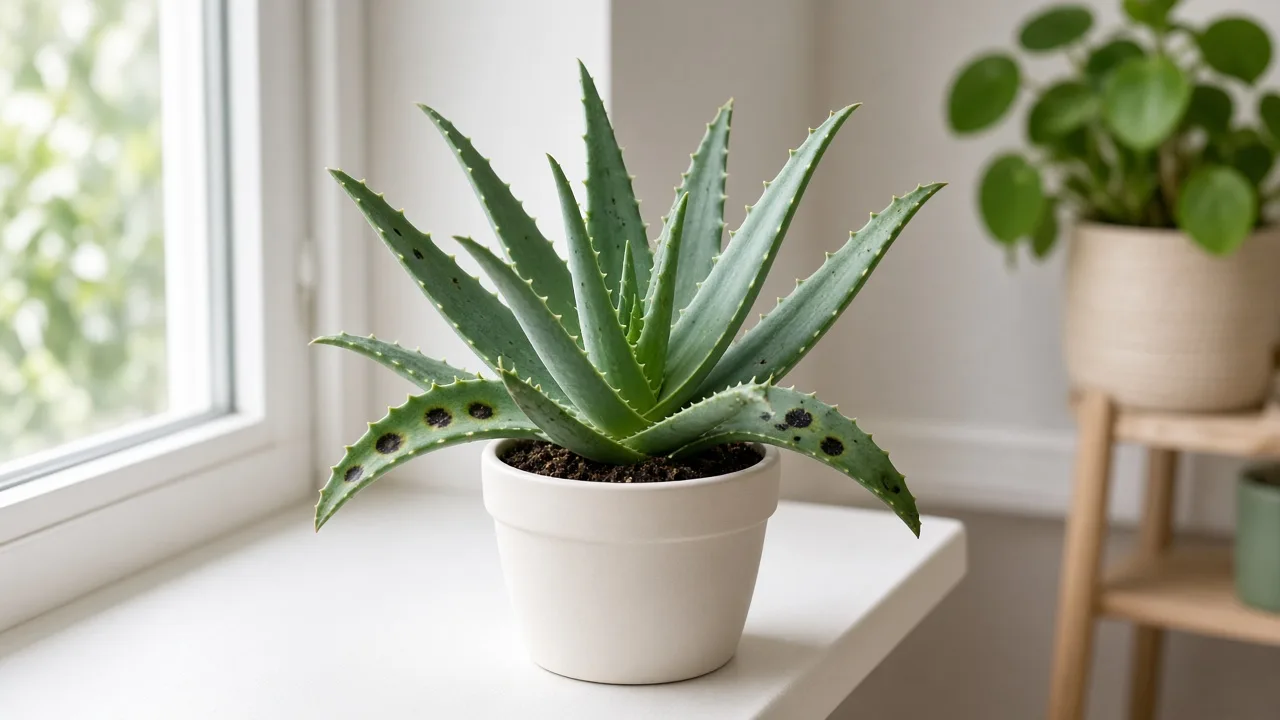
Black Spots on Aloe Vera: Causes, Checks & Fixes
This guide covers black spots on Aloe Vera. See also the general Black Spots guide, watering, and light pages for this plant.
Black Spots on Aloe Vera: Causes, Checks & Fixes
Quick answer
Black spots on Aloe Vera (Aloe vera) stand out on thick, gel-filled, serrated leaves. They are not the same as a single dry tan patch on an old outer leaf that has simply aged out. True black spots are localized lesions—usually dry and sunken with yellow halos (fungus or rust), wipe-off sooty coating (pests), water-soaked then dark (cold), or soft black at the soil line (rot).
First step: press the spot on a firm leaf and check the pot weight. Dry spot with yellow halo on firm tissue = likely fungal leaf spot or aloe rust—keep foliage dry and improve airflow. Soft black at the leaf base with heavy wet mix = rot—see root rot. For general leaf-spot science, see our black spots guide.
| What you find | What it usually means | Read next |
|---|---|---|
| Dry dark spots with yellow halos on firm mid-blade tissue | Fungal leaf spot or aloe rust after wet leaves | Stay on this page; dry foliage first |
| Black coating that wipes off with a damp cloth | Sooty mold on scale honeydew | Scale insects |
| Soft black at leaf bases on a heavy wet pot | Crown or root rot | Root rot · Overwatering |
| One dry spot on lowest outer leaf only | Old-leaf scarring or healed nick | Monitor; fix care if more appear |
When to use this page vs other Aloe Vera guides
- Brown leaves — whole-blade browning or sun stress rather than discrete spots
- Brown tips — dry margins from drought or salts, not circular lesions
- Root rot — mushy bases, sour mix, and crown failure on wet soil
- Overwatering — translucent soft leaves before spots spread
- Scale insects and mealybugs — bumps and sticky residue before sooty mold
- Spider mites — stippling and webbing before dark scarring
What black spots look like on Aloe Vera
On aloe, spots appear on thick upright blades with soft serrated edges—often on outer lower leaves first, or scattered across several blades after overhead watering or a humid spell.
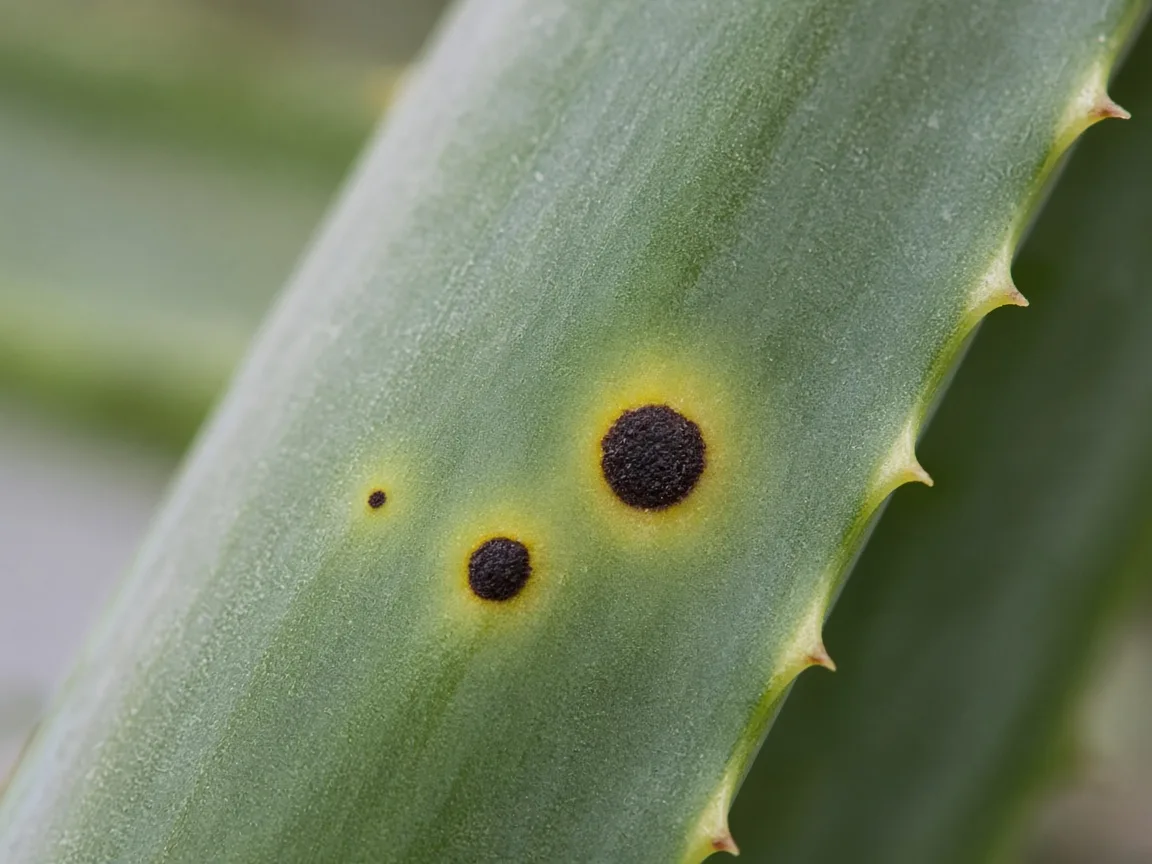
Black Spots symptoms on Aloe Vera - compare with healthy tissue on the same plant.
Fungal leaf spot:
- Round to oval black or dark brown spots with yellow halos
- Dry, slightly sunken center on otherwise firm gel-filled leaf
- New spots appear after splashing water, shower rinses, or misting
- Clemson HGIC describes fungal leaf spots as small brown lesions with yellowish margins; small black dots may appear in dead tissue
Aloe rust:
- Orange-brown pustules that darken as tissue dies—specific to aloe and related succulents
- Often on upper or lower leaf surfaces after prolonged leaf wetness
- NC State Extension lists aloe rust among common disease problems on this species
Sooty mold:
- Black coating that rubs off with a damp cloth—not sunken into the leaf
- Follows honeydew from scale or other sap feeders
- Underlying leaf tissue stays green when wiped clean
Cold injury:
- Water-soaked patches that turn dark after a cold night near glass
- Often on outer leaves touching a cold window
- Tissue may feel soft briefly, then dry black
Rot-associated black:
- Black mushy tissue at crown or base—not a flat spot on mid-blade
- Soil wet and may smell sour
- Escalate immediately to root rot
Why gel-filled aloe leaves still get spots
Aloe is marketed as indestructible, but NC State Extension notes diseases including leaf spot, aloe rust, scale, and sooty mold when culture slips. The thick leaves store water, so owners often assume surface moisture does not matter—but serrated blade edges and the rosette cup can hold splash water longer than you expect after careless top watering.
UF/IFAS emphasizes drought tolerance: water only when the top inch of soil is dry and never let the plant sit in water. When mix stays wet while leaves are also splashed, fungal spores get a double advantage—wet foliage plus a stressed root zone from overwatering.
Low winter temperatures damage succulent tissue. Aloe slows in cool, low-light months; the same watering rhythm that worked in summer leaves foliage and roots vulnerable. Clemson HGIC notes that root and stem rot fungi thrive when soil stays too wet, and girdling brown or black tissue at the soil line can follow.
Reading spots on outer rosette leaves vs. pup crowding
Aloe Vera grows as a rosette of thick leaves with offsets (pups) at the base. That shape matters for diagnosis.
Outer lower leaves naturally age first. A single dry dark freckle on one lowest blade while inner leaves stay plump and green is often old-tissue scarring, not active disease. Watch whether new spots appear on younger leaves above it.
Crowded pup clusters trap humidity at the center. Water poured over the rosette runs into the cup and between pups, keeping inner leaf bases damp overnight—the classic setup for leaf spot and rust on otherwise healthy-looking plants. If spots cluster at the inner crown after showering or misting, separate crowded offsets during the next dry repot per the repotting guide.
Weight test: Lift the pot. A light dry pot with firm leaves and isolated dry spots points to fungus or cold—not rot. A heavy wet pot with soft black bases points to root rot even when mid-blade spots are minor.
Aloe rust, leaf spot, and sooty mold on serrated blades
These three look similar in photos but need different first responses.
| Pattern | Feel / wipe test | Spread | First response |
|---|---|---|---|
| Fungal leaf spot | Dry, sunken; does not wipe off | Slow; yellow halos | Dry foliage; remove worst leaf |
| Aloe rust | Dry; may show orange-brown before black | Leaf to leaf in humidity | Same as leaf spot; isolate |
| Sooty mold | Smears off with damp cloth | Follows pest activity | Treat scale or mealybugs |
| Crown rot | Soft at base; foul smell | Fast up the stem | Stop water; unpot per root-rot guide |
RHS guidance on houseplant leaf damage ties dark spots with yellow margins to fungal leaf spot and recommends improving culture before reaching for sprays. On aloe, culture correction—dry blades, soil-level watering, airflow—solves most indoor cases without fungicide.
How to confirm the cause
- Touch the spot — Dry and firm on a plump leaf suggests fungus or rust. Soft at the base suggests rot.
- Wipe test — Sooty mold rubs off; true lesions do not.
- Check undersides and leaf bases — Scale bumps and mealybug cotton often sit where spots later appear.
- Pot weight and smell — Heavy wet mix or sour odor shifts diagnosis toward rot, not surface fungus.
- Track spread for 7–10 days — Living lesions enlarge; scars and cold marks stay fixed.
If spots multiply weekly while foliage stays deliberately dry, inspect for hidden pests and whether the pot never dries per the watering guide.
First fix for Aloe Vera
For dry fungal spots or rust on firm leaves: stop splashing water on foliage. Water the soil only with a narrow spout, let blades dry, increase airflow, and remove the most spotted outer leaf with a clean knife. Do not mist aloe—NC State lists leaf spot among diseases to prevent through dry culture.
For sooty mold: wipe blades gently, then treat the underlying pest on scale insects or mealybugs—the mold returns if honeydew continues.
For cold marks: move away from glass, keep above about 10°C (50°F), and remove collapsed outer leaves.
For base mush: do not spray fungicide on the leaf surface—stop watering and address rot per the root rot guide.
Step-by-step recovery
- Isolate the plant if spots are spreading in a crowded shelf.
- Remove outer leaves that are more than half spotted or soft at the base—sterilize the blade between cuts.
- Keep foliage dry for two to three weeks; water soil only when the top two inches are dry.
- Improve airflow — space pots apart; avoid enclosing aloe in humid cabinets.
- Treat pests if wipe tests show sooty mold or you find scale.
- Repot only if mix stays wet for weeks on a light schedule—switch to gritty cactus mix without burying the crown deeper.
- Monitor inner new growth — clean emerging leaves mean the fix is working.
Recovery timeline
Isolated fungal spots on one or two outer leaves often stop spreading within two to three weeks after foliage stays dry. Removed leaves do not regrow from the same point—recovery is clean new center growth and firm leaf bases.
If new spots appear weekly despite dry blades, check whether the pot stays wet too long—see overwatering and confirm roots are firm white or tan, not brown mush. Sooty mold clears within days of wiping once pests are controlled; underlying green tissue should show immediately.
What not to do
- Do not mist aloe leaves — surface moisture encourages fungal spotting in humid rooms.
- Do not overhead water — water at the soil line so the rosette cup stays dry.
- Do not spray fungicide on base mush — soft black at the crown means rot, not a mid-blade fungus.
- Do not water a wilted aloe on wet soil — failed roots cannot move water; more water worsens decay.
- Do not ignore weekly spreading spots on a heavy pot—unpot before crown tissue turns fully black.
Pet note: Aloe is toxic to cats and dogs. Bag and discard trimmed spotted leaves safely during cleanup.
How to prevent black spots next time
Water at the soil line with a narrow spout. Use gritty soil in a pot with drainage holes and let the top two inches dry between drinks per the watering guide. UF/IFAS warns that oversized pots hold excess moisture that can lead to root rot—size up only one to two inches when repotting pups.
Keep plants away from cold window glass in winter. Quarantine new aloes before clustering them with established rosettes. A monthly wipe along serrated edges catches scale before sooty mold coats the blades.
When to worry
Treat as urgent when base black mush spreads, several leaves detach with foul-smelling tissue, or new spots appear weekly on inner young leaves despite dry foliage—hidden rot or chronic wet mix may be active.
Lower urgency: one or two isolated dry spots on firm outer leaves that stop spreading after you keep blades dry and fix watering rhythm.
Related Aloe Vera guides
- Overview — culture baseline
- Problems hub — sibling symptoms
- Light guide — placement to avoid stress
- Propagation — salvage firm pups if the mother crown fails