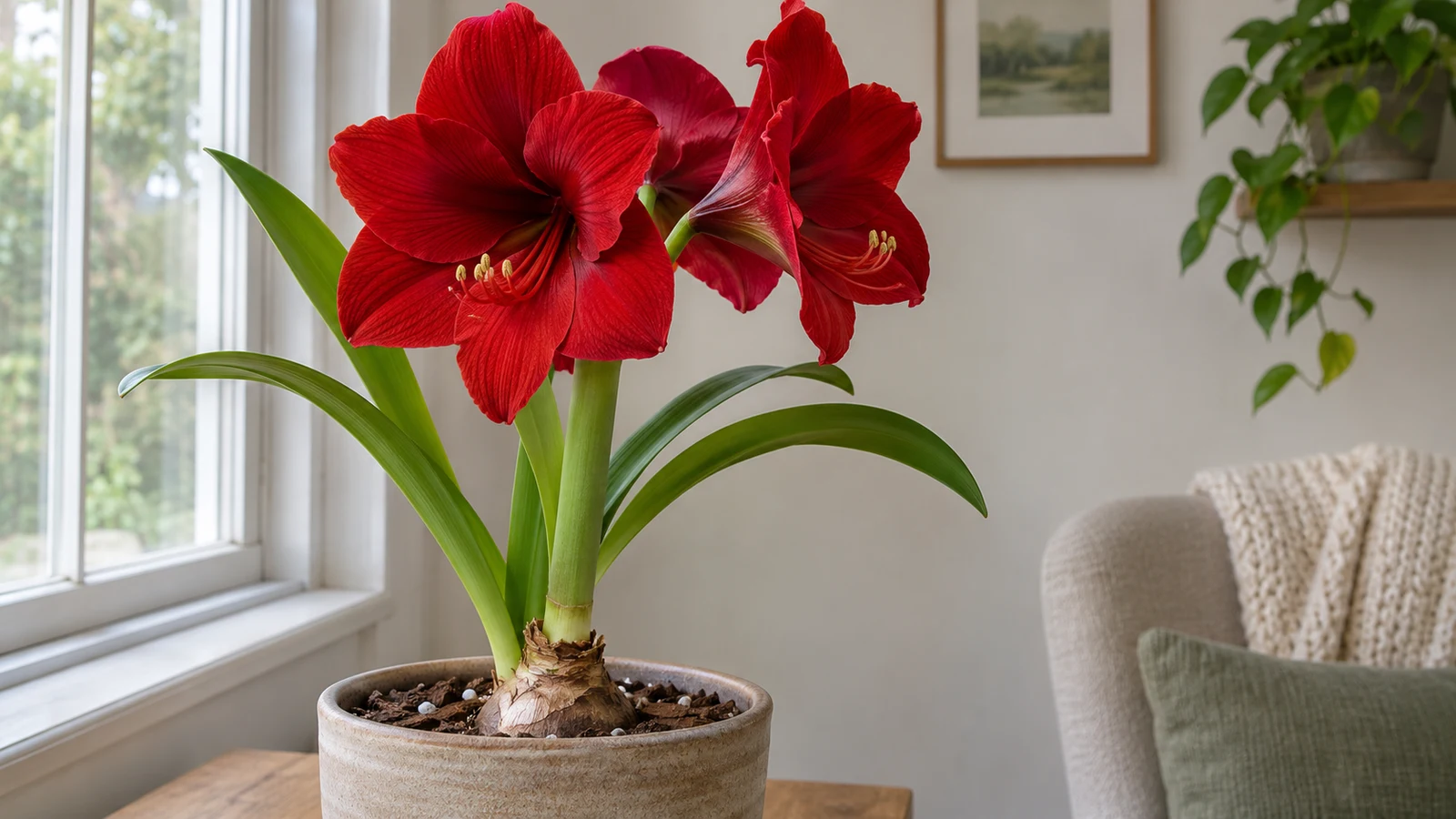
The winter-flowering bulbs commonly sold as amaryllis are usually Hippeastrum species and hybrids. True Amaryllis belladonna is a different genus native to South Africa, while Hippeastrum is native to the Americas. Check the plant label because common names overlap.
How much light does a potted amaryllis need?
Give a growing Hippeastrum bright filtered light indoors. It can take full sun to partial shade outdoors in mild weather, but acclimate it before moving it into stronger summer sun. Rotate the pot if the flower stalk leans toward the window.
How often should I water amaryllis?
Water a dormant bulb sparingly until growth begins. During active leaf growth, water when the surface of the mix starts to dry and let excess drain. Do not leave water in the saucer or keep the bulb in soggy soil.
Should I cut back the leaves after amaryllis blooms?
Remove the spent flower stalk, but keep healthy leaves growing in bright light. They help replenish the bulb. Commercial Hippeastrum bulbs can be kept evergreen; an optional cool, dry rest can be used to schedule the next bloom.
Is amaryllis toxic to cats and dogs?
Yes. ASPCA lists Hippeastrum spp. (Barbados lily) as toxic to cats and dogs, and identifies the bulb as the most poisonous part. Keep the plant inaccessible and contact a veterinarian or animal poison-control service if a pet chews it.
How do I propagate Amaryllis?
Propagate Amaryllis from healthy stem or root divisions during active growth.
What soil is best for Amaryllis?
Use use a loose, organic-rich potting mix that drains freely. A container only a little wider than the bulb helps keep the plant stable without surrounding it with a large volume of wet mix. Plant the lower roots and bulb base, leaving roughly the upper third to half of the bulb above the surface. A good mix includes Use a quality bulb or houseplant potting mix with organic matter and open drainage., Choose a pot with a drainage hole and only about 1–2 in (2.5–5 cm) of space around the bulb. Good drainage is essential; never leave the pot standing in water.
Written by Sai AnanthLead content writer at LeafyPixels. B.Pharmacy graduate from Andhra University with a background in pharmacognosy, turned indoor gardening writer after a long-time plant hobby became a research-led resource for home growers.View Sai Ananth's profile · Reviewed by LeafyPixels Review Board
This Amaryllis problems problem guide was researched and written by Sai AnanthLead content writer at LeafyPixels. B.Pharmacy graduate from Andhra University with a background in pharmacognosy, turned indoor gardening writer after a long-time plant hobby became a research-led resource for home growers.View Sai Ananth's profile. Problems symptoms on Amaryllis, lookalike causes, and step-by-step fixes are cross-checked against extension pest, disease, and care references before publication.
We prioritize sources that hold up under scrutiny:
University cooperative extension bulletins and fact sheets (Penn State, Clemson, UMD, NC State, and similar programs)
Botanical garden and horticultural society publications
Peer-reviewed plant science and veterinary toxicology references where pet safety matters (including ASPCA Animal Poison Control)
Established reference works on indoor plant culture
The LeafyPixels editorial team then reviews the draft for clarity, step-by-step usefulness, and fit with real apartment and home conditions-not ideal greenhouse setups. When guidance changes materially, we update the page and note the revision date.
Epic Gardening — How to Plant, Grow and Care for Flowering Amaryllis Plants (n.d.) Practical container size, bulb planting depth, pot drainage, bright indoor placement, and care through flowering. [Online]. Available at: https://www.epicgardening.com/amaryllis/ (Accessed: 1 March 2024).
NC State Extension Plant Toolbox — Hippeastrum (n.d.) Scientific identity, family, native region, size, growth habit, light and soil range, bulb care, and human and pet risk flags. [Online]. Available at: https://plants.ces.ncsu.edu/plants/hippeastrum/ (Accessed: 1 March 2024).
Royal Horticultural Society — Hippeastrum (n.d.) Common-name usage, size, indoor bulb planting, bright filtered light, watering stages, flowering temperature, summer care, rest, and repotting. [Online]. Available at: https://www.rhs.org.uk/advice/profile?PID=118&cID=982 (Accessed: 1 March 2024).
The Spruce — How to Grow and Care for Amaryllis (n.d.) Practical potting, indoor light, watering checks, summer placement, and seasonal reblooming care. [Online]. Available at: https://www.thespruce.com/growing-amaryllis-1402227 (Accessed: 1 March 2024).
University of Wisconsin–Madison Extension — Amaryllis, Hippeastrum (n.d.) Difference between Hippeastrum and true Amaryllis, origin, bulb planting depth, pot size, drainage, watering, after-flowering care, and optional dormancy. [Online]. Available at: https://hort.extension.wisc.edu/articles/amaryllis-hippeastrum/ (Accessed: 1 March 2024).