Potassium Deficiency on Anthurium: Causes, Checks & Fixes
Quick answer
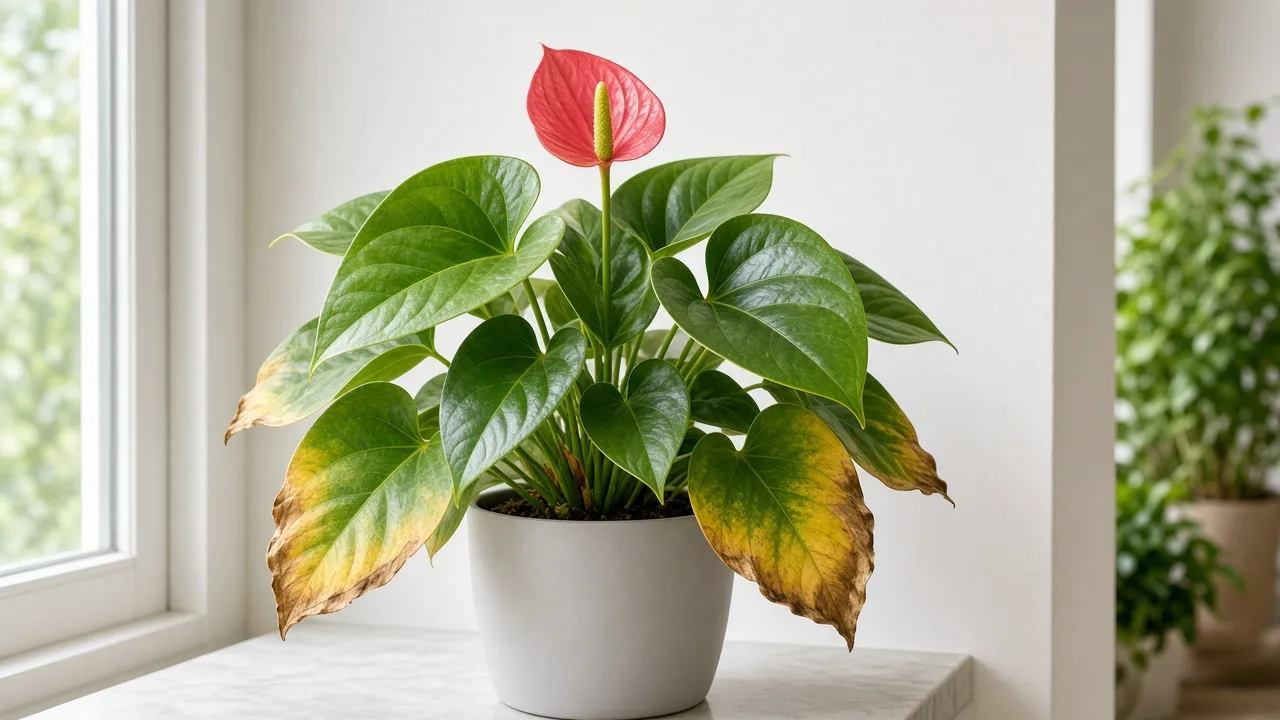
Potassium deficiency on anthurium shows as yellow or brown scorch along the margins of older heart-shaped leaves while newer crown foliage and spathes stay relatively green. First step: confirm edge-first burn on multiple lower leaves—not tip-only crisping from salts—and review feeding history before adding fertilizer.
Potassium Deficiency on Anthurium: Causes, Checks & Fixes
This guide covers potassium deficiency on Anthurium. See also the general Potassium Deficiency guide, watering, and light pages for this plant.
Potassium Deficiency on Anthurium: Causes, Checks & Fixes
Quick answer
Potassium deficiency on anthurium (Anthurium spp.) shows as yellow or brown scorch along the margins of older heart-shaped leaves while newer crown foliage and spathes stay relatively green. Potassium is mobile within plants—when soil reserves run low, anthurium pulls potassium from old tissue to support new heart leaves and inflorescences. Older leaves turn yellow and brown at the tips and margins in classic potassium shortage.
See our potassium deficiency guide for general marginal-scorch mechanics. On anthurium, inspect the outer edges of the lowest mature heart blades first—edge-first burn on multiple old leaves differs from tip-only brown tips on a single blade or uniform pale washout from nitrogen deficiency.
First step: confirm marginal scorch on multiple older lower heart leaves, then check for salt crust and review feeding history before adding fertilizer.
When to use this page vs other Anthurium guides
| Pattern | Read next |
|---|---|
| Old heart leaf margins yellow or scorched, new spathe green | Potassium deficiency (this page) |
| Dry tan tips only, interior leaf green | Brown tips from salts or dry air |
| Uniform pale old blades, small new leaves | Nitrogen deficiency |
| Yellow between veins on old leaves | Magnesium deficiency |
| Scorched margins right after heavy feeding | Salt injury—pause feed and flush |
| Mushy roots, wet mix | Overwatering or root rot |
| Spathes fade early despite good care | Faded flowers |
What potassium deficiency looks like on anthurium
Healthy anthurium holds glossy heart-shaped foliage on stiff petioles with waxy spathes above the crown. Potassium stress breaks that pattern at the margins of older lower leaves, not at the unfurling crown first.
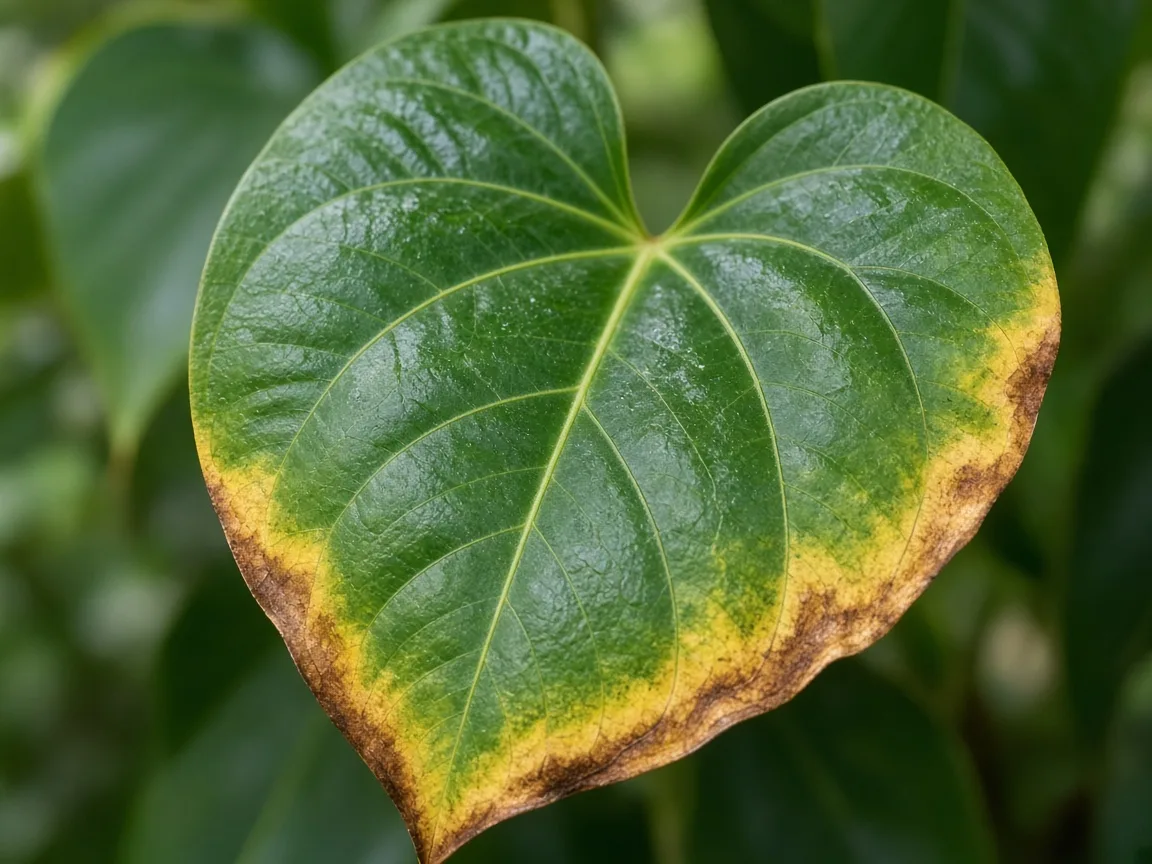
Older heart-shaped leaf with yellow-tan scorch band along the outer margin while the newest spathe at the crown stays greener—a classic mobile-potassium pattern on epiphytic aroids.
Typical signs:
- Yellow or tan scorch along outer margins of several older lower heart blades—the damage often starts at the edge and creeps inward while veins stay greener longer (marginal browning on older leaves)
- Crisp brown marginal tissue on firm glossy leaves, not soft mushy petioles
- New crown leaves and spathes stay greener than the lowest leaves for weeks
- Premature spathe browning or weak spathe stems when potassium cannot support water regulation in thick waxy tissue
- Slow spread up the stem as deficiency advances—more mid-stem leaves gain similar edge burn
- Firm aerial roots and base roots unlike limp overwatered anthurium on soggy mix
Not potassium deficiency:
- Tip-only crisp brown on one exposed blade face—brown tips from salt buildup, dry air, or uneven watering
- Uniform pale washout on whole old leaves—nitrogen deficiency
- Yellow between veins with green midrib bands—magnesium deficiency
- Marginal burn within days of a concentrated fertilizer dose—salt injury, not shortage
- One bottom leaf yellowing while a green spathe sits above—often normal senescence; see yellow leaves
- Wilting with dry mix and premature spathe collapse—underwatering
Why anthurium gets potassium deficiency
Anthurium is an epiphytic aroid grown for foliage and spathes in bright indirect light. Potassium regulates stomatal function and stress tolerance—deficiency often appears as marginal scorch when roots cannot supply enough K to sustain older heart blades while the crown keeps pushing spathes.
Anthurium-specific causes:
- Light-feeding culture on open orchid-bark mix — Anthurium needs far less fertilizer than fast-growing tropicals. Months without any complete feed during an active summer growth push can deplete mobile potassium in coarse bark-perlite media even when the plant looks healthy from stored root reserves. Container plants deplete nutrients over time.
- Leaching from regular watering — Per the watering guide, thorough drinks through fast-draining mix wash mobile potassium out if you never replace what drains.
- Bloom-boost phosphorus without potassium — Owners chasing spathes with high-phosphorus feed while skipping balanced nutrition starve potassium for leaf margins and spathe shelf life.
- Salt-blocked uptake — White crust from overfeeding or hard tap water limits potassium absorption even when fertilizer sits in the cabinet. Epiphytic roots burn easily from salt stress that mimics deficiency margins.
- Root stress limiting uptake — UC IPM notes container plants often show deficiency symptoms when root uptake is restricted, not only when soil lacks potassium. Chronic wet mix on an oversized pot mimics starvation while roots soften.
Do not diagnose potassium shortage on sour wet soil with mushy petioles at the base—that is root failure from overwatering until you confirm mostly firm white and green feeder roots.
Spathe shelf life and marginal burn on old heart leaves
Anthurium pairs foliage health with spathe performance—potassium shortage often shows in both places at once. Older heart leaves develop edge-first scorch while new spathes may brown prematurely at the margins or open smaller than usual on otherwise green crown tissue.
That pattern differs from no flowers from insufficient light alone, where leaves may still look deep green with no inflorescence at all, and from faded flowers caused mainly by age or low humidity. Potassium stress produces progressive marginal damage on multiple old blades alongside weak or short-lived spathes on a plant that is still actively growing in bright indirect light.
If spathes shrink and old leaves pale uniformly—not margin-scorched—check nitrogen deficiency first. Edge-first burn on firm roots points here.
Bloom boost vs balanced potassium
Owners often switch to high-phosphorus bloom fertilizer when spathes fade or shrink, assuming phosphorus alone will restore flowering. Without adequate potassium, waxy spathe tissue loses turgor and shelf life while older heart leaves scorch at the margins—the plant cannot regulate water in thick glossy blades.
The correct sequence: one or two months of balanced complete fertilizer at dilute strength per the fertilizer guide, then evaluate light per not enough light guidance. Anthurium needs bright indirect light and adequate potassium for both leaf margins and spathe quality.
Aerial roots and leaching in open mix
Anthurium produces aerial roots along the stem that absorb moisture and nutrients from humid air. In coarse orchid-like aroid mix, every thorough watering leaches mobile potassium unless you replace what drains during active growth.
Before feeding for potassium deficiency, confirm:
- Aerial roots and base roots are firm and green or white—not brown and mushy
- Mix is open and drains within days—not waterlogged for a week after one drink
- No heavy salt crust rings the pot—flush before feeding if white deposits present
Feeding potassium into waterlogged epiphytic roots burns tissue and worsens marginal scorch. Fix drainage per watering guide rhythm first, then apply one dilute balanced fertilizer at quarter to half strength.
Lookalike symptoms
| Pattern | Check | Likely cause |
|---|---|---|
| Old heart margins scorched, crown spathe green | Feeding history, salt crust | Potassium deficiency (this page) |
| Tip-only crisp brown | Water source, vent placement | Brown tips |
| Uniform pale old blades | Whole-leaf washout | Nitrogen deficiency |
| Yellow between veins on old leaves | Interveinal banding | Magnesium deficiency |
| Scorched margins right after heavy feed | White crust, recent dose | Salt injury—pause and flush |
| Mushy roots, wet mix | Root smell, pot weight | Overwatering |
| No spathes, deep green leaves | Light level | Not enough light |
How to confirm
- Leaf age pattern — Lowest old heart leaves first; margins before whole-blade yellow.
- Spathe performance — Premature marginal browning or weak stems alongside scorched old leaves supports potassium lack.
- Feeding history — Bloom-only fertilizer or months without complete feed.
- Root check — Firm white and green roots vs brown mush.
- Salt crust — White deposits on mix surface or pot rim suggest salt burn, not shortage.
- Mix moisture — Appropriate open mix dry-down vs chronic wetness.
- Crown comparison — Newer heart leaves and spathes greener than lowest scorched blades.
First fix for Anthurium
One dilute balanced liquid fertilizer at quarter to half label strength after confirming firm roots, no salt crust, and appropriate moisture on open—not waterlogged—mix.
Per the anthurium fertilizer guide. Anthurium prefers light feeds—one measured dose, not full-strength doubling on epiphytic roots.
Step-by-step recovery
- Feed lightly monthly through active growth with balanced fertilizer—not bloom-only all season per fertilizer guide.
- Flush accumulated salts if white crust is present—water through until runoff runs clear, then wait one week before feeding.
- Repot into fresh coarse epiphytic mix if roots fill the pot and scorched margins persist after two light feeds.
- Maintain bright indirect light without hot direct sun on scorched foliage.
- Remove fully browned lower leaves that detach easily—do not strip every symptomatic leaf at once.
- Correct overwatering if roots are mushy—potassium uptake requires healthy epiphytic roots.
Recovery timeline
Judge recovery on new heart leaves and spathe quality, not old scorched margins:
- 2–4 weeks: New crown leaves should show cleaner edges
- 4–8 weeks: New spathes open with better color hold—main success signal
- 8+ weeks: Two clean flushes confirm potassium is adequate
Scorched margins on old heart leaves rarely re-green. Success means cleaner new foliage and spathes that hold color longer.
Mistakes to avoid
- Chasing blooms with phosphorus-only feed while margins scorch. Balanced potassium first, then light optimization.
- Confusing overwatering with potassium scorch. Mushy roots on wet mix is root failure, not mobile nutrient redistribution.
- Full-strength rescue feeding on epiphytic roots. Quarter to half strength matches anthurium metabolism.
- Expecting old scorched heart leaves to re-green. Judge new crown growth and spathe quality.
- Heavy feeding on waterlogged orchid-like mix. Fix drainage before repeated fertilizer.
- Treating salt burn as deficiency. Scorched margins within days of concentrated feed need flushing, not more fertilizer.
Prevention
- Feed lightly during active growth per fertilizer guide
- Use balanced complete feeds, not bloom-only all season
- Flush salts mid-season if you feed frequently on leaching bark mix
- Refresh coarse orchid-like mix at repotting every two to three years
- Maintain open mix dry-down per watering guide
- Resume spring feeds after winter rest pause
Related Anthurium guides
- Anthurium overview
- Anthurium fertilizer
- Anthurium watering
- Anthurium soil
- Nitrogen deficiency
- Brown tips
- Overwatering
- Anthurium problems hub
Conclusion
Scorched margins on older heart leaves with weak or short-lived spathes signal potassium depletion in long-neglected epiphytic mix—confirm firm roots rule out overwatering and salt crust, feed balanced nutrition lightly once, and monitor new crown leaves and spathe quality over four to eight weeks.
Related tool
Use the Fertilizer Dilution Calculator to narrow causes for potassium deficiency on this plant before changing multiple variables at once.