Caterpillars on Anubias: Causes, Checks & Fixes
Quick answer
Caterpillars on Anubias chew ragged sections from emergent leaves and flower stalks above the waterline, leaving dark pellet-like frass—usually after emersed nursery stock, open-top paludariums, or nearby garden plants. First step: remove the rhizome to a quarantine tub and hand-pick every larva from emergent tissue at night with a flashlight before treating foliage.
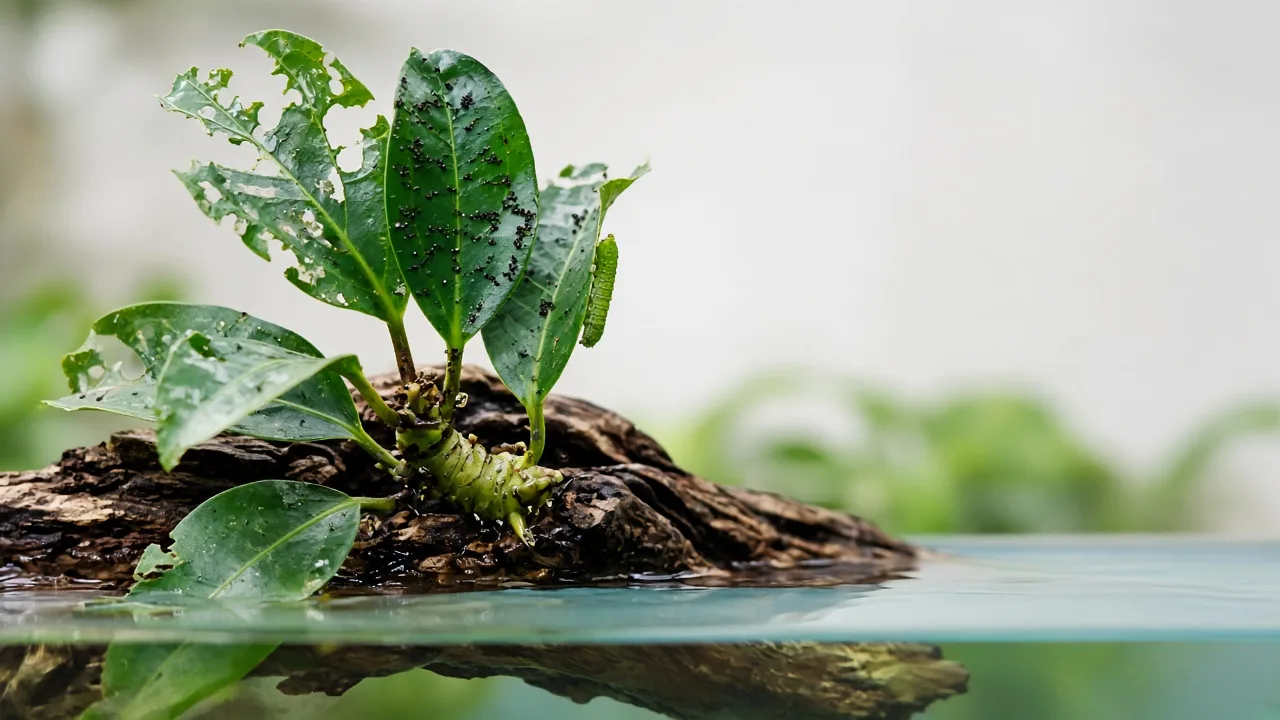
Caterpillars on Anubias: Causes, Checks & Fixes
This guide covers caterpillars on Anubias. See also the general Caterpillars guide, watering, and light pages for this plant.
Caterpillars on Anubias: Causes, Checks & Fixes
Quick answer
Ragged chew and dark pellet-like frass on emergent Anubias leaves or flower stalks? On Anubias barteri and cultivars like Anubias nana, true caterpillars are terrestrial moth and butterfly larvae feeding on tissue above the waterline—not sap-sucking pests on submerged blades. Thick submerged leaves are rarely caterpillar targets; damage concentrates on emergent tips, spathe buds, and the rhizome crown in open-top turtle tanks, paludariums, and Wabi-Kusa bowls.
For general caterpillar biology, frass signs, and when hand removal works first, see our caterpillars pest guide. On Anubias, the practical split is emergent-tissue chewing from nursery hitchhikers vs. turtle or fish grazing that leaves holes without frass or larvae.
First step: move the rhizome to a quarantine tub and hand-pick every visible caterpillar from emergent leaves and flower stalks at night with a flashlight. Do not pour Bt, neem, or insecticidal soap into occupied aquarium or turtle water.
When to use this page vs other Anubias guides
| Pattern | Read next |
|---|---|
| Ragged chew + frass pellets + segmented larvae on emergent tissue | This page |
| Pear-shaped soft insects + honeydew on flower stalks | Aphids on Anubias |
| Holes without frass; turtle at stems after feeding time | Holes in leaves (grazing) |
| White cottony wax in rhizome crevices | Mealybugs on Anubias |
| Stippling and fine webbing on emergent leaves | Spider mites on Anubias |
| Translucent mush on submerged old emersed leaves | Yellow leaves (melt) |
| Flies from emersed propagation pots | Fungus gnats |
What caterpillar damage looks like on Anubias
On Anubias, caterpillar feeding shows up on emergent growth, not on healthy submerged foliage. The thick, leathery submerged blades that make Anubias a hardy epiphyte are poor caterpillar food compared with soft new leaves breaking the surface.
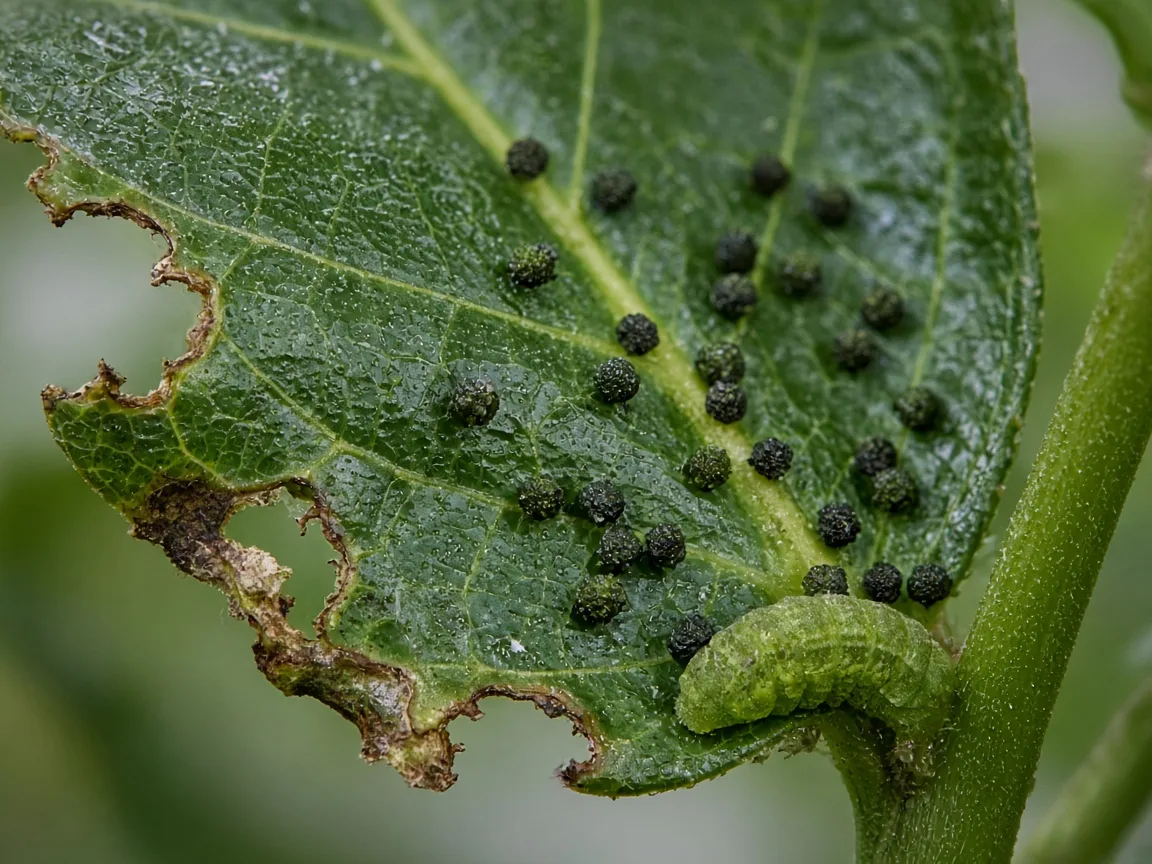
Irregular chew notches on thick emergent Anubias leaves with dark pellet-like frass—compare with an intact submerged leaf on the same rhizome.
Chewed notches and holes:
- Irregular sections missing from emergent leaves as they unfurl from the rhizome crown
- Ragged edges on flower stalks and spathe buds rising above open-top tanks
- Dark green or black pellet-like frass on leaf surfaces, the tank rim, driftwood below emergent tips, or floating at the meniscus
Larva signs (when you can see them):
- Segmented green, brown, or patterned caterpillars curled along a petiole base or flower stalk
- Small round or oval egg clusters on emergent leaf undersides from moths that entered through open windows or greenhouse benches
- Visible chewing on the youngest emergent leaf before damage spreads down the stalk
What submerged Anubias usually shows instead:
- Clean thick blades below the waterline while all chew damage sits above
- No frass pellets on submerged tissue unless frass drips from emergent colonies above
Unlike aphids on Anubias, caterpillars do not leave sticky honeydew. Unlike spider mites, there is no fine stippling or webbing—only open chewing wounds and frass.
Why Anubias gets caterpillars
Caterpillars are far less common indoors than sap-sucking pests like aphids or mealybugs. On Anubias, when you see chew damage, suspect a recent introduction on emergent tissue rather than chronic pressure in fully submerged culture.
Anubias is grown emersed in humid greenhouses before it reaches your tank—leaves and flower stalks develop above water, exactly where terrestrial caterpillars feed. Pests hitchhike on nursery stock and persist when emergent growth stays accessible.
Realistic entry paths for caterpillars on Anubias:
- Emersed nursery shipments — Eggs or tiny larvae on leaf undersides before you submerge the rhizome
- Open-top turtle tanks and paludariums — Emergent leaves breaking the water surface create caterpillar habitat in warm, humid air
- Propagation benches — Anubias divisions growing emersed beside tomatoes, peppers, or milkweed on the same shelf
- Outdoor pond margins — Seasonal tubs where rhizomes creep above the waterline in summer
- Open windows — Night-flying moths laying eggs on emergent Anubias near garden beds
Anubias is a slow rhizome epiphyte tied to rock or driftwood—not a fast stem plant in soil. Caterpillar problems center on emergent tissue and introduction routes, not buried rhizomes or aquarium substrate chemistry.
Why closed submerged-only setups rarely host caterpillars: If every leaf stays underwater and no emergent tips break the surface, terrestrial larvae have nowhere to feed. The far more common “hole” pattern in turtle tanks is herbivore grazing on soft new growth—see holes in leaves before treating for insects.
Caterpillars vs turtle grazing on thick Anubias leaves
Turtle keepers often report “something is eating my Anubias” when the real culprit is the turtle, not Lepidoptera. Use frass and insect presence to split the two:
| Sign | Caterpillars | Turtle or fish grazing |
|---|---|---|
| Frass pellets on leaves or rim | Yes — dark pellets | No |
| Visible segmented larva | Often at night on emergent tissue | No — livestock at stems |
| Damage timing | Gradual over days; larvae visible | Often overnight after feeding |
| Location | Emergent tips and flower stalks | Any soft leaf the animal reaches |
| Submerged thick blades | Usually clean below waterline | Bite marks where animal grazes |
Turtles do not reliably control caterpillar colonies on dry emergent leaves they never reach—and fish cannot climb above the waterline to clean tips. Physical hand removal still matters even in predator-heavy tanks.
If you find holes with no frass, no larvae, and turtles hanging at the plant after dinner, start with the holes in leaves guide instead of insect treatment.
How to confirm the cause
Work through these checks before treating:
- Location on the plant — Chew only on above-water leaves or stalks points to caterpillars. Uniform problems on submerged blades suggest melt, algae, or grazing—not caterpillars.
- Frass test — Hold a damaged emergent leaf over white paper and tap lightly. Dark pellets rolling off confirm caterpillars—not sticky honeydew from aphids.
- Night search — Inspect at night with a flashlight; caterpillars feed at night and hide along stems and leaf bases during the day.
- Body shape — Segmented larvae with visible head capsules and chewing mouthparts confirm caterpillars. Pear-shaped soft bodies with cornicles are aphids. Cottony wax clusters are mealybugs.
- Egg clusters — Small round dots on emergent leaf undersides mean eggs are present even if larvae are still tiny.
- Purchase timing — Damage within one to two weeks of emersed nursery stock or greenhouse divisions is a strong hitchhiker signal.
Symptom lookalike comparison
| What you see | Frass? | Moves when touched? | On Anubias, usually where? |
|---|---|---|---|
| Caterpillars | Yes — pellets | Slow crawl | Emergent leaves, flower stalks, crown |
| Aphids | No — honeydew | Slow shuffle | Emergent tips, spathe buds |
| Mealybugs | No | Slow | Rhizome crevices, leaf axils |
| Turtle grazing | No | N/A | Any reachable soft leaf |
| Acclimation melt | No | No | Submerged old emersed leaves — translucent |
| Leaf miners | Sometimes | Larva inside tunnel | Bordered trails inside leaf — rare on thick Anubias |
First fix for Anubias
Hand-pick every visible caterpillar from emergent leaves and flower stalks at night.
Unhook the rhizome from driftwood if needed and move it to a quarantine tub with matching temperature and dechlorinated water. Physical removal is the most effective first step because caterpillar numbers on a single Anubias are usually small—one larva can notch several thick emergent leaves before you notice.
Hand-picking protocol
- Inspect at dusk — Larvae feed on emergent tissue when lights dim in the room and tank.
- Check the rhizome crown — Caterpillars curl along petiole bases where thick leaves meet the exposed rhizome on wood.
- Pick or brush each larva — Drop into a sealed bag with soapy water; do not flush near outdoor waterways.
- Scrape egg clusters — Remove small round egg dots from emergent leaf undersides with a cotton swab.
- Trim heavily infested flower stalks — Anubias flowers are ornamental; snipping one stalk beats dosing pesticides into turtle water.
- Bag frass-coated leaves — Remove trimmings so larvae cannot reinfest from the bench.
That single physical step is the safest first response in turtle tanks and community aquariums. Only after hand-picking fails should you escalate to out-of-tank treatment.
When you cannot remove the plant (display tanks)
For large Anubias glued to hardscape in a display aquascape:
- Brush larvae off emergent tips with a soft toothbrush dipped in aquarium water at night
- Trim only the infested emergent leaf or flower stalk — slow regrowth means losing one tip beats tank-wide pesticide exposure
- Raise water level temporarily in a quarantine tub for divisions you can move
- Lower room lights and use a focused flashlight — larvae are easier to spot against thick dark green leaves
Out-of-tank treatment for occupied turtle aquariums
If hand-picking misses hidden larvae on emergent tissue:
- Remove the entire rhizome from the occupied tank.
- Treat emergent portions only in a bucket with insecticidal soap or Bt labeled for caterpillars, per label directions.
- Rinse thoroughly in several changes of dechlorinated water over 10–15 minutes.
- Quarantine one to two weeks in a separate tub before returning to the display tank.
Never pour soap, Bt, neem, or pyrethrin directly into occupied turtle, fish, or shrimp water.
Step-by-step recovery
After the first hand-pick:
- Isolate affected rhizomes in a quarantine tub until you see no new chew marks for two weeks. Indoor plants lack natural enemies that would control caterpillars outdoors.
- Repeat night inspections every three to five days — Caterpillars grow through several instars and one missed egg cluster can restart damage within a week.
- Submerge emergent tips when possible — Terrestrial larvae cannot feed on tissue that stays underwater, the same principle used for aphid control on Anubias.
- Wipe frass from tank rims and driftwood so you can tell whether new pellets appear after treatment.
- Hold extra fertilizer until new growth looks clean for two weeks — soft emergent shoots are easier for moths to colonize.
Recovery timeline
You should see no new frass or chew marks within five to seven days after removing all visible larvae and egg clusters. Night inspections matter because caterpillars hide during daylight hours.
New clean leaves are the real success marker. Because Anubias is slow-growing, a notched thick leaf may look damaged for several weeks to months even after pests are gone. Judge recovery by the next unfurling emergent leaf staying intact, not by old tissue repairing itself.
Plan two to three weeks of follow-up checks before merging a quarantined rhizome back with a collection. If fresh chew appears on emergent tips within that window, eggs or a missed larva remain active.
Worsening signs: multiple emergent leaves chewed in one week, frass accumulating at the meniscus, or egg clusters on new flower stalks after treatment. Those mean the outbreak is outpacing hand removal—escalate to out-of-tank soap or Bt treatment.
What not to do
Do not spray Bt, neem oil, pyrethrin, or insecticidal soap into a turtle tank or community aquarium. Residues harm fish, shrimp, beneficial bacteria, and turtles even when labels say “natural” or “organic.”
Do not use bleach or hydrogen-peroxide dips on Anubias rhizomes to kill caterpillars. Slow epiphytes recover from leaf loss, not from chemical burns on the crown.
Do not bury the rhizome while fighting pests—exposed rhizomes are how Anubias stays healthy in aquarium culture, and buried crowns rot in wet substrate per our soil and hardscape guide.
Do not assume submerged leaves are infested and dose the whole tank. Treat emergent tissue only, or remove the plant for out-of-tank care.
Do not treat once and stop. Repeat inspections are necessary because eggs hatch on a staggered schedule and early instars are easy to miss on thick dark leaves.
Anubias care cross-check
While inspecting for caterpillars, confirm the basics that keep Anubias resilient:
- Rhizome above substrate, tied to rock or driftwood—not buried in gravel
- Clean, oxygenated water with regular partial changes in turtle setups per our Anubias watering guide
- Moderate aquarium light, not sudden harsh sun on emergent leaves per our light guide
- Temperature in the 18–28 °C range matching your tank inhabitants
- No copper or algaecide residues on leaves you might later treat with soap outside the tank
Stressed plants with melting submerged leaves attract secondary problems, but caterpillar control still centers on emergent tissue and quarantine, not repotting or soil changes—Anubias does not grow in potting mix indoors.
How to prevent caterpillars next time
- Quarantine new Anubias one to two weeks in a separate tub before adding it to a display tank—the same window recommended in our fungus gnats guide.
- Inspect emersed nursery plants on arrival — Check leaf undersides and flower pits with a lens before submerging the rhizome.
- Keep emergent growth minimal in open-top turtle tanks—trim flower stalks you do not need, or keep water level high enough that new tips stay submerged.
- Scout weekly during warm growth; check emergent crowns first.
- Isolate propagation benches from garden caterpillar hosts like tomatoes and milkweed.
- Screen open windows near paludarium land zones where Anubias grows emersed.
- Rinse new divisions before sharing them between tanks.
When to worry
Escalate fast if multiple emergent leaves show fresh chew within a week, egg clusters appear on new flower stalks after hand-picking, or several emersed plants on the same bench show frass at once—those colonies spread beyond a single rhizome.
Treat as urgent in turtle tanks when you cannot trim emergent tissue and must choose between repeated out-of-tank soap treatment or removing the plant entirely. Do not let pesticides enter the water column.
If dense larvae persist after two full hand-pick cycles and nightly inspections, discard the most infested flower stalk or consider replacing a small nana cultivar rather than risking your entire aquascape.
Related Anubias guides
| Topic | Where to read next |
|---|---|
| Rhizome culture, emersed growth, species traits | Anubias care overview |
| Water changes, quarantine tubs, temperature | Anubias water parameters |
| Pear-shaped insects on emergent stalks | Aphids on Anubias |
| Turtle bite patterns without frass | Holes in leaves on Anubias |
| White cottony wax in rhizome crevices | Mealybugs on Anubias |
| Melt vs pest damage on submerged leaves | Yellow leaves on Anubias |