Black Spots on Areca Palm: Causes, Checks & Fixes
Quick answer
Black spots on areca palm (*Dypsis lutescens*) are usually fungal leaf spot on wet pinnae, spider-mite stippling that bronzes to black, sooty mold from scale or whitefly honeydew, or necrosis on aging lower fronds—not one generic cause. First step: stop misting and overhead watering, improve airflow around the clump, and check whether spots are dry and fixed or wet with yellow halos and spreading.
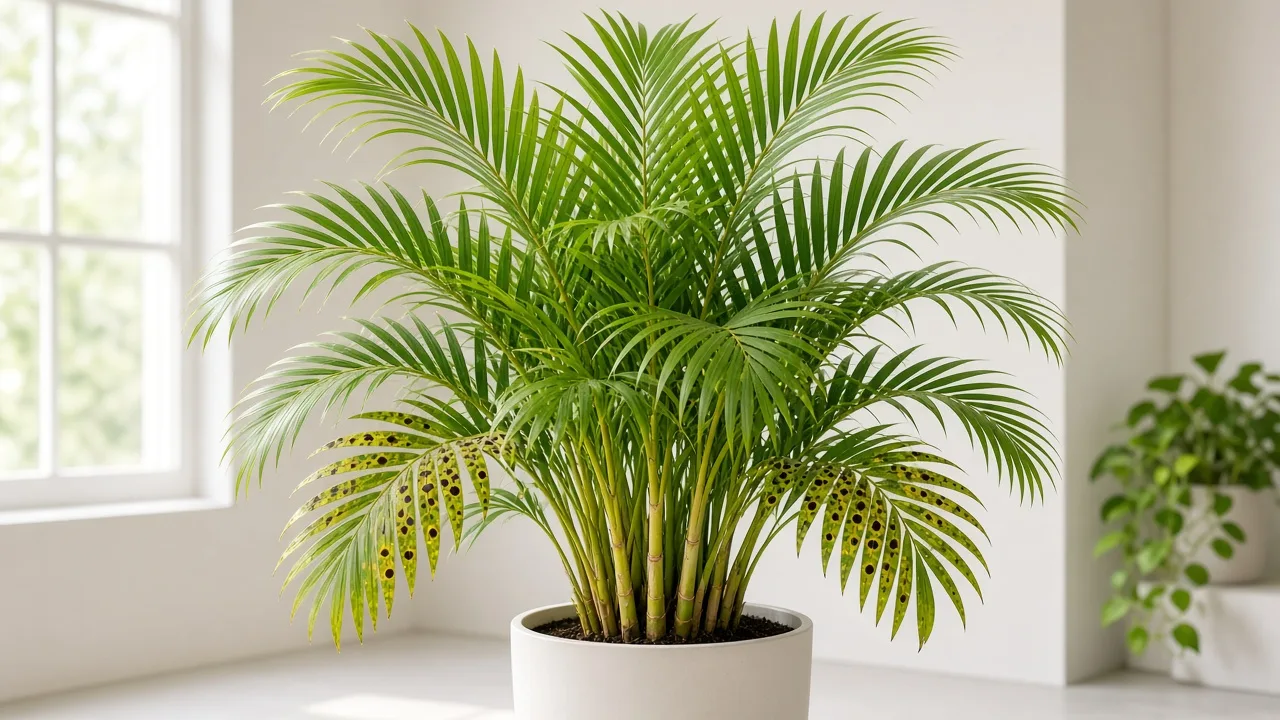
Black Spots on Areca Palm: Causes, Checks & Fixes
This guide covers black spots on Areca Palm. See also the general Black Spots guide, watering, and light pages for this plant.
Black Spots on Areca Palm: Causes, Checks & Fixes
Quick answer
Black spots on areca palm (Dypsis lutescens) are localized tissue death on narrow pinnae or, less often, dark patches on yellow-green canes. On this clumping Madagascar palm with 40–60 leaflets per arching frond, the pattern usually splits four ways: wet spots with yellow halos on pinnae point to fungal or bacterial leaf spot after foliage stays damp, fine stippling that bronzes to black tracks spider mites in dry winter air, black smear that wipes off follows honeydew from scale or whiteflies, and dry black marks on the lowest fronds only often trace normal aging—not infection. For general spot-disease mechanics, see our black spots guide. On areca palm, mist pools between overlapping pinnae in a dense multi-cane clump, wet mix lingers in winter while growth slows, and lower fronds fail first while crown spears can still look fine for weeks.
A few isolated dry black marks on one aging lower frond are cosmetic. Spreading wet-looking spots on several fronds in the same clump need action the same week—not extra fertilizer.
First step: stop misting and overhead watering, then pull the clump away from walls or tight furniture so air can move through the fronds. Water at soil level only, empty saucers, and give each cane room to breathe. Then decide whether you are dealing with leaf-surface pathogens, overwatering, pest honeydew, or light and cold damage.
When to use this page vs other Areca Palm guides
| Your question | Best page |
|---|---|
| Dark spots or lesions on pinnae or fronds | This page |
| Whole fronds yellowing on wet soil | Overwatering |
| Mushy roots, sour smell, wilt on wet mix | Root rot |
| Crisp brown tips without round spots | Brown tips |
| Uniform yellow fronds, not discrete spots | Yellow leaves |
| Fine stippling and webbing on pinnae | Spider mites |
| Black coating that wipes off | Scale insects or whiteflies |
What black spots look like on Areca Palm
Healthy areca palm fronds are pinnate—a central rachis carrying dozens of narrow, bright green leaflets (pinnae) that arch outward from bamboo-like canes. Black spotting breaks that pattern in recognizable ways:
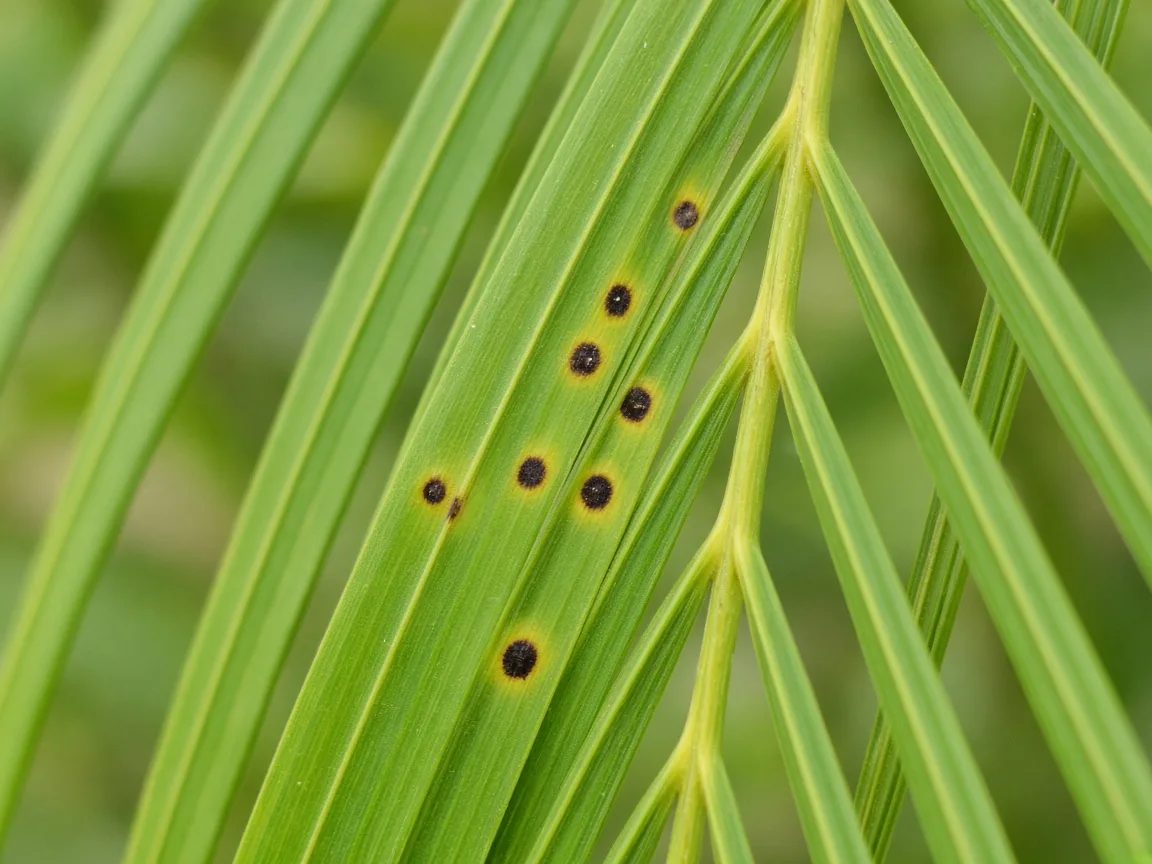
Black Spots symptoms on Areca Palm - compare with healthy tissue on the same plant.
- Small dark brown to black circles with yellow halos on pinnae — Often start water-soaked, then crisp at center. Classic fungal leaf spot on wet foliage in stagnant air between arching fronds.
- Irregular black patches merging along lower frond sections — Lesions coalesce when humidity stays high and pinnae remain wet overnight, especially where outer fronds overlap inner ones in a tight clump.
- Fine yellow-white stippling that bronzes, then looks black from a distance — Spider mite feeding on pinna undersides; webbing shows at frond bases before spots read as “black” across the canopy.
- Black smear that wipes off with a damp cloth — Sooty mold growing on honeydew from scale, whiteflies, or mealybugs on cane joints and leaflet undersides.
- Single dry black mark, no halo, no spread — Bumping, cold draft damage, or a healed mechanical wound on one pinna. Stable for months.
- Black soft tissue at cane bases on wet mix — Stem or root failure, not superficial spotting. See root rot.
Spots on new spears unfurling at the clump center are more urgent than one old mark on the lowest frond.
Reading spots on pinnae vs cane stems
Areca palms are not broad-leaf houseplants. Diagnosis depends on where the black tissue sits:
Pinna-level spots — Round or angular lesions on individual leaflets along the rachis. Fungal leaf spot and mite stippling both start here. Mites concentrate on pinna undersides where sap is accessible; fungal spots often show yellow halos on the upper surface first.
Whole-frond necrosis — An entire lower frond turns yellow-brown to black and hangs limp while mix stays wet. That is often overwatering or early root rot—not the same as scattered pinna spots on otherwise firm fronds.
Cane stem spots — Small dark marks on yellow-green bamboo-like stems may be scale covers, mechanical scuffs, or harmless corking on mature canes. Soft black tissue at the soil line on saturated mix is crown stress—inspect roots immediately.
Crown spear damage — Newest unfurling fronds with blackened tips before they fully open often follow cold drafts, fluoride burn, or chronic wet mix—not isolated leaf-spot fungi alone.
Why misting a dense multi-cane clump backfires
Areca palm is grown as a clustering palm with multiple slender canes arising from one base—not a single-trunk tree. That changes where spots start:
Overlapping pinnae trap mist. Each frond carries dozens of narrow leaflets. Routine misting or shower-rinsing leaves a film of water between layers that dries slowly in dim offices—exactly the conditions fungal leaf spot favors when air circulation is poor.
Outer fronds shelter inner ones. In a full clump pushed against a wall, outer arching fronds block airflow to inner pinnae. Spores from mold on soil splash onto sheltered leaflets first.
High humidity without dry-down invites both fungi and mites. NC State Extension notes areca palms prefer high humidity and bright indirect light—but wet pinnae plus stagnant air encourage leaf spot, while dry heat near vents flips the clump toward spider mites. Humidity at the canopy should come from a humidifier or pebble tray, not from soaking foliage nightly.
Shallow fibrous roots fail quietly. This palm wants moist but not soggy mix. When owners water on a calendar instead of the top 1–2 inch dry-down check, roots stay saturated. Chronic overwatering leads to root death—necrotic patches on lower fronds can precede obvious cane collapse.
Why Areca Palm gets black spots
Fungal or bacterial leaf spot
The most common infectious pattern: small dark spots with yellow halos on pinnae, often on lower fronds first, spreading upward when foliage stays wet. Fungal pathogens spread by splashing water and wind, so spacing looks random until lesions merge. Misting, overhead watering, and grouping palms too tightly are the usual indoor triggers—not exotic palm diseases.
Spider mite bronzing
In heated winter rooms, two-spotted spider mites pierce pinna undersides and leave fine stippling that dulls to bronze; severe feeding can make whole leaflet sections look black from across the room. Webbing at frond bases and a positive paper tap test confirm mites before you treat for fungus. See the full spider mites guide for rinse-and-repeat schedules.
Scale, whiteflies, and sooty mold
NC State lists scale, whiteflies, and spider mites as common areca palm pests. Sap-feeders excrete honeydew; sooty mold grows on that sticky film as a black coating you can wipe off. Fix the pest, not the mold alone—or spots return within days.
Overwatering and root stress
When mix stays wet for 10+ days in winter, lower fronds yellow and develop dark necrotic patches while the pot feels heavy. That is transport failure and tissue death from failed roots—not leaf-spot fungi. Route to overwatering or root rot when sour smell, algae on soil, or mushy roots accompany spotting.
Natural aging on lower fronds
Areca palms shed older lower fronds as new spears emerge from the center. One bottom frond yellowing, then browning to black at the tips before you remove it at the base is normal maintenance—not disease. Concern starts when multiple fronds at different heights spot simultaneously while mix and pests check out.
How to confirm the cause
Work through these checks in order. Each step narrows the diagnosis without stacking unnecessary treatments.
| Pattern | Spot texture | Pinna undersides | Soil at 1–2 inches | Likely cause |
|---|---|---|---|---|
| Round spots, yellow halos | Wet then crisp | Clean, no webbing | Damp 7+ days | Fungal leaf spot + wet foliage |
| Bronze stippling, fine webbing | Dry speckles | Webbing, moving dots | Normal dry-down | Spider mites |
| Black smear wipes off | Greasy film | Scale bumps or whitefly clouds | Normal | Pest honeydew / sooty mold |
| Lower frond only, firm canes | Dry edges | Clean | Dry on schedule | Aging frond—trim at base |
| Multiple fronds, limp, wet pot | Necrotic patches | Variable | Wet, cool, clings | Overwatering / root rot |
Paper tap test: Hold white paper under a spotted frond and tap the rachis. Slow-moving specks confirm mites. No movement plus yellow halos points to leaf spot.
Wipe test: Damp cloth on the spot. Black residue that transfers = sooty mold on honeydew. Spot stays fixed on the leaflet = true necrosis.
New growth check: Watch the next spear for two weeks. Clean unfurling pinnae mean your first fix worked. Fresh spots on new leaflets mean the cause is still active.
First fix — dry the canopy and improve airflow
Make one clear first move: stop misting, stop overhead watering, and reposition the clump for airflow—not a fungicide spray on day one.
- Move the pot so fronds are not pressed against a wall, curtain, or neighboring plants. Leave a few inches of space on all sides.
- Water at soil level only when the top 1–2 inches of mix are dry. Empty the saucer within 30 minutes.
- Blot wet pinnae gently with a clean cloth if you recently misted or showered the plant.
- Wait 48–72 hours and inspect new spears and the worst fronds. Spots that were fungal often stop spreading once foliage dries.
Only after foliage stays dry and spots still spread should you consider removing the worst fronds and treating with a labeled houseplant fungicide outdoors, following label directions. For confirmed mites, switch to the spider mites rinse protocol. For wipe-off mold, treat scale or whiteflies first.
Do not fertilize a spotted clump. Do not repot on day one unless canes are soft and roots are clearly failing.
Step-by-step recovery
Once the canopy is dry and you have confirmed the cause:
Fungal leaf spot
- Remove the most heavily spotted lower fronds at the base with clean shears—cut close to the cane, not mid-frond unless only a few pinnae are affected.
- Keep humidity up with a humidifier, not mist, so pinnae stay dry while air moisture rises.
- Space palms apart until no new spots appear for two weeks.
- If spread continues on new spears after dry-down, use a labeled fungicide outdoors; let fronds dry completely before returning indoors.
Spider mites
Follow the rinse-and-repeat schedule in the spider mites guide. Bronzed pinnae will not re-green; judge by clean new leaflets.
Sooty mold from pests
- Wipe sooty film with a damp cloth on sturdy pinnae.
- Treat the underlying scale, whiteflies, or mealybugs.
- Mold returns if pests remain—do not stop after wiping.
Overwatering-related necrosis
- Stop watering until the top 2 inches dry.
- Confirm drainage holes are open and the pot is not sitting in standing water.
- If lower fronds keep necrosing on wet mix, inspect roots per the root rot guide.
Recovery timeline
| Severity | What improvement looks like | Typical timeline |
|---|---|---|
| Mild leaf spot, few fronds | No new spots on emerging spears | 2–3 weeks after dry canopy |
| Mite stippling, early webbing | No fresh stippling on new pinnae after 2–3 rinse cycles | 3–4 weeks |
| Sooty mold only | Wipe stays clean; no new honeydew | 1–2 weeks after pest control |
| Overwatering necrosis | Firm canes, new spear growth, stable dry-down | 4–8 weeks |
Black necrotic pinna tissue does not turn green again. Recovery means the pattern stops on new growth. Old spotted fronds can stay marked until you trim them or the plant sheds them naturally.
Mistakes to avoid
- Misting harder when spots appear—wet pinnae feed leaf spot and do not fix mites.
- Spraying fungicide before drying foliage—chemicals on wet leaves in dim rooms rarely solve the root cause.
- Ignoring the wipe test—treating sooty mold without killing scale wastes a treatment cycle.
- Watering because fronds look dull while mix is still damp—necrosis on wet soil worsens root stress.
- Trimming every frond at once—areca palms need some foliage to photosynthesize; remove only heavily spotted blades or whole dead fronds.
How to prevent black spots next time
Align daily care with how this palm actually grows indoors:
- Water when the top 1–2 inches of mix dry; reduce frequency sharply in winter.
- Use bright indirect light so mix dries at a healthy pace—dim corners keep pinnae wet longer.
- Run a humidifier for 50–60% canopy humidity without wetting leaf surfaces.
- Quarantine new palms for two weeks before clustering them.
- Inspect pinna undersides monthly—mites and scale are listed pests on this species.
- Choose well-drained palm mix and a pot sized to the root mass, not the frond height.
Related Areca Palm guides
- Overview — Growth habit, placement, and cluster care basics
- Watering — Dry-down checks that prevent wet-mix necrosis
- Light — Bright indirect placement so fronds dry between waterings
- Spider mites — When stippling and webbing drive the spotting
- Overwatering — Lower-frond necrosis on heavy wet pots
Related tool
Use the Black Spots on Leaves Checker to narrow causes for black spots on this plant before changing multiple variables at once.