Ash Gourd Propagation: Seed Sowing Guide
Ash Gourd Propagation: Seed Sowing Guide
Ash Gourd Propagation: Seed Sowing Guide
Ash gourd propagation for Benincasa hispida—the winter melon, wax gourd, or petha vine grown across Indian kitchens—means starting from seed. Plants of the World Online (Kew) describes ash gourd as a scrambling annual cucurbit, not a perennial you can divide or root from a random vine tip. Every warm season begins with viable seed, soil that stays above about 21°C (70°F) at sowing depth, and a trellis plan ready before stems lengthen. Gardening Channel recommends sowing outdoors once soil reaches roughly 60°F (16°C) or starting indoors several weeks before the last frost in short-season regions, then moving seedlings out after nights stay warm.
If you are wondering whether a kitchen scrap can spawn another plant, put that effort into sowing instead. The payoff is one vigorous vine that can cover a terrace railing in weeks when light, water, and support align with the ash gourd overview.
How Benincasa hispida reproduces in the garden
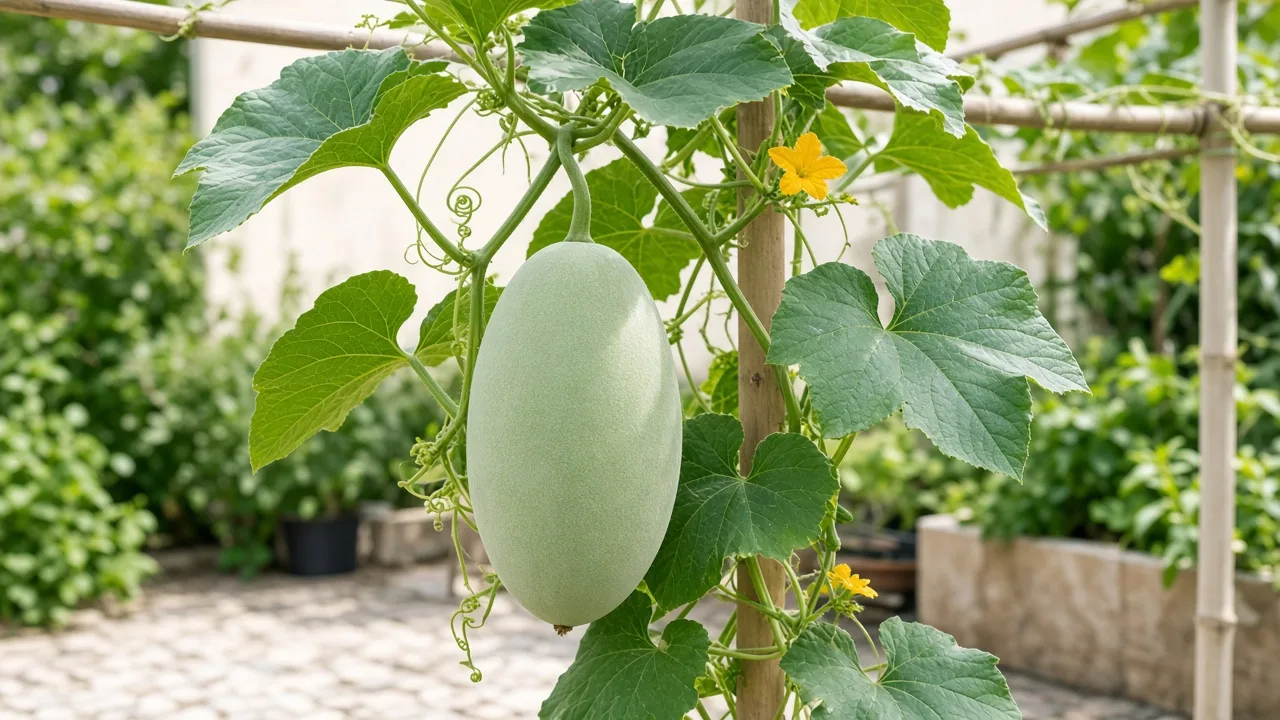
Ash gourd completes its life in one warm season. It germinates, climbs with tendrils, opens separate yellow male and female flowers on the same vine, sets large pepo fruits, and dies back after seed matures inside fully ripe gourds. There is no persistent crown to propagate by division, and home terraces rarely match the humidity and rooting hormones used for commercial stem-cuttings or grafting experiments.
Why seed is the reliable home propagation method
Commercial and kitchen-garden growers propagate ash gourd almost exclusively from seed. Tamil Nadu Agricultural University field guidance lists pit sowing of five to six seeds per station, then thinning to two vigorous plants after emergence—evidence that seed, not cuttings, drives standard production (TNAU Agritech — ash gourd). Research nurseries may use stem cuttings or graft ash gourd as a cucurbit rootstock, but those methods need controlled humidity and are poor substitutes for warm-soil sowing on a balcony. Unlike some perennial climbers, B. hispida does not root reliably from vine segments in typical container conditions.
When to sow ash gourd in India and warm climates
Ash gourd is a warm-season crop. Seeds sit idle in cold, waterlogged soil, while heat and consistent moisture drive emergence once nights stay mild.
Summer and monsoon planting windows
On many Indian plains, growers sow a summer crop in February–March and a monsoon (kharif) crop in June–July, adjusting for local rain and night temperatures. TNAU lists July and January as main planting seasons in its Tamil Nadu schedule—use that as a regional anchor, not a rule for every hill station. On a terrace, match sowing to when your container mix stays warm day and night, not merely when the calendar flips. If March nights still dip cool, wait or start under cover and harden off before exposing seedlings to open railings, as outlined in the ash gourd light guide.
Soil temperature before you commit seed
Hold off until soil at sowing depth feels warm and stays above about 20–21°C for reliable emergence; many home growers see cotyledons in roughly 7–14 days under those conditions. Gardening Channel ties outdoor sowing to soil near 70°F (21°C). Cool soil stretches germination toward three weeks and invites damping-off in crowded flats—NC State Extension notes that fungi attack germinating seed and young seedlings when media stays cool and wet. A cheap soil thermometer saves wasted seed on early February sowings.
Choose seed—and expect polyembryony
Propagation success begins with seed quality, not secret soaking formulas. Weak or old seed wastes a long trellis season.
Buy from a reputable source and note days-to-harvest on the packet. TNAU highlights regional lines such as CO 1, CO 2, and hybrid TNAU Ash Gourd Hybrid CO 1 with different fruit sizes and 120–150 day crop durations—choose a cultivar that fits your terrace space and cooking goal (tender young fruit vs large storage melons). Polyembryony is a genuine quirk of wax gourd: one seed can produce two to several seedlings at once, so a single cell in a tray may look overcrowded even when you sowed carefully. Plan to thin or gently separate seedlings at the first true-leaf stage rather than assuming one seed equals one plant.
Home saving works when fruits mature on the vine, but cucurbits can occasionally produce bitter fruit. Taste a sliver of raw flesh from the first fruits of a saved line; discard bitter ones and do not reuse seed from those plants. Gardening Channel warns that bitterness in cucurbits can signal compounds harmful to people—this matters most when you propagate from seed you saved yourself.
Prepare mix, pots, and trellis before sowing
Ash gourd vines run 5–10 m and set fruits that commonly weigh 5–20 kg, so propagation prep is as much about structure as about seed. Install a sturdy trellis, fence, or rooftop edge before sowing—a shallow decorative pot without support will not carry a reliable crop, as the ash gourd overview stresses.
Use rich, well-drained mix aligned with the ash gourd soil guide: loam or quality potting soil with compost and perlite or coarse sand, pH roughly 6.0–7.5. For direct ground sowing, TNAU describes 30 cm pits spaced about 2 m × 1.5 m with basins for irrigation—scale that spacing down only if you commit to very small fruit and aggressive pruning. Large tubs need volume and drainage holes; see repotting and transplant timing for moving peat-pot starts without tearing roots.
Direct sowing vs nursery transplant
Both paths work; the choice depends on season length, pest pressure, and how much flat space you have indoors.
Direct sowing suits warm monsoon beds and large containers once soil is consistently hot. TNAU field practice—several seeds per pit, then thin—maps cleanly to a big tub: sow two to three seeds near the center, keep moist, and leave the strongest one or two vines.
Nursery starts help short seasons and cool springs. TNAU hi-tech guidance raises 12-day-old seedlings in 98-cell protrays with cocopeat, one seed per cell, watering twice daily—then transplants to the main field. Home growers can mimic that with seed trays or peat pots started three to four weeks before outdoor planting, then harden off for several days before moving to full sun. PlotMyGarden lists about 110 days from seed to mature winter melon, so losing three weeks to cold soil may push harvest past your frost or heavy-rain window.
Step-by-step ash gourd seed sowing
Optional soak: many growers soak seeds 12–24 hours in room-temperature water to soften the hard coat, then sow immediately after draining. TNAU commercial pretreatment soaks seed in water briefly and may treat with Trichoderma or fungicide at label rates for field scale—home growers can skip chemicals if flats stay warm and airy.
Depth and cover: sow about 2–3 cm (1 inch) deep in moist mix, one seed per cell or two to three per pit. Ash gourd germination is hypogeal—cotyledons stay below the surface—so the first above-ground growth is the true seedling stem, which can look slow even when roots are active.
Warmth and moisture: keep media evenly moist, not soggy. Bottom heat near 25–30°C speeds emergence in air-conditioned rooms. Expect 7–14 days in warm soil; colder flats may take longer and rot instead.
Label flats clearly; young cucurbit seedlings look alike for the first two weeks.
After germination: thinning, hardening, and support
Once seedlings have one to two true leaves, thin extras in each pit or separate polyembryonic twins gently into individual pots if roots are still small. Crowded cells produce weak, etiolated stems that snap at transplant.
Harden nursery plants by reducing water slightly and increasing outdoor hours over five to seven days before final placement. Transplant on a mild evening or cloudy morning, burying peat pots so the stem is not buried deeper than it was in the tray. Water in with plain water—not heavy fertilizer—and shade for 48 hours if sun is intense.
Train the leading shoot toward supports within the first week outdoors. Steady moisture through establishment matters more than feed; follow the ash gourd watering guide once vines begin to run.
Hand pollination for reliable fruit set
Propagation is not finished at germination—you need fruit set to judge success. Ash gourd bears yellow male flowers on long stalks and female flowers with a tiny fruit at the base. Bees pollinate open blooms, but hand pollination in the morning often improves set on balconies with few insects, as described in the hub grower notes. Transfer pollen from a freshly opened male flower to female blooms while petals are still open.
Without pollination, vines may run meters with no fruit—a common frustration mistaken for “bad seed.”
Common propagation failures and fixes
No emergence after three weeks usually means soil was too cool or seed was old. Re-sow with fresh seed and a soil thermometer rather than drowning the first batch.
Seedlings collapse at soil line point to damping-off; improve airflow, reduce watering, and sow in fresh sterile mix (NC State Extension — damping-off).
Leggy, pale seedlings signal low light before transplant—move trays to brighter conditions or use supplemental light as in the ash gourd light guide.
Vine runs but no fruit is often pollination or premature nitrogen push; hand pollinate and align feeding with the ash gourd fertilizer guide after vines establish.
Multiple weak seedlings in one cell is polyembryony—thin early instead of letting them compete.
Saving ash gourd seed for next season
Let fruits from selected healthy vines mature fully on the plant until the rind is hard, the stem tendril dries, and the waxy bloom develops if you want storage types. Cut open, scoop seeds, rinse pulp away, and dry thoroughly on a screen for seven to ten days in a warm, airy room. Store in a cool, dark jar with low humidity; viability often lasts several years when kept dry, though germination rates fall faster in warm, humid kitchens.
Label variety, date, and whether the parent fruit was mild. Never save seed from bitter fruit. For pantry-sized landraces, rotate saved seed with fresh purchased stock every few seasons to limit inbreeding depression in small gardens.
When to use this page vs other Ash Gourd guides
Use this page when you are starting plants—choosing seed, sowing, germinating, transplanting, and troubleshooting empty flats or missing fruit. For ongoing vine care after establishment, jump to watering, soil, fertilizer, pruning, and repotting as needed. The overview ties the full cluster together if you are new to the crop.
Related Ash Gourd guides
- Overview — identity, mature size, and whether ash gourd fits your space.
- Light — full-sun placement after hardening off seedlings.
- Watering — steady moisture through flowering and fruit swell.
- Soil — loam–compost mixes for pits and large tubs.
- Fertilizer — feeding after true leaves expand and fruit sets.
- Pruning — managing vine length on trellises.
- Repotting — peat-pot transplant timing without root damage.
Conclusion
Ash gourd propagation is straightforward when you treat Benincasa hispida as the warm-season seed crop it is: sow into warm, well-drained soil, expect polyembryony and thin early, and give each vine room on a trellis before stems lengthen. Soaking and nursery starts are optional tools for slow germination or short seasons—not substitutes for soil temperature. Save seed only from mild, non-bitter fruits, and hand pollinate when morning flowers open on a quiet balcony. Nail those steps and the rest of the winter-melon cluster—water, feed, and train—turns a single seed into months of harvest.