Curling Leaves on Asparagus Fern: Causes, Checks & Fixes
Quick answer
Curling leaves on Asparagus Fern usually mean fine cladodes are rolling inward to cut water loss—most often from dry winter air, missed watering, or heat near a window. First step: check the top 2 cm of soil and lift the pot before you water, mist, or move the plant.
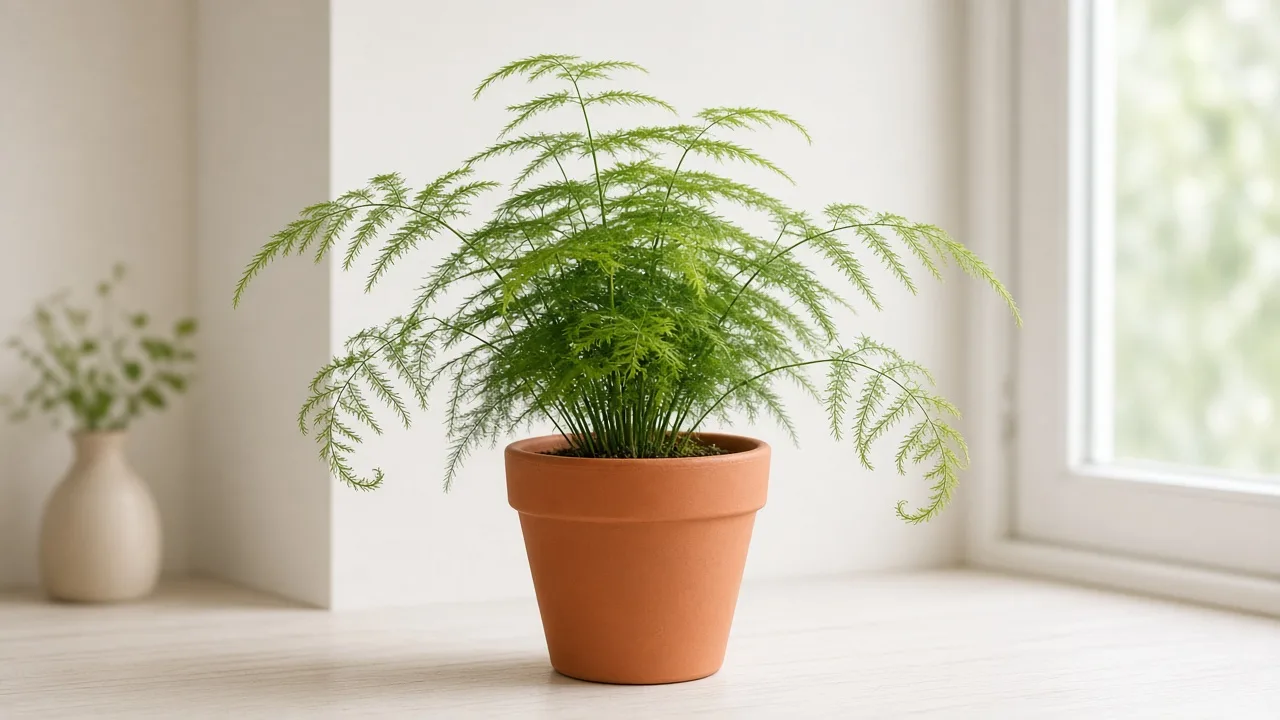
Curling Leaves on Asparagus Fern: Causes, Checks & Fixes
This guide covers curling leaves on Asparagus Fern. See also the general Curling Leaves guide, watering, and light pages for this plant.
Curling Leaves on Asparagus Fern: Causes, Checks & Fixes
Quick answer
Curling leaves on Asparagus Fern (Asparagus setaceus) are almost always a cladode moisture signal—not a missing fertilizer problem. What looks like soft fern fronds are actually fine, needle-like cladodes on wiry stems. Those flattened stems have a huge surface area and lose water fast when indoor air dries out or roots cannot supply steady moisture.
First step: push your finger into the top 2 cm of mix and lift the pot. Light and dry with inward-rolling needles means underwatering. Heavy and damp with limp, downward curl means stop watering and check tuber firmness at the soil line. Moist soil with curl concentrated near a heating vent or sunny window points to low humidity before you add more water.
For how leaf curl works in general, see our curling leaves symptom guide. On asparagus fern, the pattern usually shows up on outer cladode sprays near glass, on the crown of a hanging basket drying fastest, or on new spears that emerge twisted when thrips or aphids feed on unfolding tissue.
What curling leaves look like on Asparagus Fern
Healthy asparagus fern holds airy sprays of green cladodes in flat, horizontal planes along arching wiry stems. NC State Extension describes branches arranged in horizontal planes—stress curling breaks that feathery symmetry in recognizable ways:
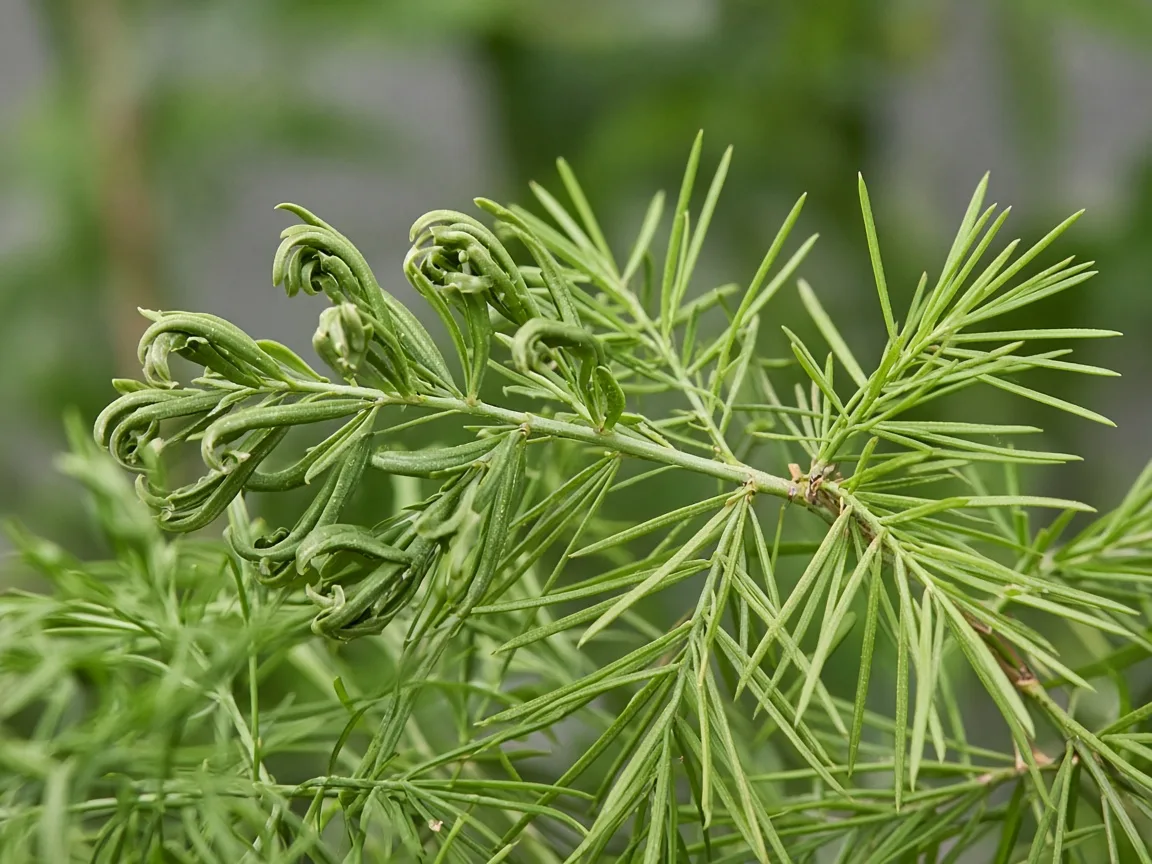
Curling leaf symptoms on asparagus fern—compare cupped cladodes with flat sprays on the same stem.
- Inward rolling of individual needles along a cladode spray, like a tiny fold running lengthwise
- Whole sprays cupping upward or twisting when dry air or heat pulls moisture faster than roots replace it
- Limp, downward-hanging curl paired with yellowing lower cladodes and mix that stays wet for days
- Crispy feel at curled tips when humidity crashes near a floor register in winter
- Small, kinked new spears emerging from the crown—often pest or heat damage on tender growth
- One-sided curl on sprays facing hot afternoon sun through glass while shaded sides stay flat
Damaged yellow or brown needles will not rejuvenate on old stems once conditions improve. Recovery shows up as fresh green spears from the crown or soil line, not re-flattening of every curled needle.
Reading curl on cladode sprays and wiry stems
Asparagus fern is not a true fern—it belongs to the Asparagaceae family and grows from tuberous roots with wiry, sometimes spiny stems. Curl distributes across zones that broad-leaf houseplants do not share:
Outer horizontal sprays curl first when transpiration outpaces root uptake. Hanging baskets and window-side pots often show damage on the crown-facing sprays while inner layers still look green briefly.
New spears at the soil line reflect current root-zone conditions. Firm tubers with dry top 2 cm and curled new growth strongly suggest thirst. Firm tubers with moist mix and twisted new spears may mean pests, heat, or distorted leaves from sap feeders.
Tuberous root reserves mask drought briefly. Wisconsin Horticulture notes tuberous roots store water and tolerate short neglect—but asparagus fern still needs bright indirect light and high humidity indoors. Curl can appear suddenly after the mix has been dry at depth for several days, not the moment the surface looks pale.
Why Asparagus Fern gets curling leaves
Dry indoor air is the most common winter trigger. Fine cladodes transpire heavily. When furnace heat drops room humidity below roughly 30–40%, needles roll inward to reduce exposed surface—a protective response similar to other humidity-sensitive foliage. If humidity is too low, browning of leaf tips can occur; curl often appears alongside or just before tip crisping.
Underwatering removes turgor from cladodes. Asparagus fern wants evenly moist, well-drained mix and should not fully dry out. Insufficient water will result in yellow needles that drop. Before yellowing spreads, many growers see inward cupping and a dramatically light pot.
Heat and direct sun compound water loss. The species is intolerant of high light intensity and prefers bright indirect light. Hot glass or afternoon sun on outer sprays causes one-sided curl and papery texture even when watering rhythm stayed steady.
Pest feeding distorts new growth permanently. NC State lists aphids, spider mites, and mealybugs on asparagus fern. Aphids and thrips on unfolding spears leave kinked, twisted cladodes that will not straighten. Spider mites prefer warm, dry conditions—dry air can invite both curl from thirst and curl from feeding damage.
Overwatering and root stress produce limp curl. Soggy mix weakens tuberous roots. Cladodes hang limply rather than rolling tight; yellowing often starts low on the plant. See overwatering and root rot if soil smells sour or tubers feel mushy.
Root-bound pots dry unevenly. Fast-growing asparagus fern can become pot bound quickly from large tuberous roots. Outer sprays curl from drought while the center still holds moisture—a pattern that looks like random stress until you find roots circling the pot wall.
How to confirm the cause
Work through these checks in order before you change multiple variables:
- Top 2 cm moisture and pot weight — Dusty dry mix and a light pot confirm thirst. Heavy, wet mix with limp curl means hold water and inspect tubers. See the asparagus fern watering guide for baseline rhythm.
- Tuber firmness at the soil line — Press gently. Firm tubers with dry mix fit underwatering. Soft tubers with wet mix fit rot—do not soak.
- Placement audit — Note distance to heating vents, radiators, fireplaces, and south- or west-facing glass. Curl on the vent-facing side with moist soil fits low humidity.
- Hygrometer reading at foliage height — RH below 30–40% in a heated room supports dry-air curl. Most houseplants prefer roughly 40–60% relative humidity.
- Pest inspection — Spread overlapping sprays and check undersides with a magnifier. Stippling plus webbing means spider mites. Distorted new spears with tiny green or black insects mean aphids or thrips.
- Light exposure — Bleached or curled sprays only on the window side suggest too much direct sun; see not enough light if inner growth is pale and stretched instead.
- New growth trend — Flat new spears after one correction mean you found the cause. Repeated twisted spears for two weeks mean keep investigating pests or chronic dry air.
First fix for Asparagus Fern
Check the top 2 cm of soil and lift the pot—then act on what you find, not what the calendar says.
If the mix is dry and the pot feels light, give a thorough soak until water runs from drainage holes, then let excess drain fully. Asparagus fern prefers regular watering in spring to autumn and sparingly in winter—but never let the root zone fully desiccate during active indoor growth.
If the top 2 cm is moist, the pot weighs normal, and curl is worst near a vent or sunny glass, move the pot away from the dry microclimate first before you add water. Relocate three to six feet off floor registers, then recheck humidity at foliage height for 24 hours.
Do not mist heavily as your only fix—brief humidity bumps wet fine cladodes on the surface without raising whole-room RH during furnace season.
Step-by-step recovery
After the first fix, escalate one step at a time so you can read the plant’s response:
- Underwatering path — Soak until runoff, discard saucer water, and resume watering when the top 2 cm feels barely moist. Mild curl often relaxes within hours if tubers are firm.
- Low-humidity path — Relocate off vents, add a pebble tray or small humidifier, and group with other plants. NC State recommends a humidifier or pebble tray to increase humidity around asparagus fern.
- Heat and light path — Pull back from hot glass; shift to bright indirect light. Trim fully crispy sprays cosmetically if they bother you—green tissue can still photosynthesize.
- Pest path — Isolate the plant, rinse cladode undersides in a sink with your palm over the soil, then treat confirmed pests per the relevant guide. Do not fertilize stressed plants until new spears look healthy.
- Root-bound path — If water runs straight through and outer sprays curl within days of every soak, plan repotting in spring—or sooner if roots are circling and growth has stalled.
Hold fertilizer until new green spears hold their shape for two weeks. Curl from stress is not a nutrient deficiency by default.
Recovery timeline
Hours to 2 days: Drought-related curl on firm tubers often relaxes after one deep soak. Limp curl from wet roots does not improve until the mix dries—do not keep watering.
Weeks 1–3: New spears should emerge with flatter cladode sprays once humidity, water, and light stabilize. Winter recovery may be slower than summer active growth.
Weeks 3–6: Fresh feathery growth replaces sparse sections if conditions stay steady. Old curled needles on mature stems may persist until you prune them back after recovery.
When to worry: Every new spear stays twisted despite good humidity and watering, webbing spreads across fronds, tubers soften with sour-smelling soil, or entire sprays collapse with a heavy pot—these overlap pests, rot, and severe wilting more than simple curl.
Lookalike symptoms
| Pattern | Likely cause | Quick check |
|---|---|---|
| Inward needle roll, moist soil, near vent | Low humidity | RH low; relocate off heat |
| Cupped sprays, light pot, dry top 2 cm | Underwatering | Soak perks foliage in 12–24 h |
| Limp curl, heavy pot, yellow lower cladodes | Overwatering / root stress | Soft tubers, wet mix |
| Stippling + webbing on undersides | Spider mites | Paper-tap test |
| Kinked new spears, distorted tips | Thrips or aphids | Inspect new growth first |
| One-sided curl on window sprays | Heat / direct sun | Move back from glass |
| Pale stretch with slight curl in dim corner | Insufficient light | See yellow leaves |
Curl vs droop: Drooping leaves hang limp along the whole stem; curl rolls individual cladodes while stems may still feel stiff.
What not to do
Do not flood the pot when the top 2 cm is already moist and curl sits near a heating vent—that invites root rot on tuberous roots.
Do not rely on daily misting alone in heated winter rooms; raise ambient RH with a humidifier or grouping instead.
Do not place the plant in direct afternoon sun to “fix” curl—this species avoids high light intensity and will scorch fine cladodes.
Do not fertilize a curling plant before moisture and humidity are stable.
Do not stack repotting, hard pruning, and pesticide on the same day as your first environmental fix.
Asparagus Fern care cross-check
Stable asparagus fern combines moderate humidity with even moisture and bright indirect light:
- Watering: Moist, well-drained mix; water when the top 2 cm dries. See the watering guide.
- Humidity: Target 40–60% RH; stress often appears below 30–40% in heated homes.
- Light: Bright indirect; avoid direct hot sun. See the light guide.
- Soil: Peaty, well-drained mix with perlite. See the soil guide.
- Temperature: Roughly 13–21°C (55–70°F) indoors; avoid sudden temperature changes that cause cladodes to drop.
The asparagus fern overview covers tuberous roots, species differences, and year-round care in more depth.
How to prevent curling leaves next time
- Run a humidifier before furnace season pushes room RH below 30%.
- Check the top 2 cm weekly instead of watering on a fixed calendar.
- Keep pots off floor registers and a few feet back from hot glass in winter.
- Scout cladode undersides monthly when indoor air is dry—pests and humidity stress overlap on this species.
- Repot every 1–2 years before tuberous roots choke drainage and create uneven dry-down.
- Quarantine new plants for two weeks; mites and aphids spread to dense cladode mats quickly.
When to worry
Escalate when curl spreads to every new spear within a week, fine webbing coats stem joints, tubers soften while soil stays wet, or yellowing climbs the plant with a sour root smell. Those patterns need pest treatment or root-zone rescue—not another humidity tweak.
Low urgency: gradual winter curl on outer sprays near an obvious heat source, firm tubers, appropriate soil moisture, and flat new growth still emerging from the crown. Relocate, humidify or adjust watering, and watch for two weeks before heavier intervention.
Related problems
- Low humidity on Asparagus Fern — papery tips and needle drop when air is dry but soil is moist
- Underwatering on Asparagus Fern — light pot, dry mix, limp yellowing sprays
- Spider mites on Asparagus Fern — stippling and webbing favored by dry indoor air
- Thrips on Asparagus Fern — silvery scars and kinked new spears
- Asparagus Fern care overview — full humidity, light, and watering baseline
Conclusion
Curling leaves on asparagus fern are a cladode-level moisture signal—dry air, missed watering, heat near glass, or pests on new spears—not a reason to overhaul care in one afternoon. Check the top 2 cm of soil and pot weight first, then match your fix to humidity, water, light, or pests. Curled needles on old stems may never flatten; fresh green spears from the crown tell you the correction is working.
When to use this page vs other Asparagus Fern guides
- Asparagus Fern watering guide — Use for routine moisture checks before assuming curl is humidity-only.
- Asparagus Fern problems hub — Browse all common issues on this species.
- Distorted leaves on Asparagus Fern — Better fit when new spears emerge twisted with pest scarring rather than simple inward roll.