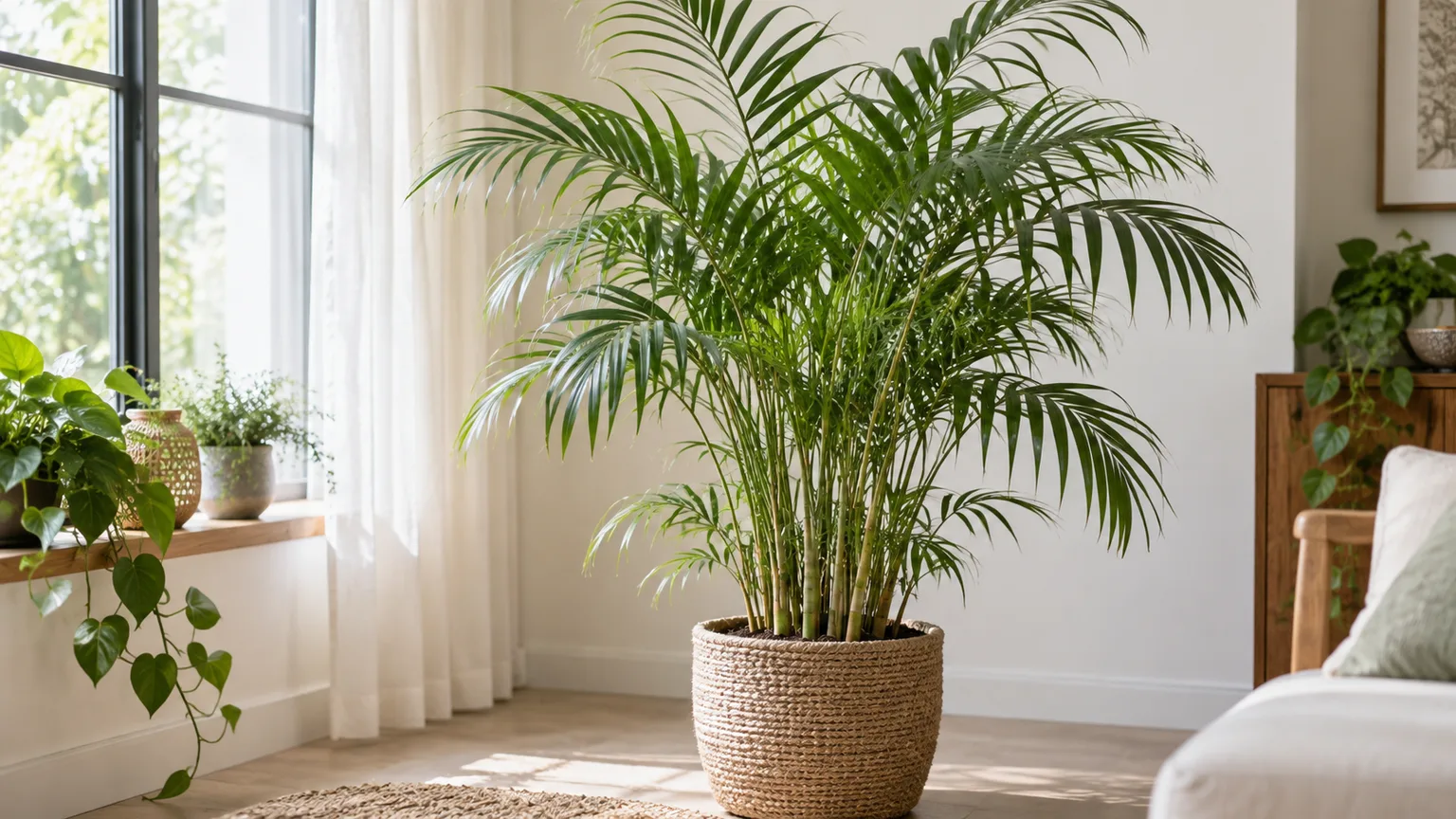
This guide uses Bamboo Palm for Chamaedorea seifrizii, also called Reed Palm. Some references also use “Parlor Palm” for it; this site’s separate Parlor Palm guide covers Chamaedorea elegans. Common names can overlap, so check the botanical name on the label.
How much light does Chamaedorea seifrizii need indoors?
Give it medium to bright filtered or indirect light, away from harsh direct sun. It can survive in low light, but growth may be slower and more open.
How often should I water Bamboo Palm?
There is no reliable calendar interval. Check the upper 2–3 cm of mix and water thoroughly once it starts to dry, then empty excess water from the saucer. Keep the mix slightly moist rather than continuously soggy.
How do you propagate Bamboo Palm?
Divide a healthy clump so each section keeps roots and canes. It can also be grown from seed; the RHS specifies a sowing temperature of at least 25°C.
Is Bamboo Palm safe for cats and dogs?
Its safety is not verified for Chamaedorea seifrizii in the sources reviewed. The ASPCA entry named Bamboo Palm is for Chamaedorea elegans, so do not transfer that listing to this species. Keep it away from pets that chew plants and ask a veterinarian if ingestion occurs.
What soil is best for Bamboo Palm?
Use use a peat-free, moisture-retentive but freely draining indoor potting mix in a pot with drainage holes. Do not let the root zone stay waterlogged. A good mix includes Peat-free indoor potting mix, Add perlite or pumice if the mix holds water too long, Use a container with open drainage holes. Moisture-retentive, yet well-drained; standing water can lead to root and stem rot.
What humidity does Bamboo Palm need?
Bamboo Palm prefers medium relative humidity. Normal household humidity is usually fine. Keep the palm away from hot or cold drafts and abrupt temperature changes It can tolerate ordinary indoor air; address watering and drainage before reacting to isolated brown tips.
Written by Sai AnanthLead content writer at LeafyPixels. B.Pharmacy graduate from Andhra University with a background in pharmacognosy, turned indoor gardening writer after a long-time plant hobby became a research-led resource for home growers.View Sai Ananth's profile · Reviewed by LeafyPixels Review Board
This Bamboo Palm problems problem guide was researched and written by Sai AnanthLead content writer at LeafyPixels. B.Pharmacy graduate from Andhra University with a background in pharmacognosy, turned indoor gardening writer after a long-time plant hobby became a research-led resource for home growers.View Sai Ananth's profile. Problems symptoms on Bamboo Palm, lookalike causes, and step-by-step fixes are cross-checked against extension pest, disease, and care references before publication.
We prioritize sources that hold up under scrutiny:
University cooperative extension bulletins and fact sheets (Penn State, Clemson, UMD, NC State, and similar programs)
Botanical garden and horticultural society publications
Peer-reviewed plant science and veterinary toxicology references where pet safety matters (including ASPCA Animal Poison Control)
Established reference works on indoor plant culture
The LeafyPixels editorial team then reviews the draft for clarity, step-by-step usefulness, and fit with real apartment and home conditions-not ideal greenhouse setups. When guidance changes materially, we update the page and note the revision date.
Hortology — Chamaedorea seifrizii Bamboo Palm (n.d.) Practical indoor guidance on filtered light, drainage, watering, household conditions, slow growth, and distinguishing the exact species. [Online]. Available at: https://hortology.co.uk/products/chamaedorea-seifrizii-bamboo-palm (Accessed: 1 March 2024).
NC State Extension Plant Toolbox — Chamaedorea seifrizii (n.d.) Species identity, common names, native region, clumping habit, mature size, light, moisture, propagation options, overwatering risk, and human contact-irritation note. [Online]. Available at: https://plants.ces.ncsu.edu/plants/chamaedorea-seifrizii/ (Accessed: 1 March 2024).
OLC — How to Care for a Bamboo Palm (Chamaedorea seifrizii) (n.d.) Practical indoor checks for filtered light, evenly moist soil, drainage, dry spells, and humidity. [Online]. Available at: https://olc.com.my/how-to-care-for-a-bamboo-palm-chamaedorea-seifrizii/ (Accessed: 1 March 2024).
Royal Horticultural Society — Chamaedorea seifrizii (n.d.) Species description, partial-shade position, mature height and spread, time to maturity, cultivation, and seed germination temperature. [Online]. Available at: https://www.rhs.org.uk/plants/46437/chamaedorea-seifrizii/details (Accessed: 1 March 2024).