Black Spots on Basil: Downy Mildew & Leaf Spot Fixes
Quick answer
Black spots on basil usually mean downy mildew, bacterial leaf spot after wet leaves, or cold shock on a windowsill—not generic houseplant stress. First step: flip a spotted leaf and look at the underside for gray-purple fuzz before you spray anything.
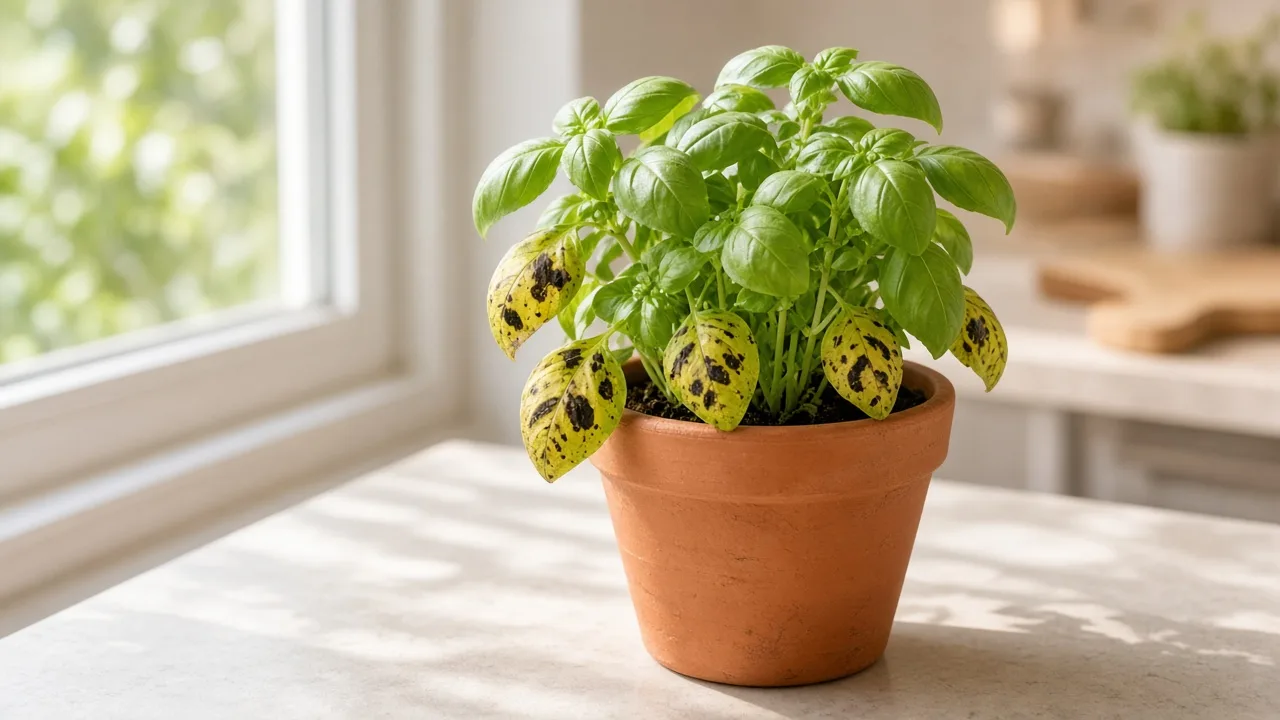
Black Spots on Basil: Causes, Checks & Fixes
This guide covers black spots on Basil. See also the general Black Spots guide, watering, and light pages for this plant.
Black Spots on Basil: Causes, Checks & Fixes
Quick answer
Black spots on sweet basil (Ocimum basilicum) are almost never a vague “indoor stress” pattern. On this fast-growing, sun-hungry culinary herb, dark blotches usually trace to basil downy mildew, wet-foliage bacterial leaf spot, fungal leaf spot after splash, or cold shock on a windowsill.
For how leaf spot diseases spread in general, see our black spots guide—on basil, the underside of the leaf tells you which branch to follow.
First step: flip one spotted leaf toward the light and inspect the underside. Gray-purple fuzzy growth means downy mildew—harvest clean leaves immediately, then remove the plant. Flat water-soaked patches without fuzz point to bacterial or fungal spot after wet leaves. Crisp black patches after a cold night, with no fuzz and no spread pattern, fit chilling injury.
When to use this page vs other basil guides
| What you see | Read next |
|---|---|
| Yellow lower leaves first, then brown/black with fuzzy undersides | This page (downy mildew) |
| Soft black stem at soil line on wet mix | Root rot |
| Round holes, not blotches | Holes in leaves |
| Whole leaves turning brown, not spotty | Brown leaves |
| Yellowing without distinct black spots | Yellow leaves |
| Crispy tan edges only, not center spots | Brown tips |
This page covers dark spots or blotches on basil foliage. If stems collapse at the seedling stage on soggy mix, start with overwatering and damping-off checks instead.
What black spots look like on basil
Basil carries soft, fragrant, oval leaves on upright branching stems. Spots show up differently on that thin herb foliage than on thick houseplant leaves.
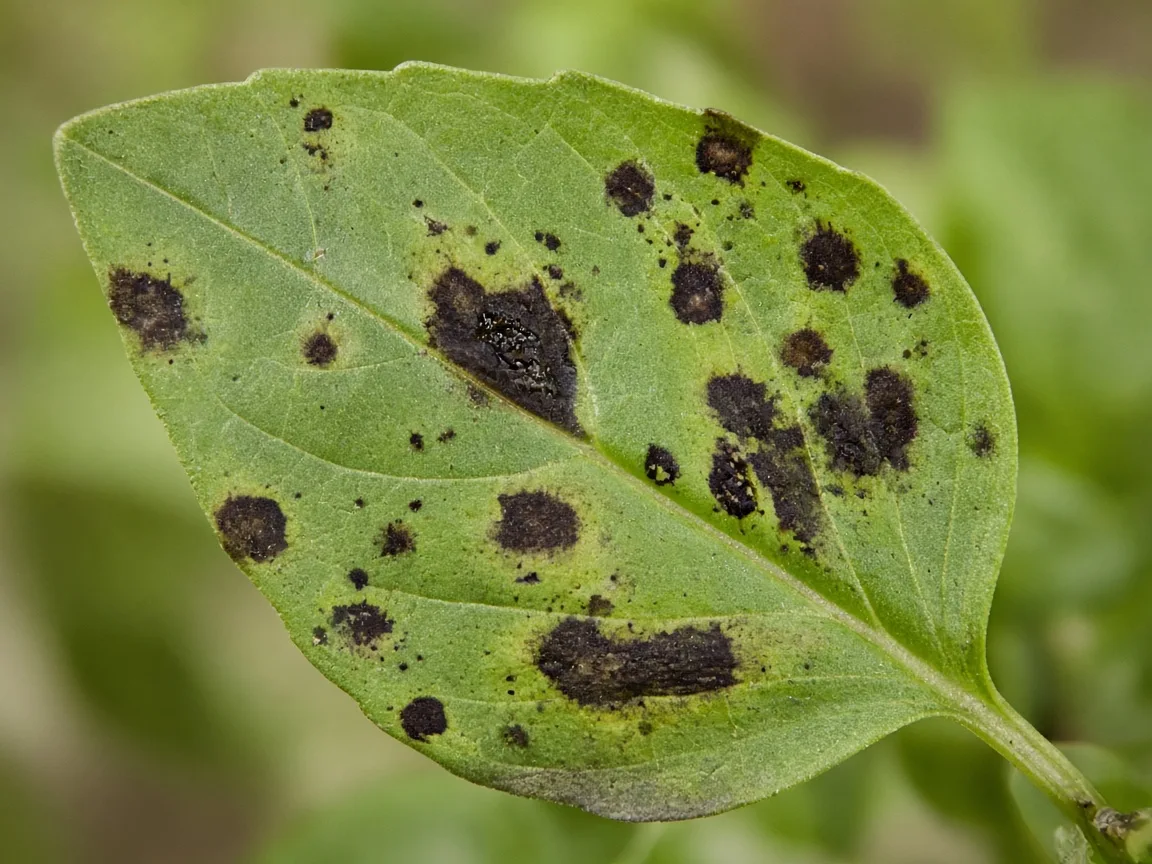
Dark spots on a basil leaf—check the underside for gray-purple downy mildew fuzz versus flat bacterial blotches.
Basil downy mildew (most serious)
Basil downy mildew is caused by Peronospora belbahrii, a water-mold pathogen that spreads on wind and wet foliage. Sweet green-leaf basil is especially vulnerable.
Typical pattern on basil:
- Lower, older leaves yellow first—often mistaken for nitrogen deficiency
- Leaves curl and wilt, then turn brown to black
- Gray-purple fuzzy growth on leaf undersides, most visible in morning humidity
- Spreads up the plant in warm, humid weather when leaves stay wet
Downy mildew affects basil only—it will not jump to your tomatoes or houseplants—but one infected pot can ruin an entire kitchen harvest within days.
Bacterial leaf spot
Dark, water-soaked spots on basil leaves often mean bacterial leaf spot from Pseudomonas species. Spots may start small and merge; advanced cases can move into wet stem rot. This follows overhead watering, misting, or rain splash that keeps foliage wet for hours—common when basil is crowded on a windowsill tray.
Fungal leaf spot
Alternaria, Septoria, and Colletotrichum can produce dark brown to black spots—sometimes with yellow halos or a shot-hole center as tissue drops out. Fungal spores splash from soil or infected debris when you water from above.
Cold and chilling injury
Basil is a tropical annual. Exposure below about 10 °C (50 °F) causes blackened or translucent patches on leaves without any fuzz underneath. This appears after a cold windowsill night, an AC draft, or bringing an outdoor pot inside without acclimating. Spots are often crisp, not water-soaked, and do not spread like mildew.
Overwatering and stem blackening (lookalike)
A soft black stem base on wet soil is not classic foliar leaf spot—it is damping off or root rot territory. Lower leaves may yellow and show dark edges, but the diagnostic clue is mushy tissue at the soil line, not scattered spots on healthy stem sections.
Why basil gets black spots
Basil wants full sun, evenly moist well-drained soil, and warm temperatures—a profile that leaves little margin when foliage stays wet or nights turn cool.
Harvest habits expose lower leaves. Regular pinching for pesto removes upper growth and leaves older lower leaves near the soil line. Those leaves catch splash, condensation, and spores—exactly where downy mildew starts.
Kitchen windowsill traps. A sunny sill sounds ideal, but glass can radiate cold at night while daytime sun heats the pot unevenly. Basil in a tight cluster on a saucer also blocks airflow between pots—humid microclimates that favor mildew after evening watering.
Overhead watering and misting. Basil needs consistent soil moisture, but wet leaves overnight invite bacterial and fungal spot. Extension guidance for basil recommends drip or soaker watering to keep foliage dry—especially important in humid summer weather when downy mildew is active.
Regional downy mildew pressure. Once P. belbahrii is present in an area, wind-borne spores can arrive on healthy plants even with good care. Reinfection from saved seed or overwintered infected plants keeps the cycle going—see prevention below.
How to confirm the cause
Work through these checks in order:
- Underside fuzz test. Hold a spotted leaf to the light. Gray-purple fuzz confirms downy mildew—no fungicide reliably cures it on home basil.
- Spot texture. Water-soaked, enlarging blotches suggest bacterial or fungal spot. Crisp black patches after a cold night suggest chilling—not disease spread.
- Which leaves first. Lower leaves yellowing then browning fits downy mildew. Random spots after misting fit bacterial spot. Tip-adjacent cold damage often hits outer leaves touching glass.
- Soil moisture. Soggy mix plus stem-base blackening points to overwatering, not foliar mildew. Probe the top 2–3 cm and lift pot weight per our watering guide.
- Spread speed. Mildew jumping to new leaves within a week in warm humid weather is urgent. A single stable spot on one old leaf may be mechanical splash or cold—monitor only.
- Stem cross-check. Cut a stem above soil. Brown streaks inside with relatively firm roots suggest Fusarium wilt—a different problem from spot diseases; discard those plants rather than spraying leaves.
First fix for basil
If you see gray-purple fuzz on leaf undersides, harvest all clean asymptomatic leaves now and use them today.
Strip every unaffected leaf and tender shoot you would eat, then bag and discard the entire plant—roots, stems, and fallen debris. UW-Madison Extension states there is no known cure for basil downy mildew; salvaging pesto-grade foliage before removal is the practical kitchen-first response.
Do not compost infected basil unless your pile reaches temperatures that reliably kill pathogens. Trash is safer for home gardeners.
If no fuzz is present and spots appeared after wet leaves or cold exposure, your first fix is different: stop wetting foliage—switch to base watering only—and move the pot out of cold drafts. Fix one variable before reaching for sprays.
Step-by-step recovery
Downy mildew (fuzzy undersides confirmed)
- Harvest clean leaves immediately for same-day use
- Remove and bag the entire plant and fallen leaf litter
- Do not replant sweet basil in the same container without washing it; fresh sterile mix is safer
- If mildew is active in your region, plant resistant varieties next time—Eleonora, Amazel®, Rutger DMR series, or Prospera®
- Space new pots for airflow; water at the base only
Home fungicides are not recommended for basil downy mildew—they rarely work well enough to save an edible crop.
Bacterial or fungal leaf spot (no mildew fuzz)
- Remove the most spotted leaves with clean scissors when plants are dry
- Pick up fallen debris on the soil surface
- Water at the base with a drip, saucer soak, or watering can directed at soil—not leaves
- Improve airflow: thin crowded stems, separate pots, avoid misting
- Do not overhead sprinkle in the evening; leaves must dry before cool night temperatures
Severely infected plants may not be worth saving late in the season—starting fresh seed in clean mix is often faster than repeated leaf picking.
Cold injury (crisp black patches, no fuzz, no spread)
- Move the pot away from single-pane winter glass, AC vents, and outdoor exposure when nights drop below 50 °F (10 °C)
- Trim fully dead black tissue; wait for warm stable conditions before judging recovery
- Do not fertilize cold-stressed basil until new growth looks healthy
When stem base blackens on wet soil
- Stop watering and inspect roots—follow the root rot guide if tissue is mushy
- This is a root-zone problem, not a leaf-spot spray problem
Recovery timeline
Downy mildew: No recovery of infected tissue. Clean harvest is same-day; expect to restart from seed or resistant transplants. In active mildew seasons, NC State Extension notes replanting the same year may fail if spores remain prevalent until frost.
Bacterial or fungal spot: Spotting should stop spreading to new leaves within one to two weeks after foliage stays dry and damaged leaves are removed. New pinched shoots should emerge clean.
Cold injury: Stabilization in three to seven days once warmth returns. Old black patches stay dead; judge success by fresh green shoots at the crown.
Worsening signs: Fuzz on upper leaves, rapid wilt despite moist soil, soft stem at soil line, or total defoliation within days—escalate to full plant removal rather than repeated leaf picking.
Lookalike symptoms
| What you see | Underside | Soil / context | Likely cause |
|---|---|---|---|
| Yellow lower leaves → brown/black | Gray-purple fuzz | Warm, humid | Downy mildew |
| Water-soaked dark spots | Flat, no fuzz | After misting or overhead water | Bacterial leaf spot |
| Brown-black spots with yellow halo | Dry | Splash from soil | Fungal leaf spot |
| Crisp black patches | Clean | After cold night | Chilling injury |
| Soft black stem base | N/A | Wet, sour mix | Root rot |
| Chewed holes | Clean | Outdoor or open window | Caterpillars |
What not to do
Do not mist basil leaves to “boost humidity” when spots are present—wet foliage spreads mildew and bacterial spot on an herb you eat raw.
Avoid home fungicide sprays on downy mildew expecting a saved crop—extension sources say consumer products rarely control it adequately on basil, and you may not meet safe harvest intervals anyway.
Do not save seed from spotted plants—downy mildew can pass through infected seed, and bacterial pathogens persist on debris.
Do not overwater because leaves look wilted when soil is already wet—basil wilts from root damage too; more water deepens overwatering and stem blackening.
Skip composting infected plants unless you know your pile reaches pathogen-killing temperatures.
How to prevent black spots next time
- Water at the base so leaves stay dry; use the basil watering guide finger test rather than a calendar
- Give full sun (6+ hours) with airflow between pots—see the light guide
- Use well-draining mix with perlite; avoid dense garden soil in small kitchen pots per our soil guide
- Plant resistant cultivars if downy mildew is common in your area—Thai basil, lemon basil, and purple types are less susceptible than sweet basil
- Buy steam-treated seed when available; do not save seed from diseased plants
- Harvest often so lower leaves do not linger as spore traps—but remove heavily spotted leaves promptly
- Keep basil above 50 °F (10 °C) on windowsills; move pots indoors before cold snaps
- Rotate containers and use fresh mix if a previous basil crop showed mildew
Can you still eat basil with black spots?
Basil is a food crop, so harvest safety matters. Clean, asymptomatic leaves harvested before you remove a downy-mildew plant are usually fine for same-day pesto if the plant was grown without pesticides and tissue is firm and fragrant.
Do not eat leaves showing gray-purple fuzz, slimy wet spots, mold, or rapid stem blackening. Discard any foliage from plants treated with fungicides or insecticides until label harvest intervals pass.
When in doubt, restart from seed for kitchen use—a new pot of basil is cheaper than guessing about pathogen contamination.
Related basil problems
If spot fixes do not match your symptoms, check these guides:
- Yellow leaves on basil — often the stage before downy mildew turns black
- Brown leaves on basil — whole-leaf browning rather than spotty blotches
- Brown tips on basil — margin burn, not center spots
- Root rot on basil — soft stem base on wet soil
- Overwatering on basil — chronic wet mix and lower-leaf yellowing
- Basil overview — full care hub for sun, water, and harvest rhythm
Conclusion
Black spots on basil reward a 30-second underside check before any treatment. Gray-purple fuzz means downy mildew—harvest clean leaves, then remove the plant and restart with resistant seed in dry-leaf conditions. Water-soaked spots without fuzz call for dry foliage and base watering. Crisp black patches after cold nights need warmth, not fungicide. Basil grows fast enough that a clean restart is often the best fix—especially when your goal is trustworthy leaves for the kitchen.
Reviewed by LeafyPixels Review Board · Claims validated against extension and botanical sources · See methodology in page metadata
When to use this page vs other Basil guides
- Basil watering guide — Use for routine moisture checks before assuming black spots is the main issue.
- Basil problems hub — Browse all common issues on this species.
- Yellow Leaves on Basil — Different entry point when yellowing precedes blackening.
- Root Rot on Basil — Different entry point when the stem base softens on wet soil.
- Brown Leaves on Basil — Different entry point when whole leaves brown rather than spot.