Magnesium Deficiency on Begonia Maculata: Causes, Checks &
Quick answer
Magnesium deficiency on begonia maculata shows as yellow tissue between dark green veins on older lower angel-wing leaves while silver spots may still show through the chlorosis. First step: confirm interveinal yellowing on older foliage—not uniform pale leaves from nitrogen loss alone.

Magnesium Deficiency on Begonia Maculata: Causes, Checks & Fixes
This guide covers magnesium deficiency on Begonia Maculata. See also the general Magnesium Deficiency guide, watering, and light pages for this plant.
Magnesium Deficiency on Begonia Maculata: Causes, Checks & Fixes
Quick answer
Magnesium deficiency on begonia maculata (Begonia maculata) shows as yellow tissue between dark green veins on older lower angel-wing leaves while silver polka dots may still show through the chlorosis. Magnesium is a mobile nutrient and chlorosis appears on mature leaves first.
See our magnesium deficiency guide. On polka dot begonia, inspect oldest lower angel-wing leaves—interveinal yellowing with visible silver dots through chlorosis is classic magnesium.
First step: confirm interveinal chlorosis on older lower leaves, not uniform pale washout from nitrogen loss.
When to use this page vs other Begonia Maculata guides
| Pattern | Read next |
|---|---|
| Old leaves yellow between green veins | Magnesium deficiency (this page) |
| Uniform pale lower leaves, faded spots | Nitrogen deficiency |
| Margin scorch on old wings | Potassium deficiency |
| Mushy stem, wet soil | Overwatering |
| New top leaf crinkle | Calcium deficiency |
What magnesium deficiency looks like on begonia maculata
Begonia maculata’s spotted angel-wing leaves make magnesium deficiency visually distinctive—dark green veins frame yellow interveinal tissue while silver dots still show through the chlorosis on oldest lower leaves.
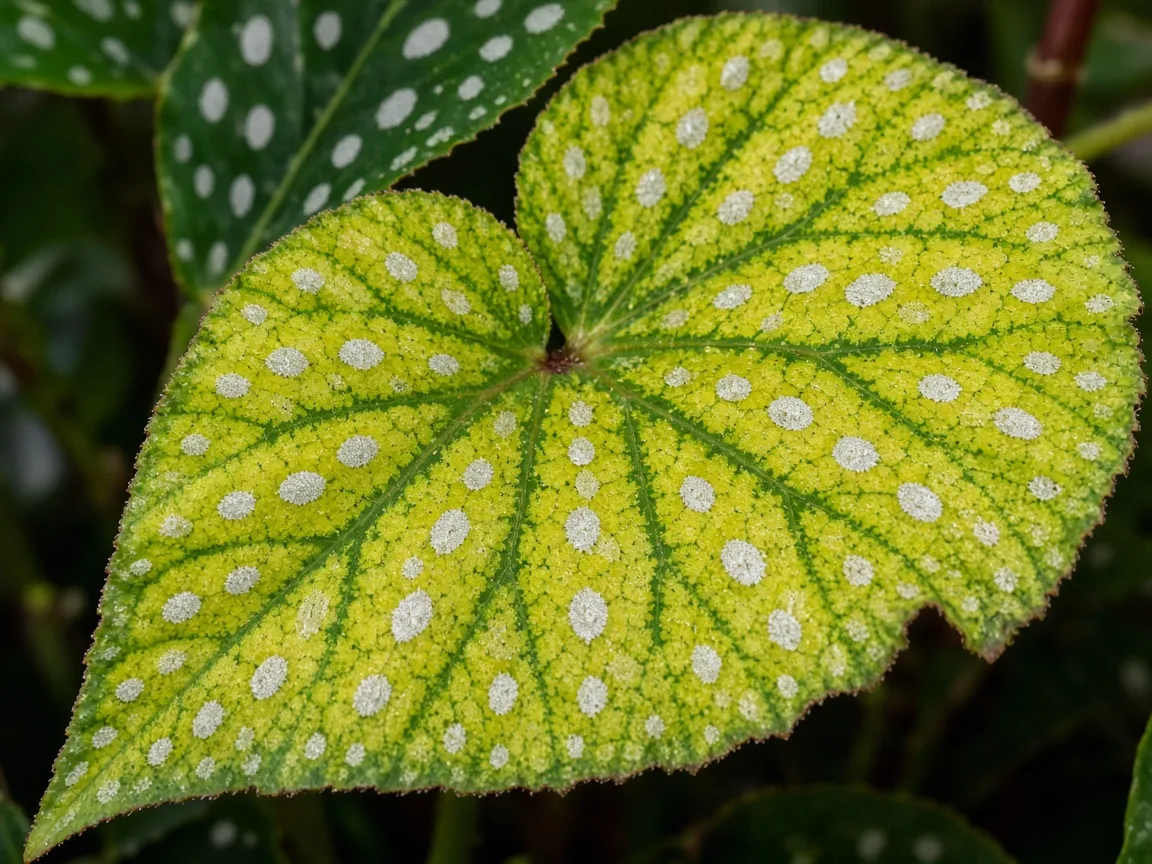
Interveinal chlorosis on a lower angel-wing leaf—green veins and silver polka dots visible through yellow tissue between them.
Typical signs:
- Yellow or pale green between dark green veins on older lower angel-wing leaves (interveinal chlorosis is the hallmark pattern)
- Silver polka dots visible through chlorotic tissue
- Veins stay relatively green while interveinal areas bleach
- New top leaves may look normal initially
- Firm stem base unlike mushy overwatered begonia
- Mid-season onset after fast summer growth with nitrogen-only feeding
Not magnesium deficiency:
- Uniform pale lower leaves — nitrogen deficiency
- Margin scorch — potassium deficiency
- Mushy stem on wet soil — overwatering
- New leaf distortion — calcium deficiency
Why begonia maculata gets magnesium deficiency
Fast-growing begonias deplete micronutrients quickly in bright indirect light with frequent watering. Nitrogen-heavy summer feeding without magnesium, plus leaching from regular irrigation, shows interveinal chlorosis on lower spotted leaves by mid-season.
Begonia-maculata-specific causes:
- Nitrogen-heavy feed without micronutrients — Fast leaf production, depleted magnesium.
- Leaching in light summer mix — Per the watering guide. Container plants need complete micronutrient feeds during fast growth.
- Same pot all season — Depleted without refresh.
- Blocked uptake from overwatering — Overwatering on soggy mix.
- Confusion with nitrogen deficiency — Uniform pale vs vein pattern.
- Wet foliage damage misread — Never wet spotted leaves; edge burn on mature wings differs from interveinal lower-leaf banding.
Interveinal chlorosis through silver polka dots
Begonia maculata’s spotted angel-wing leaves make magnesium deficiency visually distinctive—dark green veins frame yellow interveinal tissue while silver dots still show through the chlorosis on oldest lower leaves. That vein skeleton pattern differs from nitrogen washout, which fades the whole leaf including vein color and spot contrast uniformly.
Mid-season fast growth with nitrogen-only feeding is the most common trigger on container polka dot begonias. The diagnostic combination—visible silver dots through yellow interveinal tissue—is unique to this species and would not apply to plain-leaf begonias or other houseplants.
Fast summer growth and the micronutrient gap
Begonia maculata is a fast upright grower that can add multiple angel-wing leaves per month in bright indirect light. Each flush demands magnesium for chlorophyll. When owners push growth with nitrogen-heavy feed but skip micronutrients, lower leaves show interveinal banding while new top shoots may still look green—a split canopy that worsens through summer unless corrected.
Apply fertilizer at soil level—do not wet spotted foliage during treatment. Water at the base per watering guide to avoid confusing wet-leaf edge burn with nutrient symptoms.
Lookalike symptoms
| Pattern | Likely cause | Key difference on Begonia Maculata |
|---|---|---|
| Old leaves yellow between veins, dots visible | Magnesium deficiency (this page) | Interveinal banding with silver dots through chlorosis |
| Uniform pale lower leaves, faded spots | Nitrogen deficiency | Whole-leaf washout including veins |
| Margin scorch on old wings | Potassium deficiency | Outer edge burn, not between veins |
| Mushy stem, wet soil | Overwatering | Soft stem base |
| New top leaf crinkle | Calcium deficiency | Expanding top tissue only |
How to confirm
- Vein pattern on lower angel-wing leaves — Interveinal chlorosis with green veins.
- Spot visibility through chlorosis — Dots still show in yellow tissue.
- Fertilizer label — Micronutrients included vs nitrogen-only.
- Uniform pale vs interveinal — Nitrogen vs magnesium pattern.
- Stem firmness — Firm vs soft rot from overwatering.
- Season timing — Mid-season after heavy growth and feed imbalance.
- Wet foliage ruled out — Mature edge burn from overhead water differs from lower-leaf vein banding.
First fix for Begonia Maculata
One soil drench with Epsom salt at 1 tablespoon per gallon of water, or one half-strength complete fertilizer containing magnesium—after confirming firm stem base and appropriate moisture.
Apply at soil level—do not wet spotted foliage. Fix overwatering before repeated Epsom drenches on soggy mix.
Step-by-step recovery
- Switch to complete balanced fertilizer every two to four weeks per the fertilizer guide.
- Apply one Epsom drench if interveinal yellowing is clear—repeat once after two weeks only if pattern persists.
- Repot into fresh mix if roots fill the pot and chlorosis persists after two treatments.
- Correct overwatering if stem base is soft.
- Water at soil level only—never wet angel-wing foliage during recovery.
- Monitor new top angel-wing leaves for clean green without interveinal banding.
Recovery timeline
Judge recovery on new top angel-wing leaves:
- 1–2 weeks: Interveinal spread on lower leaves should stop
- 2–4 weeks: New top leaves emerge with uniform green and sharp silver dots—main success signal
- 4+ weeks: Two clean flushes confirm magnesium is adequate
Older chlorotic angel-wing leaves rarely fully re-green. Success means bold new leaves with clear spot contrast.
Mistakes to avoid
- Confusing nitrogen spot fade with magnesium banding. Nitrogen washes out whole leaves; magnesium keeps vein skeleton visible.
- Wetting spotted foliage when feeding. Water at soil level only on begonia maculata.
- Nitrogen-only feeding through fast summer growth. Micronutrients deplete quickly on fast begonias.
- Repeated Epsom on soggy mix. Fix drainage before second supplement.
- Expecting old lower leaves to re-green. Judge new top angel-wing flushes.
- Ignoring mid-season leaching. Same pot all summer depletes magnesium in light mix.
Prevention
- Use complete balanced fertilizer with micronutrients through growing season per fertilizer guide
- Refresh depleted mix at annual repotting
- Water at soil level per watering guide—never wet spotted leaves
- Avoid nitrogen-only products during fast summer extension
- Track feeding dates through peak growth months
- Flush mix occasionally to limit salt build-up
Related Begonia Maculata guides
- Begonia maculata overview
- Begonia maculata fertilizer
- Begonia maculata watering
- Nitrogen deficiency
- Potassium deficiency
- Calcium deficiency
- Begonia maculata problems hub
Conclusion
Yellow between green veins on lower polka-dot angel-wing leaves—with silver dots still visible through chlorosis—signals magnesium depletion during fast summer growth. Apply one Epsom drench or complete feed at soil level and monitor new top leaves for clean green and sharp spot contrast over two to four weeks.
Related tool
Use the Fertilizer Dilution Calculator to measure Epsom salt or half-strength complete fertilizer for magnesium deficiency recovery on this plant before changing multiple variables at once.