Calcium Deficiency on Bird's Nest Fern: Causes, Checks &
Quick answer
Calcium deficiency on Bird's Nest Fern shows as tan-brown necrosis, cupped margins, or stuck unfurl on the newest central fiddlehead while older outer strap fronds may stay glossy green. First step: confirm damage on expanding nest tissue—not green-vein yellowing from iron—then stabilize rim watering on moist (not waterlogged) mix so calcium can move with transpiration to the opening frond.
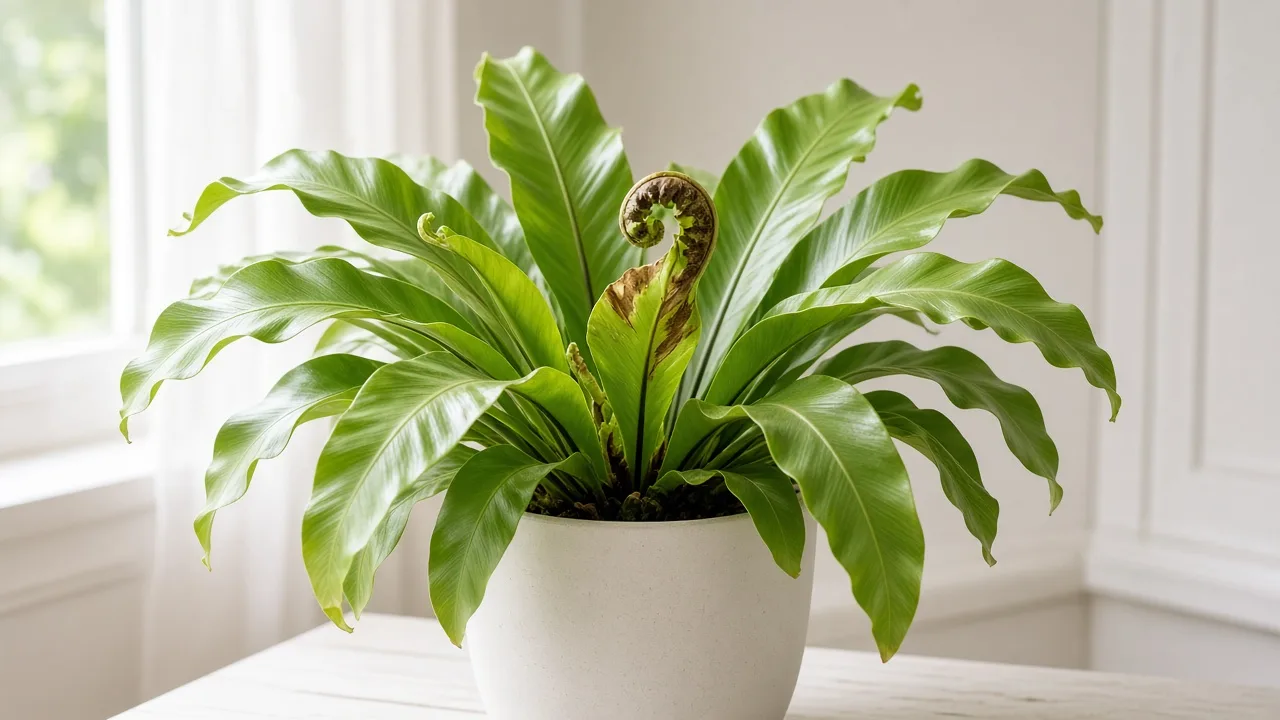
Calcium Deficiency on Bird's Nest Fern: Causes, Checks & Fixes
This guide covers calcium deficiency on Bird's Nest Fern. See also the general Calcium Deficiency guide, watering, and light pages for this plant.
Calcium Deficiency on Bird's Nest Fern: Causes, Checks & Fixes
Quick answer
Calcium deficiency on Bird’s Nest Fern (Asplenium nidus) shows on the newest central fiddlehead—tan-brown necrosis along the wavy margin, a cupped or hooked tip, or a frond that stalls while uncurling—while older outer strap fronds may still look glossy apple-green. Calcium is immobile in the plant, so deficiency symptoms show up first on new growth as expanding cell walls fail to get enough Ca, not on the lowest old fronds the way magnesium deficiency does.
See our calcium deficiency guide and the calcium deficiency symptom hub. On Bird’s Nest Fern, read damage on the blade still opening from the nest center—marginal browning and distorted unfurl point here before iron deficiency, which shows pale tissue between darker green veins on the same new frond.
First step: confirm marginal necrosis or hooked distortion on the newest unfurling fiddlehead—not green-vein chlorosis—then stabilize rim watering on moist (not waterlogged) mix.
When to use this page vs other Bird’s Nest Fern guides
| Pattern | Read next |
|---|---|
| Brown margins or hooked tips on newest nest fiddlehead | Calcium deficiency (this page) |
| Pale new frond with dark green veins (no brown necrosis) | Iron deficiency |
| Yellow between veins on oldest outer fronds | Magnesium deficiency |
| Puckered nest frond with silver streaks, black specks | Distorted leaves (thrips, dry unfurl) |
| Uniform pale older fronds without vein pattern | Nitrogen deficiency |
| Brown scorch at frond edges on lower blades | Potassium deficiency or brown tips |
| All fronds yellow, wet mix, soft crown | Overwatering or root rot |
| Multiple yellow causes at once | Yellow leaves |
What calcium deficiency looks like on Bird’s Nest Fern
Healthy Bird’s Nest Fern holds broad, wavy, undivided strap fronds in a funnel-shaped rosette, with new blades slowly uncurling from the central nest. Calcium supports cell wall formation in that expanding tissue, so when delivery fails, the youngest fiddlehead shows damage while the outer ring may look fine.
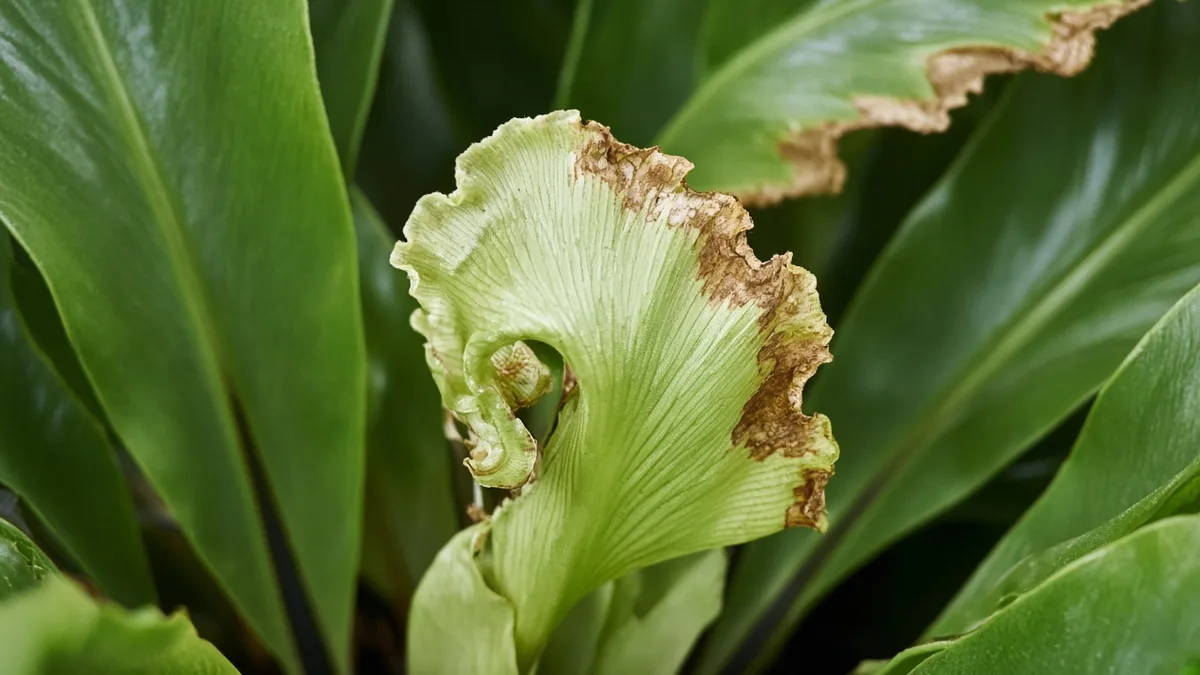
Marginal necrosis on a young nest frond—tan-brown tissue along the wavy edge of the opening fiddlehead while older outer blades stay greener. Judge recovery on the next unfurl, not on hardened scar tissue.
Typical signs:
- Tan or brown necrotic patches along the margin of the frond still uncurling from the nest center
- Cupped, hooked, or crinkled tips on the newest strap blade (young leaves may be misshapen with brown chlorotic spots along margins)
- Stuck or slow unfurl when the fiddlehead should be opening in warm humid months
- Smaller or ragged new fronds despite adequate indirect light
- Older outer fronds may stay bright green while only central new growth looks damaged
- Firm frond bases unlike mushy crowns on overwatered ferns
Not calcium deficiency:
- Pale lime tissue between darker green veins on the new central frond—iron deficiency (iron deficiency affects the youngest leaves first with a chlorosis pattern, not marginal necrosis alone)
- Yellow bands between veins on the lowest outer fronds—magnesium deficiency
- Silver feeding scars and stippling on the coiled nest frond—distorted leaves from thrips or dry-air stuck unfurl
- Crispy brown tips on otherwise green mature fronds without new-margin necrosis—salt or feed burn; see Bird’s Nest Fern fertilizer
- All fronds yellow on persistently wet soil with a soft crown—root rot
Why Bird’s Nest Fern gets calcium deficiency
Bird’s Nest Fern is a slow, rosette-forming epiphyte that adds only a few fronds per year indoors. Calcium is a component of cell walls and moves with water toward areas of high transpiration—like a rapidly expanding fiddlehead—yet it is absorbed and transported largely by a passive mechanism tied to transpiration. When that stream stutters, the nest center shows it first.
Bird’s Nest Fern–specific causes:
- Dry spells between rim waterings—RHS notes calcium deficiencies in containers are often caused by poor distribution within the plant following drying of the compost, not because the bag of potting mix lacked Ca on day one.
- Distilled or very soft water without calcium in the feed—Routine drinks that never supply secondary nutrients leave slow-growing rosettes short on Ca during unfurl season.
- Years in the same bark-coir pot—NC State Extension describes slow growth and modest feeding needs; a fern can look fine from across the room while mix is depleted and new fiddleheads struggle.
- Excess potassium or magnesium from fertilizer—Conditions that lead to calcium trouble often involve competition from K or Mg when growers chase deep green with incomplete formulas.
- Blocked uptake from wet roots—Chronic saturation in a cachepot prevents normal water and nutrient flow; see overwatering before calcium supplements.
- Low transpiration in dim corners—A nest fern in very low light may unfurl slowly with weaker Ca delivery to expanding tips even when mix contains some calcium.
Do not diagnose calcium deficiency on sour wet mix with a soft central crown—that is root failure until you confirm mostly firm roots at the pot edge.
Central fiddlehead vs the outer frond skirt
Calcium deficiency on Bird’s Nest Fern localizes to the blade still uncurling from the nest center—a pattern that would be wrong on a vining pothos where new leaves emerge along a runner, or on magnesium stress where oldest outer fronds band between veins first.
Walk the rosette from the inside out: if tan necrosis or a hooked tip sits only on the innermost opening fiddlehead while the lowest draping fronds look glossy, calcium belongs on the list. If every new frond shows pale tissue with dark green veins, switch to iron deficiency. If outer fronds yellow between veins, switch to magnesium deficiency.
Because nest ferns uncurl slowly, one damaged fiddlehead can sit in view for weeks—use that single central blade as your diagnostic anchor before repotting, changing fertilizer, or spraying the crown.
Transpiration, rim watering, and calcium delivery
Bird’s Nest Fern is watered at the outer pot edge, never into the central cup, per the Bird’s Nest Fern watering guide. That habit protects the crown from rot but means roots at the rim must stay functional and the plant must transpire enough to pull water—and calcium—into the opening fiddlehead at the top of the rosette.
When owners let the pot bone-dry for days, then flood it, or when a sealed cachepot keeps the core soggy while the surface looks fine, calcium distribution inside the plant can fail even though a fertilizer label lists Ca. The transpiration process is important in the transport of calcium.
Match drinks to your home: top 2–3 cm dry between waterings in warm months, slightly longer in winter when unfurling stalls. Pair that rhythm with 50–70% humidity so new fronds can expand without tearing—see low humidity when edges crisp during unfurl.
Never pour calcium or fertilizer into the rosette cup
Bird’s Nest Fern evolved as a litter-trapping epiphyte whose funnel collects debris and rain—not concentrated fertilizer or calcium poured into the crown. Gardening Know How stresses consistent moisture without wetting the crown and warns that excess fertilizer deforms fronds with brown or yellow edges.
For any calcium correction, apply only at the outer soil rim on already-moist mix—the same safe zone as routine feeding per Bird’s Nest Fern fertilizer. Pouring solution into the nest cup risks crown rot and will not reliably fix marginal necrosis on the opening fiddlehead if rim roots are stressed.
This crown-vs-rim rule is specific to funnel-shaped ferns; it does not apply to terrestrial vegetables or flat rosette succulents.
Lookalike symptoms
| Pattern | Check | Likely cause |
|---|---|---|
| Brown margins on newest nest fiddlehead | Watering swings, feed label, mix age | Calcium deficiency (this page) |
| Pale new frond, green veins, little necrosis | Alkaline water, wet mix | Iron deficiency |
| Interveinal yellow on oldest outer fronds | Epsom history, winter pause | Magnesium deficiency |
| Silver streaks on coiled frond | Magnifier on nest | Distorted leaves |
| Uniform pale older fronds | Months without feed | Nitrogen deficiency |
| All yellow, wet heavy pot, soft crown | Root smell | Overwatering |
| Crispy tips on many fronds after feed | White crust on rim | Brown tips |
How to confirm
- Symptom locus—marginal necrosis or hooked tips on the newest central fiddlehead, not uniform yellow on outer fronds alone.
- Iron split—green-vein pale wash on the same new blade without brown necrotic margins points to iron, not calcium.
- Crown firmness—soft, sunken nest tissue rules out simple starvation until rot is addressed.
- Moisture history—repeated dry-to-flood cycles or chronic wet core fit RHS calcium distribution failure more than a missing bottle on day one.
- Water and feed—distilled-only watering without complete feed; or heavy potassium bloom formulas without calcium listed.
- Pest cross-check—magnify the coiled frond for thrips before nutrition drenches.
- Growth season—warm months with visible unfurling vs cold stalled rosette with no new blades.
First fix for Bird’s Nest Fern
Confirm marginal necrosis or hooked distortion on the newest central fiddlehead—not green-vein chlorosis—before any supplement.
Once the pattern matches, stabilize rim watering so the top 2–3 cm of mix dries predictably between drinks while the root ball stays evenly moist (never bone-dry for days, never soggy for days) per Bird’s Nest Fern watering. That single rhythm correction restores the transpiration stream calcium needs before you add products.
After one to two weeks of stable moisture on a firm crown during warm active growth, apply one half-strength dose of complete liquid fertilizer that lists calcium on the label at the outer pot rim on already-moist mix, following the Bird’s Nest Fern fertilizer guide—fern feeding two to three times a year at half strength in spring and summer is a common conservative practice.
Do not drench a waterlogged pot, a fern with a soft crown, a plant you repotted within the last month, or a cold stalled specimen with no new fronds. Do not use Epsom salt as a calcium substitute—that adds magnesium, not Ca.
Step-by-step recovery
- Hold the corrected watering rhythm for one to two weeks while monitoring the opening fiddlehead.
- Apply one half-strength complete feed with calcium at the outer rim during late spring or summer active unfurl.
- Flush salts if white crust rings the pot—leach with plain water at the edge, then resume with a complete formula.
- Repot into fresh bark-coir mix if roots fill the pot and two successive new fronds stay necrotic after watering fix and one measured feed—see Bird’s Nest Fern repotting.
- Repeat one measured feed after six to eight weeks only if the crown stays firm and the next fiddlehead still shows marginal browning—do not feed weekly on a slow fern.
- Leave partially green distorted fronds in place until replacements open; do not strip half the rosette at once.
- Monitor the next unfurling frond for even green margins without expanding brown patches.
Mistakes to avoid
- Calcium spray or drench before moisture check—Products cannot fix distribution failure on alternately dried and flooded mix.
- Pouring feed into the rosette cup—Crown rot risk outweighs any shortcut for nest-margin necrosis.
- Confusing iron and calcium—Vein-retained chlorosis on a pale new frond is the iron page; marginal necrosis on the same age tissue points here.
- Epsom salt for brown tips—Magnesium correction targets outer interveinal banding, not central marginal necrosis.
- Feeding during cold stall—Salts accumulate when nights drop and unfurling stops.
- Expecting scarred fiddleheads to flatten—Judge recovery by the next opening frond, not by old brown margins.
Recovery timeline
Correct calcium delivery on healthy roots shows cleaner margins on the next one or two unfurling fronds within four to ten weeks during warm active growth. Fiddleheads that already hardened with brown edges rarely re-green; the rosette slowly replaces them as new blades open from the center.
Full outer-ring refresh on a large specimen may take one warm season because Bird’s Nest Fern adds fronds slowly. If three successive new fiddleheads stay necrotic after stable watering and two measured complete feeds with a firm crown, reassess iron deficiency, light, and overlapping pale leaves causes.
Prevention
- Water at the outer rim on a predictable schedule; avoid long dry spells that interrupt Ca distribution per RHS guidance.
- Feed with complete balanced fertilizer that includes calcium during active late spring and summer per the Bird’s Nest Fern fertilizer guide—pause in cool months when unfurling stalls.
- If you use soft or distilled water, ensure the feed supplies secondary nutrients including Ca.
- Flush salts mid-season when hard tap water or frequent feeding builds crust on the rim.
- Refresh bark-coir soil every two years when repotting slow-growing rosettes.
- Pair nutrition with adequate humidity and indirect light so new fronds transpire and expand normally.
Related Bird’s Nest Fern guides
- Bird’s Nest Fern overview — species baseline and care hub
- Bird’s Nest Fern problems — full symptom index for this fern
- Bird’s Nest Fern fertilizer — dilute feed timing and salt mistakes
- Bird’s Nest Fern watering — rim watering that pairs with calcium delivery
- Bird’s Nest Fern soil — airy coir-bark mix that holds nutrients without waterlogging
- Iron deficiency — when new crown fronds yellow with green veins
- Magnesium deficiency — when outer fronds band between veins
- Distorted leaves — thrips and dry unfurl on the nest fiddlehead
- Yellow leaves — moisture-first diagnosis when color shifts broadly
Scope note: Use this page when tan necrosis or hooked margins hit the newest central fiddlehead on a firm rosette. Use iron deficiency when pale tissue between green veins dominates the same new frond; use distorted leaves when silver scarring or pests explain puckered nest growth.
Conclusion
Marginal browning or a stuck unfurl on the newest Bird’s Nest Fern fiddlehead is a calcium delivery signal during warm active growth—confirm the damage stays off the classic iron vein pattern, verify a firm crown, rule out thrips on the coiled frond, stabilize rim watering, then apply one measured complete feed with calcium at the pot edge on moist mix.
Related tool
Use the Fertilizer Dilution Calculator to narrow causes for calcium deficiency on this plant before changing multiple variables at once.