Caterpillars on Bird's Nest Fern: Causes, Checks & Fixes
Quick answer
Caterpillars on Bird's Nest Fern chew irregular holes through undivided strap fronds and leave dark pellet-like frass, usually after patio time, nursery hitchhikers, or moth eggs near open windows. First step: isolate the fern and hand-pick every larva from the central funnel and frond undersides at dusk with a flashlight.
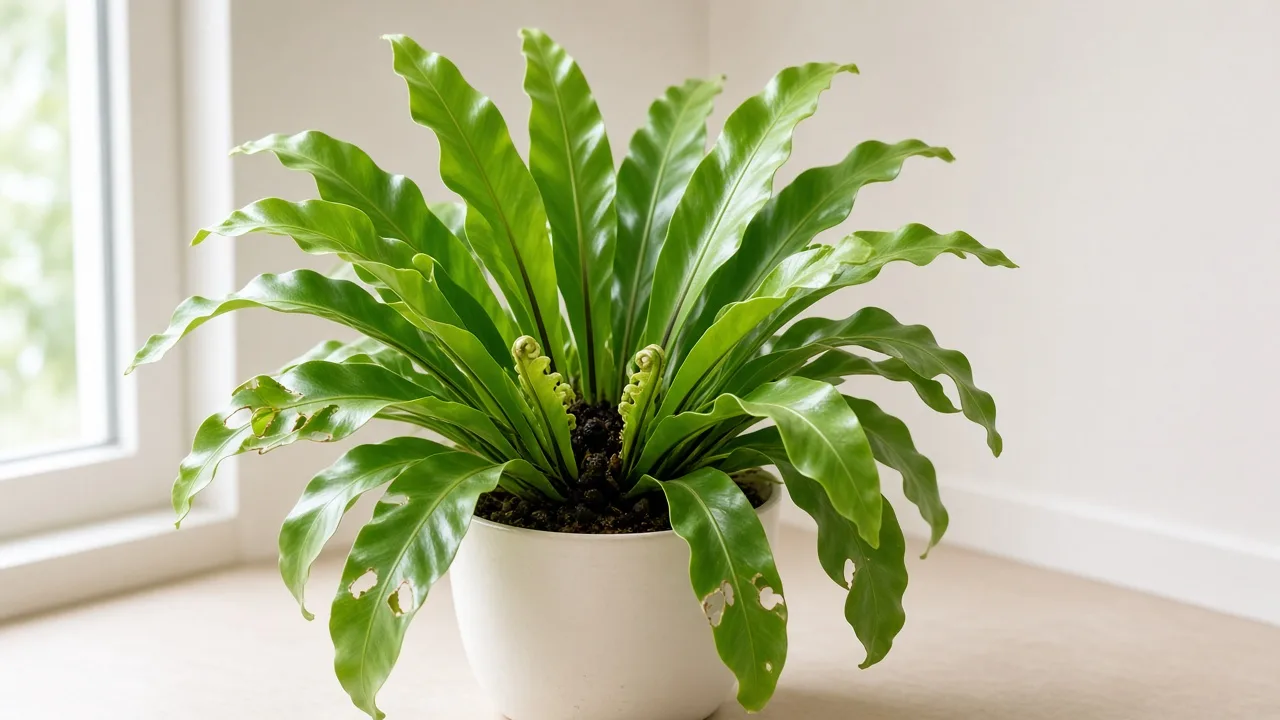
Caterpillars on Bird's Nest Fern: Causes, Checks & Fixes
This guide covers caterpillars on Bird's Nest Fern. See also the general Caterpillars guide, watering, and light pages for this plant.
Caterpillars on Bird's Nest Fern: Causes, Checks & Fixes
Quick answer
Caterpillars on Bird’s Nest Fern (Asplenium nidus) chew irregular holes and notched margins through undivided strap-shaped fronds and leave dark pellet-like frass on foliage, the pot rim, or the shelf below. Indoor cases are uncommon compared with scale, mealybugs, slugs, and snails on bird’s nest fern, and usually trace to hitchhiking larvae after patio season, nursery stock, open windows, or moth eggs on outdoor ferns.
For general caterpillar biology and control options, see our caterpillars guide. On Bird’s Nest Fern, larvae often concentrate in the funnel-shaped central rosette and along midrib undersides of overlapping strap fronds—exactly where the plant collects falling debris as a litter trapper and where a quick watering check at the pot edge never looks.
First step: isolate the fern and hand-pick every caterpillar from the central funnel and frond undersides at dusk with a flashlight.
When to use this page vs other Bird’s Nest Fern guides
| Pattern | Read next |
|---|---|
| Ragged chew + frass pellets + visible larvae | This page |
| Open holes but unsure of chewer type | Holes in leaves |
| Serpentine tunnels inside blade, no through-holes | Leaf miners |
| Silvery streaks, black specks, no full holes | Thrips |
| White cottony clusters at frond bases | Mealybugs |
| Brown armored bumps on fronds or rhizome | Scale insects |
| Fine webbing and stippling on frond undersides | Spider mites |
| Straight dark lines on frond undersides, no chew | Normal spores (see below)—not a pest page |
| Soft crown, sour soil, wilt without frass | Overwatering or root rot |
What caterpillars look like on Bird’s Nest Fern
Caterpillars in houseplants are uncommon but unmistakable once you find the larva. On Asplenium nidus, the signature is ragged holes chewed through glossy, entire strap fronds with a prominent dark midrib—not the bordered internal tunnels of leaf miners or the sticky shine of sap feeders.
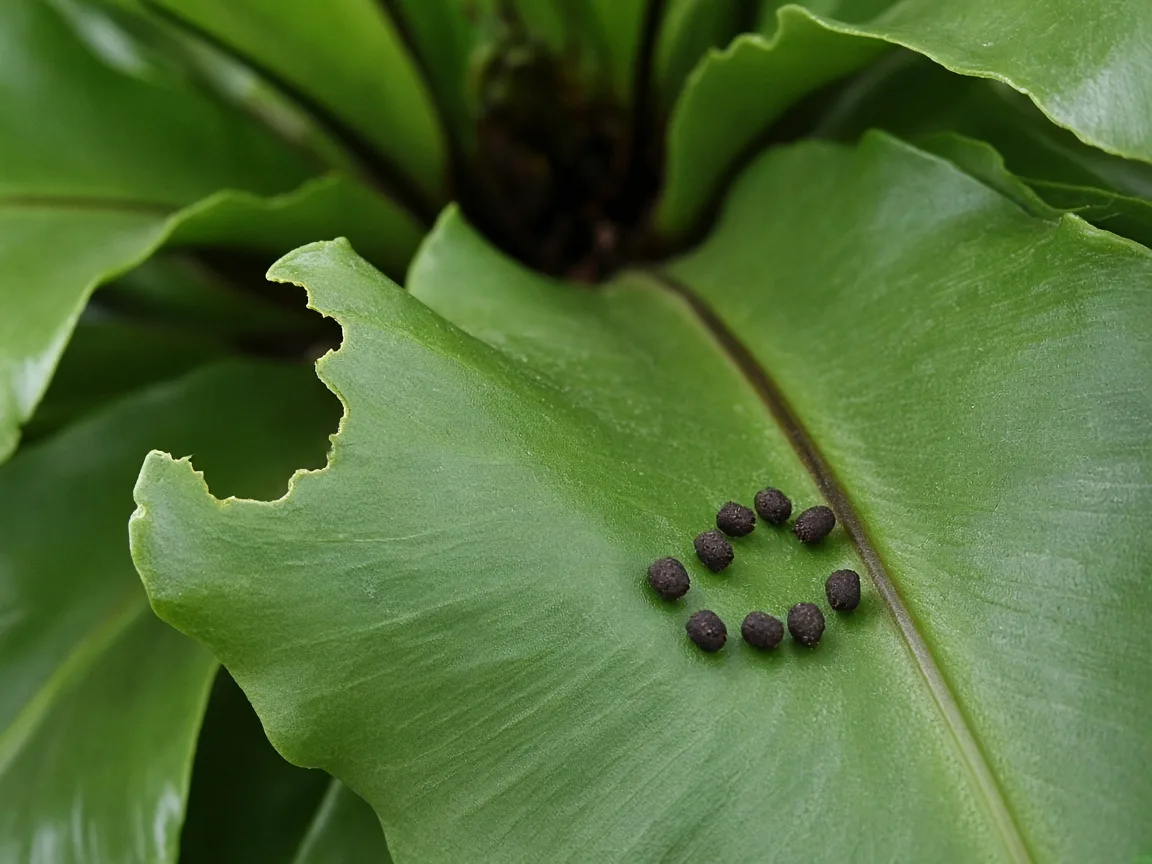
Irregular chew notches through a wavy strap frond with dark pellet-like frass at the central rosette—compare with an intact neighbor frond on the same plant.
Chewed holes and ragged margins:
- Irregular holes and notched edges on bright green, wavy strap fronds with tissue torn inward, not a clean crease from bumping the pot
- Damage concentrated on newest soft fronds still uncurling from the crown before it spreads to mature outer blades
- Dark pellet-like frass on frond surfaces, inside the central funnel, on pot rims, saucers, or the shelf below the rosette
Larva signs (when you can see them):
- Green, brown, or patterned caterpillars tucked along the underside midrib, between overlapping frond bases, or inside rolled or silk-tied frond tips
- Visible chewing on the highest unfurling strap blade before damage spreads to lower fronds
- Thin silk on frond edges from some leaf rollers—gently open one suspect roll before assuming humidity crinkle
Growth impact on Bird’s Nest Fern:
- Shredded unfurling fronds when feeding is heavy during warm humid months
- Stalled crown growth when larvae keep chewing the same soft tip before it hardens
- Whole-rosette limp collapse without frass or larvae still points to overwatering, crown rot from watering the funnel, or root rot—not caterpillars alone
Unlike spider mites, caterpillars do not produce stippling or webbing. Unlike mealybugs, no cottony wax appears—only open chewing wounds and frass.
Central funnel hiding spots (Bird’s Nest Fern only)
Asplenium nidus grows as a funnel-shaped rosette of undivided fronds that unfurl from a tight center—not divided pinnae like a Boston fern. Caterpillars exploit that architecture:
- Larvae curl between overlapping strap frond bases in the crown where debris naturally collects and daytime light is dim
- Soft new crown fronds are easier to chew than stiff mature outer blades—repeat hole damage often starts on the highest unfurling strap before lower fronds show notches
- Some species roll or tie frond tips with silk; on bird’s nest fern a stuck-shut wavy blade is a leaf-roller sign, not low-humidity crinkle alone
- Night feeding means daytime inspections skip active larvae—plan dusk passes inside the funnel, not just glossy tops viewed from across the room
This funnel pattern is why bird’s nest fern caterpillar cases get misdiagnosed as distorted leaves or mechanical tears until someone finds frass in the rosette bowl.
Spore lines vs frass pellets (Bird’s Nest Fern only)
True ferns reproduce by spores, not flowers. On bird’s nest fern, sori appear as dark lines on frond undersides arranged in herringbone fashion from the midrib toward the margin. That pattern confuses many owners:
- Spore lines are straight, fixed, and symmetrical on the underside—they do not fall off when you tap the frond
- Frass pellets are loose, barrel-shaped, and roll off onto white paper when you shake the blade
- Spores do not come with ragged chew margins or a visible larva; caterpillars do
- UF/IFAS notes slugs and snails on bird’s nest fern leave slime trails, not pellet frass—route slime-only damage toward holes in leaves and outdoor exposure checks
Do not spray fungicide on normal spore lines. Confirm chew and frass before any pesticide.
Rinsing larvae without crown rot (Bird’s Nest Fern only)
After hand-picking, a lukewarm shower can dislodge tiny eggs or hatchlings—but bird’s nest fern has a strict watering rule: never flood the central rosette. NC State lists fragile foliage and crown stress among common problems.
- Tilt the pot and rinse frond surfaces and undersides while keeping the funnel as dry as practical
- Water at the pot rim during normal care—see the Bird’s Nest Fern watering guide—not into the crown
- Let fronds dry in medium indirect light with airflow; soggy crown tissue after a heavy rinse invites rot faster than caterpillars do
- If you must rinse, do it once after picking, then switch to dry inspection passes for the next week
Why Bird’s Nest Fern gets caterpillars
Caterpillars are far less common indoors than sap-sucking pests on tropical foliage. When chew damage appears on a bathroom or living-room bird’s nest fern, suspect a recent introduction rather than chronic indoor pressure.
Outdoor patio and nursery hitchhikers. Ferns summered outdoors or near open windows can pick up moth or butterfly eggs on frond undersides. Pests arrive on nursery stock and outdoor plants and continue feeding indoors where predators are absent.
Soft crown fronds in humid rooms. Bird’s nest fern pushes new strap blades from the rosette whenever medium indirect light and warmth are good. Caterpillars prefer soft, expanding tissue—one larva can shred an unfurling frond before you notice holes on mature outer blades.
Litter-trapping crown microhabitat. The rosette catches debris that mimics forest-floor cover—ideal daytime cover for small larvae between frond bases.
Indoor warmth without predators. Indoor plants lack natural enemies that control caterpillars outdoors. A single egg mass can hatch into multiple larvae feeding in the same funnel where birds and parasitic wasps cannot reach.
Extension references for bird’s nest fern emphasize scale, mealybugs, slugs, and snails—not caterpillars—so chewing with frass is a strong sign you are dealing with a hitchhiker, not the fern’s usual pest list.
How to confirm the cause
Work through these checks before you spray:
- Crown funnel first — Spread overlapping frond bases gently and look inside the rosette bowl. Caterpillars feed where tissue is softest and debris accumulates.
- Night inspection — Inspect at dusk or dawn with a flashlight; larvae feed actively on frond undersides and inside rolled tips.
- Frass check — Hold a damaged strap frond over white paper and tap the midrib. Black or green pellets rolling off suggest caterpillars—not fixed spore lines.
- Backlight test — Hold a suspect frond to light. Internal bordered tunnels confirm leaf miners, not caterpillars.
- Slime check — Silvery dried trails without pellets point to slugs or snails per UF/IFAS pest notes, especially after outdoor culture.
- Unroll tied tips — Silk-bound curled blades may hide a small larva or frass line inside—open one suspect roll carefully.
- Isolate first — Move the fern away from other houseplants. Caterpillars walk between pots on shared shelves.
- Recent history — Note outdoor time, new purchases, open windows, or greenhouse bench plants in the past month.
If you find a larva with ragged holes and pellet frass, caterpillars are confirmed. If only internal tunnels appear, switch to the leaf miners guide.
First fix for Bird’s Nest Fern
Hand-pick every caterpillar you can find before reaching for sprays. Gardening Know How recommends plucking caterpillars and dropping them into a bucket of soapy water, and checking for egg clusters on frond undersides at the same time.
Work at dusk or dawn when larvae feed openly. Start at the crown funnel and move outward:
- Lift overlapping strap fronds and inspect midribs, bases, and debris in the rosette bowl
- Cut out and bag rolled frond tips that hide larvae or egg clusters rather than tearing them into the crown
- Check the pot rim and soil surface where larger larvae hide by day
- Remove frass and dropped frond bits from the saucer so you can tell whether new feeding continues
Make this one correction before insecticides. Watch the fern for five to seven days. If new holes appear, move to the secondary steps below.
If hand-picking is not enough
When larvae are too numerous, hidden in tied frond tips, or returning after a first pass, escalate in this order rather than stacking treatments the same day.
Apply Bacillus thuringiensis (Bt kurstaki)
Bt is a microbial insecticide that kills lepidopteran larvae when they eat treated foliage; Ask Extension notes Bt kurstaki as an option for caterpillars on houseplants when hand removal fails. Spray frond surfaces, not the crown pool, in late afternoon or on a cloudy evening when larvae are actively eating—Bt must be ingested to work. Repeat every seven to ten days until you see no new damage.
Target rolled fronds and funnel axils
For leaf rollers, clip and bag tied blades with visible silk and frass rather than spraying the entire rosette. Direct any spray to crown fronds and midrib undersides where bird’s nest fern keeps soft tissue—not random drenching into the funnel.
Insecticidal soap on small larvae only
Insecticidal soap labeled for ornamentals can contact-kill very small caterpillars on houseplants. It does not replace Bt on larger larvae and can stress fragile bird’s nest fronds if you spray in harsh sun. Test one frond first.
Avoid broad-spectrum synthetic sprays on stressed ferns unless a local extension directs them—and never stack soap, Bt, and horticultural oil on the same day on wilted foliage.
Recovery timeline
Judge progress by a clean new frond uncurling from the crown, not by old notched strap blades.
- Within one week: Hand-picking should stop new frass in the funnel if you caught active larvae
- Three to six weeks: Expect one intact new strap frond on a firm rosette in medium indirect light with steady moisture at the pot edge—bird’s nest fern grows slowly compared with vines
- Chewed mature fronds: Permanent cosmetic damage—remove only after a replacement frond opens so you do not strip too much photosynthetic area at once
- Repeated defoliation: If crown fronds are stripped every warm month, review outdoor exposure, quarantine new ferns, and scout weekly during patio season
Whole-rosette collapse with soft crown tissue and sour soil is a watering emergency, not caterpillar recovery—read overwatering before you keep spraying foliage.
Mistakes to avoid
- Pouring water or pesticide into the crown funnel — Invites rot on a fern that must stay dry at the rosette center
- Mistaking spore lines for frass — Fixed herringbone lines on undersides are normal; loose pellets are not
- Fertilizing a chewed fern first — Nutrients do not remove larvae; confirm pests before feeding—see the Bird’s Nest Fern fertilizer guide only after new growth looks stable
- Repotting on day one — Unnecessary unless you also find waterlogged mix or root failure; caterpillars rarely require repotting
- Rough handling — Fragile fronds break easily; support blades when inspecting the funnel
How to prevent caterpillars next time
- Quarantine new ferns two to three weeks before placing them beside established plants
- Brush debris from the crown funnel after every outdoor patio stay
- Screen open windows at night in warm months when moths are active
- Scout weekly during fast summer growth—soft crown fronds appear quickly in humid bathrooms
- Keep saucers clean — frass at the pot rim signals ongoing feeding if you miss a larva
- Maintain airy, well-draining mix — stressed ferns recover slower after defoliation; follow the Bird’s Nest Fern soil guide
Related Bird’s Nest Fern guides
Use this page when you see ragged chew, pellet frass, and larvae or egg clusters on strap fronds—especially in the central funnel. Route to holes in leaves when damage is unclear, leaf miners for internal tunnels, and mealybugs or scale insects when sap-feeding signs dominate without frass. For baseline culture that keeps ferns resilient after pest removal, start with the Bird’s Nest Fern overview and problems hub.
Related tool
Use the Plant Problem Diagnosis Tool to narrow causes for caterpillars on this plant before changing multiple variables at once.