Black Spots on Blue Star Fern: Causes, Checks & Fixes
Quick answer
Black spots on Blue Star Fern are usually fungal or bacterial leaf spot on wet lobed fronds, sun scorch on blue-green blades, sooty mold above sap feeders, rhizome rot from buried wet rhizomes, or normal sori on the underside—not random fern failure. First step: stop misting and overhead watering, keep golden rhizomes on the dry mix surface, and improve airflow before any spray.
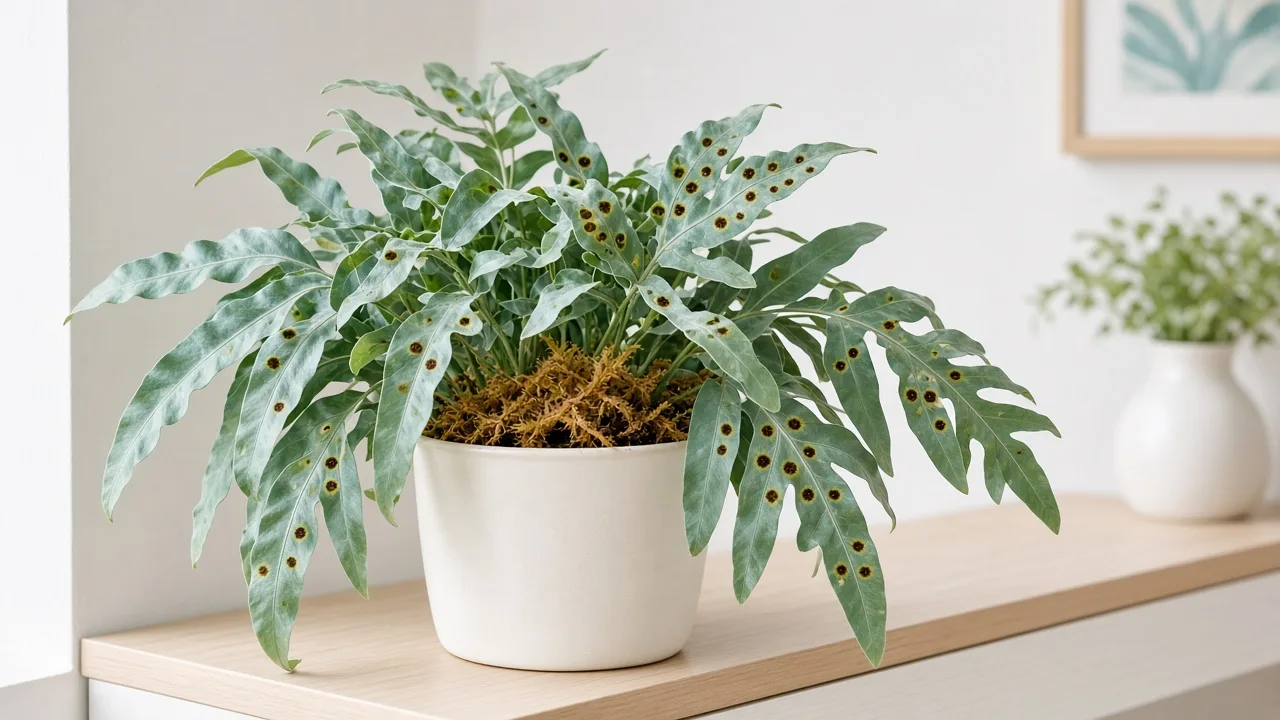
Black Spots on Blue Star Fern: Causes, Checks & Fixes
This guide covers black spots on Blue Star Fern. See also the general Black Spots guide, watering, and light pages for this plant.
Black Spots on Blue Star Fern: Causes, Checks & Fixes
Quick answer
Black spots on Blue Star Fern (Phlebodium aureum) are localized dead tissue on the wavy, blue-green, deeply lobed fronds that spread from creeping golden-scaled rhizomes. On this epiphytic fern, the usual split is: wet circular spots with yellow halos on the upper lobe surface mean fungal or bacterial leaf spot after foliage stays damp; flat black patches on sun-facing blades often track scorch; black smear that wipes off points to sooty mold above scale insects or spider mites; soft black rhizomes at the soil line mean rot from buried or constantly wet rhizomes; and organized brown patches on the underside only are normally sori (spores), not disease.
For general spot-disease mechanics on houseplants, see our black spots guide. On Blue Star Fern, the fuzzy rhizomes are meant to sit on the mix surface like they would on bark—when mist, splash, or heavy top-watering keeps them wet, black rot and leaf-spot pathogens both get an easy start.
First step: stop wetting foliage, let surface rhizomes dry, and improve airflow around the clump. Resume edge watering only once you have confirmed the pattern below.
When to use this page vs other Blue Star Fern guides
| Your pattern | Best page |
|---|---|
| Dark spots or patches on frond lobes | This page |
| Soft black golden rhizomes on soggy mix | Overwatering / Root rot |
| Crispy brown edges only, no mid-lobe circles | Brown tips / Low humidity |
| Whole fronds yellowing on heavy wet soil | Overwatering |
| Sticky leaves with black coating that rubs off | Scale insects (sooty mold) |
| Pale dull fronds in a dim corner | Not enough light |
What black spots look like on Blue Star Fern
Healthy Phlebodium aureum forms a loose clump of arching, deeply lobed, glaucous blue-green fronds from thick rhizomes densely covered in golden scales that creep across the pot surface. Black-spot problems break that look in recognizable ways:
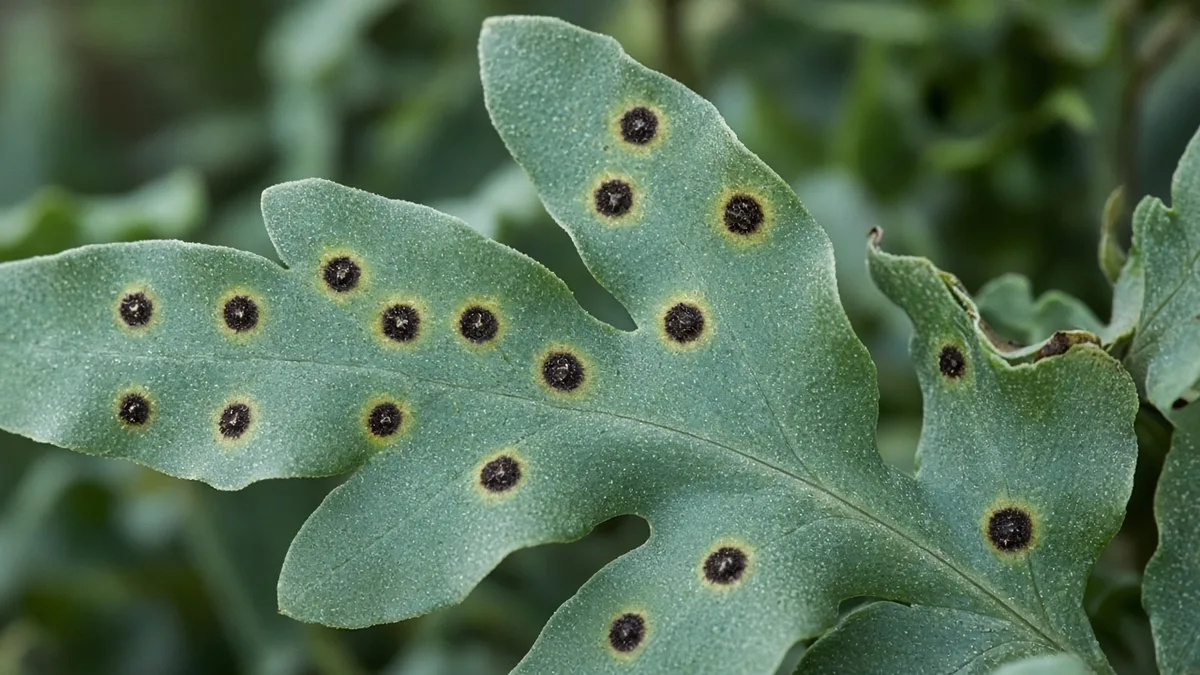
Leaf-spot lesions on Blue Star Fern—compare wet halos and lesion edges with healthy blue-green tissue on the same lobe.
- Small dark brown to black circles with yellow halos on the upper frond surface — Often start water-soaked, then crisp at center. Matches fungal leaf spot with yellowish margins after splash or misting.
- Water-soaked black specks that merge in humid air — Bacterial leaf spots stay uniform early, may show greasy margins, and spread faster when fronds stay wet overnight.
- Flat dry black patches on the sun-facing side of lobes — Usually too much direct light or heat on a shade-adapted fern, not infection.
- Blackening along surface rhizomes while mix is soggy — Rhizome tissue failure from water trapped against golden scales; see overwatering, not mid-blade leaf spot alone.
- Brown to orange patches on the underside — Normal sori on mature fronds; stable for months, no upper-surface halos.
- Black coating that wipes away — Sooty mold on honeydew from scale or mites, not fixed necrosis inside the blade.
Spots on newly unfurling frond tips are more urgent than one dry mark on the lowest arching frond.
Sori vs disease on lobed Blue Star fronds
Blue Star Fern reproduces by spores, not flowers. On mature lobes you will see brown to black sori on the underside, often as scattered patches or short rows along the lobe midrib. They feel slightly textured, stay in fixed positions, and do not produce yellow halos on the upper surface.
Leaf-spot disease targets the upper blade: expanding circles, greasy margins when wet, and new lesions on neighboring fronds within one to two weeks. If you only see organized patches underneath while the top stays uniformly blue-green, you do not need fungicide—you need to stop confusing normal fern biology with infection.
This distinction is plant-specific: the lobed, glaucous fronds and creeping rhizome habit do not match bird’s nest or maidenhair diagnosis pages. Compare the same lobe top and bottom in bright light before treating.
Why golden rhizomes on the surface change the risk
In the wild, Phlebodium aureum grows as a rhizomatous epiphyte with golden-scaled rhizomes spreading over bark. Indoors, that same anatomy means buried or drip-soaked rhizomes rot faster than buried roots on many houseplants.
Surface rhizomes should sit on or just above the mix, not under soggy bark. Gardening guidance for this species stresses watering at the pot edge and avoiding direct soak of rhizomes—chronic wet scales invite black mush that looks like “mystery spots” climbing from the base into fronds.
Wavy lobe margins hold mist droplets in the ripples overnight. In still bathroom air or crowded shelves, those pockets stay damp long enough for fungal spores to germinate on foliage—especially on the broad, slightly rubbery lobes Blue Star Fern is known for.
NC State lists crown rot and root rot among diseases on this species when culture stays too wet, while also noting the plant tolerates drying between waterings better than many ferns—so black basal tissue often means wet rhizomes, not underwatering alone.
Why Blue Star Fern gets black spots
Fungal leaf spot (most common on wet fronds)
Several fungi cause small brown spots with yellowish margins; tiny black dots may appear in dead tissue. Splash from infected soil, shared watering cans, or wet cachepot overflow moves spores between pots. Blue Star Fern’s horizontal, lobed fronds catch more splash than narrow upright leaves.
Bacterial leaf spot
Bacterial infections show water-soaked spots, sometimes with yellow halos, that can enlarge in wet conditions. Warm, humid, stagnant air around a bathroom cluster favors bacteria—especially if you trim with unsanitized scissors.
Sun scorch and heat stress
Blue Star Fern wants bright indirect light, not direct sun. A frond pushed against a hot south window or grow light can develop dry black patches on the exposed face while the shaded side stays glaucous green. RHS guidance notes shade lovers brown when light is too strong.
Sooty mold from sap feeders
NC State recommends monitoring spider mites and thrips on this fern. Honeydew from mites or scale grows superficial black mold that wipes off—unlike embedded leaf-spot necrosis. Treat the pest, then rinse fronds gently with room-temperature water.
Rhizome rot and basal blackening
Moist but aerated mix is the target—yet chronically soggy bark plus water pooling on rhizomes produces soft black tissue along golden scales, not isolated mid-lobe spots. Route to root rot when roots are soft and multiple fronds wilt on wet mix.
Normal lower-frond senescence
One older arching frond may develop brown-to-black tips or patches before the plant sheds it. No halos on new growth, firm surface rhizomes, and stable mix moisture mean aging—not epidemic leaf spot.
How to confirm the cause
Work through these checks in order:
- Top vs bottom — Upper-surface halos = disease or scorch; underside patches only = likely sori.
- Wet test — Touch the spot. Greasy and water-soaked suggests bacteria; dry and papery suggests scorch or fungal spot after drying.
- Wipe test — Black smear that rubs off = sooty mold; spot stays in the leaf = necrosis.
- Rhizome squeeze — Press golden scales at the soil line. Firm tissue supports leaf-spot culture fixes; soft black mush means escalate to overwatering / root rot.
- Light map — Spots only on the window-facing side point to light stress before fungicide.
- Pest scan — Check lobe undersides and rhizome joints for webbing (spider mites) or bumps (scale).
- Recent culture — Misting, shower rinses, or pouring water over rhizomes in the last week strongly favor leaf spot over random stress.
The first fix to try
Stop wetting foliage and let surface rhizomes dry today. Blot pooled water from frond bases with a dry cloth, move the plant slightly away from neighbors for airflow, and switch to edge watering only when the top 3 cm of mix begin to dry—apply water near the pot rim, not directly onto rhizomes.
Do not fertilize, repot, and spray fungicide the same day. Give the fern one week of dry frond surfaces and firm rhizomes and watch whether new spots stop forming on the newest unfurling lobe.
Step-by-step recovery
Week 1 — Culture correction
- Remove the worst-spotted fronds at the base with clean, sharp scissors—dispose of infected tissue away from other pots.
- Empty saucers and cachepots within 30 minutes after watering.
- Run a humidifier or pebble tray instead of misting blades.
- Confirm soil mix drains freely (bark-heavy, wide shallow pot).
Week 2 — If spots still spread
- Isolate from other ferns; avoid shared mist bottles.
- For confirmed fungal leaf spot on multiple fronds after culture fixes, a labeled houseplant fungicide applied per product directions may help—only after fronds stay dry and airflow improves.
- If pests are present, treat spider mites or scale before chasing fungus alone.
When rhizomes are involved
- Unpot only if rhizomes feel soft or smell sour. Trim black mush with sterile shears, repot into fresh bark-heavy mix with rhizomes on the surface, and follow root rot salvage steps if decay is extensive.
Recovery timeline
| Situation | What to expect |
|---|---|
| Mild leaf spot on one to two fronds | New spots stop within 7–14 days after fronds stay dry; trim old lesions for appearance |
| Several fronds spotted, firm rhizomes | Clean new lobes in 3–6 weeks; full clump may take a season |
| Soft black rhizomes on wet mix | Poor prognosis for that rhizome section; focus on firm divisions if any remain |
| Scorch only | Stable once light is corrected; damaged tissue does not re-green |
Lookalike symptoms
| You see | Likely cause | Page |
|---|---|---|
| Underside brown patches, top blue-green | Sori (normal) | This page — no treatment |
| Upper halos after misting | Fungal/bacterial leaf spot | This page |
| Black mush on golden rhizomes, wet soil | Rhizome rot | Overwatering |
| Wipes off, sticky elsewhere | Sooty mold | Scale insects |
| Window-side dry black patch | Sun scorch | Light |
| Crispy margins, light pot | Dry air / thirst | Brown tips |
Mistakes to avoid
- Misting fronds daily while leaf spot is active—keeps spores germinating on lobed tissue.
- Burying golden rhizomes under wet bark because the pot “looks bare”—invites basal rot on Phlebodium.
- Moving instantly into harsh sun to “dry spots”—burns shade-adapted blue fronds.
- Fungicide before drying foliage—chemicals do not replace dry leaf surfaces and airflow.
- Confusing sori with infection—unnecessary treatment and stress.
How to prevent black spots next time
Match culture to this fern’s epiphytic habit: medium indirect light, bark-heavy aerated mix, and steady humidity without wet blades. Water at the pot edge on the dry-down schedule from the watering guide. Quarantine new ferns before shelfing them with your clump, sanitize shears between plants, and inspect monthly for pests so sooty mold never coats the lobes.
Review the full Blue Star Fern overview and problems hub when symptoms overlap—spotting plus yellow fronds may need a different sibling page.
Related Blue Star Fern guides
- Overview — baseline light, water, and humidity targets for Phlebodium aureum
- Watering — edge watering and dry-down checks that keep rhizomes firm
- Light — medium indirect placement without scorch
- Overwatering — when black tissue tracks soft rhizomes on wet mix
- Root rot — mushy roots and collapse after chronic wet culture
- Brown tips — marginal crisping from dry air, not mid-lobe circles
Related tool
Use the Plant Problem Diagnosis Tool to narrow causes for black spots on this plant before changing multiple variables at once.