Potassium Deficiency on Bougainvillea: Causes, Checks &
Quick answer
Potassium deficiency on bougainvillea shows as yellow or brown scorch along the margins and tips of older true leaves on woody lower stems, while new shoots and colorful bracts may still look fine for weeks. First step: confirm edge-first burn on several mature true leaves—not interveinal banding on lower foliage or tip-only crisping after a heavy feed.
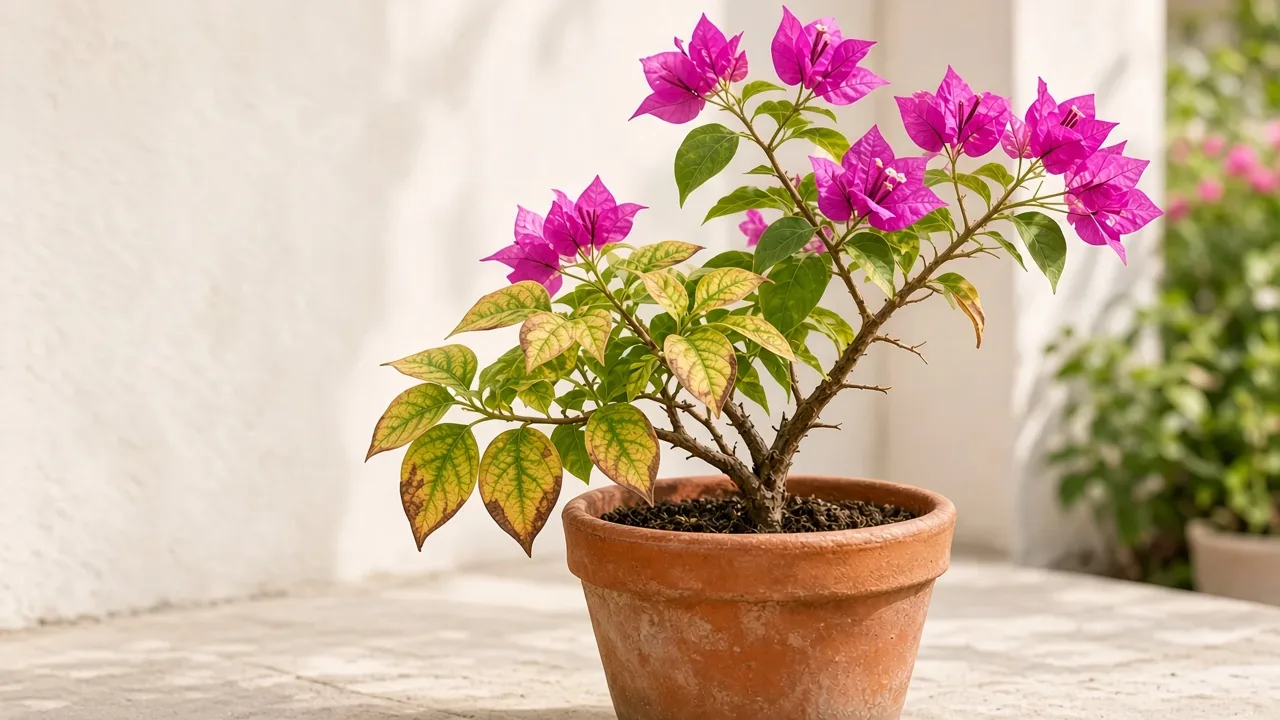
Potassium Deficiency on Bougainvillea: Causes, Checks & Fixes
This guide covers potassium deficiency on Bougainvillea. See also the general Potassium Deficiency guide, watering, and light pages for this plant.
Potassium Deficiency on Bougainvillea: Causes, Checks & Fixes
Quick answer
Potassium deficiency on bougainvillea (Bougainvillea spp.) shows as yellow or brown scorch along the margins and tips of older true leaves on woody lower stems, while new shoots at the vine tips and colorful papery bracts may still look normal for weeks. Potassium deficiency in broadleaves causes leaves to turn yellow and then brown at the tips and margins, with older leaves affected first as the plant moves mobile potassium toward active growth. For universal nutrient mechanics, see our potassium deficiency guide. On bougainvillea, read the thin true leaves on interior lower thorny wood—not the showy bracts alone—edge-first scorch on mature foliage differs from magnesium deficiency interveinal yellow between green veins and from iron deficiency on new tip leaves with green veins.
First step: confirm marginal scorch on multiple older true leaves along lower branches, then check salt crust and feeding history before adding fertilizer.
When to use this page vs other Bougainvillea guides
| Pattern | Read next |
|---|---|
| Brown or yellow scorch at margins and tips of oldest lower true leaves | Potassium deficiency (this page) |
| Yellow between green veins on oldest lower true leaves | Magnesium deficiency |
| Yellow new shoot leaves with green veins | Iron deficiency |
| Uniform pale new growth, weak bract color | Nitrogen deficiency or pale leaves |
| Dry tan tips only right after feeding | Brown tips from salt or dry air |
| Yellow leaves on wet heavy pot, limp canopy | Overwatering or root rot |
| Broad yellowing after care change | Yellow leaves |
What potassium deficiency looks like on Bougainvillea
Healthy bougainvillea carries thin elliptical true leaves on thorny woody stems with long-lasting colorful bracts at shoot ends. Potassium stress shows on mature true foliage in the lower and interior canopy, not on papery bracts first.
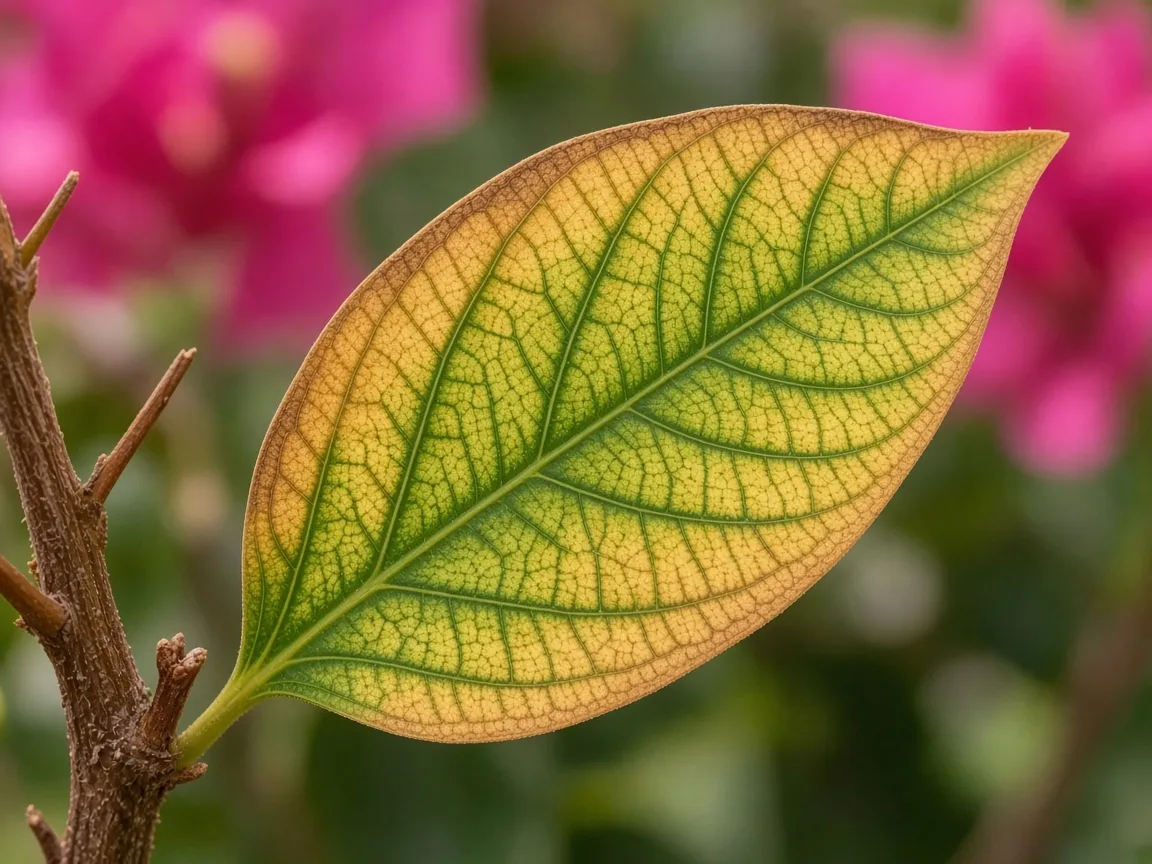
Yellow-tan scorch band along the outer margin and tip of an older bougainvillea true leaf while the midrib area stays greener—classic mobile potassium redistribution on a flowering vine.
Typical signs:
- Yellow or tan scorch along outer margins and tips of several older true leaves on lower woody branches—the damage often starts at the edge and creeps inward while veins stay greener longer
- Crisp dry marginal tissue on thin true leaves, not soft mushy blades from rot
- New true leaves at extending shoot tips stay greener than the lowest leaves on the same stem for weeks
- Slow spread up the branch as deficiency advances—more old leaves gain similar edge burn
- Limp or thin new shoots in advanced cases when potassium cannot support water regulation during hot active growth (WVU Extension)
- Firm woody stems and normal dry-down unlike limp overwatered bougainvillea on soggy mix
Not potassium deficiency:
- Yellow between green veins on lower mature true leaves—magnesium deficiency
- Green veins on new tip true leaves with yellow lamina—iron deficiency
- Uniform pale washout on whole old leaves—nitrogen deficiency
- Marginal burn within days of a concentrated fertilizer dose—salt injury; see brown tips
- One bottom true leaf yellowing while a green leaf opens above—often normal senescence; see yellow leaves
Why Bougainvillea gets potassium deficiency
Bougainvillea is a fast-growing sun vine that prefers lean, well-drained mix and periodic dry-down between drinks. Potassium regulates water balance and stress tolerance in plants—when soil reserves run low in a leaching container, the vine pulls potassium from old lower true leaves to fund thorny extension and bract display.
Bougainvillea-specific causes:
- Years in the same fast-draining patio mix without complete feed — Owners skip fertilizer because the vine blooms on stress, until old margins scorch on otherwise woody, rigid stems. See the Bougainvillea fertilizer guide for conservative bloom-oriented feeding.
- Leaching through perlite-heavy soil — Each thorough soak per the Bougainvillea watering guide flushes mobile potassium through drainage holes faster than owners replace it in small pots.
- Nitrogen-heavy feeds without potassium balance — UF/IFAS notes too much nitrogen encourages leaves instead of blooms; heavy nitrogen without adequate potassium can leave margins scorching on lower true foliage while shoots elongate.
- Root stress limiting uptake — UC IPM notes container plants often show deficiency when root uptake is restricted, not only when soil lacks potassium. Chronic wet mix or root rot mimics starvation.
- High-potassium bloom cycles without magnesium — Excess potassium can reduce magnesium availability (UF/IFAS EP081); marginal scorch may overlap with magnesium deficiency if only bloom boosters were used.
Do not diagnose potassium shortage on sour wet soil with soft stem bases—that is root failure from overwatering until woody tissue feels rigid and mix dry-down matches the watering guide.
Bracts stay vivid while true leaves scorch
The diagnostic trap on bougainvillea is judging plant health from magenta, orange, or purple bracts alone. Bracts are modified leaves built for display; they can stay colorful while interior true leaves on lower thorny wood show dry tan edge bands.
Run your hand along mature true foliage under the bract clusters and along interior lower branches before assuming drought or pest damage from a single yellow blade at the soil line. Potassium marginal scorch keeps the center of the true leaf greener with a crisp perimeter on several old leaves. Overwatering yellows whole lower leaves on persistently wet mix with limp stems. Magnesium deficiency washes the mid-blade pale between green veins, not edge-first scorch.
If bracts drop but woody stems stay firm and margins scorch on true leaves only, pair nutrient review with bud drop and no flowers guides only after you confirm the leaf-edge pattern here.
Bloom-feed leaching in fast-draining patio pots
Container bougainvillea on sunny patios dries quickly—a habit growers pair with high-potassium bloom formulas to push bract color. That combination makes potassium deficiency confusing because owners assume any bloom feed covers potassium needs.
Leaching in perlite-heavy mix: Each deep drink per the watering guide flushes mobile potassium. A phosphorus-heavy bloom product applied twice a season may not replace potassium lost across a summer of twice-weekly soaks. Marginal scorch on old true leaves while shoot tips still extend points to depleted mobile potassium, not a need for more nitrogen.
Salt crust vs shortage: White rim on the pot after heavy feeding limits uptake even when fertilizer sits in the cabinet—flush with plain water twice normal volume, then resume at half strength per Clemson HGIC guidance before diagnosing true soil deficiency.
Deliberate drought for bloom: Slight dry-down before flowering is normal bougainvillea culture; potassium marginal scorch still shows edge burn on multiple old true leaves with firm wood, not uniform wilt from underwatering alone.
Thorny lower-canopy inspection order
Potassium symptoms on this vine require reading leaf age along woody stems, not scanning the newest bract cluster at the trellis top.
- Lowest true leaves on each main branch — Edge scorch here with greener shoot-tip foliage supports mobile potassium redistribution (WVU Extension).
- Interior shaded true leaves — Often show scorch first because the plant sacrifices older shaded tissue before sun-exposed new growth.
- Newest true leaf at each extending tip — Should stay greener longer; tip-wide uniform yellow points to nitrogen or iron, not this page.
- Stem firmness — Woody thorny stems should stay rigid; soft bases mean rot triage before any feed.
- Pot weight and top 3–5 cm moisture — Press the mix and lift the pot; chronic wetness blocks uptake per UC IPM.
Wear gloves—bougainvillea thorns and sap irritate skin during close inspection.
Lookalike symptoms
| Pattern | Check | Likely cause |
|---|---|---|
| Marginal scorch on multiple old lower true leaves | Feed history, leaching, salt crust | Potassium deficiency (this page) |
| Interveinal yellow on oldest lower true leaves | Vein pattern | Magnesium deficiency |
| Yellow new tip true leaves, green veins | Shoot tip foliage | Iron deficiency |
| Tip-only crisp brown after heavy feed | Timing, white crust | Brown tips |
| Uniform pale oldest true leaves | Even washout | Nitrogen deficiency |
| All yellow, wet heavy pot | Stem softness, smell | Overwatering |
| Bleached patches on sun-facing leaves | Exposure | Heat or sun scorch after not enough light recovery in harsh sun |
How to confirm
- Margin pattern on lower branch true leaves — Yellow or tan scorch along the outer edge on multiple older leaves, not tip-only on one leaf after feeding.
- Potassium vs magnesium split — Even marginal burn with greener interior tissue points here; yellow between veins on the same old leaves points to magnesium.
- Potassium vs iron split — Greener new tip true leaves while lower margins scorch support mobile potassium; yellow new leaves with green veins point to iron.
- Container and leaching context — Fast-draining mix, years without complete feed, or frequent summer soaks increase likelihood (UC IPM).
- Salt crust and timing — Scorched margins within days of concentrated feed suggest salt injury—flush before another dose.
- Root-zone moisture — Appropriate dry-down per watering guide; soggy mix means fix roots first.
- Bract context — Vivid bracts do not rule out true-leaf potassium stress on the interior canopy.
First fix for Bougainvillea
Confirm marginal scorch on multiple older true leaves—not interveinal banding or new-tip iron chlorosis—before any supplement.
Once the pattern matches, firm woody stems, appropriate dry-down, and warm active extension are present, apply one half-strength dose of complete liquid fertilizer with adequate potassium (bloom-oriented ratios such as 6-8-10 or 10-10-10 at half label strength) on already-moist mix, following the Bougainvillea fertilizer guide. Water normally first so roots are hydrated, then apply enough solution that a small amount drains from the bottom of the container.
Do not feed a waterlogged pot, a vine repotted within the last month, a cold stalled specimen with no new growth, or a plant showing fresh salt crust without flushing first. UC IPM warns that adding complete fertilizer to fix one deficient element can excess others and contribute to salinity problems—one measured half-strength feed beats stacking bloom booster, Epsom salt, and iron chelate on the same day.
Step-by-step recovery
- Apply one half-strength complete feed with potassium on moist mix during active growth in full sun.
- Flush accumulated salts if white crust rings the pot—leach with plain water twice normal volume, wait one week, then feed once at half strength.
- Pause extra bloom boosters for four to six weeks so you can read the response without deepening magnesium deficiency from potassium-heavy repeats.
- Adjust watering so the top 3–5 cm dries and the pot lightens between drinks—uptake fails in chronic wet mix.
- Repeat one measured feed after four to six weeks only if marginal scorch spreads but stems stay firm—never weekly full-strength doses.
- Refresh mix when root-bound if scorch persists after two measured treatments—see repotting and soil guidance; slight root restriction helps bloom but exhausted mix starves potassium.
- Monitor the next two true leaves on extending shoots for clean margins without progressive edge burn.
Mistakes to avoid
- Bloom booster before moisture and root check — Concentrated salts on rotting roots worsen decline and will not fix scorch.
- Epsom salt for marginal burn — That targets magnesium interveinal chlorosis, not edge scorch; misapplication can skew K/Mg balance (UF/IFAS EP081).
- Confusing magnesium and potassium — Mid-blade vein banding on lower leaves means magnesium deficiency, not this page.
- Judging health from bracts only — True leaves on lower wood carry the nutrient signal.
- Repot + hard prune + heavy feed same week — Stack one change at a time on a stressed patio vine.
- Expecting old true leaves to re-green — Judge recovery by fresh shoot foliage, not by lower blades darkening again.
Recovery timeline
Correct potassium on healthy roots in warm sun shows new true leaves with clean margins within four to eight weeks after one measured half-strength feed and stable culture. Older scorched true leaves may persist until the vine sheds them naturally along woody stems.
Full interior canopy refresh on a large trellised specimen may take one warm season. If three successive new true leaves show edge burn after two measured feeds with firm wood, reassess iron deficiency, light, and overlapping yellow leaves causes.
Prevention
- Feed with complete low-nitrogen formulas that include adequate potassium during active growth per the Bougainvillea fertilizer guide—hold feed in late fall and winter when extension stalls.
- Flush container salts mid-season after heavy bloom feeding, then resume with a balanced micronutrient-inclusive formula (Clemson HGIC).
- Refresh fast-draining mix every two to three years when roots circle densely—nutrients deplete even when slight root restriction helps flowering.
- Pair feeding with full sun and dry-down watering—bougainvillea performs better when soil is not kept constantly wet.
- Avoid stacking high-potassium bloom cycles without magnesium in exhausted root-bound pots—alternate complete feeds that list both K and Mg.
Related Bougainvillea guides
- Bougainvillea overview — species baseline and care hub
- Bougainvillea problems — full symptom index for this vine
- Bougainvillea fertilizer — bloom-oriented NPK and salt-flush timing
- Bougainvillea watering — 3–5 cm dry-down that pairs with nutrient uptake
- Bougainvillea soil — drainage and pH targets for containers
- Magnesium deficiency — interveinal yellow on oldest lower true leaves
- Iron deficiency — new tip true leaves yellow with green veins
- Yellow leaves — moisture-first diagnosis when color shifts broadly
Scope note: Use this page when dry tan scorch sits on the outer margins and tips of the oldest lower true leaves on firm woody stems. Use magnesium deficiency when yellow sits between green veins on those same old leaves; use iron deficiency when new tip foliage shows the vein pattern.
Conclusion
Dry edge bands on older true leaves along thorny lower bougainvillea wood are a potassium signal during warm active growth—confirm the pattern stays off interveinal mid-blade banding, verify firm stems and appropriate dry-down, rule out fresh salt crust, then apply one half-strength complete feed with potassium on moist soil.
Related tool
Use the Fertilizer Dilution Calculator to narrow causes for potassium deficiency on this plant before changing multiple variables at once.