Bucephalandra Care Guide: Aquarium Light, Rhizomes
Bucephalandra spp.
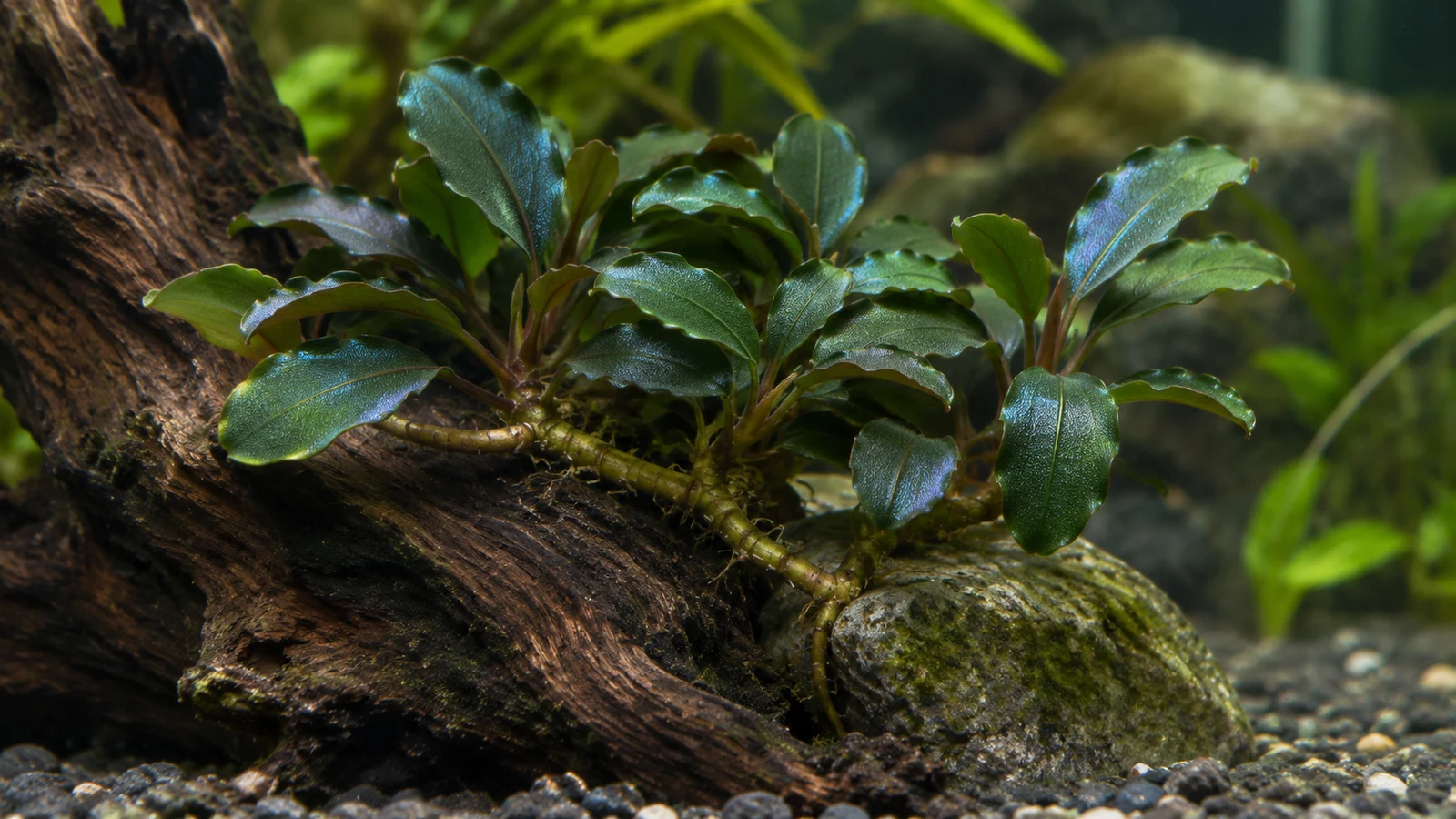
Attach Bucephalandra to aquarium-safe rock or driftwood, keep its rhizome exposed, and grow it in stable freshwater under low to moderate light. It is slow-growing; propagate it by dividing a healthy rhizome.
Bucephalandra Aquarium Care Guide
Start with wateringThe most common care mistake for BucephalandraBucephalandra Watering and Water Quality →Bucephalandra care essentials
Light
Low to moderate aquarium light
Water
Grow Bucephalandra submerged in a stable freshwater aquarium. Attach the creeping rhizome to aquarium-safe rock or driftwood with thread or aquarium-safe cyanoacrylate gel. Keep the rhizome exposed: roots may extend down toward the substrate, but covering the rhizome can cause it to deteriorate. The plant does not need a terrestrial watering schedule or potting mix.
Soil
Terrestrial soil is not needed for submerged aquarium culture. Secure Bucephalandra to rock or driftwood and leave its rhizome uncovered. Its roots can grow around the hardscape or toward the substrate, but the rhizome should not be buried under gravel or soil.
Humidity
Submerged freshwater aquarium conditions
Temperature
Use stable tropical freshwater conditions appropriate for the aquarium's livestock; tolerance varies among Bucephalandra species and trade forms.
Fertilizer
Additional fertilizer is optional. If the aquarium's plants need nutrients, use a product labeled for freshwater aquariums and follow its directions; do not add terrestrial garden fertilizer to the tank.. Aquarium plant fertilizer used according to its label
About Bucephalandra
Bucephalandra is native to Borneo, typically reaches Size varies substantially among species and aquarium-trade forms; there is no single mature height that describes the genus. Many cultivated forms stay compact and spread along a creeping rhizome. indoors, with slow in aquarium culture; the rate varies with species and tank conditions growth. Bucephalandra has a rhizomatous rheophytic aroid. bucephalandra grows in and along streams in borneo and may be found emergent or submerged; aquarium plants are usually grown submerged and attached to hardscape. growth habit and part of the Araceae family. It is also known as Buce.
| Detail | Information |
|---|---|
| Also known as | Buce |
| Native region | Borneo |
| Mature size | Size varies substantially among species and aquarium-trade forms; there is no single mature height that describes the genus. Many cultivated forms stay compact and spread along a creeping rhizome. |
| Growth rate | Slow in aquarium culture; the rate varies with species and tank conditions |
| Growth habit | Rhizomatous Rheophytic Aroid. Bucephalandra Grows In And Along Streams In Borneo And May Be Found Emergent Or Submerged; Aquarium Plants Are Usually Grown Submerged And Attached To Hardscape. |
| Scientific name | Bucephalandra spp. |
| Family | Araceae |
How to care for Bucephalandra?
How much light does Bucephalandra need?
Low to moderate aquarium light. Low aquarium light. Moderate planted-tank light. Brighter light when algae is controlled and the rest of the aquarium is balanced. low light
- Low to moderate aquarium light - Low to moderate aquarium light.
- Low aquarium light - Low to moderate aquarium light.
- Moderate planted-tank light - Moderate planted-tank light.
- Brighter light when algae is controlled and the rest of the aquarium is balanced - Brighter light when algae is controlled and the rest of the aquarium is balanced.
- low light - Low to moderate aquarium light.
When should you water Bucephalandra?
Grow Bucephalandra submerged in a stable freshwater aquarium. Attach the creeping rhizome to aquarium-safe rock or driftwood with thread or aquarium-safe cyanoacrylate gel. Keep the rhizome exposed: roots may extend down toward the substrate, but covering the rhizome can cause it to deteriorate. The plant does not need a terrestrial watering schedule or potting mix.
- Check that the rhizome remains firm and uncovered and that the plant is still attached to its rock or wood. A few older leaves may be lost after a change from emersed to submerged growth - Attach the creeping rhizome to aquarium-safe rock or driftwood with thread or aquarium-safe cyanoacrylate gel.
- remove decaying leaves and watch the rhizome and new growth before discarding the plant - Attach the creeping rhizome to aquarium-safe rock or driftwood with thread or aquarium-safe cyanoacrylate gel.
- Drain excess water - Grow Bucephalandra submerged in a stable freshwater aquarium.
What soil works best for Bucephalandra?
Terrestrial soil is not needed for submerged aquarium culture. Secure Bucephalandra to rock or driftwood and leave its rhizome uncovered. Its roots can grow around the hardscape or toward the substrate, but the rhizome should not be buried under gravel or soil.
- Aquarium-safe rock or driftwood for attachment - Secure Bucephalandra to rock or driftwood and leave its rhizome uncovered.
- Aquarium-safe thread or cyanoacrylate gel to hold the plant while it attaches - Terrestrial soil is not needed for submerged aquarium culture.
How to propagate Bucephalandra?
Bucephalandra is propagated by dividing a healthy rhizome. Use clean scissors, preferably at a natural bend where separate foliage clumps have formed, then secure the new piece to aquarium-safe hardscape without burying the rhizome. Allow time for it to attach and resume growth; it may grow slowly while establishing.
- Remove or lift the attached plant carefully from its hardscape - Use clean scissors, preferably at a natural bend where separate foliage clumps have formed, then secure the new piece to aquarium-safe hardscape without burying the rhizome.
- Use clean scissors to divide a healthy section of rhizome - Use clean scissors, preferably at a natural bend where separate foliage clumps have formed, then secure the new piece to aquarium-safe hardscape without burying the rhizome.
- Reattach each section to rock or driftwood with its rhizome exposed - Use clean scissors, preferably at a natural bend where separate foliage clumps have formed, then secure the new piece to aquarium-safe hardscape without burying the rhizome.
Grower notes for Bucephalandra
Keep the rhizome above the substrate
Attach the plant to rock or driftwood and leave its creeping rhizome uncovered. Roots can extend toward the substrate, but burying the rhizome can cause it to rot. Aquarium Co-Op's genus guide specifically recommends mounting Bucephalandra on hardscape rather than planting its rhizome in substrate.
Give a slow grower modest light
Low to moderate aquarium light is a practical starting point. Aquarium Co-Op and Gensou describe Bucephalandra as slow-growing and warn that excessive light can give algae an advantage on its leaves. More intense lighting is not a shortcut to rapid growth.
Let it establish on hardscape
Tie the rhizome loosely to rock or driftwood, or use aquarium-safe gel to hold it in place while it attaches. Avoid repeatedly moving it to check progress: Bucephalandra grows slowly, and a newly attached piece may take time to settle in.
Keep water conditions steady
Bucephalandra species are rheophytic plants associated with streams, and aquarium guides report that established specimens tolerate moving water. Aim for stable freshwater and useful circulation around the leaves; do not change the whole tank abruptly to meet one plant's preferences.
Expect possible leaf loss after a transition
A plant changing from emersed nursery growth to submerged aquarium growth may lose some older leaves. Aquarium Co-Op describes this transition as possible melt. Remove decaying leaves, keep the rhizome exposed, and look for firm tissue or new growth before deciding the plant has failed.
Divide the rhizome to make another plant
Once a plant is established, use clean scissors to divide the rhizome at a natural bend where separate foliage clumps have formed, then attach the new piece to hardscape. Aquarium Co-Op describes rhizome division as the practical aquarium route to propagation; allow the new piece time to resume its slow growth.
Bucephalandra and Pets
This review did not find a species-specific veterinary toxicity assessment for Bucephalandra. Its use as an aquarium plant and its absence from general toxic-plant lists do not establish that it is safe to eat. Keep the aquarium secured from chewing pets and contact a veterinarian if an animal eats the plant or aquarium products.
No species-specific veterinary toxicity classification was located for Bucephalandra in this review. Keep all household-pet entries at caution / needs-review; do not infer safety from aquarium use or from omission on a general toxic-plant list.
Watering Bucephalandra
For Bucephalandra, check that the rhizome remains firm and uncovered and that the plant is still attached to its rock or wood. A few older leaves may be lost after a change from emersed to submerged growth; remove decaying leaves and watch the rhizome and new growth before discarding the plant. and water there is no separate watering interval for a submerged plant. Keep water conditions stable for the aquarium's livestock, maintain routine tank care, and avoid abrupt changes made only to speed this slow-growing plant. Aquarium care is not seasonal watering. Keep the tank's temperature, lighting, and maintenance steady through seasonal room changes, and make adjustments for the whole aquarium rather than Bucephalandra alone.
| Detail | Information |
|---|---|
| How often | There is no separate watering interval for a submerged plant. Keep water conditions stable for the aquarium's livestock, maintain routine tank care, and avoid abrupt changes made only to speed this slow-growing plant. |
| How to check | Check that the rhizome remains firm and uncovered and that the plant is still attached to its rock or wood. A few older leaves may be lost after a change from emersed to submerged growth; remove decaying leaves and watch the rhizome and new growth before discarding the plant. |
| Seasonal changes | Aquarium care is not seasonal watering. Keep the tank's temperature, lighting, and maintenance steady through seasonal room changes, and make adjustments for the whole aquarium rather than Bucephalandra alone. |
Soil & potting for Bucephalandra
Use a mix of Aquarium-safe rock or driftwood for attachment, Aquarium-safe thread or cyanoacrylate gel to hold the plant while it attaches for Bucephalandra. Not applicable to a submerged aquarium plant. Provide stable, clean freshwater and steady circulation around the attached plant; avoid burying or packing substrate over the rhizome. Repot not applicable; reposition or divide the hardscape-attached plant instead, ideally in any time the aquarium is stable; avoid unnecessary disturbance.
| Detail | Information |
|---|---|
| Recommended mix | Aquarium-safe rock or driftwood for attachment, Aquarium-safe thread or cyanoacrylate gel to hold the plant while it attaches |
| Drainage | Not applicable to a submerged aquarium plant. Provide stable, clean freshwater and steady circulation around the attached plant; avoid burying or packing substrate over the rhizome. |
| Repotting frequency | Not applicable; reposition or divide the hardscape-attached plant instead |
| Best season to repot | Any time the aquarium is stable; avoid unnecessary disturbance |
Signs it needs repotting
- The rhizome has been covered by substrate and needs to be uncovered
- A section has outgrown its space or needs to be divided for propagation
- The plant is loose and needs to be secured again to rock or driftwood
Humidity & temperature for Bucephalandra
Bucephalandra prefers submerged freshwater aquarium conditions. Keep temperatures around use stable tropical freshwater conditions appropriate for the aquarium's livestock; tolerance varies among Bucephalandra species and trade forms. Aquarium Co-Op reports a broad genus-level range of 21–28°C (70–82°F) and pH 6–8. Treat these as that guide's general values, not a guarantee for every species or a reason to change a stable community tank abruptly.
| Detail | Information |
|---|---|
| Humidity | Submerged freshwater aquarium conditions |
| Ideal temperature | Use stable tropical freshwater conditions appropriate for the aquarium's livestock; tolerance varies among Bucephalandra species and trade forms. |
| Temperature notes | Aquarium Co-Op reports a broad genus-level range of 21–28°C (70–82°F) and pH 6–8. Treat these as that guide's general values, not a guarantee for every species or a reason to change a stable community tank abruptly. |
Humidity tips
- Keep the plant submerged during routine aquarium care and when moving it between tanks
- Maintain steady water circulation around the leaves without letting the plant become detached
Fertilizer & pruning for Bucephalandra
Feed Bucephalandra additional fertilizer is optional. If the aquarium's plants need nutrients, use a product labeled for freshwater aquariums and follow its directions; do not add terrestrial garden fertilizer to the tank. using aquarium plant fertilizer used according to its label. The best feeding window is during active aquarium plant growth, when the wider tank needs nutrients. Terrestrial fertilizers or any product not labeled for aquarium use.
| Detail | Information |
|---|---|
| Fertilizer schedule | Additional fertilizer is optional. If the aquarium's plants need nutrients, use a product labeled for freshwater aquariums and follow its directions; do not add terrestrial garden fertilizer to the tank. |
| Best season | During active aquarium plant growth, when the wider tank needs nutrients |
| Fertilizer type | Aquarium plant fertilizer used according to its label |
| What to avoid | Terrestrial fertilizers or any product not labeled for aquarium use |
Pruning (optional)
Remove dead or deteriorating leaves with clean aquascaping scissors. Keep healthy rhizome tissue intact, and avoid frequent trimming that would disturb this slow-growing plant.