Browse general houseplant problems or use our diagnosis tool for Bucephalandra.
Bucephalandra problems
Use the guides below to diagnose and fix common issues on Bucephalandra. Each problem page explains why it happens on this species and what to do first.
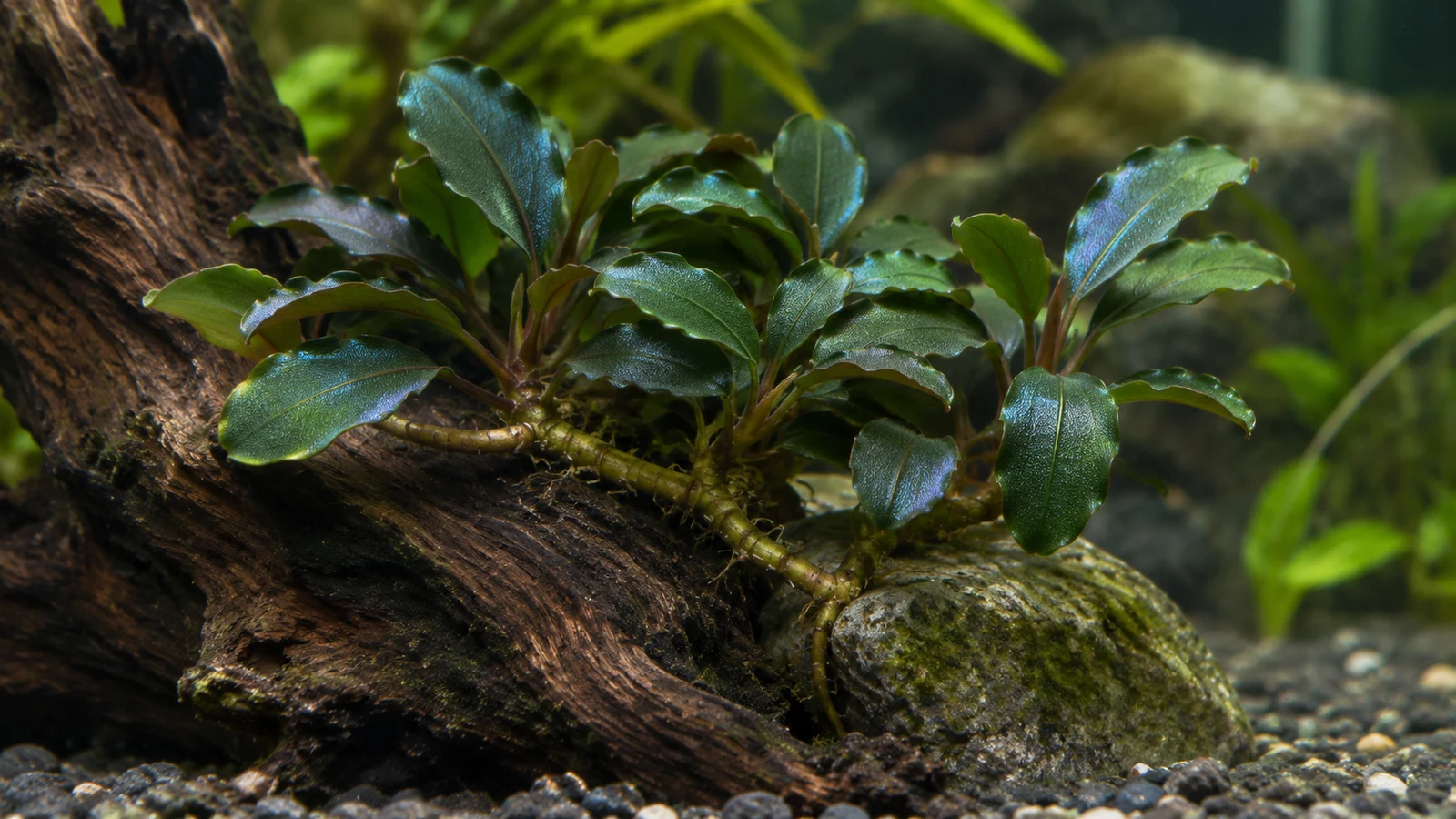
Attach it to rock or driftwood instead. Its roots can reach the substrate, but keep the creeping rhizome exposed rather than burying it under gravel or soil.
What light does Bucephalandra need?
Start with low to moderate aquarium light. The genus grows slowly, and brighter light can encourage algae on the leaves if the tank is not balanced.
Does Bucephalandra need injected CO2?
Injected CO2 is not essential for keeping it in an aquarium. CO2 and fertilizer may support a broader high-growth planted-tank setup, but stable water and an exposed, securely attached rhizome are the basics.
Why are my Bucephalandra leaves melting?
Some older leaves may die back when a plant shifts from emersed growth to fully submerged conditions. Remove decaying leaves, keep the rhizome uncovered, and monitor it for firmness and new growth; avoid abrupt tank changes.
How do I propagate Bucephalandra?
Divide a healthy rhizome with clean scissors and attach each section to aquarium-safe hardscape with the rhizome uncovered. Choose a natural bend between foliage clumps when possible. New divisions can take time to establish because the plant grows slowly.
Is Bucephalandra safe for pets?
This review found no species-specific veterinary toxicity assessment for Bucephalandra, so its pet-safety status remains unverified. Aquarium use does not establish that it is safe to eat; keep the tank inaccessible to chewing pets and consult a veterinarian after ingestion.
How often should I water Bucephalandra?
Grow Bucephalandra submerged in a stable freshwater aquarium. Attach the creeping rhizome to aquarium-safe rock or driftwood with thread or aquarium-safe cyanoacrylate gel. Keep the rhizome exposed: roots may extend down toward the substrate, but covering the rhizome can cause it to deteriorate. The plant does not need a terrestrial watering schedule or potting mix. In practice, water there is no separate watering interval for a submerged plant. Keep water conditions stable for the aquarium’s livestock, maintain routine tank care, and avoid abrupt changes made only to speed this slow-growing plant. Check that the rhizome remains firm and uncovered and that the plant is still attached to its rock or wood. A few older leaves may be lost after a change from emersed to submerged growth; remove decaying leaves and watch the rhizome and new growth before discarding the plant. Aquarium care is not seasonal watering. Keep the tank’s temperature, lighting, and maintenance steady through seasonal room changes, and make adjustments for the whole aquarium rather than Bucephalandra alone.
How this Bucephalandra problems guide is reviewed?
Written by Sai AnanthLead content writer at LeafyPixels. B.Pharmacy graduate from Andhra University with a background in pharmacognosy, turned indoor gardening writer after a long-time plant hobby became a research-led resource for home growers.View Sai Ananth's profile · Reviewed by LeafyPixels Review Board
This Bucephalandra problems problem guide was researched and written by Sai AnanthLead content writer at LeafyPixels. B.Pharmacy graduate from Andhra University with a background in pharmacognosy, turned indoor gardening writer after a long-time plant hobby became a research-led resource for home growers.View Sai Ananth's profile. Problems symptoms on Bucephalandra, lookalike causes, and step-by-step fixes are cross-checked against extension pest, disease, and care references before publication.
We prioritize sources that hold up under scrutiny:
University cooperative extension bulletins and fact sheets (Penn State, Clemson, UMD, NC State, and similar programs)
Botanical garden and horticultural society publications
Peer-reviewed plant science and veterinary toxicology references where pet safety matters (including ASPCA Animal Poison Control)
Established reference works on indoor plant culture
The LeafyPixels editorial team then reviews the draft for clarity, step-by-step usefulness, and fit with real apartment and home conditions-not ideal greenhouse setups. When guidance changes materially, we update the page and note the revision date.
Sources used
Aquarium Co-Op — Bucephalandra: The Complete Guide (n.d.) Aquarium attachment and exposed-rhizome guidance, light and algae considerations, reported water parameters, flow tolerance, transition melt, CO2, and rhizome propagation.. [Online]. Available at: https://www.aquariumcoop.com/blogs/aquarium/bucephalandra (Accessed: 1 March 2024).
Gensou — Bucephalandra vs Anubias Petite Comparison Guide (n.d.) Practical aquarium comparison describing Bucephalandra spp. as small rhizome-mounted plants with low-to-medium light demand and slow growth.. [Online]. Available at: https://gensou.sg/bucephalandra-anubias-petite-comparison-guide/ (Accessed: 1 March 2024).
Tropica — Bucephalandra sordidula 'Blue' (n.d.) A named cultivar example for slow growth, low light and CO2 demands, and attachment to hardscape; those details are not treated as universal measurements for every species.. [Online]. Available at: https://tropica.com/en/plants/plantdetails/?id=30011 (Accessed: 1 March 2024).
USDA APHIS — Aquarium and Pond Plants of the World E3: Bucephalandra (n.d.) Genus taxonomy, Araceae family, Borneo range, and rheophytic rhizomatous growth habit in and along streams.. [Online]. Available at: https://idtools.org/appw/index.cfm?packageID=1130&entityID=4877 (Accessed: 1 March 2024).