Calathea Freddie Light Guide: Best Window & Warning Signs
Calathea Freddie Light Guide: Best Window & Warning Signs
Calathea Freddie Light Guide: Best Window & Warning Signs
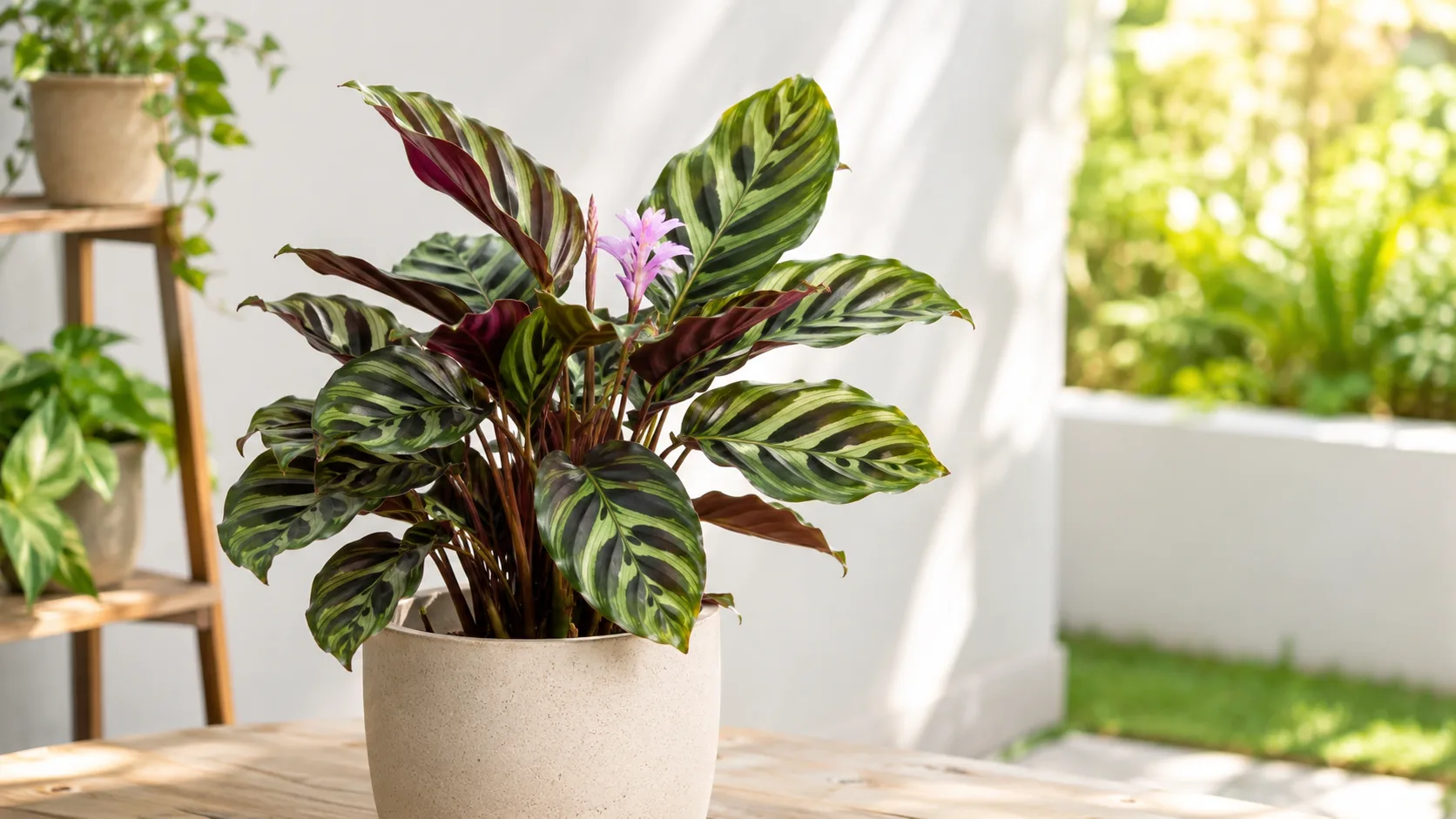
Calathea Freddie can look immaculate for weeks — narrow leaves rolling up at night, green-on-green zebra bands sharp, purple undersides clean — and then a window move or a spring sun angle change leaves the same plant bleached, curled, or stalled within days. The frustrating part is that Goeppertia concinna ‘Freddie’ tolerates indoor conditions just long enough to make you think the placement is fine. It is not a snake plant and not a monstera. It is a compact Marantaceae prayer plant built for filtered rainforest understory light, and it will eventually tell you — through faded zebra striping, crispy sun-facing patches, or slow stretched growth — whether it agrees with your window.
This guide covers the full indoor light picture for Calathea Freddie: how much brightness this cultivar actually needs, which window works best, how much direct sun is safe, what too much and too little light look like on Freddie’s narrow leaves, when to add a grow light, and how to move the pot without burning foliage that spent months adapting to a softer spot.
The Short Answer: How Much Light Calathea Freddie Needs
Calathea Freddie grows best in medium to bright indirect light — roughly three to six hours of strong, plant-facing brightness each day, with direct sun rays never landing on the leaves for more than gentle early-morning exposure. The RHS recommends growing Goeppertia ‘Freddie’ with bright indirect light or light shade, in partial shade with east-, south-, or west-facing sheltered exposure indoors. For the parent species, Goeppertia concinna should be kept in shaded conditions well lit by indirect light — the same practical band most prayer plants need.
In everyday terms, the spot should be bright enough to read comfortably by daylight at the plant without turning on lamps, but soft enough that your hand casts a blurred shadow rather than a sharp dark silhouette when held over the leaves at midday. Horticultural references for the wider calathea group often cite roughly 50 to 250 foot-candles (about 540 to 2,700 lux) for healthy growth — within the medium-light range extension guides describe for prayer plants — bright enough to hold Freddie’s alternating green bands, but well below unfiltered midday intensity that triggers bleaching. Judge success by firm new leaves with intact zebra contrast and steady compact growth — not by how decorative the pot looks in a dim corner.
Why Calathea Freddie Needs Filtered Light, Not Direct Sun
Light is not a background detail for Calathea Freddie. It drives stripe contrast, nyctinastic fold quality, growth speed, and how quickly the pot dries between waterings. A Freddie in appropriate filtered light pushes new rolled leaves on short petioles, holds clean green-on-green banding with purple undersides visible at night, and folds cleanly at dusk. A plant in harsh direct sun bleaches or crisps; a plant in dim light drinks slowly, stays wet longer, produces smaller paler leaves on elongated stems, and often looks acceptable for months while roots quietly weaken.
That matters because Freddie is often grouped with generic tropicals that tolerate bright direct light — fiddle-leaf figs, monsteras on sunny sills, bird of paradise. Those plants evolved for brighter edge habitats. Goeppertia concinna did not. Its narrow elliptical leaves and shade-adapted photosynthetic machinery are built for dappled understory light, not midday beams through unfiltered glass. Get the light wrong and you get faded zebra bands, chronic brown edges that look like a humidity problem but trace to photoinhibition, or etiolated growth that mimics underwatering on Calathea Freddie when the real issue is insufficient photosynthesis.
Freddie’s Zebra Leaves and Rainforest Understory Biology
In native Central and South American rainforest understories, Goeppertia species grow as clump-forming herbaceous perennials in warm, humid shade. NC State Extension describes related Goeppertia as needing bright, indirect light or partial shade in warm, humid habitats with moist, well-drained mix — conditions defined as much by filtered light as by water and temperature. Freddie’s nyctinastic movement — leaves folding upward at night — is characteristic of Marantaceae. The purple leaf undersides, rich in anthocyanin pigments, help capture reflected light from the forest floor so lower leaves can still photosynthesize.
Freddie’s all-green zebra pattern is an advantage over white-variegated calatheas like Goeppertia lietzei ‘Fusion White’: more chlorophyll buffer means Freddie tolerates average home brightness slightly better than paper-thin white sections. It is still not a sun plant. Missouri Botanical Garden notes that Goeppertia species need bright shade locations indoors, avoiding full sun particularly in afternoon heat, while tolerating some early morning sun or diffused light. You are recreating dappled canopy brightness — strong enough to fuel striped foliage, gentle enough that sunbeams never scorch the leaf surface.
What Bright Indirect Light Means for Calathea Freddie
“Bright indirect light” means the plant sits where daylight is strong, yet the sun’s direct path does not strike foliage for more than brief, gentle morning minutes. Outdoors, that is open shade or dappled sun. Indoors, it is one to three feet from north or east glass, or four to eight feet back from south or west glass with filtering.
The better question is not “direct or indirect?” in the abstract. It is: Does direct sunlight actually fall on Freddie’s leaves for multiple hours, and is the plant close enough to the window to receive usable brightness? Intensity drops sharply with distance. A Freddie on a bookshelf across the room from an east window is getting low indirect light at best, regardless of how sunny the window looks. Freddie needs the light on the plant, not in the room generally.
Human eyes adapt to indoor brightness faster than you notice. A north-facing room that feels adequately lit may measure far below what Freddie needs to maintain zebra contrast through winter. Conversely, a south windowsill that looks cheerful may deliver enough direct intensity to bleach bands within a week. Watching new leaf quality over two to three weeks is more reliable than any single light-meter reading.
The Hand-Shadow Test for Freddie
Around midday, hold your hand between the plant and the window, about an inch above the foliage. A sharp, dark shadow with crisp edges means direct sun is hitting the plant — usually too intense for Freddie unless it is early morning east exposure and you are watching closely for bleaching. A faint shadow with soft, blurred edges means bright indirect light — the target zone. Almost no shadow means the spot is too dim for long-term health; expect fading stripes, slow growth, and watering mistakes as the plant metabolizes less water.
Run this test in both summer and winter. A spot that reads as perfect indirect light in December may deliver harsh direct beams by June when the sun’s angle shifts. Freddie does not acclimate to seasonal changes automatically — you adjust placement, or the plant adjusts by showing damage.
Best Window Placement for Calathea Freddie Indoors
The best window for Calathea Freddie delivers consistent bright indirect light without sustained direct sun on the leaves. Distance matters as much as direction. Place the pot one to three feet from north or east glass, or four to eight feet back from south or west glass with filtering, rather than on a sun-baked sill unless you are deliberately using winter-only south exposure. The RHS growing guide recommends a bright spot out of direct sunlight, with north- or east-facing placement ideal in summer and a south-facing windowsill better in winter when daylight is shorter.
Rotate the pot a quarter turn every week or two so growth does not lean permanently toward the light source. Wipe dust from Freddie’s narrow leaves monthly with a soft damp cloth; NC State Extension notes that dust on leaves slows photosynthesis, and clean foliage absorbs more usable light from an already-filtered window. If the pot rim or leaf surface feels hot to the touch at midday, pull back, add a sheer curtain, or move to an east or north exposure.
North and East Windows: The Easiest Matches
A north-facing window in the Northern Hemisphere is the lowest-stress default for Calathea Freddie. It delivers steady bright indirect light without direct sun crossing the leaves at any season. Place the pot one to three feet from the glass so Freddie receives plant-facing brightness rather than dim ambient light deeper in the room. Growth may be slightly slower than on an east window, but zebra band retention is usually excellent and scorch risk is minimal.
An east-facing window is often the best overall compromise. East light provides two to four hours of gentle direct morning sun, which most Freddies tolerate well, followed by bright indirect light for the rest of the day. By mid-morning the direct beam has moved off the leaves. If you see pale bleaching on upper leaves facing the glass, pull the pot two to three feet back — intensity drops quickly with distance. The RHS genus guide notes that an east-facing windowsill is ideal for calatheas, or behind frosted glass in a humid bathroom.
South and West Windows: Distance, Curtains, and Seasonal Moves
A south-facing window is not automatically wrong for Freddie, but it is never set-and-forget. In winter, when the sun sits lower and days are short, the RHS specifically recommends a south-facing windowsill as better than north for calatheas — extra brightness compensates for reduced daylight without reaching summer intensity. In spring and summer, that same sill may deliver enough direct sun to bleach zebra bands within days. Move Freddie four to six feet back from south glass, or keep it on the sill behind a sheer curtain.
A west-facing window is the highest-risk common exposure because afternoon sun is warm and intense. West sills are where crisp brown patches appear after a single sunny afternoon on unacclimated tissue. If west is your only bright option, place Freddie six to eight feet back or use layered filtering — sheer inner curtain plus partial blind angle — and expect to water slightly less often in the back-of-room position because evaporation is lower.
Can Calathea Freddie Take Any Direct Sun?
Calathea Freddie can handle brief, gentle direct sun under specific conditions — typically early morning east exposure for a few hours, or filtered direct light through a sheer curtain. What it cannot handle is unfiltered midday or afternoon sun on leaves that formed in lower light. The RHS places Goeppertia in a bright spot shaded from direct sunlight and suggests sun-loving alternatives if you need a plant for a truly sunny window.
The distinction that saves most plants is duration, intensity, and acclimation, not a blanket rule that any photon touching the leaf is fatal. Morning east sun is low-angle and cool relative to west or south midday beams. A sheer curtain converts harsh direct sun into usable bright indirect light. A plant slowly moved closer to an east window over two weeks may tolerate more morning exposure than one jumped from a dim interior shelf to the sill overnight.
If leaves bleach only on the window-facing side during peak hours, filter or pull back slightly rather than relocating to a dim room — you likely need softer light, not less total brightness. The worst outcome for Freddie is swinging between extremes: scorching sun one week, dark corner the next.
Warning Signs Your Calathea Freddie Is Getting Too Much Light
Too much light shows up on Calathea Freddie as tissue damage and pattern loss rather than slow stretching. Watch for bleached or washed-out patches on sun-facing leaves, where green zebra bands fade to pale yellow; crisp brown edges or spots that feel dry and papery on the side facing the glass; curling or folding during the brightest hours even when soil is moist; sudden limpness after a move to a sunnier sill; and new leaves that open smaller, paler, or with reduced band contrast compared to older shaded foliage.
Sun stress usually follows a placement change, a seasonal shift when spring sun strengthens, or removing a curtain that previously filtered the window. Damage is often one-sided, concentrated on leaves facing the glass. Because Freddie’s pattern is all green rather than white-variegated, bleaching can look like the stripes are “washing out” rather than turning white — a subtle sign that is easy to miss until edges crisp.
How to Recover a Sun-Stressed Calathea Freddie
Recovery starts with moving the plant immediately to bright indirect light — not a dark closet. A dim rescue spot trades sun damage for low-light etiolation and overwatering risk. Pull the pot back from the window, rehang a sheer curtain, or shift to a north or east exposure one to three feet from the glass. Do not repot, fertilize, or increase watering while the plant stabilizes. Trim fully crisp brown tissue with clean scissors only after the plant has been in softer light for a week.
Watch the newest rolled leaf for improvement over the next two to four weeks. Old bleached patches on mature leaves will not revert to full color. Success means new foliage opens with restored zebra banding and no fresh crisping. If new leaves still bleach, the new spot is still too bright — move farther back or add another layer of diffusion.
Warning Signs Your Calathea Freddie Is Not Getting Enough Light
Insufficient light is quieter than sun scorch but equally damaging over time. Watch for longer, thinner petioles between leaves; smaller new leaves that take longer to unfurl; loss of zebra contrast, where bands blur toward uniform pale green; persistent leaning toward the nearest window; reduced nyctinastic movement, with leaves staying flat or drooping at night; and soil that stays wet for days because the plant photosynthesizes too slowly to use water.
Low light also makes Freddie more susceptible to root stress — not because light directly rots roots, but because growers maintain the same Calathea Freddie watering routine from a brighter season while the plant in dim light needs less. The RHS lists poor, weak growth due to low light levels as a common Goeppertia problem and recommends moving to a brighter position or using artificial grow lights.
These symptoms overlap with overwatering and low humidity, which is why new growth is the diagnostic signal. If the newest leaf is small, pale, and on a stretched petiole while older leaves still look fine, light is the prime suspect. If all leaves yellow and the base goes soft, think roots and soil drainage on Calathea Freddie first. If bands fade uniformly in a back-corner shelf position, think light before fertilizer.
Light, Watering, and Humidity: Why They Move Together on Freddie
Light and watering are linked for every houseplant, but the connection is especially sharp for Calathea Freddie because the plant already sits on a narrow edge of moisture tolerance. More light means faster transpiration and faster soil drying. Less light means slower water uptake and longer wet compost — a direct path to root stress in a genus the RHS warns against overwatering in winter.
When you move Freddie to a brighter filtered window, check moisture more often and expect to water slightly sooner in spring and summer per your watering guide. When you move it dimmer for recovery or seasonal adjustment, extend the dry interval — let the top two centimeters of mix dry before rewetting. Never keep the same calendar schedule across light conditions.
Humidity interacts with light in a less obvious way. Freddie prefers high relative humidity (above 60% when you can measure it) and tolerates average homes better than white-variegated calatheas, but high light increases transpiration demand. Crisping from sun exposure and crisping from dry air look similar. Check which side of the leaf is damaged: sun-facing uniform bleaching points to light; even marginal browning on all sides points to humidity or water quality. Fix light first because you cannot humidify your way out of a south-sill scorch.
Grow Lights for Calathea Freddie: Setup, Hours, and Distance
When natural light is insufficient — common in north-facing apartments, interior rooms, or short winter days — a full-spectrum LED grow light is a practical fix. The RHS notes that if there is insufficient natural light, you could use artificial grow lights for calatheas. Target roughly 2,000 to 5,000 lux at the leaf canopy, run 12 to 14 hours daily on a timer, and position the fixture 12 to 18 inches above the tallest leaves.
Choose a full-spectrum or balanced white LED rather than a purely red-blue blurple panel. Freddie is a foliage plant; it needs even coverage across the whole clump, not a single hot spot. Hang the light directly over the plant, not across the room. Introduce grow lights gradually — start with eight to ten hours and increase to twelve to fourteen over a week if leaves show no stress. Watch for bleaching under LEDs the same way you watch window sun; raise the fixture two to four inches if new leaves pale or curl.
How Calathea Freddie Compares to Other Prayer Plants on Light
Most calatheas sold today share the same broad preference — medium to bright indirect — but sensitivity varies by leaf thickness and variegation. Goeppertia zebrina has larger, bolder stripes and a more open habit; it needs similar filtered light but may look more dramatic when stretched in dim conditions. Goeppertia lietzei ‘Fusion White’ is the canary: heavily white-variegated sections need softer light farther from south or west glass than Freddie’s all-green bands.
Freddie sits in a practical middle ground — easier than Fusion White in average home light, but still a true prayer plant that will not thrive on a dark bookshelf. Its compact size (typically 0.1 to 0.5 metres per the RHS Freddie profile) means etiolation shows quickly as leggy, sparse clumps rather than graceful height. Until you know your specific window, treat Freddie as shade-preferring and increase light only by watching new leaf banding, not by assuming it behaves like a generic tropical foliage plant.
Seasonal Light Shifts and When to Reposition Freddie
Window light is not static. The sun’s angle, day length, and intensity change through the year, and Freddie does not automatically adjust. The RHS seasonal guidance is worth taking literally: north or east in summer, south in winter when you want to maximize brightness without summer scorch. The perfect July placement may fail in January and vice versa.
In late autumn, watch for slowing growth and wet compost lingering longer — often a combined signal of cooler temperatures, shorter days, and slightly insufficient light. Moving Freddie closer to the brightest filtered window or adding a grow light for a few extra hours often stabilizes winter condition better than extra fertilizer on Calathea Freddie. In late spring, watch for new bleaching on upper leaves as sun angle strengthens — add a sheer curtain or pull the pot back before crisping starts.
How to Move Calathea Freddie Without Bleaching or Leaf Drop
Calathea Freddie reacts badly to sudden environmental swings — light, humidity, temperature, and water quality all at once. The goal when repositioning is one variable at a time, with enough waiting period to read the newest leaf before the next change. Moving from a dim interior shelf to an east windowsill in a single afternoon is the classic failure mode.
When increasing light, move the pot closer to the target window in stages over seven to fourteen days. When decreasing light after sun stress, one step back to confirmed bright indirect is enough — do not continue into a dim corner. Keep watering, humidity, and water source stable during acclimation. If you must move the plant because of a room renovation or seasonal shift, do it on a cloudy week when window intensity is naturally lower.
Days 1–3: Place Freddie at the new window distance but add sheer curtain or partial blind filter if moving brighter. Water as usual and do not fertilize. Days 4–7: If the newest leaf shows no bleaching or crisping, move six inches to one foot closer to the target position. Days 8–14: Reach final placement if new growth remains clean. If any bleaching appears, hold at the previous distance for another week before advancing.
Conclusion
Calathea Freddie light care comes down to a single practical band: bright enough to read by at the plant, soft enough that direct midday sun never scorches the zebra bands. North and east windows are the easiest indoor matches; south and west work with distance, sheer curtains, and seasonal repositioning. Direct sun is not a growth hack for this cultivar — it is the fastest way to bleach the pattern you bought the plant to enjoy. Too little light is quieter but just as costly, slowing growth, fading stripes, and setting up overwatering failures.
Use the hand-shadow test, watch new leaf banding instead of old damage, link light changes to watering adjustments, and add a full-spectrum grow light when architecture or season denies Freddie enough brightness. Move gradually, recover in bright indirect light rather than dark corners, and remember that this compact prayer plant rewards stable filtered brightness with the folding, striped foliage that makes the fuss worthwhile.
When to use this page vs other Calathea Freddie guides
- Calathea Freddie overview — Start here for whole-plant context, pet safety, and humidity basics before deep-diving light placement.
- Calathea Freddie watering — Use when light is correct but leaves still curl or yellow; watering must shift whenever you change brightness.
- Calathea Freddie soil — Escalate here if soil stays wet too long even after improving light, or if root health is in question.
- Calathea Freddie fertilizer — Only after light and watering are stable; fertilizer cannot fix faded stripes from dim placement.