Calathea Freddie Watering Guide: Schedule & Soil Checks
Calathea Freddie Watering Guide: Schedule & Soil Checks
Calathea Freddie Watering Guide: Schedule & Soil Checks
Calathea Freddie (Goeppertia concinna ‘Freddie’) is sold as an easy zebra-striped prayer plant, then punishes you for watering it like a pothos. The narrow leaves fold at night, curl when stressed, and brown at the tips from hard tap water long before the roots actually fail. That drama is normal for Marantaceae — but Freddie has its own rhythm. It stays compact (often under 50 cm per RHS max-height data), dries faster in a 4-inch pot than a tall zebrina, and tolerates average home humidity better than white-variegated calatheas while still demanding evenly moist, airy soil and clean water.
This guide covers how to water Freddie without a fixed calendar: the top 2 cm dry check, which water to use, seasonal slowdowns, top vs bottom watering, over- and underwatering signs, and how Freddie differs from the broader Calathea Freddie overview care picture.
The Short Answer: How to Water Calathea Freddie Correctly
Water Calathea Freddie when the top 2 cm (about the first knuckle) of potting mix feels just beginning to dry — not on a weekly autopilot, and not while the surface still feels cool and damp. During active growth, that usually means checking every 5 to 7 days in spring and summer and every 7 to 10 days in fall and winter, then watering only when the shallow layer passes the dry test. The RHS Calathea growing guide recommends keeping compost evenly moist in the growing season and, in autumn and winter, letting the surface dry before rewetting while never allowing the root ball to go bone dry.
Use room-temperature water — ideally rainwater, distilled water, or filtered water. The RHS Goeppertia concinna profile specifically advises distilled or rainwater to prevent white stains and chemical damage on foliage. If you use tap water, let it stand overnight so free chlorine can dissipate, though this does not remove chloramine in all municipal supplies. Water thoroughly until excess drains from the bottom, then empty the saucer or cachepot immediately. Freddie needs moist but well-drained soil (RHS Goeppertia ‘Freddie’) — not a swamp and not a dried peat brick.
What Makes Freddie Different From Generic Calathea Advice
Most online calathea watering articles assume a medium or large pot and a top 1 inch (2.5 cm) dry rule copied across every cultivar. Freddie is a compact clump-forming plant with a mature spread often under 50 cm. Less soil volume means faster dry-down in bright, warm rooms and less forgiveness for oversized pots that hold unused wet mix around a small root ball.
Compact size and faster dry-down in small pots
A Freddie in a 12 cm nursery pot on a bright east windowsill may need water every 4 to 6 days in July. The same schedule applied to a dormant plant in a dim corner in January will keep the mix wet for two weeks and invite root stress. Treat published day ranges as reminders to check, not commands to pour. Lift the pot, probe the top 2 cm, and let this pot in your room set the interval.
Freddie’s smaller footprint also means you should resist repotting into a much larger container “to reduce watering chores.” Extra wet soil the roots never reach is the most common hidden overwatering trap on compact prayer plants.
Green zebra foliage and humidity tolerance vs white-variegated relatives
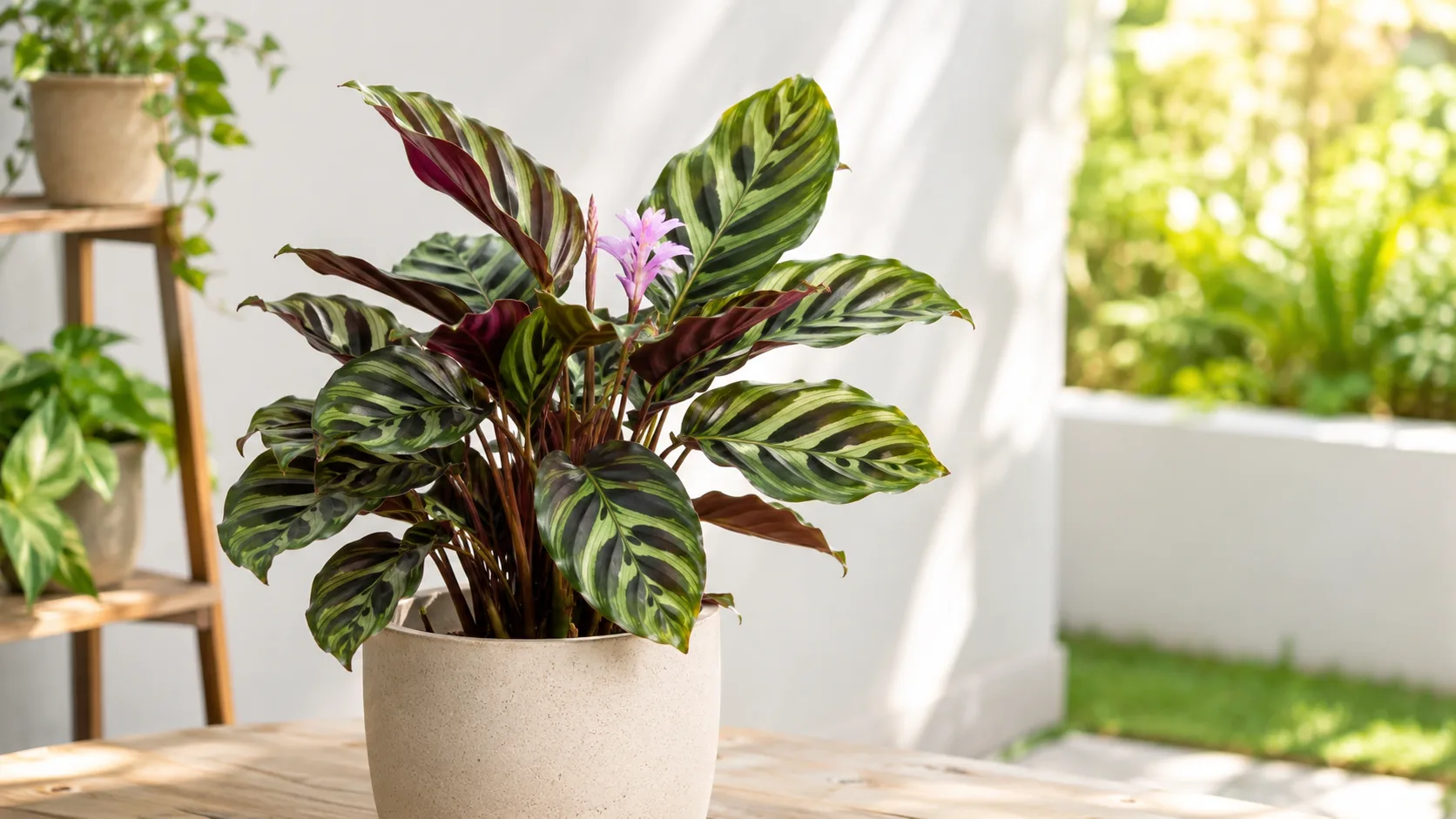
Freddie’s green-on-green zebra striping (pale green blades with dark green streaks from midrib to margin, purple undersides) lacks the white or pink variegation that makes cultivars like White Fusion hypersensitive to dry air. Freddie still prefers high humidity (NC State Extension recommends about 60% for Goeppertia houseplants) and benefits from a humidifier or pebble tray, but it often survives average homes better than heavily variegated relatives. Do not interpret that as drought tolerance — it is still a tropical understory prayer plant, not a succulent.
When new leaves open with crisp brown edges despite correct soil moisture, suspect water chemistry or airflow before assuming you need to water more. Humidity supports leaf edges; soil checks govern roots.
Why Freddie Watering Feels Harder Than a Pothos
Freddie sends loud leaf signals that do not always match the root zone. Curling, drooping, and edge browning can mean underwatering, overwatering, low humidity, cold drafts, or mineral buildup — and the same symptom can point to opposite fixes. Adding water to already-damp soil is the classic mistake; so is letting a peat-heavy mix dry into a hydrophobic block because you feared rot.
Prayer plants in the Marantaceae family evolved on tropical forest floors where soil stays lightly moist but drains freely after rain. NC State Extension notes that Goeppertia species need moist, well-drained potting mix and suffer from both overwatering and allowing soil to dry out. Fine roots die quickly in stagnant water, and once they do, leaves wilt even though the pot feels heavy — the signature confusion that makes growers water more and accelerate decline.
What prayer plant roots need from the mix indoors
In native tropical forest-floor habitats across Central and South America, calatheas and Goeppertia relatives grow in loose organic soil with steady moisture and high humidity. Indoors, recreate that with a peat- or coco-based mix with perlite, a drainage hole, and a watering habit that keeps the center moist while oxygen still moves through the mix. Pair watering with the right Calathea Freddie soil — a heavy, compaction-prone blend will stay wet in the core while the top looks dry.
Good Freddie watering protects roots first. Judge the newest fully opened leaves and root-zone moisture before reacting to every brown edge on an older blade.
How Often to Water Calathea Freddie Without a Fixed Calendar
There is no universal “water every seven days” rule. Frequency shifts with light (see the Calathea Freddie light guide), temperature, humidity, pot material, mix composition, and seasonal growth speed. A Freddie pushing new rolled leaves in a warm room transpires faster than the same plant in a cool, dim winter spot where photosynthesis slows and the mix retains moisture longer.
The useful target is consistent moisture without saturation. Freddie should not cycle between desert-dry and flood-wet. Repeated full dry-outs stress fine roots and make rewetting difficult in peat-heavy media. Constant sogginess invites rot, fungus gnats, and winter oedema — water-soaked leaf patches when the plant cannot transpire fast enough in cool, dim conditions.
The top 2 cm finger test
Press your finger into the soil to about 2 cm depth. If the mix feels cool and damp, wait. If it feels just beginning to dry at that depth, water thoroughly. If it is hard, dusty, and pulling away from the pot wall, the plant has gone too dry and needs a careful full soak with full drainage — not nervous daily splashes that only wet the surface.
Freddie’s shallow dry check matches its compact root zone better than the deeper 2.5 cm rule often quoted for larger calatheas in big pots. In a 10–12 cm pot, 2 cm is a meaningful slice of the root ball, not just surface crust.
Pot weight and skewer checks
Lift the pot right after a thorough watering (saucer emptied) and notice the full weight. As the mix dries, the pot feels noticeably lighter. When weight drops and the top 2 cm feels ready, water again. For a second opinion without disturbing roots, insert a wooden skewer near the pot wall for a minute — damp residue means wait; a clean dry stick confirms readiness.
Moisture meters can help but often misread chunky, peat-based mixes. If the meter says dry but the pot is heavy and the skewer is damp, trust the pot.
Best Water for Calathea Freddie
The best water for Freddie is clean, room-temperature water low in heavy minerals and sodium. Repeated watering with hard or chemically treated tap water leaves mineral deposits in the mix and can burn leaf tips and edges even when moisture levels are correct — the RHS links calathea tip browning mainly to low humidity, but better water quality still helps when edges keep crisping on new growth.
The RHS Calathea growing guide notes that all houseplants prefer rainwater because mains tap water contains lime and chlorine, but calatheas will tolerate tap water left to stand 24 hours so chlorine can evaporate. Rainwater, distilled water, reverse-osmosis water, or dehumidifier condensate are safer long-term choices when tips keep browning on new growth.
Fluoride, chlorine, and brown leaf tips
Brown tips on Freddie are not always a frequency problem. The RHS Calathea growing guide ties tip browning mainly to low humidity; hard tap water adds calcium and magnesium that crust the soil surface and pot rim. The RHS Goeppertia concinna profile recommends distilled or rainwater to prevent chemical foliage damage. If soil checks look right but new leaves keep crisping, switch water sources and raise humidity before changing your schedule again.
Letting tap water stand overnight helps chlorine but not reliably chloramine. If standing water does not improve new growth after four to six weeks, run filtered or rainwater for a full growing season and compare the next two leaves. Flush the pot occasionally with plain water until it runs freely from the drainage hole — especially if you follow the Calathea Freddie fertilizer guide during active growth.
Avoid softened water, which often contains sodium that builds up in small pots over months.
Top Watering vs Bottom Watering for Freddie
Both methods work when the goal is even root-zone moisture and full drainage afterward. Neither fixes a bad mix, a pot without drainage, or a schedule that ignores soil dryness.
Top watering — slow pour onto the soil until excess runs from the drainage hole — is the default. It flushes salts, shows when the mix is saturated, and keeps water off foliage. Freddie leaves can spot if water sits on them in bright or cool conditions.
Bottom watering — setting the pot in a tray and letting the mix wick upward — delivers even moisture and keeps the surface drier. The RHS suggests watering from the base to reduce fungus gnats, which breed in constantly wet surface soil. Soak until the top 2 cm feels moist, then remove the pot and drain fully.
Choose bottom watering if gnats are a problem or the surface dries unevenly. Choose top watering when you need to flush salts or the mix has gone hydrophobic. Whichever you use, never leave the pot standing in water after it finishes absorbing.
Signs You Are Overwatering Calathea Freddie
Overwatering is the more dangerous failure mode indoors — especially in winter, in dim rooms, in oversized pots, or when a decorative cachepot traps runoff. Watch for yellowing lower leaves, soft stems at the soil line, soil that stays wet beyond 7 to 10 days, musty smell, fungus gnats, and wilting or curling despite wet soil. New leaves may emerge smaller or fail to open cleanly.
Overwatering often follows good intentions: slight leaf curl triggers a drink into already-damp soil, or a summer weekly schedule continues into November while growth slows. Freddie’s fine roots suffocate quickly; the plant cannot move water to leaves even when the pot feels heavy.
How to recover a soggy plant
Stop watering and empty all standing water from saucers and cachepots. Move Freddie to bright indirect light with stable temperature and slightly better airflow. Do not fertilize. Let the mix dry to the appropriate level before the next thorough watering — this may take a week or more in a saturated pot.
If decline continues — spreading yellow leaves, base softness, sour smell — unpot and inspect roots. Trim mushy brown tissue, repot into fresh airy mix in a pot only slightly larger than the root ball (see Calathea Freddie repotting), and water once lightly. Old yellow leaves will not green up; success means firm new leaves from the center.
Signs You Are Underwatering
Underwatering shows as daytime leaf curl or roll, drooping petioles, crispy brown edges and tips, a lightweight pot, and mix pulling away from the pot wall or becoming difficult to rewet. Freddie may fold leaves more tightly than usual and show less dramatic nightly movement. A single dry episode usually recovers with one thorough soak and full drainage. Repeated drought cycles damage fine roots and cause new leaves to brown at the edges even after you correct the schedule.
The distinguishing check is soil and pot weight. Dusty top 2 cm, light pot, dry skewer — water, even if you run a humidifier. Wet heavy soil with crisp edges — humidity or water quality is the lever, not another drink.
When rehydrating dry mix, water thoroughly once rather than giving tiny daily sips that moisten only the surface. If water runs down the sides without soaking in, bottom water for 30 to 45 minutes or top water slowly in stages until the root ball absorbs evenly.
Seasonal Watering: Spring Through Winter
Freddie watering shifts through the year even indoors because day length and light intensity change. In spring and summer, active growth increases water use. Check every 4 to 7 days. Water when the top 2 cm is just beginning to dry. Heat waves or air conditioning may speed drying.
In fall and winter, growth slows. Lower light means less transpiration and longer dry-down times. The RHS advises allowing the compost surface to dry before rewetting in autumn and winter while never letting compost dry completely. Check every 7 to 10 days; many Freddies in cool, dim rooms need water only every 10 to 14 days from December through February. The RHS Goeppertia ‘Freddie’ profile says to keep just moist in winter — not wet, not desert dry.
Adjust after environment changes, not only calendar dates. Moving Freddie closer to a window in March increases water use; moving it from a heating vent in October slows drying. Repotting in spring temporarily changes dry-down until roots explore fresh mix.
Winter oedema when compost stays wet in low light
Oedema happens when roots absorb water faster than leaves can transpire, causing patchy water-soaked areas that later brown and cork. The RHS lists oedema as a calathea problem most likely in winter when compost is too wet. Cool temperatures, short days, and dim light reduce transpiration. Summer watering frequency in that environment keeps the mix saturated while the plant is essentially resting.
Prevent winter oedema by reducing watering frequency, giving Freddie the brightest indirect light available, avoiding cold window drafts, and letting the surface dry appropriately before the next drink. If oedema appears, reduce water, improve light if possible, and judge recovery by the next one or two new leaves.
How Light, Humidity, and Pot Size Change Frequency
Light is the largest driver after season. Freddie in medium to bright indirect light may need water every 5 to 7 days in summer. The same plant in low indirect light may need half as often because it is barely photosynthesizing. When you improve light, check moisture more often; when you move dimmer, extend the dry-down window.
Humidity above 60% reduces edge burn but does not replace soil checks. Dry heated air may crisp edges even when roots are fine — use a humidifier for leaves and the finger test for roots.
Pot size and material change the math immediately. Terracotta breathes and dries faster than plastic or glazed ceramic. Cachepots without drainage hide standing water — empty them after every watering. A large pot after an eager repotting keeps unused mix wet around a small Freddie root ball; that is overwatering by design.
Soil composition matters as much as volume. Heavy peat without enough perlite stays wet in the center. A chunky coco-perlite blend dries faster and needs more frequent checks but forgives less chronic sogginess. If the pot stays wet beyond 10 days in normal indoor conditions, fix the soil mix before blaming the plant.
Conclusion
Calathea Freddie watering comes down to one repeatable habit: check the top 2 cm and the weight of the pot, then water thoroughly with good-quality room-temperature water only when the root zone is ready — and always let the pot drain. Spring and summer usually mean checks every 5 to 7 days; fall and winter often stretch to 7 to 10 days or longer in cool, dim rooms. The calendar is a reminder to look, not a command to pour.
Read the root zone, not just the leaves. A light pot with a just-dry top 2 cm means water. A heavy wet pot with yellowing lower leaves means wait, improve drainage, and inspect if decline continues. Brown tips on new growth point to water quality or humidity as often as frequency. Winter wet soil in low light invites oedema and rot — slow down when Freddie slows down. Get moisture steady, water clean, and drainage honest, and this compact zebra prayer plant stops feeling random.
When to use this page vs other Calathea Freddie guides
- Calathea Freddie overview — Start here for whole-plant context, pet safety, and placement before deep-diving watering.
- Calathea Freddie light — Use when the pot dries too slowly or too fast because brightness changed; light drives water use.
- Calathea Freddie soil — Escalate here when the mix stays wet beyond 10 days despite careful watering.
- Calathea Freddie fertilizer — Feed only after watering rhythm is stable; salts compound tip-burn from hard water.
- Calathea Freddie repotting — Use when root rot, chronic soggy mix, or overcrowding requires a fresh start.