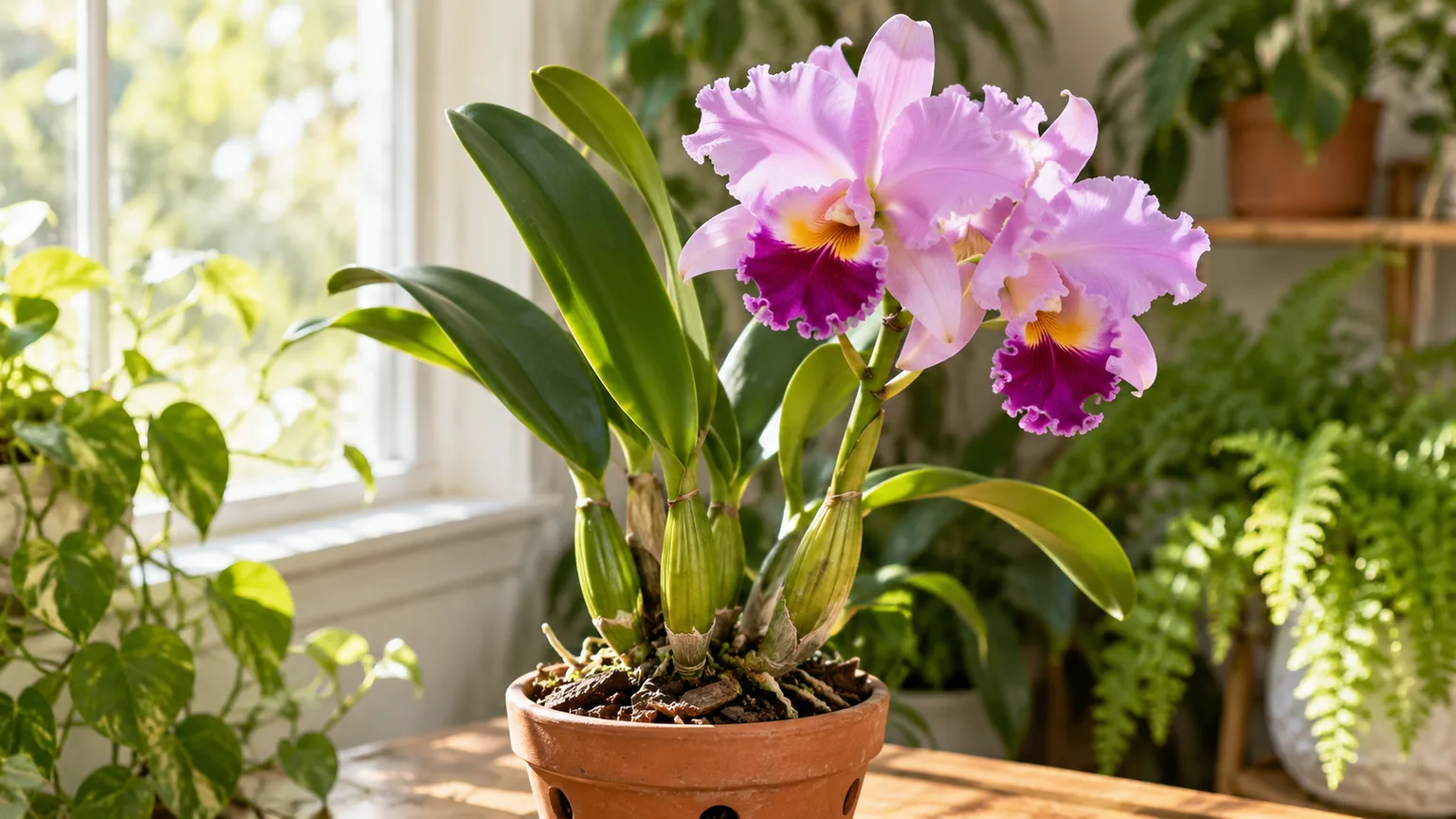
Check the bark and pot rather than watering on a fixed weekday. Water thoroughly when the open mix is nearly dry, then let excess drain; warmth, light, pot size, and the growth cycle all change the interval.
Does a Cattleya need direct sun?
It needs very bright light to grow and flower, but sudden hot midday sun can scorch leaves. Start with a bright east- or west-facing window or filtered greenhouse light and acclimate gradually.
What potting mix is best for Cattleya orchids?
Use an airy, coarse orchid mix based on bark, optionally with charcoal or perlite. Do not use ordinary dense potting soil, and keep the rhizome near the surface rather than burying it.
When should I repot a Cattleya?
Repot when the bark has broken down, drainage has slowed, or the rhizome has outgrown its pot. If possible, repot as new roots begin to grow; the timing varies with the species or hybrid.
Are Cattleya orchids safe for pets?
NC State Extension lists Cattleya as non-toxic to cats, dogs, and horses. That listing does not confirm safety for rabbits, birds, turtles, or tortoises, so keep the plant away from those animals unless a veterinarian confirms otherwise.
What light does Cattleya need?
Cattleya grows best in very bright filtered light. A bright east- or west-facing window is a useful starting point; acclimate gradually and shield the leaves from hot midday sun. It also tolerates Gentle morning sun after gradual acclimation, Bright shade or filtered light in a conservatory. Avoid deep shade and sudden exposure to strong unfiltered midday sun; too little light can prevent flowering, while intense direct sun can scorch leaves.
How do I propagate Cattleya?
Propagate Cattleya from healthy stem or root divisions during active growth.
Written by Sai AnanthLead content writer at LeafyPixels. B.Pharmacy graduate from Andhra University with a background in pharmacognosy, turned indoor gardening writer after a long-time plant hobby became a research-led resource for home growers.View Sai Ananth's profile · Reviewed by LeafyPixels Review Board
This Cattleya problems problem guide was researched and written by Sai AnanthLead content writer at LeafyPixels. B.Pharmacy graduate from Andhra University with a background in pharmacognosy, turned indoor gardening writer after a long-time plant hobby became a research-led resource for home growers.View Sai Ananth's profile. Problems symptoms on Cattleya, lookalike causes, and step-by-step fixes are cross-checked against extension pest, disease, and care references before publication.
We prioritize sources that hold up under scrutiny:
University cooperative extension bulletins and fact sheets (Penn State, Clemson, UMD, NC State, and similar programs)
Botanical garden and horticultural society publications
Peer-reviewed plant science and veterinary toxicology references where pet safety matters (including ASPCA Animal Poison Control)
Established reference works on indoor plant culture
The LeafyPixels editorial team then reviews the draft for clarity, step-by-step usefulness, and fit with real apartment and home conditions-not ideal greenhouse setups. When guidance changes materially, we update the page and note the revision date.
Sources used
Colorado State University Extension PlantTalk — Orchid: Cattleya (n.d.) Epiphytic roots, water-storing pseudobulbs, bright light, coarse media, humidity and day/night temperature guidance, and retaining several pseudobulbs when dividing. [Online]. Available at: https://planttalk.colostate.edu/topics/houseplants/1347-orchid-cattleya/ (Accessed: 1 March 2024).
Gardener's Path — How to Water Orchids (n.d.) Practical signs for judging orchid watering from medium, pot weight, season, and orchid type instead of using one fixed schedule. [Online]. Available at: https://gardenerspath.com/plants/flowers/water-orchids/ (Accessed: 1 March 2024).
NC State Extension Gardener Plant Toolbox — Cattleya (n.d.) Cattleya identity, tropical American range, epiphytic habit, pseudobulbs, high-light requirements, coarse medium, growth cycle, and cat/dog/horse non-toxic classifications. [Online]. Available at: https://plants.ces.ncsu.edu/plants/cattleya/common-name/queen-of-orchids/ (Accessed: 1 March 2024).
Royal Horticultural Society — Cattleya intermedia (n.d.) Species-level variation in pseudobulbs, flowering season, cultivation, and the need to time repotting with new growth. [Online]. Available at: https://www.rhs.org.uk/plants/3220/cattleya-intermedia/details (Accessed: 1 March 2024).
Royal Horticultural Society — Cattleya maxima (n.d.) Cattleya pseudobulb morphology; coarse bark-based medium; bright light; watering and feeding during active growth; winter reduction; repotting and division guidance. [Online]. Available at: https://www.rhs.org.uk/plants/3224/cattleya-maxima/details (Accessed: 1 March 2024).