Cattleya Orchid Care: Light, Water, Bark, and Blooming
Cattleya spp. and Cattleya-alliance hybrids
Grow Cattleya orchids with bright filtered light, airy bark mix, and watering guided by pseudobulbs and active growth. Learn when to repot and why bloom timing varies across Cattleya species and hybrids.
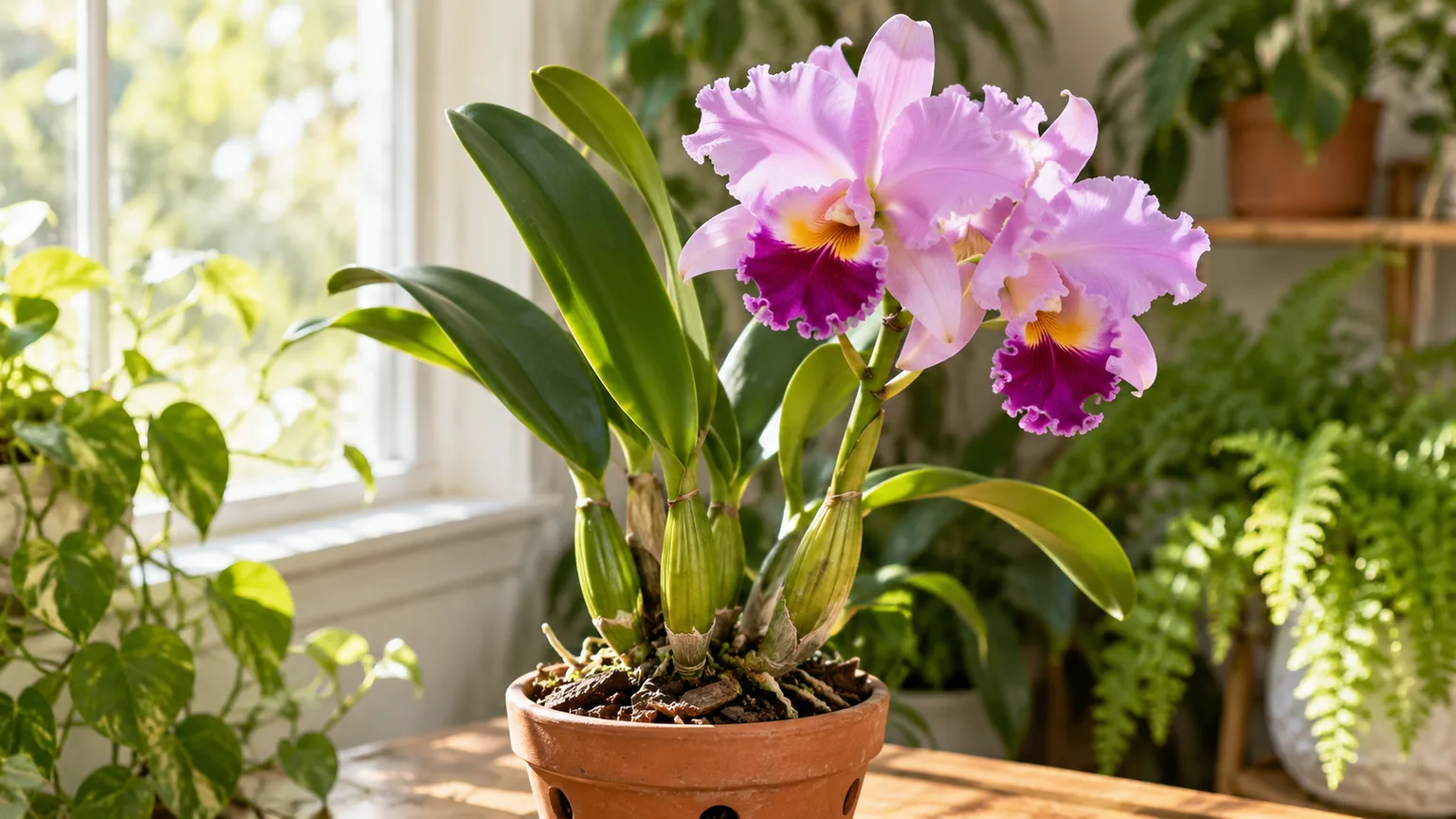
Cattleya Orchid Care Guide: Bright Light, Airy Roots, and Flowers
Start with wateringThe most common care mistake for CattleyaWatering guide →Cattleya care essentials
Light
Very bright filtered light. A bright east- or west-facing window is a useful starting point; acclimate gradually and shield the leaves from hot midday sun.
Water
Water thoroughly when the coarse orchid mix is approaching dry, then let all excess drain. Cattleya pseudobulbs store water, so avoid keeping the roots constantly wet. Check the mix and plant rather than following a fixed weekly schedule; warm bright conditions use water faster than cool dim ones.
Soil
Use a coarse, open orchid mix based on bark, with charcoal, perlite, or another airy component if needed. Cattleya roots are adapted to exposed, aerated conditions, so ordinary dense potting soil is unsuitable.
Humidity
Temperature
Fertilizer
If the leaves stay deep green and the plant grows but rarely flowers, review the light before increasing fertilizer.
About Cattleya
Cattleya is native to Tropical America; the native range varies by species, typically reaches Highly variable by species and hybrid. Compact plants stay relatively small, while mature clumps expand sideways as new pseudobulbs grow from the rhizome. indoors, with moderate during active growth. a growing cycle usually adds one or more pseudobulbs; flowering time and growth rhythm differ among species and hybrids. growth. Cattleya has a sympodial, mostly epiphytic orchids. a creeping rhizome produces roots and upright pseudobulbs that carry one or two leathery leaves. growth habit and part of the Orchidaceae family. It is also known as Queen of Orchids and Corsage Orchid.
| Detail | Information |
|---|---|
| Also known as | Queen of Orchids, Corsage Orchid |
| Native region | Tropical America; the native range varies by species |
| Mature size | Highly variable by species and hybrid. Compact plants stay relatively small, while mature clumps expand sideways as new pseudobulbs grow from the rhizome. |
| Growth rate | Moderate during active growth. A growing cycle usually adds one or more pseudobulbs; flowering time and growth rhythm differ among species and hybrids. |
| Growth habit | Sympodial, Mostly Epiphytic Orchids. A Creeping Rhizome Produces Roots And Upright Pseudobulbs That Carry One Or Two Leathery Leaves. |
| Scientific name | Cattleya spp. and Cattleya-alliance hybrids |
| Family | Orchidaceae |
How to care for Cattleya?
How much light does Cattleya need?
Very bright filtered light. A bright east- or west-facing window is a useful starting point; acclimate gradually and shield the leaves from hot midday sun.. Gentle morning sun after gradual acclimation. Bright shade or filtered light in a conservatory
- Very bright filtered light. A bright east- or west-facing window is a useful starting point - A bright east- or west-facing window is a useful starting point; acclimate gradually and shield the leaves from hot midday sun..
- acclimate gradually and shield the leaves from hot midday sun - A bright east- or west-facing window is a useful starting point; acclimate gradually and shield the leaves from hot midday sun..
- Gentle morning sun after gradual acclimation - Gentle morning sun after gradual acclimation.
- Bright shade or filtered light in a conservatory - Bright shade or filtered light in a conservatory.
When should you water Cattleya?
Water thoroughly when the coarse orchid mix is approaching dry, then let all excess drain. Cattleya pseudobulbs store water, so avoid keeping the roots constantly wet. Check the mix and plant rather than following a fixed weekly schedule; warm bright conditions use water faster than cool dim ones.
- Check below the surface of the bark or lift the pot to judge its weight. When the medium is nearly dry - Check the mix and plant rather than following a fixed weekly schedule; warm bright conditions use water faster than cool dim ones.
- run lukewarm water through the pot and let it drain fully. Keep water from pooling in the saucer or around the rhizome - Water thoroughly when the coarse orchid mix is approaching dry, then let all excess drain.
- Drain excess water - Water thoroughly when the coarse orchid mix is approaching dry, then let all excess drain.
What soil works best for Cattleya?
Use a coarse, open orchid mix based on bark, with charcoal, perlite, or another airy component if needed. Cattleya roots are adapted to exposed, aerated conditions, so ordinary dense potting soil is unsuitable.
- Use medium or coarse orchid bark sized to the roots and pot. - Use a coarse, open orchid mix based on bark, with charcoal, perlite, or another airy component if needed.
- Add coarse perlite or charcoal when the mix needs more air space. - Use a coarse, open orchid mix based on bark, with charcoal, perlite, or another airy component if needed.
- Avoid compact garden soil and do not leave the pot standing in runoff. - Cattleya roots are adapted to exposed, aerated conditions, so ordinary dense potting soil is unsuitable.
Grower notes for Cattleya
Read the pseudobulbs, not the calendar
Cattleya pseudobulbs are swollen stems that store water and support one or two leathery leaves. Their presence makes the plant more tolerant of a short dry interval than a constantly wet root zone. Water when the open mix is nearly dry, then drain the pot completely; do not let a schedule override the plant's growth and the room's temperature.
Give it enough light to flower
Cattleyas need brighter conditions than many common moth orchids. Aim for a bright east- or west-facing window or filtered greenhouse light. A dark green plant may be receiving too little light for flowering; increase exposure gradually and protect the leaves from harsh midday sun.
Keep the roots airy
In nature, Cattleyas grow as epiphytes, with roots attached to trees or other supports instead of buried in soil. Recreate that airflow with a coarse orchid mix and a freely draining pot. Keep the rhizome on top of the mix so new pseudobulbs and roots can develop without being smothered.
Let the growth cycle guide seasonal care
New roots and pseudobulbs are the clearest signal that a plant is actively growing and using more water. Some species or hybrids slow down after flowering and need less water in winter; others do not follow the same rest pattern. Reduce watering as growth slows, but do not force every Cattleya through a long dry period.
Repot only when the plant needs it
Cattleyas settle well in a snug pot and can be set back by unnecessary repotting. Replace bark when it decays or drainage fails, or move the plant when the rhizome has outgrown the container. When dividing a mature clump, keep several established pseudobulbs on each division so it retains stored energy for new roots and growth.
Expect flowering to vary
Cattleya flowers form on mature growth, and bloom season differs among species and hybrids. Many plants flower once in a year, but a missed bloom is not a signal to add fertilizer immediately. First check that the plant has completed a healthy new growth and receives enough bright light.
Pet safety
NC State Extension lists its Cattleya profile as non-toxic to cats, dogs, and horses. That listing does not confirm every intergeneric Cattleya-alliance hybrid or safety for rabbits, birds, turtles, or tortoises. Confirm the plant's identity and keep it away from unverified pets unless a species-specific veterinary source confirms suitability.
The NC State Extension Cattleya profile tags Cattleya as non-toxic for cats, dogs, and horses. It does not clear every intergeneric Cattleya-alliance hybrid or other orchid genera; do not extend the classification beyond the exact plant identity supported by the profile.
Watering Cattleya
For Cattleya, check below the surface of the bark or lift the pot to judge its weight. When the medium is nearly dry, run lukewarm water through the pot and let it drain fully. Keep water from pooling in the saucer or around the rhizome. and water check the pot every few days in warm, bright weather and less often in cool weather. Bark size, pot material, airflow, and the plant's active growth all change how quickly it dries. Some species and hybrids have a drier rest period, while others continue growing; follow the plant's seasonal pattern. Increase checks during warm, bright active growth, when new roots and pseudobulbs are developing. Reduce watering in cooler or naturally drier rest periods, but do not impose a long dry rest on every Cattleya: species and hybrids differ.
| Detail | Information |
|---|---|
| How often | Check the pot every few days in warm, bright weather and less often in cool weather. Bark size, pot material, airflow, and the plant's active growth all change how quickly it dries. Some species and hybrids have a drier rest period, while others continue growing; follow the plant's seasonal pattern. |
| How to check | Check below the surface of the bark or lift the pot to judge its weight. When the medium is nearly dry, run lukewarm water through the pot and let it drain fully. Keep water from pooling in the saucer or around the rhizome. |
| Seasonal changes | Increase checks during warm, bright active growth, when new roots and pseudobulbs are developing. Reduce watering in cooler or naturally drier rest periods, but do not impose a long dry rest on every Cattleya: species and hybrids differ. |
Signs of overwatering
- The potting mix stays wet for many days or smells stale.
- Roots darken or soften while the pot remains damp.
- New growth weakens in a poorly draining mix.
Signs of underwatering
- Several pseudobulbs become increasingly shriveled during active growth.
- The mix is dry and the plant's leaves or new growth lose firmness.
Soil & potting for Cattleya
Use a mix of Use medium or coarse orchid bark sized to the roots and pot., Add coarse perlite or charcoal when the mix needs more air space., Avoid compact garden soil and do not leave the pot standing in runoff. for Cattleya. Fast and reliable drainage matters. Use a pot with open drainage holes and leave the rhizome at the surface of the medium instead of burying it. Target soil pH around Not specified; prioritize an airy orchid medium and dependable drainage. Repot repot when the bark breaks down, drainage slows, or the rhizome has outgrown the pot; many plants need fresh medium about every two to three years., ideally in repot as new roots begin to grow, often in spring, so the plant can establish into the fresh medium. The best timing varies by species and growth cycle.
| Detail | Information |
|---|---|
| Recommended mix | Use medium or coarse orchid bark sized to the roots and pot., Add coarse perlite or charcoal when the mix needs more air space., Avoid compact garden soil and do not leave the pot standing in runoff. |
| Drainage | Fast and reliable drainage matters. Use a pot with open drainage holes and leave the rhizome at the surface of the medium instead of burying it. |
| Soil pH | Not specified; prioritize an airy orchid medium and dependable drainage. |
| Repotting frequency | Repot when the bark breaks down, drainage slows, or the rhizome has outgrown the pot; many plants need fresh medium about every two to three years. |
| Best season to repot | Repot as new roots begin to grow, often in spring, so the plant can establish into the fresh medium. The best timing varies by species and growth cycle. |
Signs it needs repotting
- Bark is decomposing, compacted, or staying wet much longer than before.
- The rhizome has grown over the pot edge or the clump is unstable.
- Roots have little healthy room to enter fresh medium.
Humidity & temperature for Cattleya
Fertilizer & pruning for Cattleya
Use if the leaves stay deep green and the plant grows but rarely flowers, review the light before increasing fertilizer. for Cattleya.
| Detail | Information |
|---|---|
| Fertilizer type | If the leaves stay deep green and the plant grows but rarely flowers, review the light before increasing fertilizer. |