Do Orchids Need Sunlight? A Practical Light Guide
Do orchids need sunlight to bloom? Find the right window for your orchid, use grow lights if needed, and spot signs of too much or too little light.
The practical answer: orchids need bright light, not full-day direct sun
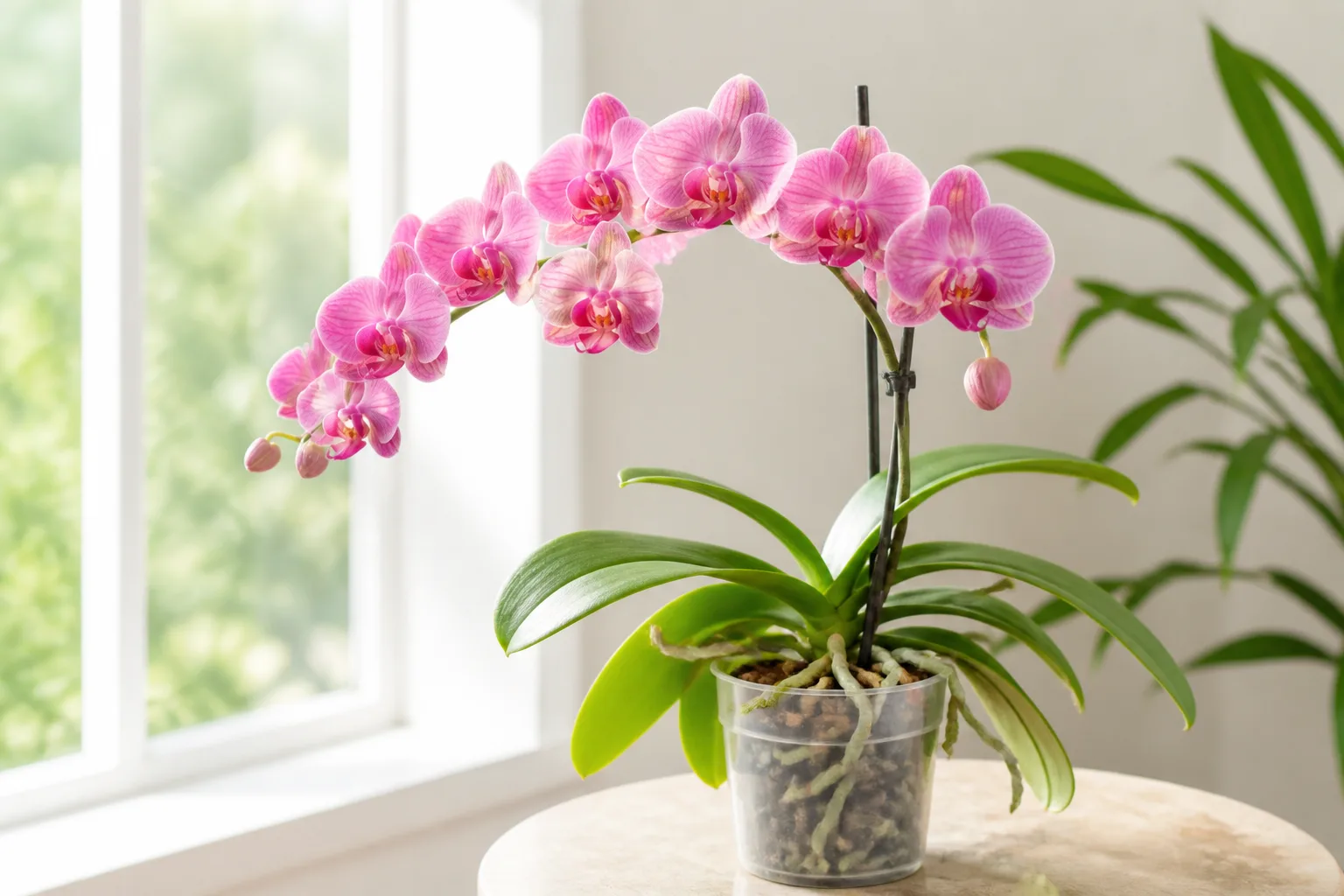
Yes, orchids need light to make energy, grow leaves and roots, and produce flower spikes. For the familiar grocery-store moth orchid, or Phalaenopsis, a bright window with filtered light is a dependable starting point; a hot, unshaded afternoon window is usually too intense. North Carolina State Extension likewise recommends an east-facing window for moth orchids and says shaded west or south windows can work. (NC State Extension)
“Orchid” covers a huge range of plants, though. Some popular kinds grow and flower in gentler light, while others need a much brighter position. So the useful answer is not “give every orchid six hours of sun.” Identify the orchid if you can, then match the light to that group and to the actual conditions at your window.
Identify the orchid before choosing a light level
If you bought a flowering plant at a grocery store, it is likely a Phalaenopsis hybrid, but check the label before treating that guess as fact. Other common indoor orchids include Cattleyas, Dendrobiums, and Paphiopedilums; their leaves, stems, and growth habits can look very different, and the amount of light that suits one may leave another alive but reluctant to flower.
The American Orchid Society gives useful light references for several groups, but its foot-candle ranges describe greenhouse conditions, where growers can measure and control exposure. Treat those figures as a way to understand relative demand, not as a promise that a phone app reading at a household window predicts flowering. The window guidance below is the more practical starting point for most homes.
Phalaenopsis: bright, filtered light
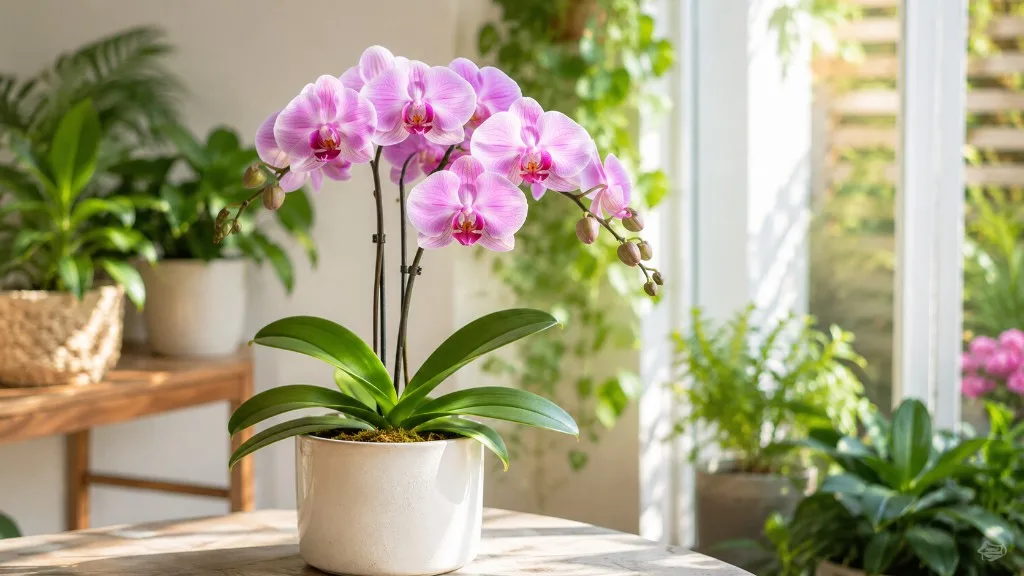
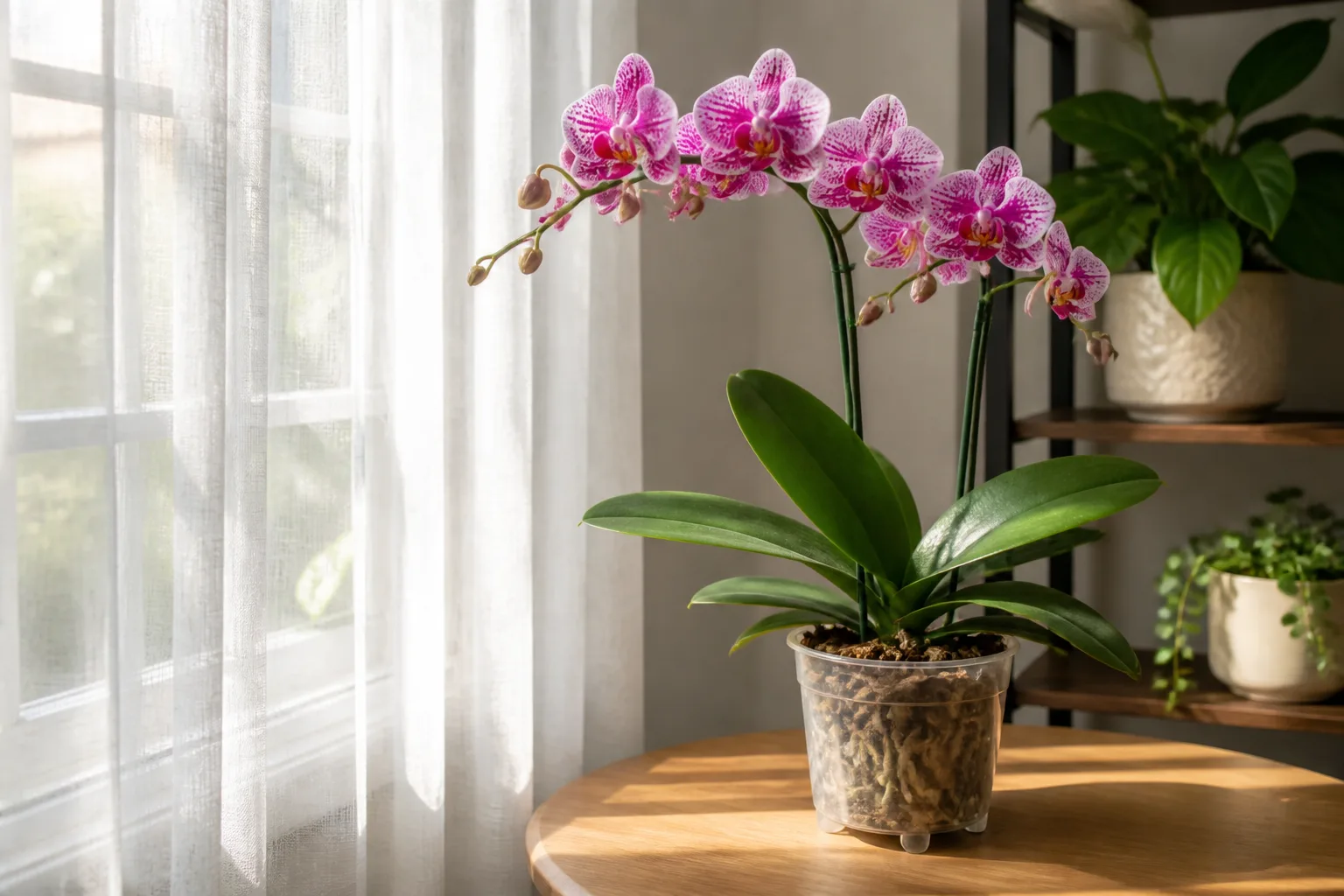
Moth orchids usually do well in a bright room where the leaves receive plenty of daylight without sitting in strong, hot sun for hours. An east-facing window is an easy first choice. A south- or west-facing window can also work if a sheer curtain softens the beam or the plant stands back from the glass. (American Orchid Society, RHS)
For scale, the American Orchid Society lists about 1,000–2,000 foot-candles for Phalaenopsis in a greenhouse. That is roughly 10,800–21,500 lux, but the number does not mean you should chase the same reading at every point in your home: glass, distance, curtain fabric, season, and time of day all change what reaches the leaf.
A useful home check is whether the orchid gets a broad stretch of bright ambient light, not only a short sunbeam and many hours in a dim corner. Joy Us Garden’s Phalaenopsis care guidance makes the same practical distinction: give the plant as much bright natural light as possible while avoiding hot, direct sun, especially at a south or west window. (Joy Us Garden)
Cattleya: brighter light for reliable flowering
Cattleyas generally need more light than a moth orchid to grow and bloom well. The American Orchid Society describes chartreuse-green leaves as a useful target and gives a greenhouse range of about 2,000–3,500 foot-candles. For indoor growers, it recommends a bright window, ideally south-facing, with more than four hours of direct sun for flowering. (American Orchid Society: Cattleya culture)
That recommendation does not mean a newly purchased Cattleya should be moved abruptly from a shaded shop to an uncurtained midday window. A plant accustomed to low light can scorch during a sudden jump, and the same south window can be much harsher in a hot, sunny climate than in a cloudy northern winter. Start with strong filtered light, then increase exposure gradually while watching the leaves and how warm the plant becomes.
If a Cattleya grows leaves but will not flower, insufficient light is a sensible factor to check, not the only possible cause. The plant may be immature, out of its normal growth rhythm, or affected by other care conditions. Increase light carefully and give the new position time before changing several parts of its care at once.
Paphiopedilum: light shade, with some direct sun tolerated
Lady’s-slipper orchids are often grouped with lower-light orchids, but “low light” should not be read as “a dark shelf.” The American Orchid Society says most Paphiopedilums do well with two to three hours of shaded sunlight and lists east, north, or west windows as possible home positions, depending on the plant. It also warns that hotter conditions call for more shade. (American Orchid Society: Paphiopedilum culture)
That range is a reminder to avoid rigid labels. A shaded morning beam or a bright window with a curtain may suit one slipper orchid, while another species or hybrid may prefer a cooler, dimmer location. If the tag gives a named species or a more specific light instruction, follow that over a generic care card for the whole genus.
Dendrobium: needs depend on the group
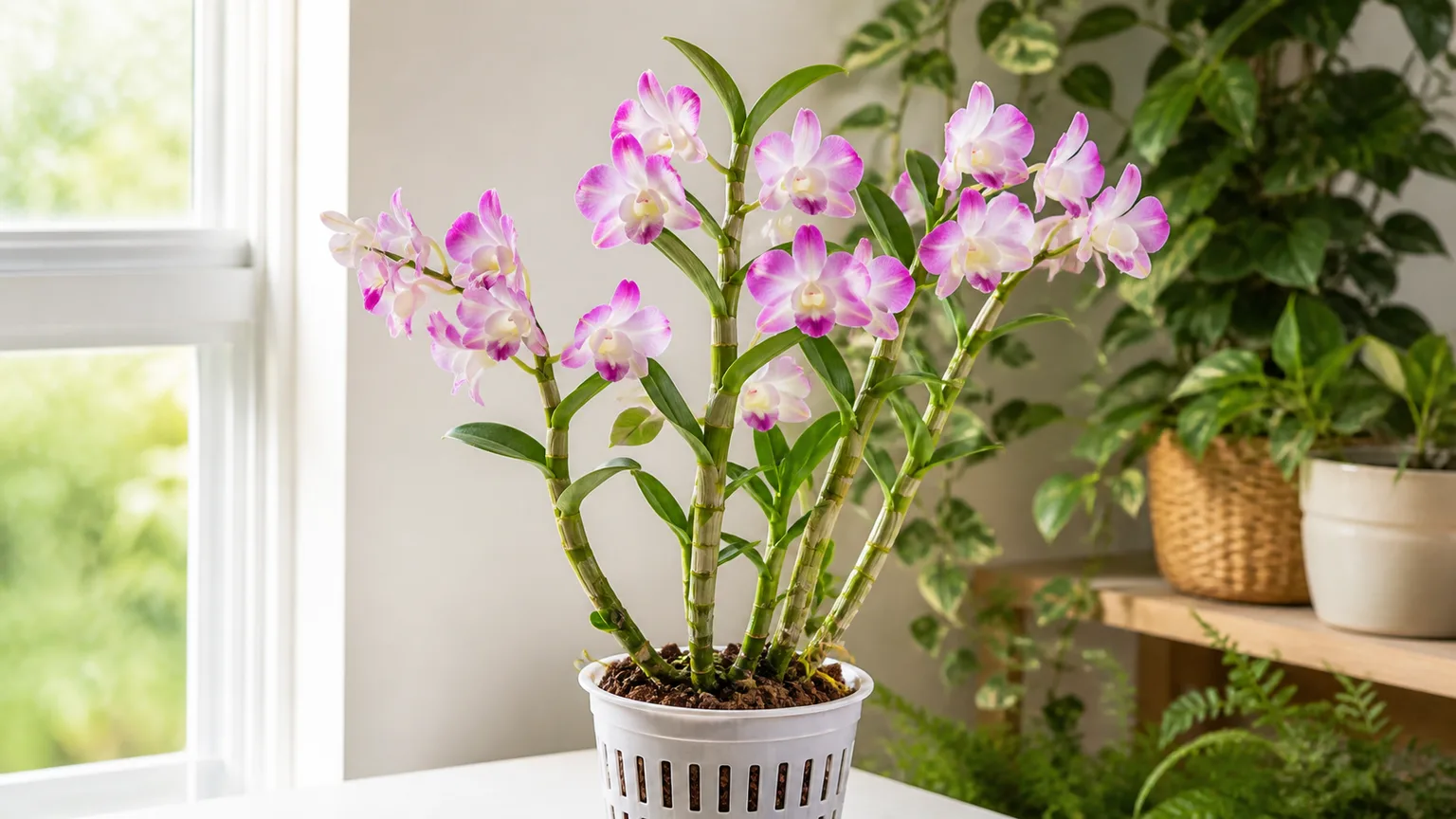
Dendrobiums are a large and varied genus, so a single light prescription can mislead. Many commonly grown types prefer brighter conditions than Phalaenopsis, but the exact requirement depends on the species or hybrid and its growing cycle. A broad-window position with filtered light is safer while you identify the plant than either deep shade or immediate exposure to strong midday sun.
Blooming Backyard’s practical orchid guidance also separates moth orchids from brighter-growing Cattleya and Dendrobium types, while emphasizing that orchid groups do not all want the same exposure. Use that as a prompt to check the plant’s name and grower’s label, then adjust the position according to how the plant responds rather than assuming every Dendrobium is interchangeable. (Blooming Backyard)
What “bright indirect light” means at home
Bright indirect light is daylight strong enough to reach the plant clearly, but softened by distance, a curtain, an overhang, or another barrier so the leaves are not heated by prolonged direct rays. It is not a technical measurement, and two rooms that look equally bright to a person can deliver very different light at the plant. A nearby building, deep balcony, tinted glass, or heavy curtain can cut the amount substantially.
A window’s orientation helps you predict the pattern, but it does not tell the whole story. The size and cleanliness of the glass, trees outside, the orchid’s distance from it, and the season all matter. Think about the brightness at the leaves through the day, not the brightness of the room from the doorway.
Read the light at leaf level
Observe the spot for a full day before moving the orchid. Note when a direct sun patch reaches the leaves, how long it stays, and whether that beam is gentle morning sun or hot afternoon sun. A hand held a few inches above a sheet of paper can provide a rough comparison: a crisp, dark shadow indicates stronger direct light, while a soft-edged shadow suggests diffuse light. It is a quick check, not a horticultural meter.
Repeat the observation on a clear day and during the season when you expect to keep the orchid there. Sun angle changes over the year, and a position that is mild in winter may receive a much longer, hotter beam in summer. If you use a lux-meter app, hold the phone at leaf height and take readings at several times rather than treating one number as the plant’s daily total.
The American Orchid Society’s greenhouse ranges help explain why light needs differ, but a greenhouse reading and a windowsill reading are not interchangeable. A phone sensor may be poorly calibrated, and an instantaneous lux reading measures visible brightness, not the total usable light the plant received over the day. Compare readings between two possible spots with the same device; use the plant’s growth and condition as the final check.
Choose a window, then adjust it for season
East, south, west, and north windows
In the Northern Hemisphere, east windows usually offer gentler morning sun and are often the easiest place to start with a Phalaenopsis. South windows receive more sustained direct light, and west windows can deliver intense late-day sun; either may work for brighter orchids or for a moth orchid behind a sheer curtain. North windows provide the least direct sun in much of the Northern Hemisphere, so they suit shade-tolerant types or a very bright, unobstructed room better than a dim corner.
| Window in the Northern Hemisphere | Typical pattern | Practical starting point |
|---|---|---|
| East | Direct morning light, usually less intense than late-day sun | Good first choice for Phalaenopsis; assess Paphiopedilum here too |
| South | Long, strong exposure, especially in summer | Use a sheer curtain or distance for Phalaenopsis; consider for Cattleya |
| West | Strong afternoon and evening sun | Filter for moth orchids; watch leaf heat and summer scorch |
| North | Mostly indirect light | Try for a lower-light orchid if the window is large and unobstructed |
These are tendencies, not rules. A small north window blocked by a porch may be dimmer than a large east window, and a high floor with open sky may receive much more light than a ground-floor room under trees. If the plant’s leaves become hot to the touch in direct sun, move it back or add a curtain while you reassess.
Account for hemisphere and season
Window directions reverse across the equator: in the Southern Hemisphere, north-facing windows usually receive the strongest sun and south-facing windows the least. If you live in the tropics, the sun’s seasonal path and the angle of the building can make simple compass rules less reliable, so observe the actual sun pattern at the plant.
Moth orchids often benefit from a brighter position in winter, when daylight is shorter and weaker. The RHS recommends bright winter light for flowering and protection from direct summer sun, with east- or west-facing windowsills as useful options. If you move an orchid closer to glass for winter, mark a reminder to check that spot again as days lengthen. (RHS)
Keep the orchid away from cold glass in winter and from hot panes or heating vents in summer. Light and heat arrive together at a sunny window, but a leaf that overheats can be damaged even when the light level might otherwise suit that orchid. A little distance, a sheer, or a change in season may solve the problem without abandoning the bright location.
Can an orchid sit in direct sunlight?
Sometimes. Direct sun is not automatically harmful to every orchid: American Orchid Society guidance for Cattleyas describes a bright, sunny indoor window as useful for flowering, and it gives Paphiopedilums a range that includes limited direct exposure. The key is how intense the beam is, how long it lasts, whether the plant is acclimated, and which orchid you have. (American Orchid Society: Cattleya culture, American Orchid Society: Paphiopedilum culture)
For most grocery-store Phalaenopsis, avoid hours of hot, unfiltered midday or afternoon sun. Gentle early morning sun may be tolerated in some homes, but a sheer curtain is a safer choice if the plant is new to the window or you cannot monitor it. The RHS specifically cautions against direct summer sun for moth orchids because it can scorch the leaves. (RHS)
Outdoor summering adds another variable: sun intensity is much greater outside than behind a window, and wind and temperature also change. If you take an orchid outdoors, place it in open shade or dappled light first, protect it from heavy rain and strong wind, and check it daily before trying a brighter position. Do not move an indoor plant straight into afternoon sun because it seemed fine on a bright windowsill.
How many hours of sunlight do orchids need?
There is no reliable number of direct-sun hours that applies to all orchids. Six hours at a bright east window is not the same exposure as six hours of hot western sun; a curtain, glass type, latitude, and time of year change intensity. Also, “hours of daylight” and “hours of direct sun on the leaves” are different things.
The practical aim for a Phalaenopsis is a bright part of the home for much of the day, with direct sun softened or limited. A Cattleya may need a stronger window and several hours of sun to flower, while a Paphiopedilum may do better with lower intensity or only shaded exposure. These ranges reflect different plants, not a contradiction to solve by averaging them.
If a care label gives a time range, treat it as a starting point for that orchid in the stated growing conditions. Then check the window’s actual pattern and the plant’s response over several weeks. A fixed hour count cannot compensate for very weak light, nor does it make intense sun safe for a shade-adapted plant.
Can orchids grow under artificial light?
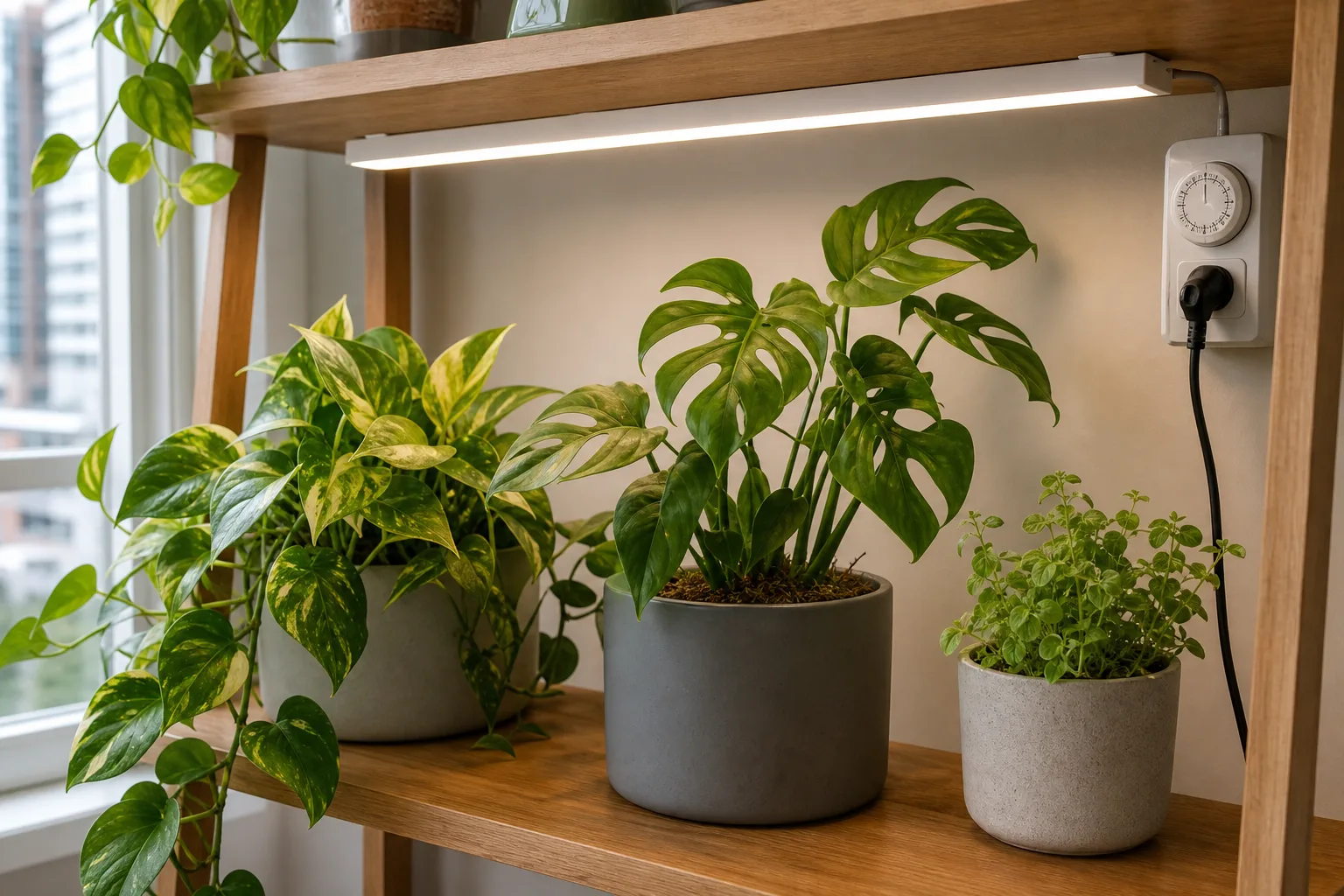
Yes. A grow light can supplement a dim winter window or provide the main light in a room without suitable daylight. The American Orchid Society says many Phalaenopsis grow under artificial lighting and gives a starting lamp distance of about one to two feet; actual results still depend on the fixture’s output, coverage, and orchid type. (American Orchid Society)
Choose a horticultural LED with a broad, plant-appropriate spectrum and follow its distance guidance rather than choosing by wattage alone. Two fixtures with the same power can deliver very different light at the leaves. If you use a light meter, measure at leaf height; if not, keep the lamp at the manufacturer’s suggested distance and look for steady, healthy growth without bleaching or excessive warmth.
A timer makes the schedule consistent, but a timer cannot fix a lamp that is too weak, too far away, or too hot. Start with a moderate daily period recommended for the fixture, keep the orchid’s normal dark period, and adjust in small steps if growth remains weak or the leaves show stress. Avoid a hot bulb pressed close to the leaves, and do not assume that a longer day always compensates for poor light intensity.
When combining a window and a grow light, account for both sources. A plant may receive enough natural light for part of the day and only need a few supplemental hours, especially in winter. If the plant is already getting strong afternoon sun, adding a lamp on top of it may create unnecessary heat and stress rather than solving a shortage.
Diagnose too much versus too little light
Leaves can help you assess exposure, but no single color or mark proves the cause. Compare new growth with older leaves, look at which side faces the window, note when the change began, and check for other stress such as damaged roots or a sudden temperature swing. A change that appears only on the sun-facing surface is more suggestive of excess light than a general decline across the whole plant.
Signs the light is too strong
Sun scorch often begins as a bleached, pale, yellowish, or reddish patch on the most exposed part of a leaf and may later become dry and brown. Severe damage does not turn green again after you move the plant; the goal is to prevent the mark from spreading and protect new growth. Red or purple pigment can also occur naturally in some orchids, so do not diagnose sunburn from color alone.
If the leaves feel unusually warm during the brightest part of the day, increase the distance from the glass or filter the sun immediately. Do not cut off a mostly healthy leaf just because it has a small scar. Wait until the plant is stable; trim only tissue that is fully dead or damaged enough to create a separate hygiene problem, using clean tools.
Signs the light is too weak
Persistently dark green leaves, slow or stretched growth, and a healthy orchid that repeatedly produces leaves but no flower spike can point to insufficient light. They are clues rather than proof: cultivar, plant maturity, root condition, and seasonal temperature cues also affect flowering. Blooming Backyard describes leaf color as a way to read light, but the useful decision is based on several signs together, not a color chart alone. (Blooming Backyard)
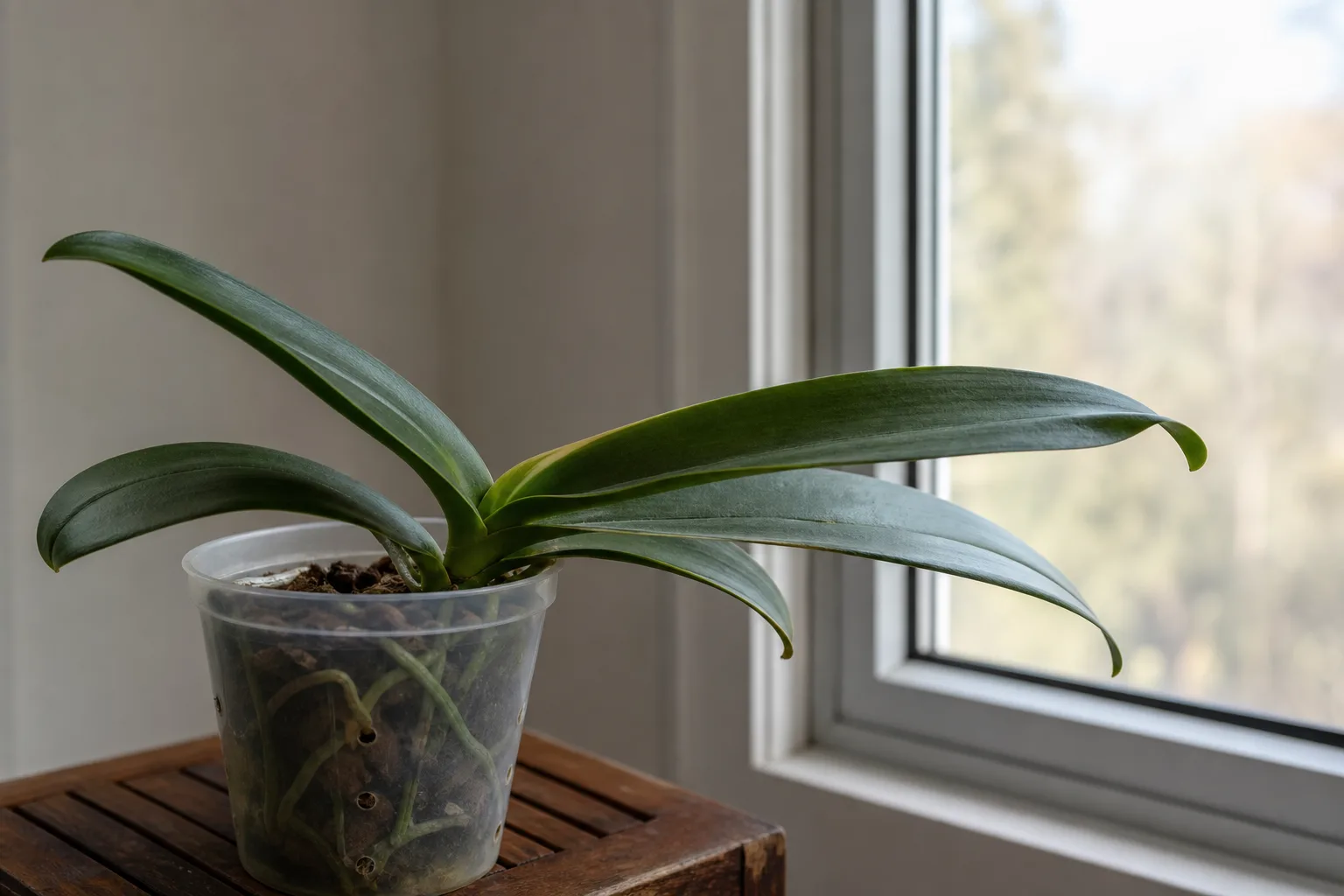
If the orchid has firm roots and leaves but little growth, compare its location with a brighter spot before changing fertilizer or watering. A plant in weak light uses water more slowly, so moving it to a brighter area may also shorten the time it takes for the potting medium to dry. Conversely, after moving it to less light, check the medium before repeating the old watering interval.
Change orchid light gradually and reassess
Make one change at a time so you can tell whether the new position helped. For a plant moving brighter, begin with a little more distance from the curtain or a short period of gentle morning exposure; over the next week or two, increase exposure only if the leaves stay firm and unbleached. This is especially important for plants coming from a store, a shaded shelf, or a long winter indoors.
For a plant that appears light-starved, move it closer to a bright window or add a grow light, then keep the setup steady long enough to observe new growth. Old leaves will not necessarily change shape or color after conditions improve, and an existing flower spike may not respond immediately. New leaves and roots provide better evidence than expecting a quick bloom.
Keep notes on the window, curtain position, time of day, and season. If symptoms worsen after a move, return to the last safe position and adjust by a smaller amount. If the orchid still will not flower after several months in suitable light, reassess its identity and overall care rather than increasing sun indefinitely; light is one part of flowering, not a guarantee by itself.
Conclusion
Most orchids need bright light to thrive, but “bright” depends on the orchid. Start a grocery-store Phalaenopsis in an east window or behind a sheer at a brighter south or west window; give Cattleyas a brighter position, and check the specific needs of Paphiopedilum and Dendrobium types before exposing them to strong sun.
Watch the light at the leaves, adjust for your hemisphere and the season, and move the plant gradually. If you remember one rule, make it this: choose a bright position first, then tune direct sun to the orchid you actually have.