The Right Temperature for Orchids and Better Blooms
Find ideal orchid temperatures by type, from Phalaenopsis to Cymbidium, with practical day and night ranges, safe bloom cues, and indoor placement advice.
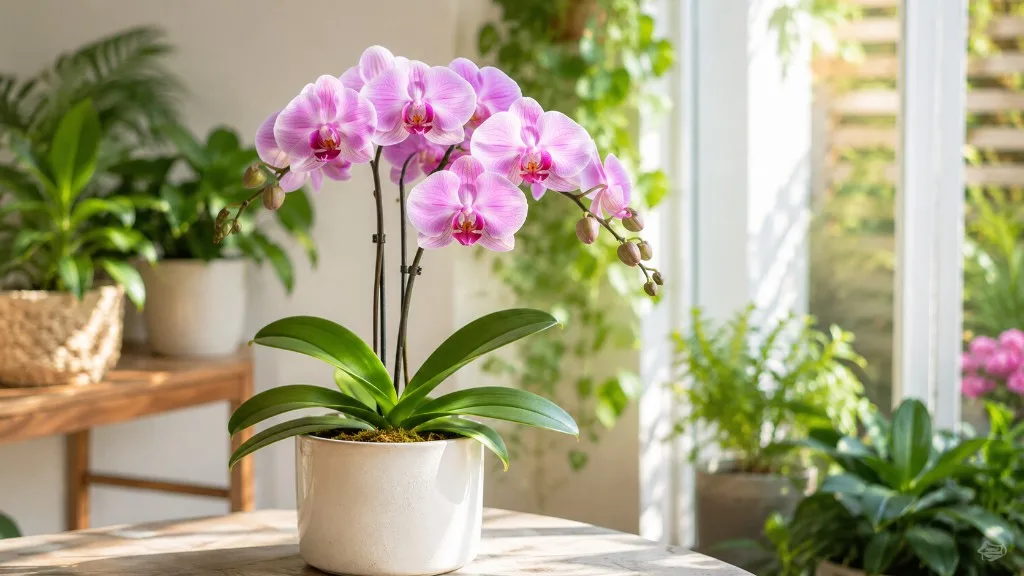
There is no single ideal temperature for every orchid. A grocery-store moth orchid usually wants a warm, steady room, while a Cymbidium often needs cooler nights; even two Phalaenopsis hybrids may respond differently when it is time to set a flower spike. For most indoor growers, the useful answer is to identify the orchid, measure the temperature where its leaves sit, and avoid sudden extremes.
If the plant is the common moth orchid, aim for warm days and nights that generally stay above 60°F (16°C). A short, controlled cool period may help some mature plants rebloom, but routine care and bloom induction are different jobs. The rest of this guide explains those ranges and how to use them without turning the thermostat into a guessing game.
The quick answer: identify the orchid first
Most orchids sold as houseplants are tropical or subtropical, but “orchid” describes a huge plant family rather than one climate. Start with the label or genus if you have it; broad, leathery leaves arranged in a low fan with arching sprays of rounded flowers often indicate Phalaenopsis, while canes, pseudobulbs, or narrow strap-like leaves may point to other groups.
For a typical Phalaenopsis, a reasonable home target is about 70–85°F (21–29°C) by day and 60–70°F (16–21°C) at night, with stable conditions more important than hitting an exact number. That practical range sits within specialist guidance, but references do not all use identical limits because they describe different hybrids and purposes. Check the plant’s culture sheet before applying the Phalaenopsis range to a Cattleya, Dendrobium, Vanda, or Cymbidium.
The New York Botanical Garden’s orchid guide recommends measuring daytime and nighttime conditions at the intended growing location, then choosing an orchid whose temperature group fits that space. A temperature label or seller’s care note is more useful than the broad “most orchids like warmth” rule.
Orchid temperature ranges by growing group
Orchid growers often group plants as warm, intermediate, or cool growers. The figures below are starting ranges from the New York Botanical Garden’s culture guidance, not rigid limits for every species; use the plant’s name and cultivar details whenever available.
| Growing group | Typical daytime range | Typical nighttime range | Common examples |
|---|---|---|---|
| Warm | 75–85°F (24–29°C) | 65–70°F (18–21°C) | Phalaenopsis, Vanda |
| Intermediate | 66–75°F (19–24°C) | 55–65°F (13–18°C) | Cattleya, many Dendrobium and Oncidium |
| Cool | 55–65°F (13–18°C) | Night lows around 50°F (10°C) | Cymbidium and some high-elevation orchids |
The groups help you compare a plant with a home’s normal conditions; they do not mean that each orchid must experience the full spread every day. A healthy plant can often tolerate brief departures from its preferred band, while repeated cold nights, prolonged heat, or a fast swing can stress it even when the room average looks acceptable.
A group name is a shortcut, not a complete care card. Some references emphasize winter night minima; others give preferred day and night bands, which is why a cold-tolerance number can sound inconsistent with a warm daytime recommendation. Treat the night figure as a limit to avoid crossing repeatedly, then use the daytime range and the plant’s growth pattern to judge comfort. If the label only says “orchid,” ask the seller or nursery for the genus or hybrid before deliberately changing temperatures.
Warm growers: Phalaenopsis and Vanda
Warm growers suit heated homes because they do not need a cold winter rest. The New York Botanical Garden places Phalaenopsis and Vanda in this group, with warm days and nights generally in the mid-60s or above; the Royal Horticultural Society’s moth-orchid guide also describes Phalaenopsis as a plant for consistently warm indoor conditions.
Vanda can be more demanding than a supermarket Phalaenopsis, especially in light, humidity, and airflow, so “warm-growing” does not make the genera interchangeable. If a Vanda or an unfamiliar hybrid came with a tag, use the seller’s culture notes instead of assuming the moth-orchid range applies.
Intermediate growers: Cattleya and many Dendrobiums
Intermediate orchids generally prefer warmer days and cooler nights than a typical heated room provides in some seasons. NYBG places Cattleya, Dendrobium, and Oncidium in an intermediate band, but Dendrobium is a large and varied genus; a cane-form type and a warm-growing Phalaenopsis-type Dendrobium may not follow one identical schedule.
Use the exact name on the label to narrow the range, especially if the plant has pseudobulbs or canes and you are trying to encourage flowering. The practical lesson is not to chill every plant with “Dendrobium” on its tag; it is to match the culture sheet for that type to the day and night readings in your space.
Cool growers: Cymbidium and other cool-climate orchids
Cymbidiums are a familiar example of a cool-growing orchid. Their flowering cycle is often tied to cooler nights, so a bright, heated living room that suits Phalaenopsis may stay too warm for reliable Cymbidium bloom even if the plant continues to look green.
Some orchids from high elevations also prefer cooler conditions, but the genus name alone is not always enough to set a minimum. NYBG lists night lows around 50°F (10°C) for its cool-growing examples; treat that as a culture reference for suitable plants, not a safe target for every orchid or a reason to expose a potted plant to a cold draft.
A practical temperature target for Phalaenopsis
For the common moth orchid, a warm, ordinary room is usually a better starting point than trying to recreate a greenhouse. NYBG gives a preferred band of 75–85°F (24–29°C) by day and 65–70°F (18–21°C) at night, while the American Orchid Society’s Phalaenopsis culture sheet says nights should usually stay above 60°F (16°C) and days can be 75–85°F (24–29°C) or warmer when humidity and air movement are also suitable. The RHS range is broader, which is another reason to think in workable bands instead of a single magic number.
As a household target, aim near the middle of those recommendations: comfortable warm days, nights in the 60s°F (roughly 16–21°C), and no abrupt blast of hot or cold air. A normal room that cools modestly overnight is generally easier to manage than a plant placed beside a radiator, an air conditioner, or a drafty pane.
This is a target for steady growth, not a promise of flowers. If your plant’s leaves, roots, and new growth look healthy, a few degrees outside the center of the range do not automatically mean it is in danger; make changes when readings show a repeated pattern or the plant develops a problem that matches the timing.
Why cooler nights can help an orchid bloom
For some orchids, a cooler night is a seasonal cue that helps initiate a flower spike. It is not a universal daily rule that every orchid needs a 10–15°F drop, and a temperature dip cannot make an unhealthy or light-starved plant bloom.
The American Orchid Society explains that Phalaenopsis needs both adequate health and stored energy from good growing conditions, plus the appropriate flowering cue. In the Northern Hemisphere, many large-flowered moth orchids respond to autumn nights around 55°F (13°C); the NC State Extension profile notes that some large-flowered spring types may use a brief chill near that point, while modern dwarf hybrids may not need a cool treatment.
Guides describe the timing differently. The American Orchid Society’s reblooming advice discusses cooler fall nights in the 50s and 60s°F (10–16°C), while RHS suggests moving a healthy, non-flowering moth orchid to a spot about 8°F (5°C) cooler for roughly a month. These are examples of cultivar-dependent cues, not instructions to hold every plant at 55°F all winter.
The AOS also notes that Phalaenopsis may fail to flower when daytime temperatures remain above about 82°F (28°C). That is a bloom-related warning, not a general leaf-damage threshold: a plant can survive warmer conditions while still missing the day/night pattern that favors a spike. Keep enough light and stable root health in the plan, and use the specific culture sheet before trying to induce flowering.
How to measure the temperature your orchid experiences
The thermostat measures the room sensor’s location, not necessarily the air around a plant on a windowsill. Sun on glass, a cold pane at night, an air-conditioning stream, a grow light, or a heater can create a small hot or cold pocket that the room display misses.
Use a digital minimum–maximum thermometer or a simple data logger with its sensor near the orchid’s leaves. Leave it there for several days and note the warmest daytime reading and the lowest reading before dawn; if grow lights are used, include the hours when they are on and off.
Do not tape the sensor to cold glass or put it directly in a sunbeam, because that measures the surface or radiant heat rather than the plant’s surrounding air. Compare the readings with the temperature group for the orchid you own, then move the pot or adjust the room gradually if the same out-of-range condition repeats.
Keep a short note of the plant’s name, daily high and low, and any changes in buds, leaves, or new growth. This gives you a way to tell whether a room adjustment helped instead of changing temperature, watering, humidity, and light at once.
If the readings swing sharply, compare the current spot with a nearby shelf or table before changing the thermostat. A small move away from cold glass or an HVAC register may smooth the plant’s overnight low without changing the rest of the room. After moving it, log the new location for several more days so you know whether the adjustment solved the temperature pattern.
Where to place an orchid indoors
Choose a bright location with a relatively even temperature and enough distance from abrupt air currents. A good place for the plant is often more important than setting the whole home to a precise temperature, because the orchid responds to its immediate microclimate.
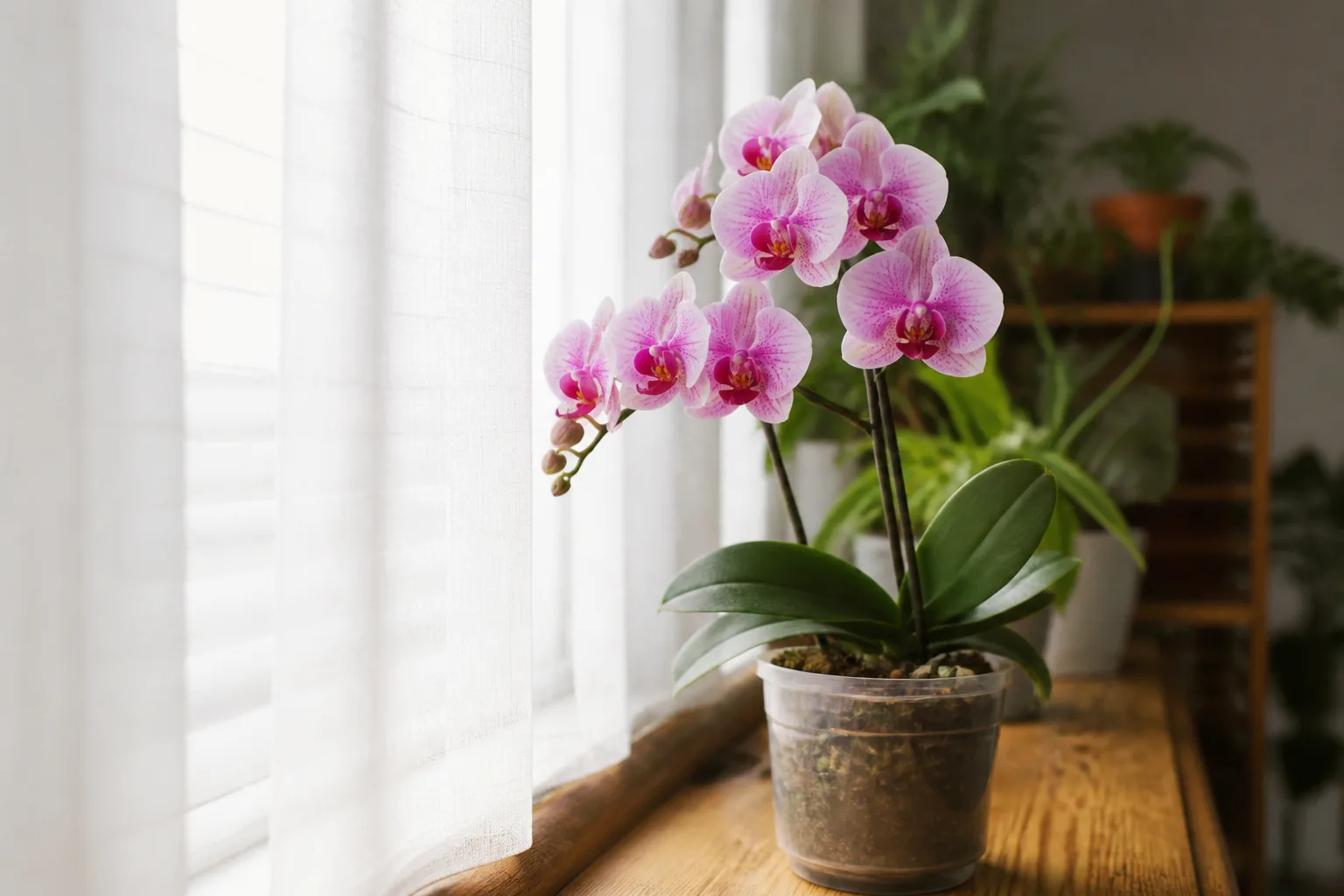
Windowsills, cold glass, and sunny shelves
An east-facing window is a common starting point for Phalaenopsis because it offers bright light with gentler morning sun. In a cold season, move the pot a little back from chilly glass if the overnight reading drops sharply; in a hot season, filter strong direct sun so the leaves and pot do not heat up even when the room air feels comfortable.
A windowsill can be warmer than the rest of the room during a sunny afternoon and colder than the room overnight. If the plant is doing well there, you do not need to move it just because the outdoor weather changed, but a thermometer can tell you whether the sill’s low is outside the plant’s usual range.
People sometimes move an orchid repeatedly between a window, a table, and a bathroom to chase an ideal number. Avoid that cycle: each move changes light, airflow, and temperature together, making it harder to identify what the plant actually needs.
Heating and air-conditioning vents
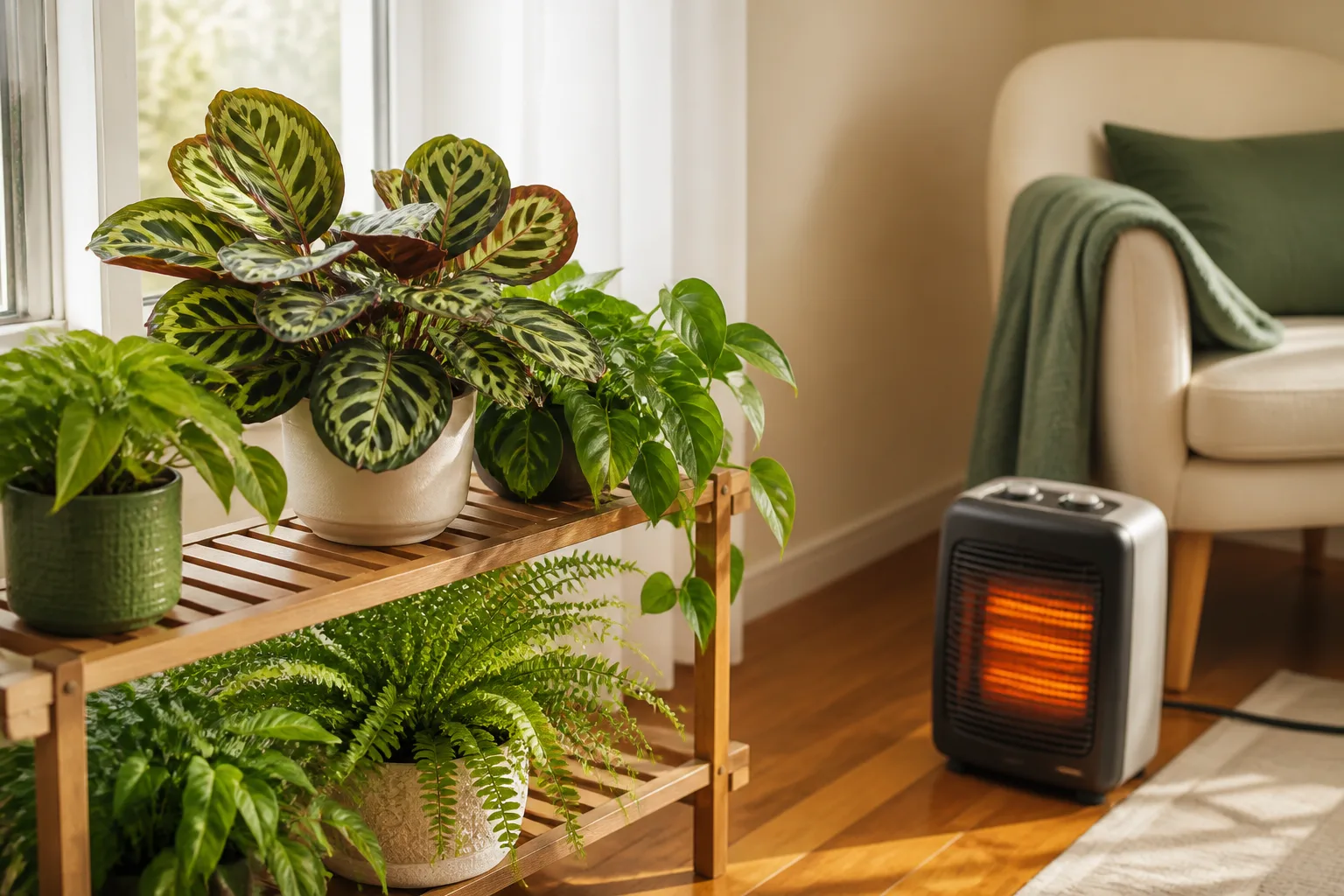
Do not place an orchid in the direct path of a radiator, space heater, furnace register, or air-conditioning vent. A warm blast can dry a bud or leaf quickly, while a cold stream can chill one side of the plant and create repeated temperature swings even though the thermostat is set within range.
The gardening experts at Epic Gardening also advise checking temperature and airflow when choosing an orchid’s location, and point out that a plant close to a window may experience colder conditions than the middle of a room. Leave some space around the leaves for gentle air movement, but do not use a fan that blows continuously straight onto the plant.
Adjusting temperature through the seasons
In a climate with mild nights, a protected outdoor spot can give some orchids a useful day/night change during the growing season. Move a plant outside only after checking the needs of its type and the forecast low; use shade or filtered light, shelter from wind and rain, and bring it back before nights approach the lower end of its range.
Acclimate it over several days rather than moving it from a dim room straight into strong sun or a windy patio. An indoor location may be the safer choice in an arid climate, during a heat wave, or where nighttime lows swing sharply; a balcony is not automatically better just because it is outdoors.
When autumn nights become cooler, a healthy mature Phalaenopsis may receive a natural bloom cue near a window or in a slightly cooler room. Do not put it outside unattended or leave it beside an open window to force the cue; measure first, avoid cold drafts, and remember that some modern hybrids can flower without a deliberate chill.
Other genera may need different seasonal routines. Cymbidiums often benefit from cooler conditions to flower, while some Dendrobiums need a species-specific seasonal pattern; use the plant’s culture sheet rather than copying a Phalaenopsis rebloom schedule. Orchid Bliss, a grower-focused orchid site, makes the same useful planning point: choose and place orchids according to the temperature conditions you can actually provide, not a theoretical greenhouse you do not have. (Orchid Bliss temperature guide)
Heat stress: what to change first
There is no single temperature at which every orchid is suddenly “too hot.” The duration of the heat, the orchid type, direct sun, humidity, airflow, and whether roots can take up water all affect the plant’s response.
For Phalaenopsis, the American Orchid Society gives 90–95°F (32–35°C) as an upper recommended limit only when higher humidity and air movement accompany the heat. Treat that as an edge condition for managed growing, not a household target; if your readings often approach it, move the plant out of direct sun and away from hot glass or a heater, then improve gentle room airflow.
Do not compensate for heat by keeping the pot constantly wet. Check the medium and roots as usual, water thoroughly when needed, and drain the pot; a hot, waterlogged root zone can create a second problem instead of solving the first.
If temperatures rise only for a short afternoon, first reduce direct sun and check the plant’s location before buying a humidifier or changing fertilizer. A warm room with bright filtered light and gentle air movement is easier on an orchid than a cool reading in one corner and a scorching leaf in the sunbeam.
Cold exposure: when to move the plant
A cool night used as a flowering cue is not the same as leaving a tropical orchid in cold air for an open-ended period. For ordinary Phalaenopsis care, keep nights above about 60°F (16°C) where practical; a brief reading near 55°F (13°C) may be used by some mature hybrids as a bloom cue, but it is not a universal minimum for routine care.
If a cold front is coming, move the pot away from exterior glass and doors before the room cools. Do not set the plant on a cold floor, transport it uncovered through freezing air, or put it outside simply because the daytime forecast is warm.
After an unexpected chill, return the orchid to a stable bright place and let it settle. Avoid swinging it immediately into a very hot spot or soaking a cold pot; inspect leaves, roots, and buds over the next few days, since one fallen bud alone does not prove the whole plant was chilled.
Temperature-related bud drop and other causes
Orchid buds can yellow, shrivel, and fall after a sudden environmental change, but temperature is only one possible cause. NC State lists changes in temperature, humidity, moisture, fertilizer, or location among possible causes of Phalaenopsis bud drop, so look for what changed during the days before the buds dropped.
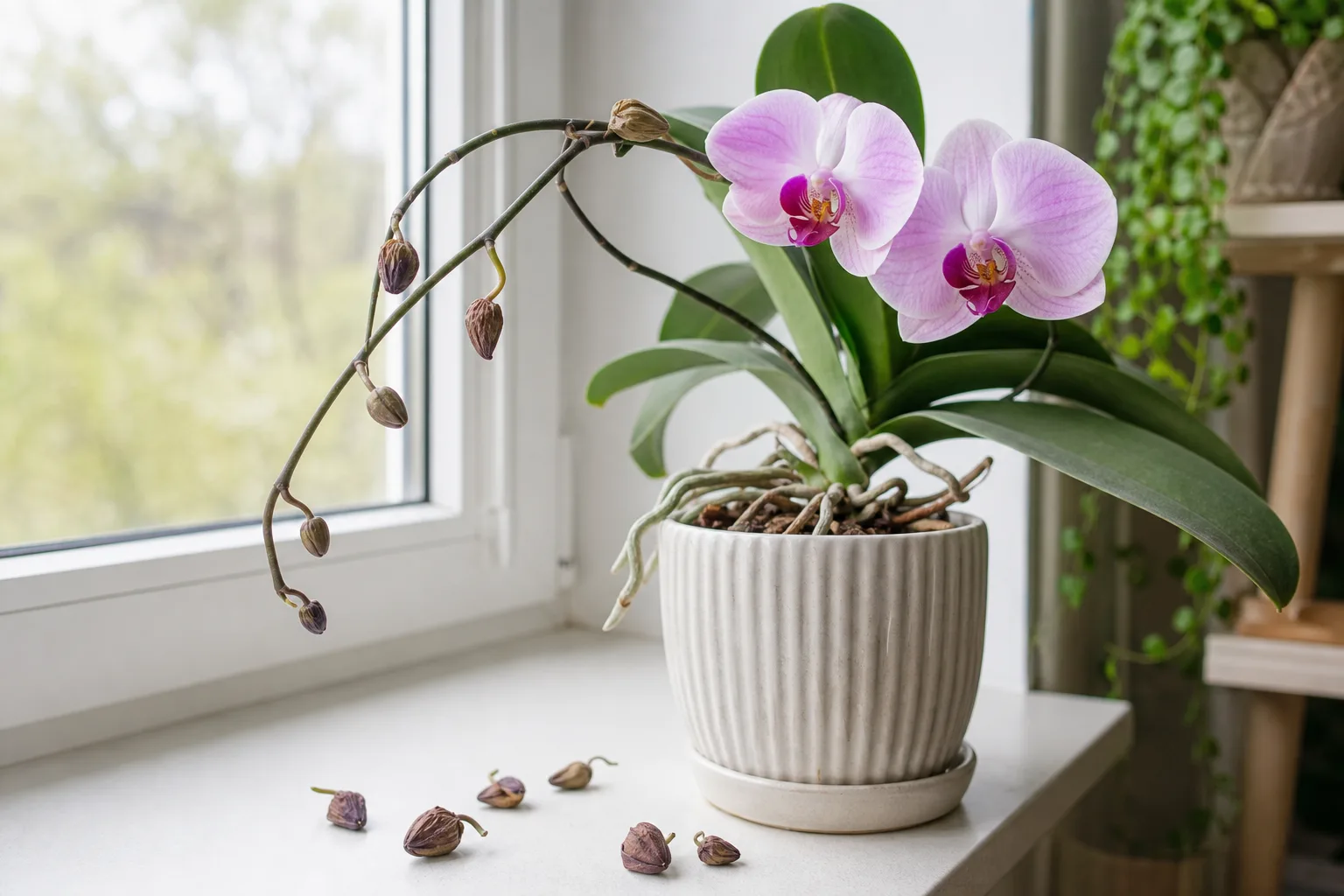
If buds fell after a move from a warm shop to a cold car, a drafty window, or an abrupt heater blast, stabilize the location first. Keep the plant in bright filtered light, away from vents and cold glass, and do not move it again unless the temperature reading confirms a problem.
If there was no clear temperature event, check whether the plant was recently purchased, whether the room became much drier, whether the roots stayed too wet or too dry, and whether the plant is getting suitable light. Bud drop after shipping or a change of home can reflect several stresses arriving together; changing the thermostat alone may not bring those buds back, though stable conditions can protect the next growth cycle.
Temperature mistakes that backfire
The first mistake is applying a single “orchids like 70°F” rule to every genus. A warm home may suit a Phalaenopsis and frustrate a Cymbidium, so identify the plant before making a seasonal change.
The second is confusing a blooming cue with a survival requirement. Cooler nights can help some orchids form spikes, but that does not mean every plant needs a long cold treatment; the American Orchid Society and NC State both describe variation among Phalaenopsis types, including modern hybrids that may flower without the same chill.
The third is trusting the room thermostat without measuring the plant’s location. A shelf above a radiator, a sill against winter glass, and a table in the room’s center can each experience different temperatures, so check the high and low at leaf height before moving the orchid.
The fourth is changing several care factors at once. If the orchid has dropped buds, move it once to a stable spot, then keep light and watering consistent while you observe; changing temperature, watering frequency, humidity, and fertilizer together hides the cause and can add more stress.
Finally, do not chase a number so closely that you create a new problem. Avoid direct hot or cold air, protect the leaves from intense sun, and use the orchid’s own growth and the actual temperature log to decide whether a small adjustment is needed.
Conclusion
The right orchid temperature depends on its growing group, and the day’s warmth is only half the story. For a common Phalaenopsis, start with warm days and nights mostly above 60°F (16°C); for Cattleya, Dendrobium, Oncidium, or Cymbidium, check the specific culture range before assuming that the same room is ideal.
Measure the high and low where the orchid sits, keep it away from drafts and direct heater or air-conditioner flow, and change its location gradually. If a healthy moth orchid needs a flowering cue, use the plant’s cultivar guidance to decide whether cooler autumn nights are appropriate; do not mistake a short bloom-induction period for the everyday temperature target.