Oncidium Orchid Care: Light, Water, Pseudobulbs
Oncidium spp. and commonly cultivated hybrids
Give Oncidiums bright filtered light and airy orchid bark. Water thoroughly when the medium approaches dryness, then adjust the interval to the species, root type, and season.
Oncidium Orchid Care Guide
Start with wateringThe most common care mistake for OncidiumWatering guide →Oncidium care essentials
Light
Bright filtered light. Warm-growing types generally need a bright position; cool-growing types prefer more subdued light. Some species tolerate a few hours of gentle sun.
Water
Water thoroughly when the orchid medium is approaching dryness, then let all excess drain away. During active growth, fine-rooted types do best with more even moisture; thicker-leaved or mule-ear types can dry further between waterings. Keep the mix airy rather than saturated, and do not leave the pot standing in water. Use the plant label and the medium's dry-down to adjust care, since Oncidium species and hybrids vary.
Soil
Use a loose, bark-based orchid medium rather than ordinary potting soil. Choose a finer or more moisture-retentive blend for fine-rooted types and a coarser blend for thicker-rooted or mule-ear types, matching the mix to the room and pot.
Humidity
Temperature
Fertilizer
About Oncidium
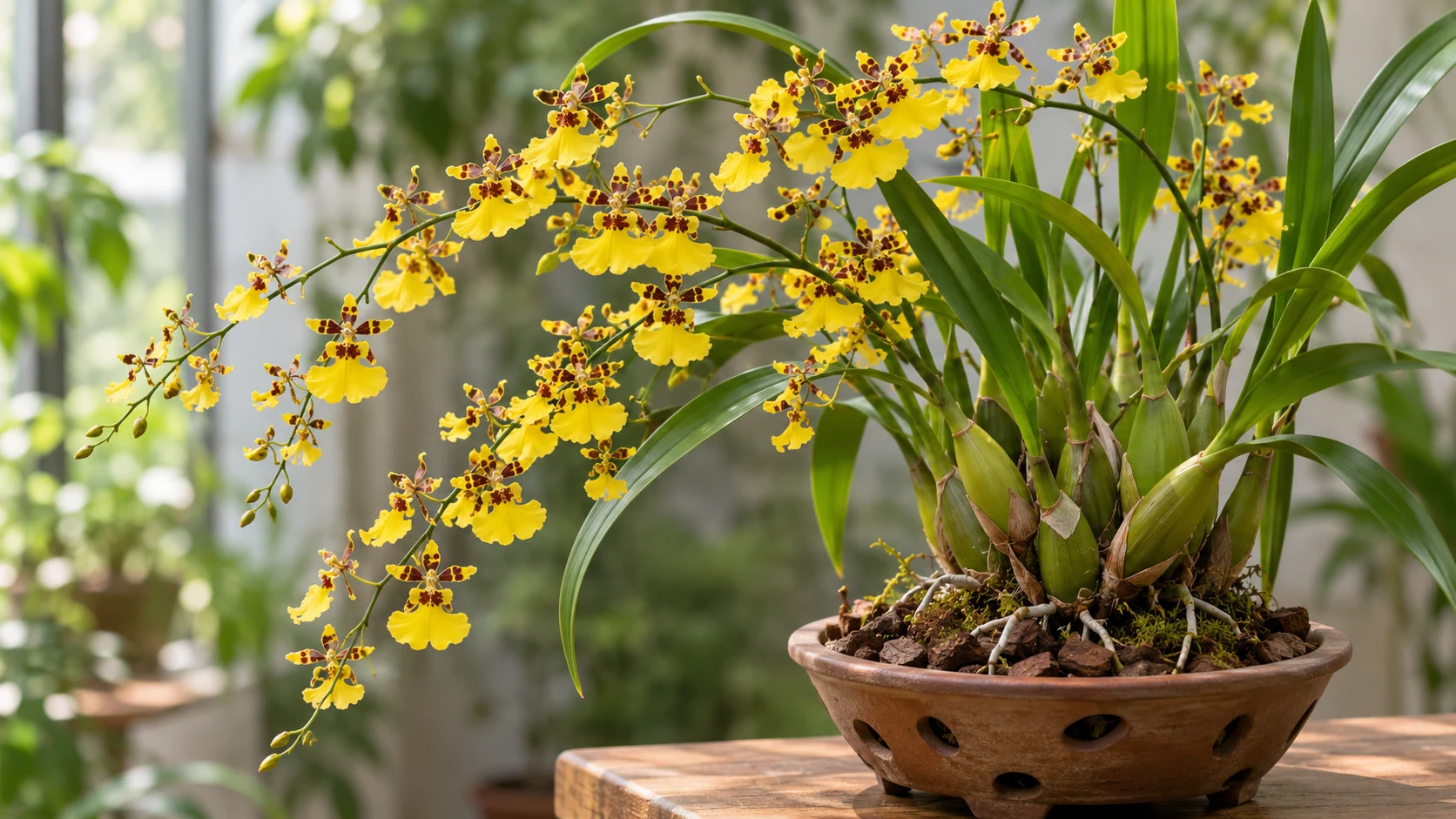
Oncidium is native to Tropical and subtropical parts of the Americas; the range and elevation vary by species, from warm-growing types to cool-growing Andean orchids., typically reaches Varies widely by species and hybrid. Many form compact clumps of pseudobulbs, while some have leaves up to about 60 cm and branching flower sprays that can reach 30 cm to 1.2 m. indoors, with moderate during active growth; many cultivated types flower as a new pseudobulb reaches maturity. growth. Oncidium has a sympodial, mostly epiphytic orchids that grow along a rhizome. many form pseudobulbs, while mule ear types have thicker leaves and reduced or indistinct pseudobulbs. growth habit and part of the Orchidaceae family. It is also known as Oncidium orchid, Dancing lady orchid, Dancing ladies orchid, and Butterfly orchid.
| Detail | Information |
|---|---|
| Also known as | Oncidium orchid, Dancing lady orchid, Dancing ladies orchid, Butterfly orchid |
| Native region | Tropical and subtropical parts of the Americas; the range and elevation vary by species, from warm-growing types to cool-growing Andean orchids. |
| Mature size | Varies widely by species and hybrid. Many form compact clumps of pseudobulbs, while some have leaves up to about 60 cm and branching flower sprays that can reach 30 cm to 1.2 m. |
| Growth rate | Moderate during active growth; many cultivated types flower as a new pseudobulb reaches maturity. |
| Growth habit | Sympodial, Mostly Epiphytic Orchids That Grow Along A Rhizome. Many Form Pseudobulbs, While Mule Ear Types Have Thicker Leaves And Reduced Or Indistinct Pseudobulbs. |
| Scientific name | Oncidium spp. and commonly cultivated hybrids |
| Family | Orchidaceae |
How to care for Oncidium?
How much light does Oncidium need?
Bright filtered light. Warm-growing types generally need a bright position; cool-growing types prefer more subdued light. Some species tolerate a few hours of gentle sun.. Gentle morning sun for acclimated plants. Bright artificial light
- Bright filtered light. Warm-growing types generally need a bright position - Warm-growing types generally need a bright position; cool-growing types prefer more subdued light.
- cool-growing types prefer more subdued light. Some species tolerate a few hours of gentle sun - Some species tolerate a few hours of gentle sun..
- Gentle morning sun for acclimated plants - Gentle morning sun for acclimated plants.
- Bright artificial light - Bright artificial light.
When should you water Oncidium?
Water thoroughly when the orchid medium is approaching dryness, then let all excess drain away. During active growth, fine-rooted types do best with more even moisture; thicker-leaved or mule-ear types can dry further between waterings. Keep the mix airy rather than saturated, and do not leave the pot standing in water. Use the plant label and the medium's dry-down to adjust care, since Oncidium species and hybrids vary.
- Feel or probe the medium halfway down the pot and compare the pot's weight after watering and as it dries. Firm pseudobulbs are a useful baseline - Use the plant label and the medium's dry-down to adjust care, since Oncidium species and hybrids vary.
- a newly wrinkling pseudobulb is a reason to check both moisture and root health - During active growth, fine-rooted types do best with more even moisture; thicker-leaved or mule-ear types can dry further between waterings.
- not an automatic instruction to soak - Keep the mix airy rather than saturated, and do not leave the pot standing in water.
- Drain excess water - Water thoroughly when the orchid medium is approaching dryness, then let all excess drain away.
What soil works best for Oncidium?
Use a loose, bark-based orchid medium rather than ordinary potting soil. Choose a finer or more moisture-retentive blend for fine-rooted types and a coarser blend for thicker-rooted or mule-ear types, matching the mix to the room and pot.
- Fine or medium orchid bark for many common Oncidium hybrids. - Use a loose, bark-based orchid medium rather than ordinary potting soil.
- Add a little sphagnum or another moisture-retentive component only if the root type and room dry the bark too quickly. - Choose a finer or more moisture-retentive blend for fine-rooted types and a coarser blend for thicker-rooted or mule-ear types, matching the mix to the room and pot.
- Keep the mix loose and replace it when the bark breaks down or stays wet. - Use a loose, bark-based orchid medium rather than ordinary potting soil.
Grower notes for Oncidium
Check whether your Oncidium is warm- or cool-growing
The name covers many species and hybrids, not one indoor climate recipe. RHS separates warm- and cool-growing Oncidiums, and the American Orchid Society notes that light and temperature tolerance vary across the group. Check the nursery label before setting temperature or giving a seasonal rest. The common name dancing lady orchid can also be used for different Oncidium species and hybrids.
Give bright light, then watch the leaves
Many cultivated Oncidiums need brighter conditions than a moth orchid, but the amount of sun depends on the type. A bright east-facing window or filtered light is a useful starting point. Increase light gradually and keep leaves away from hot afternoon sun. RHS notes that bright green foliage is a useful sign; dark green may signal too little light, while reddish-green can mean too much.
Water for the roots and the current growth
Water use rises when a new shoot and its roots are actively growing. Oncidium roots need air as well as moisture, so water through the medium and let it drain. AOS guidance and RHS care sheets describe different rhythms for different types; check the medium rather than copying a calendar from another orchid.
Read pseudobulbs together with root condition
Pseudobulbs store water and nutrients, and a new one should mature firm rather than collapse. Wrinkles can follow prolonged dryness, but a plant with damaged roots may also wrinkle while the mix is wet. Check the roots, medium, and newest growth before changing the watering routine. Older pseudobulbs can remain useful even after they stop flowering.
Keep the potting mix open and repot at new root growth
Most indoor Oncidiums grow in bark-based orchid medium with enough drainage and air around their roots. Repot when the medium breaks down or the clump outgrows its container, ideally as new roots start. Keep pseudobulbs above the mix and avoid repeatedly disturbing fresh root tips.
Expect flowers from the plant's own growth cycle
Many Oncidiums flower when a new growth matures, while timing varies by species and hybrid. Do not automatically apply a Phalaenopsis spike pruning routine or a long dry rest. ASPCA lists specific Oncidium species as non-toxic to cats, dogs, and horses; it does not provide the same species-level classification for every pet.
Are Oncidium orchids safe for pets?
ASPCA lists Oncidium flexuosum and Oncidium sphacelatum as non-toxic to cats, dogs, and horses, and its bouquet guidance names Oncidium orchids among pet-safe flowers. The ASPCA list is not exhaustive and other Oncidium species or pet types may not have a direct entry. Keep plants out of reach; eating plant material can still cause stomach upset.
The non-toxic classification is supported for the Oncidium species named by ASPCA and its broad bouquet guidance. Do not extend it to every allied orchid or pet species without a matching source.
Watering Oncidium
For Oncidium, feel or probe the medium halfway down the pot and compare the pot's weight after watering and as it dries. Firm pseudobulbs are a useful baseline; a newly wrinkling pseudobulb is a reason to check both moisture and root health, not an automatic instruction to soak. and water check the pot every few days during warm, bright growth, but use the moisture in the middle of the medium and the pot's weight to decide when to water. Cooler or dimmer conditions usually lengthen the interval. Avoid a rigid weekly schedule or a long dry rest unless the identified type calls for it. Increase checks as new shoots and roots develop in warm, bright weather. Reduce watering as light and temperature fall, but keep the needs of cool-growing types in mind and do not impose one dry winter rest on every Oncidium.
| Detail | Information |
|---|---|
| How often | Check the pot every few days during warm, bright growth, but use the moisture in the middle of the medium and the pot's weight to decide when to water. Cooler or dimmer conditions usually lengthen the interval. Avoid a rigid weekly schedule or a long dry rest unless the identified type calls for it. |
| How to check | Feel or probe the medium halfway down the pot and compare the pot's weight after watering and as it dries. Firm pseudobulbs are a useful baseline; a newly wrinkling pseudobulb is a reason to check both moisture and root health, not an automatic instruction to soak. |
| Seasonal changes | Increase checks as new shoots and roots develop in warm, bright weather. Reduce watering as light and temperature fall, but keep the needs of cool-growing types in mind and do not impose one dry winter rest on every Oncidium. |
Signs of overwatering
- The center of the medium remains wet for a long time or smells stale.
- Roots or pseudobulbs become soft, dark, or mushy.
- The plant wilts even though the medium is wet.
Signs of underwatering
- New pseudobulbs become increasingly shriveled while the medium dries quickly.
- Developing leaves show accordion-like pleating.
- New growth stalls during a warm, bright active period.
Soil & potting for Oncidium
Use a mix of Fine or medium orchid bark for many common Oncidium hybrids., Add a little sphagnum or another moisture-retentive component only if the root type and room dry the bark too quickly., Keep the mix loose and replace it when the bark breaks down or stays wet. for Oncidium. The medium should hold some moisture but leave open air spaces around the roots and drain freely. Do not let the roots sit in standing water. Repot repot when the bark-based mix has decomposed, the plant has outgrown its pot, or the rhizome has no room for new growth. This is often after a couple of years, but the medium and root condition matter more than a fixed calendar., ideally in repot as new roots begin to grow, often in spring, so they can establish in the fresh medium. Avoid disturbing a plant in flower unless its medium is failing.
| Detail | Information |
|---|---|
| Recommended mix | Fine or medium orchid bark for many common Oncidium hybrids., Add a little sphagnum or another moisture-retentive component only if the root type and room dry the bark too quickly., Keep the mix loose and replace it when the bark breaks down or stays wet. |
| Drainage | The medium should hold some moisture but leave open air spaces around the roots and drain freely. Do not let the roots sit in standing water. |
| Repotting frequency | Repot when the bark-based mix has decomposed, the plant has outgrown its pot, or the rhizome has no room for new growth. This is often after a couple of years, but the medium and root condition matter more than a fixed calendar. |
| Best season to repot | Repot as new roots begin to grow, often in spring, so they can establish in the fresh medium. Avoid disturbing a plant in flower unless its medium is failing. |
Signs it needs repotting
- Bark is breaking down and staying wet much longer than it used to.
- The rhizome and new growths are pushing beyond the pot.
- The plant cannot be watered evenly because roots crowd the container.