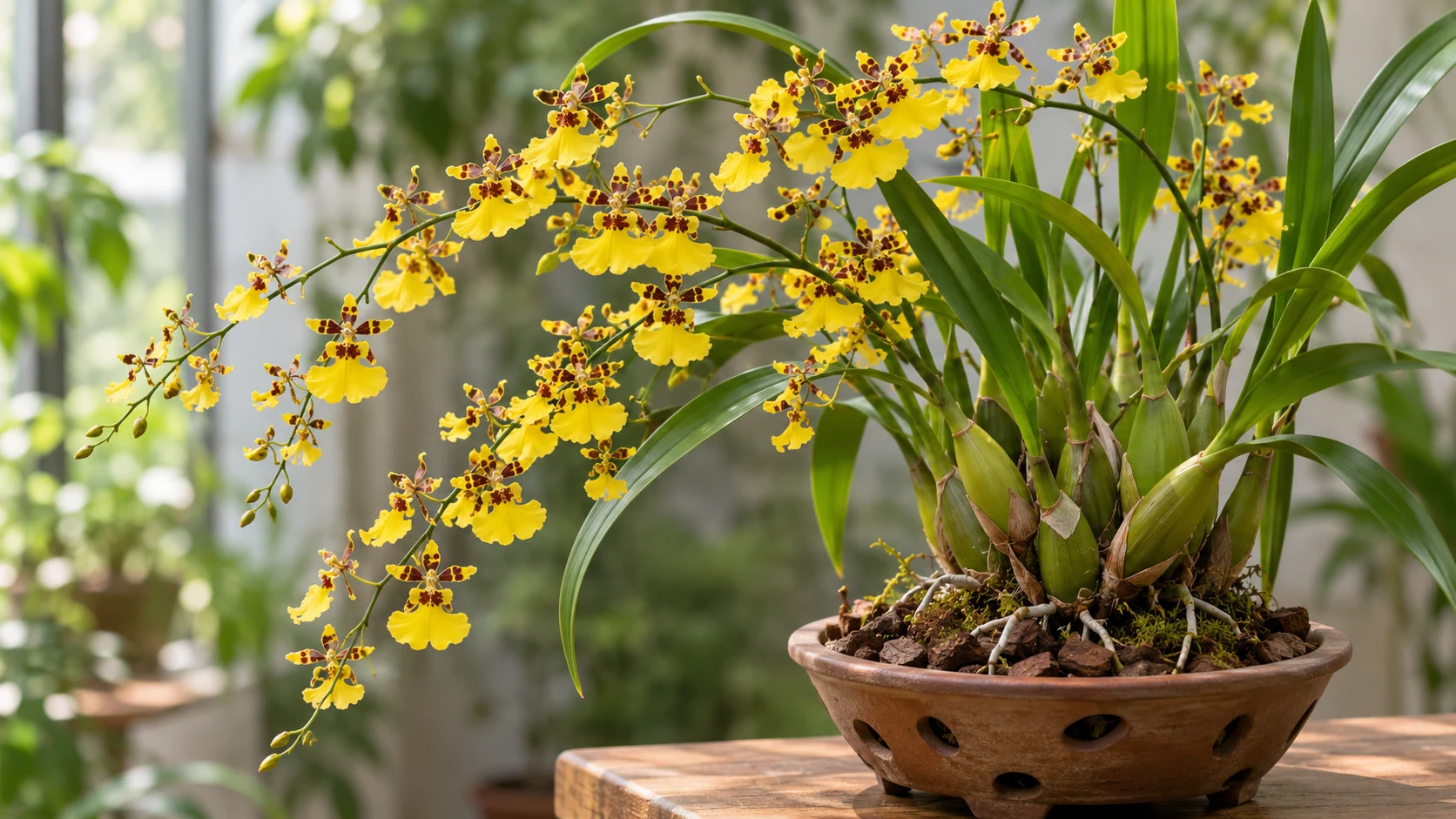
Start with bright filtered light. Many warm-growing types can take more light than a moth orchid, while cool-growing types prefer filtered, subdued light. Acclimate gradually and watch leaf color and new growth.
How often should I water an Oncidium?
There is no single schedule for the genus. Check the medium partway down the pot and water thoroughly as it approaches dryness. Fine-rooted types may need more even moisture during active growth; let all excess drain.
Why is my Oncidium pseudobulb wrinkled?
A wrinkling pseudobulb can mean the plant has dried too far, but root damage in wet mix can also prevent water uptake. Check the medium and roots before adding water, and compare the newest growth with older bulbs.
Should I give every Oncidium a dry rest to make it bloom?
No. Warm- and cool-growing Oncidiums have different needs, and many flower when a new pseudobulb matures. Follow the species or hybrid label rather than forcing a long dry rest.
When should I repot an Oncidium?
Repot when the bark has decomposed, the pot is crowded, or the rhizome needs room for new growth. The start of new root growth, often in spring, is a good time to limit setbacks.
Are Oncidium orchids pet-safe?
ASPCA lists Oncidium flexuosum and Oncidium sphacelatum as non-toxic to cats, dogs, and horses. Other Oncidium species and other pets may not have the same listing, so keep plants away from chewing animals.
How do I propagate Oncidium?
Propagate Oncidium from healthy stem or root divisions during active growth.
Written by Sai AnanthLead content writer at LeafyPixels. B.Pharmacy graduate from Andhra University with a background in pharmacognosy, turned indoor gardening writer after a long-time plant hobby became a research-led resource for home growers.View Sai Ananth's profile · Reviewed by LeafyPixels Review Board
This Oncidium problems problem guide was researched and written by Sai AnanthLead content writer at LeafyPixels. B.Pharmacy graduate from Andhra University with a background in pharmacognosy, turned indoor gardening writer after a long-time plant hobby became a research-led resource for home growers.View Sai Ananth's profile. Problems symptoms on Oncidium, lookalike causes, and step-by-step fixes are cross-checked against extension pest, disease, and care references before publication.
We prioritize sources that hold up under scrutiny:
University cooperative extension bulletins and fact sheets (Penn State, Clemson, UMD, NC State, and similar programs)
Botanical garden and horticultural society publications
Peer-reviewed plant science and veterinary toxicology references where pet safety matters (including ASPCA Animal Poison Control)
Established reference works on indoor plant culture
The LeafyPixels editorial team then reviews the draft for clarity, step-by-step usefulness, and fit with real apartment and home conditions-not ideal greenhouse setups. When guidance changes materially, we update the page and note the revision date.
Sources used
American Orchid Society — Oncidium (n.d.) Genus classification, taxonomic variation, and Oncidium plant morphology. [Online]. Available at: https://www.aos.org/explore/oncidium (Accessed: 1 March 2024).
American Orchid Society — Oncidium Culture Sheet (n.d.) Light, temperature, humidity, watering, pseudobulbs, active growth, fertilizing, and potting differences across Oncidium types. [Online]. Available at: https://www.aos.org/orchid-care/care-sheets/oncidium-culture-sheet (Accessed: 1 March 2024).
ASPCA — Mother’s Day Bouquets: What’s Safe for Pets? (n.d.) ASPCA identifies Oncidium orchids among safe bouquet flowers and notes that any orchid plant material may cause mild gastrointestinal upset if pets eat more than a small amount. [Online]. Available at: https://www.aspca.org/news/mothers-day-bouquets-whats-safe-pets (Accessed: 1 March 2024).
Chula Orchids — Oncidium Orchid Care: Watering, Pseudobulbs and Light (n.d.) Practical hybrid variation, fine root care, pseudobulb observation, repotting timing, and flower-spike handling, treated as grower advice. [Online]. Available at: https://chulaorchids.com/orchid-types/oncidium-orchid-care/ (Accessed: 1 March 2024).
Everyday Orchids — Oncidium Orchid Care: What You Need to Know (n.d.) Practical indoor guidance on light, seasonal moisture, pseudobulbs, temperature, and flower stems, used alongside primary orchid sources. [Online]. Available at: https://everydayorchids.com/oncidium-orchid-care-what-you-need-to-know-2109s/ (Accessed: 1 March 2024).
Royal Horticultural Society — How to Grow Cool-Growing Oncidium Orchids (n.d.) Cool-growing types, former Odontoglossum labels, filtered light, temperature, watering, humidity, and repotting. [Online]. Available at: https://www.rhs.org.uk/plants/oncidium-orchids/cool/growing-guide (Accessed: 1 March 2024).
Royal Horticultural Society — How to Grow Warm-Growing Oncidium Orchids (n.d.) Warm-growing type care, filtered light, temperature, watering, humidity, pseudobulbs, and bark-based orchid compost. [Online]. Available at: https://www.rhs.org.uk/plants/oncidium-orchids/warm/growing-guide (Accessed: 1 March 2024).