Dracula Orchid Care: A Guide to Cool, Humid Growing
Learn Dracula orchid care with practical guidance for cool temperatures, high humidity, filtered light, moist roots, repotting, flowering, and common problems.
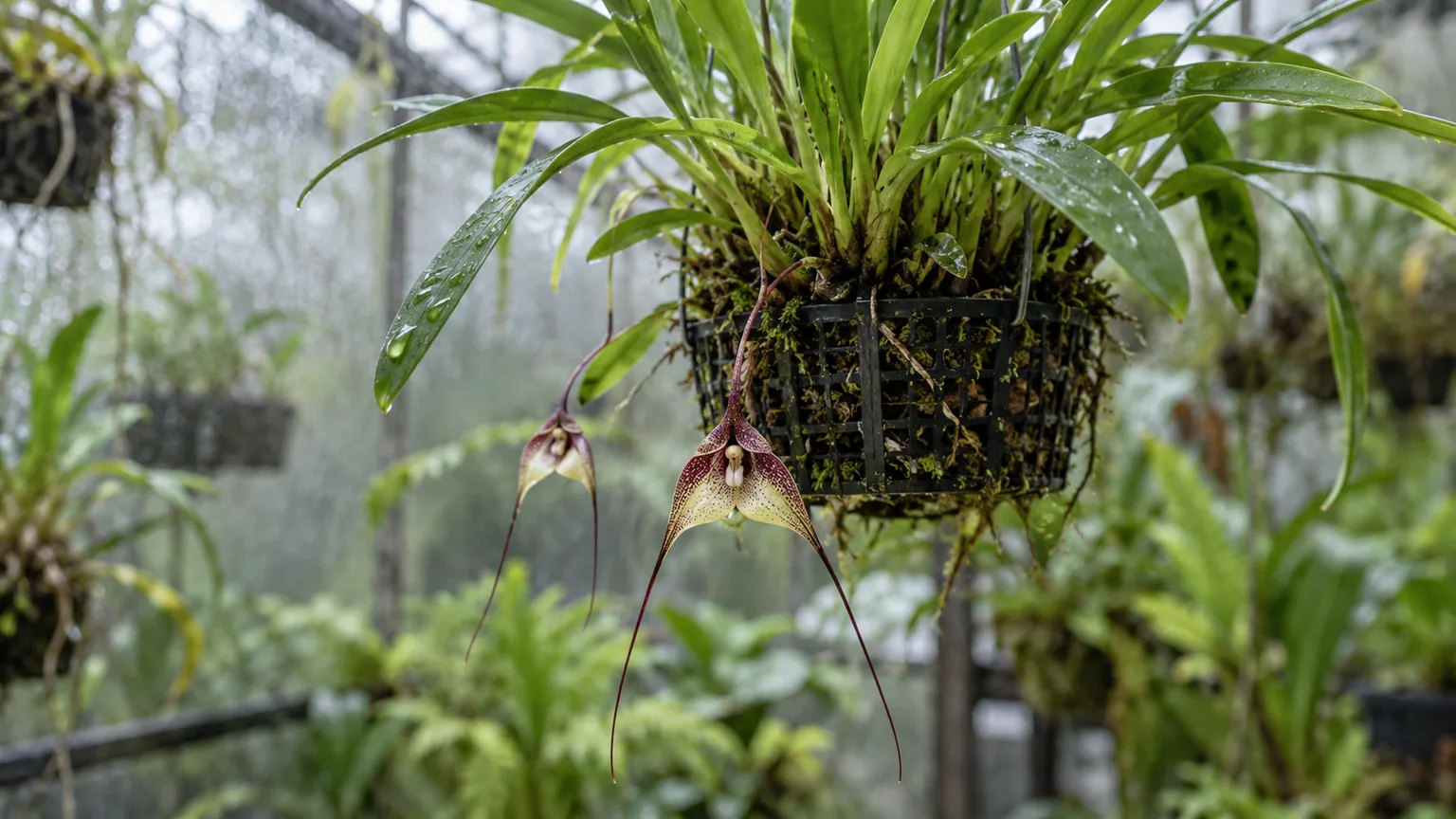
A Dracula orchid is a rewarding plant only when its growing space can stay cool, humid, shaded, and ventilated at the same time. That combination is why a bright, warm living room often proves harder than a small cool greenhouse or an open orchid cabinet. Before buying one, measure the conditions where it will actually hang; a thermometer and hygrometer at leaf height tell you more than a room thermostat across the room.
Dracula Orchid Basics: What Makes This Genus Different
Dracula is a genus of orchids from the moist montane forests of Central and South America, with many species associated with the Andes. Their unusual flowers have long, narrow sepal tails that give them a dragonlike outline; the short petals and central column can look like a small face, which explains the familiar “monkey face orchid” nickname. The American Orchid Society describes roughly 134 recognized species in its 2023 growing article, though taxonomy and counts can change over time. (American Orchid Society’s growing notes)
Many Dracula grow on mossy branches, rocks, or cliffs rather than in ordinary soil, and a few are terrestrial. They are sympodial orchids: new growths extend from a rhizome and form a clump, often without the water-storing pseudobulbs that make some other orchids more forgiving of dry spells. Most species send flower stems down or outward from the base of the plant. That growth pattern affects the pot you choose as much as the plant’s care does.
The genus has a cloud-forest reputation for good reason, but “cool-growing” is not one exact temperature prescription for every species. A grower who reported experience with more than 90 species emphasized consistently high humidity and shade, while also noting that several degrees of temperature variation can be tolerated. Use broad targets to plan your setup, then refine them with the seller’s notes for the named species or hybrid you own.
Choose an Orchid That Fits Your Growing Space
Dracula orchids suit growers who can control a small microclimate, not people who want to water once a week and leave a plant beside a sunny window. A cool room, shaded greenhouse, or ventilated plant cabinet can work if it stays humid without becoming stagnant. In a heated apartment with dry winter air and warm nights, a Dracula may remain alive for a while yet fail to grow well or flower; buying one before solving those constraints can turn a rare plant into an expensive experiment.
Ask the nursery for the full species or hybrid name, the temperatures under which it was grown, its current potting medium, and whether it is newly imported or acclimated. A plant raised in a greenhouse may need gradual adjustment to your home, especially if your humidity is lower or your nights are warmer. Also ask whether the flowers on that plant hang downward; this determines whether a mesh basket or open hanging pot is necessary.
Do not choose solely by a “monkey face” product photo. Flower color, markings, size, scent, and spike direction vary across the genus, and some species look less like a face than the common nickname suggests. The widely collected D. chimaera, D. dodsonii, and D. vampira are examples of the range, not a promise that all share identical care or bloom timing. If a vendor cannot identify the plant beyond “Dracula orchid,” treat the care label as a starting point rather than a guarantee.
Build a Cool, Humid Setup Before You Buy
Make the setup measurable. Put a digital thermometer/hygrometer near the leaves and record daytime highs, nighttime lows, and relative humidity for several days, including when heating or air conditioning runs. The American Orchid Society’s experienced Dracula grower describes humidity below 60 percent as something to avoid except briefly and gives 70–85 percent as an ideal range in that growing space. Those are useful planning targets, not a species-wide law; a stable 65 percent with good roots may be safer than an unstable enclosure kept near saturation.
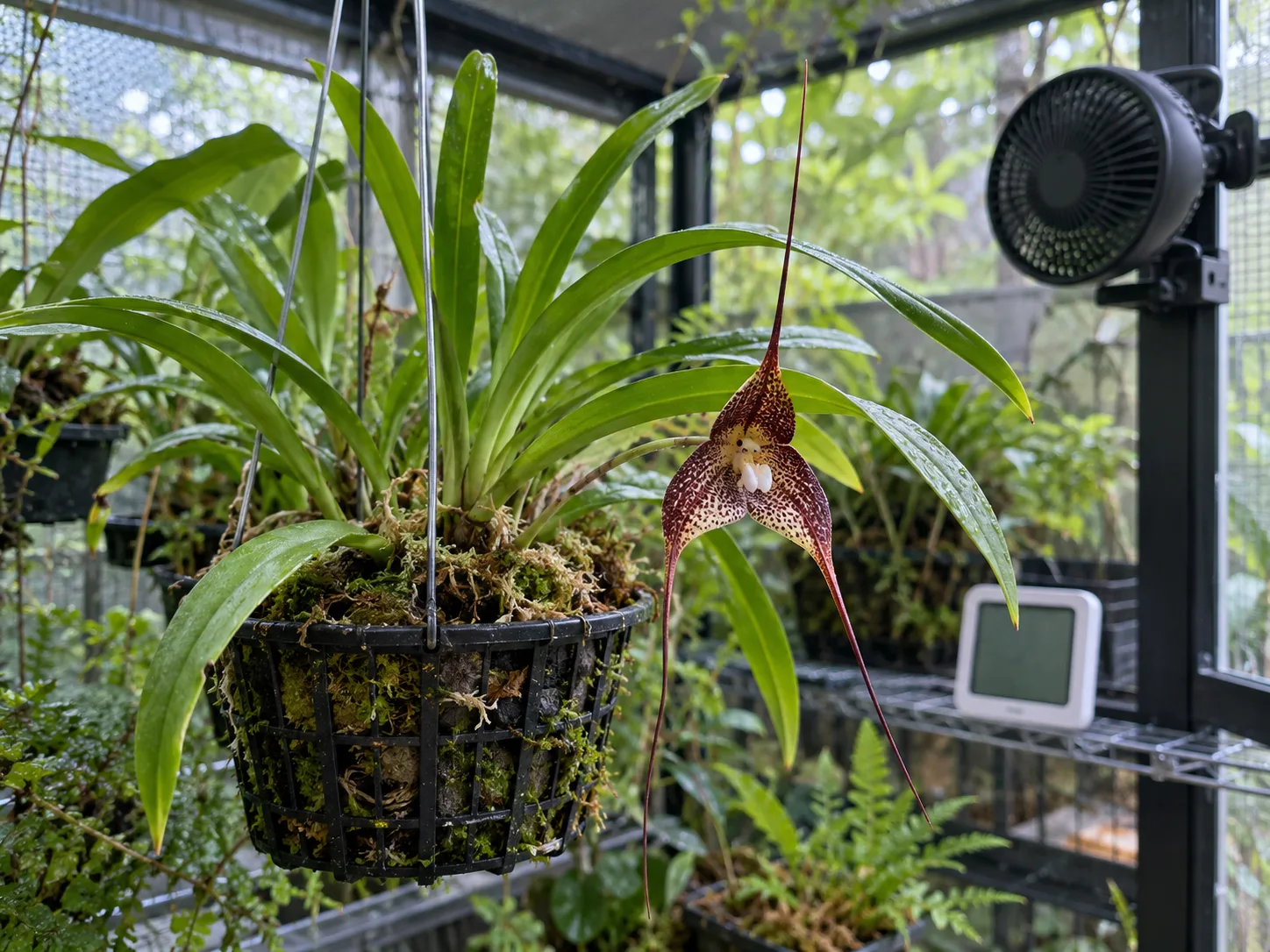
A small greenhouse, shaded cool room, or open-front plant cabinet can hold humidity more reliably than a pebble tray. A humidifier can help, but place it so mist does not constantly soak leaves, walls, or the medium. Make sure excess water drains away and that some air is exchanged. If the only way to reach high humidity is sealing the orchid in a stagnant box, the setup is incomplete: add ventilation and gentle circulation before moving the plant in.
Think of the setup as a linked system. Warmer air dries a small pot faster; stronger airflow can dry it faster still; dense moss may stay wet while the leaves dry out. Adjust one variable at a time and note the result. This is more useful than copying a watering schedule from a greenhouse with different temperatures, pot size, and air movement.
Light: Bright Shade, Not a Dark Corner
Give a Dracula orchid bright, filtered light with no prolonged direct midday sun. The thin leaves can scorch in hot sun, especially when the plant is already stressed by heat or low humidity. A north- or east-facing window may offer a workable starting point in a warm climate; a shaded greenhouse bench or a bright position behind a sheer curtain can also work. The American Orchid Society’s indoor-orchid guidance cautions that “low light” orchids still need meaningful light, so do not equate shade with a distant, dim corner. (American Orchid Society indoor orchid care)
If you grow under lights, start with a moderate, diffuse setup rather than a powerful lamp close to the foliage. Follow the grower’s species-specific guidance and keep the light on a consistent timer; lights can also add heat, which matters in a warm enclosure. Check the leaves after a week or two. Faded patches, dry tan areas, or leaves that feel hot signal too much intensity or heat; persistently weak, stretched growth can point to inadequate light, although root trouble can produce similar symptoms.
Move the plant gradually when changing its position. A Dracula brought from a shaded nursery bench should not go directly into a sunny window, even if the room feels cool. Rotate a hanging basket only if doing so does not twist or rub a growing flower spike; the goal is even growth, not a strict weekly ritual.
Temperature: Prioritize Cool Nights and Avoid Heat Spikes
Use cool, steady conditions as the default, with a modest day-to-night drop when possible. As a home starting point, many growers aim for days in the 60s to low 70s °F and nights in the 50s to low 60s °F, then adjust to the species and the plant’s response. The exact range is not universal: an experienced Dracula grower has overwintered plants at 47–54°F (8–12°C), while noting that a few degrees warmer can also work in that collection. Do not treat that personal winter routine as a minimum for every plant.
Avoid sustained hot conditions and sudden hot, dry episodes. The same grower reported that extreme summer heat and drought prevented many buds from reaching bloom, even when plants survived with frequent fogging; adding shade, humidity control, and air circulation improved flowering. That experience is a warning about heat stress, not proof that a brief warm afternoon will kill a plant. If your room often exceeds the low 70s or rises sharply near a window, measure at the basket and move the orchid to a cooler shaded location before changing fertilizer or watering.
The Royal Horticultural Society’s guide to cool-growing oncidiums also notes that cooler nights can support flowering in that orchid group, but its temperatures apply to oncidiums, not automatically to Dracula. (RHS cool-growing orchid guide) Ask the supplier about the plant’s natural seasonal rhythm instead of forcing a dramatic cold spell. Never place a wet orchid in a chilly draft or against cold glass; cool roots and stagnant wet media are a poor combination.
Humidity and Airflow Must Be Managed Together
High humidity slows water loss from leaves and helps recreate the damp air around cloud-forest orchids, but humidity without air exchange can keep leaves and pot surfaces wet for too long. Use a small fan set to move air around the growing area rather than blow directly at the plant. You should feel circulation nearby, not a constant gust on the leaves or roots. Orchid Bliss’s practical orchid advice similarly recommends indirect, low-speed fan movement to reduce stagnant air without drying plants out. (Orchid Bliss temperature and airflow advice)
Read humidity at leaf height, especially if a humidifier is below the plant or the cabinet has warm and cool zones. Misting may briefly wet a leaf but does not reliably maintain a stable room humidity; frequent misting can leave water trapped in leaf joints or on flowers. A humidifier with a controlled output is easier to manage. Clean its reservoir as directed, and keep the nozzle from sending mineral residue onto the orchid.
If condensation stays on the enclosure walls all day, the air may be too still or the enclosure too closed. Increase ventilation before cutting humidity sharply. Conversely, if the medium dries within hours and the leaves look limp, the airflow may be excessive for the basket or the local humidity too low. Adjust the fan angle, enclosure opening, or humidifier gradually, then observe new growth rather than expecting damaged leaf tips to turn green again.
Potting Mix: Hold Moisture Without Smothering Roots
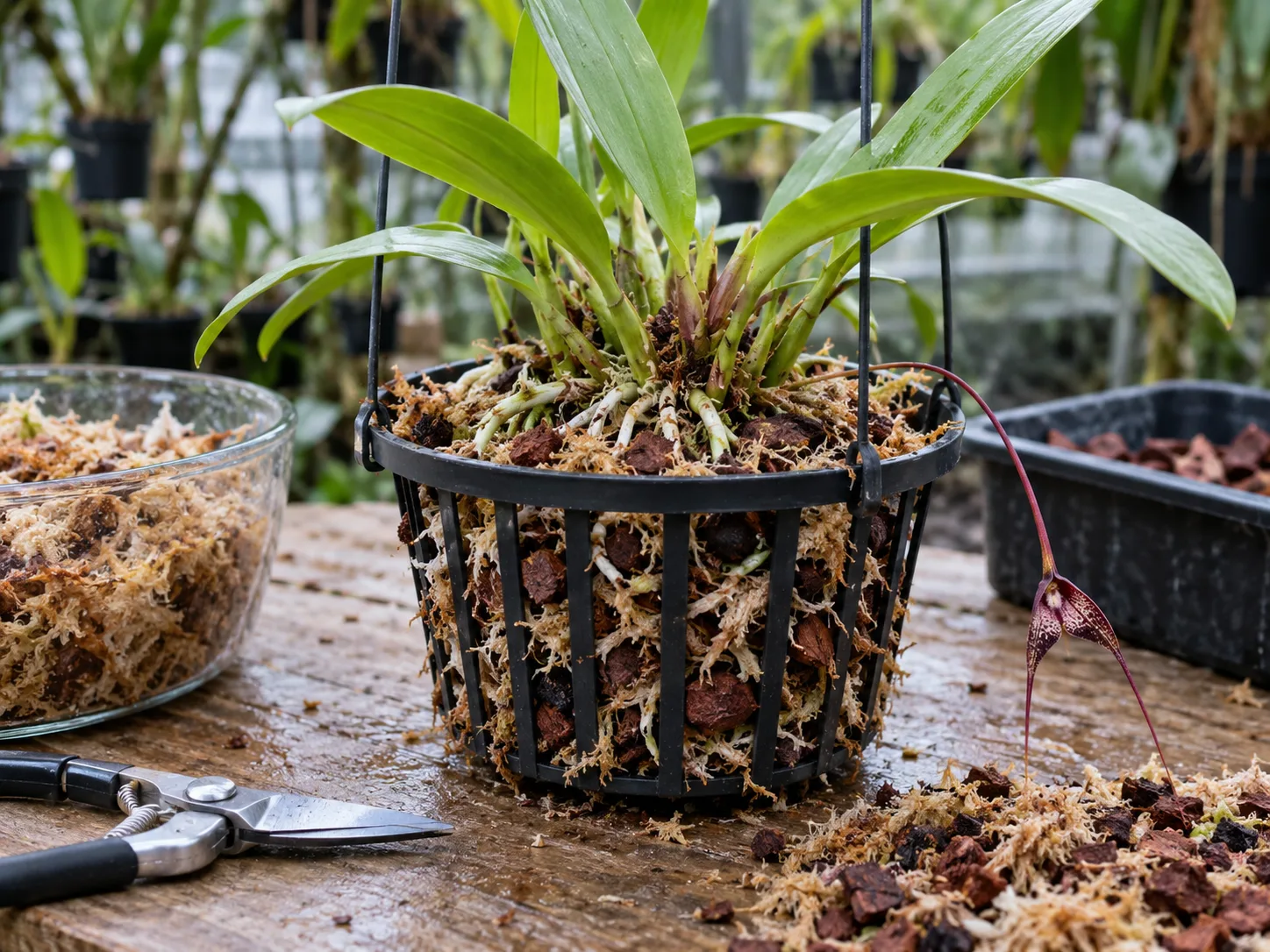
A Dracula medium should remain evenly moist while leaving air spaces around fine roots. Long-fiber sphagnum moss can retain moisture, while small orchid bark or washed coconut chips keep the mix more open. One experienced grower reports success with equal parts sphagnum and coconut chips and annual repotting; other growers use bark blends. The useful principle is texture and freshness, not one magic recipe. (American Orchid Society’s Dracula growing notes)
Avoid garden soil, dense houseplant potting mix, and moss packed so tightly that it stays cold and airless. At the other extreme, very coarse bark in a warm, dry room may not hold enough moisture for a small Dracula root system. If you are unsure, use a modest amount of a familiar orchid mix amended with sphagnum and observe how long the center stays damp. Roots need moisture and oxygen; a sour smell, a constantly heavy pot, or a mix that has collapsed into sludge means the structure has failed.
Rinse new moss or chips with low-mineral water and remove loose dust before potting. Keep the mix loose enough that water can pass through quickly, but do not leave roots exposed to drying air simply because the container has large holes. Your room’s humidity, temperature, basket size, and watering access determine how moisture-retentive the blend should be.
Watering: Keep the Root Zone Evenly Moist
Check the medium every day while learning your setup, then water when it is approaching the dry side—not after it has gone bone dry. A lightweight hanging basket, pale moss surface, and slightly damp center are better cues than a fixed calendar. In warm weather a small basket may need frequent watering; in a cool room it may stay moist much longer. The American Orchid Society grower describes Dracula roots as needing consistently moist to wet conditions, but this does not mean leaving the plant in stagnant water.
Water thoroughly so the whole root zone is refreshed, then let the basket drain completely. Do not leave it sitting in a cachepot full of runoff. If your tap water leaves white crust on pots or has high mineral content, use rainwater or reverse-osmosis water when practical. The AOS grower highlights the genus’s sensitivity to salts and uses low-conductivity water and dilute feeding. At home, watch for deposits on the basket or moss, brown root tips, and leaf-tip burn; these are reasons to review both water and fertilizer, not to add more feed.
A simple routine is: feel the medium; water through when it is nearly dry but still slightly cool or damp inside; drain; and reassess the next day. If roots are firm and the new growth is steady, the interval is probably close. If they are wrinkled and dry, shorten the interval or raise humidity. If they are brown, mushy, or foul-smelling, inspect the mix and airflow before watering again.
Fertilizing Without Burning Sensitive Roots
Feed lightly. Use a complete orchid fertilizer at a low dilution and apply it only to already-moist roots; strong fertilizer or repeated concentrated doses can leave salts around the delicate root tips. The AOS Dracula grower reports using a very dilute solution every three to four weeks and measuring conductivity, but most home growers do not need to copy that exact meter reading. Start below the product label’s full strength, especially if you do not know the water quality or the plant’s previous feeding history.
Use plain low-mineral water periodically to flush the basket and carry accumulated fertilizer through the drainage holes. If the moss is old or mineral deposits are visible, flushing alone may not restore it; repot into fresh medium. Do not feed a plant with damaged roots to “make it recover faster.” First correct the moisture, temperature, or root problem, then resume weak feeding after new root tips appear.
There is no special high-phosphorus bloom formula that can compensate for a plant that is too warm, too dry, or immature. A healthy root system and stable conditions matter more than a more aggressive fertilizer schedule. If the plant is making leaves but not flowers, check light, temperature, and plant maturity before changing the nutrient ratio.
Pot Choice and Repotting for Downward Flowers
Choose a small, well-drained container that suits the plant’s root mass and leaves room for most flower stems to emerge below or beyond the rim. Mesh pots and open hanging baskets are practical for the many species with pendent or decumbent inflorescences; solid pots can block a spike or force it to bend. Some species produce more upright flowers, so confirm the habit for your plant. A basket should be secure, clean, and easy to water without disturbing a spike.
Repot when the medium decomposes, becomes compact, smells sour, or stays wet much longer than it used to—not automatically because a year has passed. Annual repotting works for some growers using sphagnum and coconut, but the calendar depends on material and climate. If possible, repot after flowering or as new roots begin to grow, when the plant can establish into fresh medium. Do not delay if rotting roots or collapsed moss threaten the plant just to wait for an ideal season.
Remove loose old media gently, trim only roots that are dead and mushy with a clean tool, and preserve firm roots even if their outer surface is stained. Position the rhizome at the surface rather than burying the growing points. Settle the mix around roots without compressing it. Keep the basket slightly more sheltered while new roots attach, but continue gentle air exchange and keep the medium lightly moist.
Encouraging Blooms and Reading the Flowers
A mature, healthy Dracula can flower at different times depending on species and growing conditions. Instead of chasing a month on the calendar, look for steady new growth, firm roots, and a stable cool-humid environment. When a spike appears, leave it undisturbed and make sure there is space below the pot. A basket that was convenient for foliage can still frustrate flowering if its bottom or shelf blocks the spike.
Many Dracula flowers hang downward and have a complex outline; their tails and patterned centers vary by species. Some have a mushroom-like scent. A 2019 study in Ecological Entomology found that Dracula orchids mimic mushrooms in appearance and scent and attract fungus-visiting flies; the research also showed that the relationship is more complicated than simple deception because flies may feed, shelter, or mate on flowers. (Policha et al., “Dracula orchids exploit guilds of fungus visiting flies”; Botany One’s research report)
If a bud dries or drops, note what changed in the preceding days: a heater switched on, humidity fell, the plant was moved, a window was opened, or the basket dried faster than usual. Bud drop has several possible causes, so correct the most obvious environmental swing and protect remaining buds from abrupt changes. Do not move the plant repeatedly to “find the perfect spot” once a spike is developing.
Propagating a Mature Clump by Division
Division is the practical home method for a mature clump, but it is not a way to multiply a small single-growth plant quickly. Wait until the orchid has several healthy growths and roots, ideally after flowering or when new roots are visible. A divided piece with little foliage or few roots may stall for a long time. Keep divisions large enough to recover rather than splitting the plant into the smallest pieces possible.
Remove the plant from its basket, loosen the medium, and trace the rhizome so you can see where natural sections form. With a disinfected blade, separate a section that has multiple established growths and a working root system. The exact number depends on how large and vigorous the clump is; preserving healthy roots and enough leaves is more important than meeting a rigid count. Discard only dead, mushy tissue and use fresh medium for each division.
Set each division into a container that just accommodates its roots. Keep the medium evenly moist, not flooded, and maintain the same gentle humidity and airflow as for the parent plant. Do not fertilize heavily while roots are settling in. New root tips and leaves—not a fixed number of weeks—are the sign that the division has resumed growth.
Troubleshooting Yellow Leaves, Drooping Spikes, and Root Loss
Diagnose patterns, not one leaf. An old lower leaf can yellow and fall as part of normal aging, while several leaves yellowing together, a soft base, or a sour-smelling basket points to a more serious root or environmental problem. Before changing care, record temperature and humidity at the plant, feel the medium, and inspect a few roots through the basket. Then make one change and give new growth time to respond.
| Symptom | First checks | Useful first response |
|---|---|---|
| Buds or flower spikes droop | Did humidity fall, heat rise, or the plant dry out? | Restore stable humidity and moisture; keep the spike away from vents and drafts. |
| Leaf tips turn brown | Is the basket drying too fast, or is there a salt crust? | Check humidity and water quality; flush with low-mineral water and reduce fertilizer. |
| Several leaves yellow | Are roots firm, or is the medium compact and sour? | Inspect the rhizome and roots; correct waterlogging or drought before feeding. |
| Roots are soft or foul-smelling | Does water drain freely, and does the mix stay heavy? | Remove dead roots, replace decomposed medium, and improve drainage and air exchange. |
| No flowers despite healthy leaves | Is the plant mature, sufficiently bright, and cool at night? | Confirm the species’ needs with the grower and stabilize conditions before changing feed. |
A brown tip will not turn green again, so judge a correction by the next leaf or root rather than the damaged tissue. Similarly, old roots may be stained by moss or water; firmness matters more than color alone. If decline continues after the environment and medium have been corrected, ask the specialist nursery that supplied the orchid to help identify the species and its growing history.
Preventing Pests and Rot in a Humid Collection
Moist growing conditions can favor fungus gnats, especially when organic medium stays wet and decays. Keep fallen leaves and old flowers out of the basket, remove decomposed moss, and use sticky cards to monitor adult gnats. If larvae persist, identify them before selecting a treatment and follow the product label; do not pour an unverified pesticide or household mixture through fine orchid roots.
Root problems are more often prevented by balancing moisture with drainage and ventilation than by keeping the plant dry. A fan should move air gently, but it cannot rescue a pot packed with collapsed moss. Conversely, extra holes in a basket do not solve a dry room if roots lose moisture between waterings. Check the complete system—medium, pot, local temperature, humidity, and airflow—before applying a fungicide or changing the entire routine.
Inspect new plants separately before hanging them among a collection. Look under leaves and around growth bases for scale, mealybugs, or webbing, and isolate a plant if you find pests. Clean tools between divisions and avoid sharing old medium. These small habits limit problems without exposing a sensitive orchid to unnecessary sprays.
Growing Dracula Orchids Outdoors or in a Terrarium
Outdoor growing is realistic only where summer conditions remain cool, shaded, and humid enough for the species. A sheltered north-facing porch in a mild climate may work for part of the year, but an exposed patio or hot summer balcony can warm the basket quickly and dry it between checks. Move plants outdoors gradually, protect them from direct sun and wind, and bring them back before nights or heat waves exceed the grower’s guidance. Do not use outdoor placement as a substitute for measuring conditions.
A terrarium or Wardian case can stabilize humidity, but it needs ventilation. A permanently sealed jar traps heat and stale air, while frequent opening can create large humidity swings. Choose a container that lets the basket hang freely, add gentle circulation or regular air exchange, and watch for persistent condensation. If airflow is difficult to provide, a partially open cabinet is usually easier to manage than a sealed terrarium.
The right choice depends on your home’s actual seasonal pattern. The RHS notes that cool-growing orchids can be challenging in ordinary homes when the required temperatures are difficult to maintain; that advice is written for oncidiums, but the practical lesson is relevant: choose a plant that fits your conditions instead of trying to force a warm room into a cloud forest. (RHS cool-growing orchid guidance) If you cannot keep a Dracula cool, humid, and ventilated together, select a more forgiving orchid and enjoy this genus at a botanical collection.
Conclusion
Dracula orchid care comes down to a handful of linked conditions: filtered light, cool and steady temperatures, high but controlled humidity, gentle air exchange, and roots that stay moist without sitting in stagnant water. Check those conditions before buying, then use the species or hybrid name and the seller’s growing notes to adjust your targets. A bright, warm room is not automatically suitable just because it looks like a good plant spot.
Use a small thermometer and hygrometer, water according to the basket rather than the calendar, and repot when the medium loses its structure. Give the downward flower spikes room, make changes gradually, and treat new roots and leaves as your clearest feedback. With a workable microclimate, a Dracula orchid can grow steadily—and its unusual flowers become a welcome result rather than the only measure of success.



