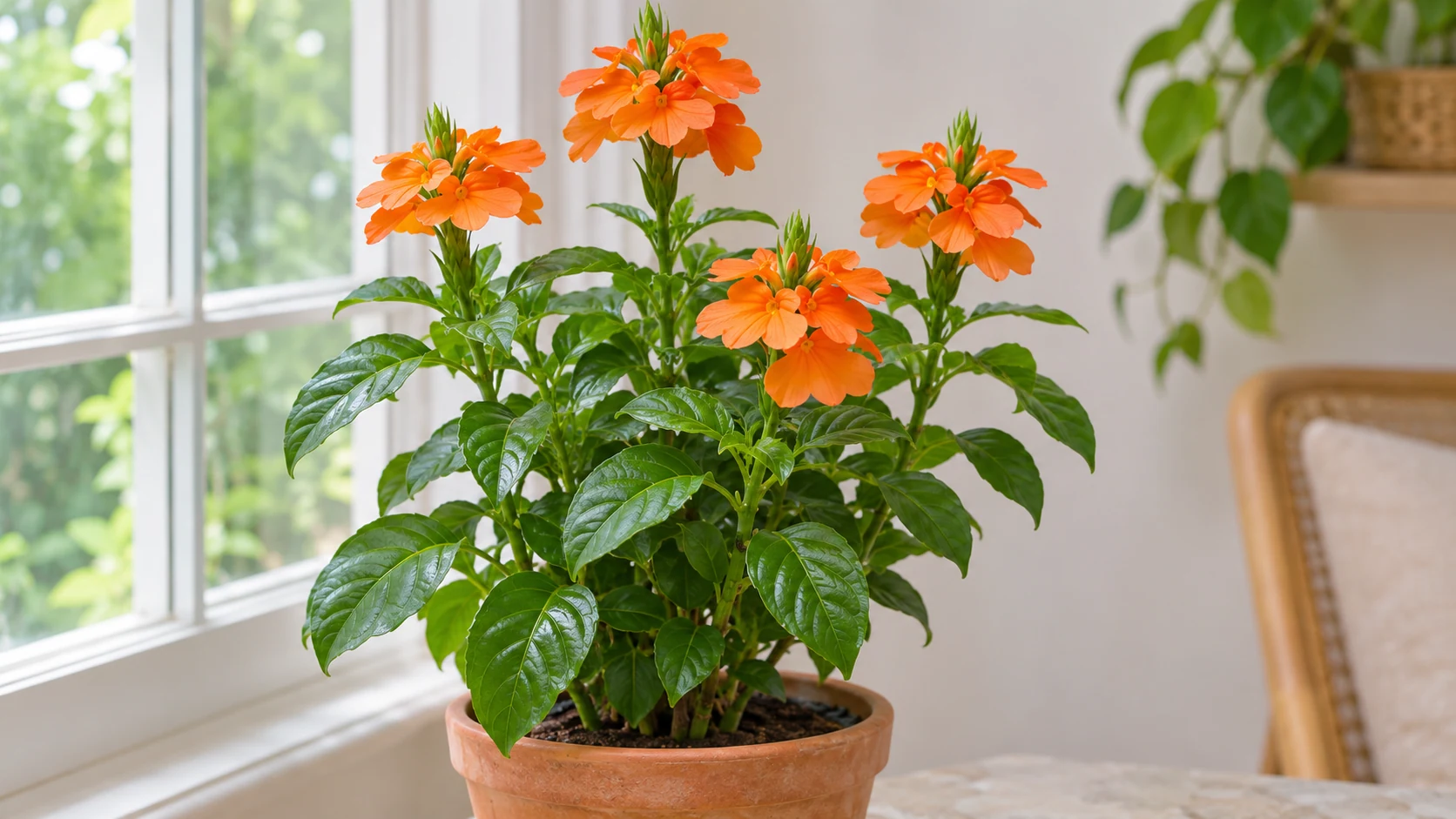
Crossandra infundibuliformis is commonly called firecracker flower or firecracker plant. The name refers to its seed capsules, which can split open when mature and wet.
How much light does Crossandra need?
Give it bright filtered or indirect light, or gentle morning sun with some shade from intense afternoon heat. It tolerates full sun in mild conditions, while deep shade can reduce flowering.
How often should I water Crossandra?
Check the top inch of potting mix and water when it begins to dry. Keep the root ball lightly moist during active growth, let excess water drain, and water less when the plant grows slowly in cool or dim conditions.
Can Crossandra grow indoors?
Yes. Grow it in a warm room with bright indirect light, an open-draining pot, and enough humidity to prevent the air from becoming very dry. Bring outdoor plants in before cold weather; temperatures below about 55°F (13°C) can damage leaves.
Is Crossandra safe for cats and dogs?
NC State Extension tags Crossandra infundibuliformis as non-toxic to cats and dogs, and also lists it as non-toxic to horses. Safety for rabbits, birds, turtles, and tortoises was not verified here; discourage chewing and ask a veterinarian about a concerning ingestion.
How do I propagate Crossandra?
Propagate Crossandra from healthy stem or root divisions during active growth.
What soil is best for Crossandra?
Use use a fertile, organic-rich but free-draining potting mix. Crossandra prefers slightly acidic conditions and steady moisture, while good drainage protects its roots from waterlogging. A peat-free container compost with added perlite or another open-textured material is a practical choice indoors. A good mix includes Use a peat-free, organic-rich potting compost in a container with open drainage holes., Add perlite or pumice if the mix compacts or stays wet too long., Do not leave the pot standing in water after irrigation. Moist but well-drained; avoid saturated beds and pots without drainage holes. Target soil pH around Slightly acidic is preferred; sources place the target near pH 5.8–6.5, but avoid adjusting a healthy mix without a soil test.
Written by Sai AnanthLead content writer at LeafyPixels. B.Pharmacy graduate from Andhra University with a background in pharmacognosy, turned indoor gardening writer after a long-time plant hobby became a research-led resource for home growers.View Sai Ananth's profile · Reviewed by LeafyPixels Review Board
This Crossandra problems problem guide was researched and written by Sai AnanthLead content writer at LeafyPixels. B.Pharmacy graduate from Andhra University with a background in pharmacognosy, turned indoor gardening writer after a long-time plant hobby became a research-led resource for home growers.View Sai Ananth's profile. Problems symptoms on Crossandra, lookalike causes, and step-by-step fixes are cross-checked against extension pest, disease, and care references before publication.
We prioritize sources that hold up under scrutiny:
University cooperative extension bulletins and fact sheets (Penn State, Clemson, UMD, NC State, and similar programs)
Botanical garden and horticultural society publications
Peer-reviewed plant science and veterinary toxicology references where pet safety matters (including ASPCA Animal Poison Control)
Established reference works on indoor plant culture
The LeafyPixels editorial team then reviews the draft for clarity, step-by-step usefulness, and fit with real apartment and home conditions-not ideal greenhouse setups. When guidance changes materially, we update the page and note the revision date.
Sources used
Better Homes & Gardens — How to Plant and Grow Crossandra (n.d.) Seasonal and container growing, partial shade in hot weather, humidity, soil pH, watering, temperature, feeding, pinching, and repotting guidance. [Online]. Available at: https://www.bhg.com/gardening/plant-dictionary/annual/crossandra/ (Accessed: 1 March 2024).
Epic Gardening — How to Plant, Grow, and Care for Crossandra (n.d.) Practical propagation, pinching and flower-spike care, seed-pod behavior, and common pest observations. [Online]. Available at: https://www.epicgardening.com/crossandra/ (Accessed: 1 March 2024).
National Parks Board Singapore Flora and Fauna Web — Crossandra infundibuliformis (n.d.) Species identity, growth form, dimensions, range, flowering and seed-pod description, cultivation, drainage, pruning, and propagation. [Online]. Available at: https://www.nparks.gov.sg/florafaunaweb/flora/1/8/1884 (Accessed: 1 March 2024).
NC State Extension Gardener Plant Toolbox — Crossandra infundibuliformis (n.d.) Scientific identity, family, origin, size, light, soil, pollinator value, cultivars, hardiness, pet-safety tags, and pests. [Online]. Available at: https://plants.ces.ncsu.edu/plants/crossandra-infundibuliformis/ (Accessed: 1 March 2024).
Royal Horticultural Society — Crossandra infundibuliformis (n.d.) Evergreen habit, size, warm frost-free outdoor conditions, filtered summer light under glass, pinching, and propagation by seed or cuttings. [Online]. Available at: https://www.rhs.org.uk/plants/42165/crossandra-infundibuliformis/details (Accessed: 1 March 2024).
The Spruce — How to Grow and Care for Crossandra (n.d.) Indoor light, soil, watering, humidity, cold sensitivity, container care, and species identification. [Online]. Available at: https://www.thespruce.com/grow-crossandra-inside-1902641 (Accessed: 1 March 2024).