Crossandra Care: Light, Water, Soil, and Firecracker
Crossandra infundibuliformis (L.) Nees
Grow Crossandra with bright filtered light, evenly moist well-drained soil, warmth, and humidity. Learn watering, pruning, and indoor care.
Crossandra Care Guide: Light, Water, and Flowering
Start with wateringThe most common care mistake for CrossandraWatering guide →Crossandra care essentials
Light
Bright filtered light or partial shade; gentle morning sun can support flowering
Water
Keep the root zone moderately and evenly moist while Crossandra is actively growing, but let the surface begin to dry before watering again. Water the mix thoroughly and let excess drain away. The plant dislikes both prolonged drought and waterlogged soil, so do not leave its pot standing in a saucer.
Soil
Use a fertile, organic-rich but free-draining potting mix. Crossandra prefers slightly acidic conditions and steady moisture, while good drainage protects its roots from waterlogging. A peat-free container compost with added perlite or another open-textured material is a practical choice indoors.
Humidity
Temperature
Fertilizer
About Crossandra
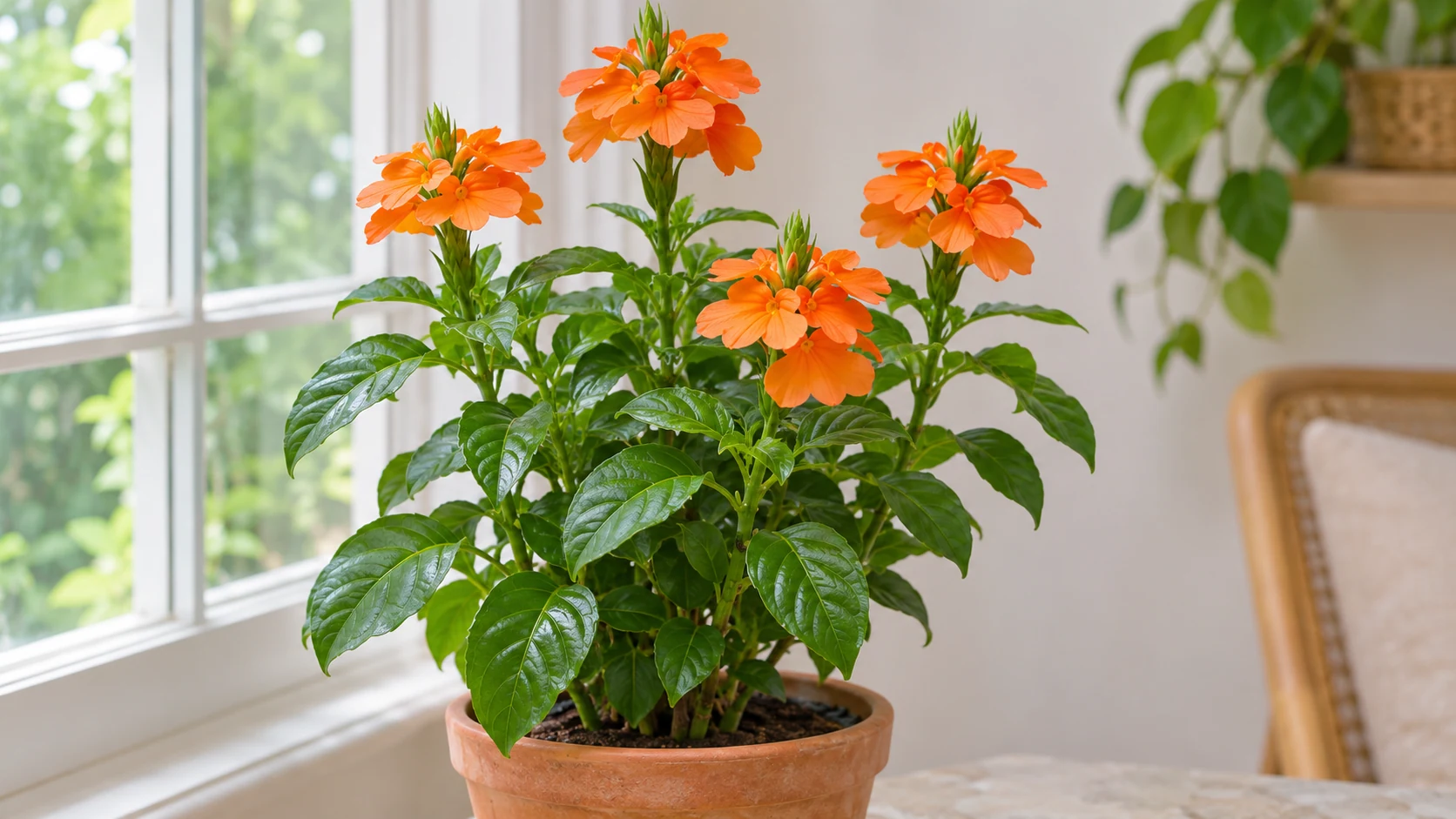
Crossandra is native to South India and Sri Lanka; regional profiles also report a broader range, typically reaches About 1–3 ft (0.3–1 m) tall and 1–2 ft (0.3–0.6 m) wide; cultivar and growing conditions affect size indoors, with moderate to fast in warm growing conditions growth. Crossandra has a erect, evergreen tropical subshrub; perennial in frost free climates and often grown as an annual or houseplant in colder regions growth habit and part of the Acanthaceae family. It is also known as Firecracker Flower and Firecracker Plant.
| Detail | Information |
|---|---|
| Also known as | Firecracker Flower, Firecracker Plant |
| Native region | South India and Sri Lanka; regional profiles also report a broader range |
| Mature size | About 1–3 ft (0.3–1 m) tall and 1–2 ft (0.3–0.6 m) wide; cultivar and growing conditions affect size |
| Growth rate | Moderate to fast in warm growing conditions |
| Growth habit | Erect, Evergreen Tropical Subshrub; Perennial In Frost Free Climates And Often Grown As An Annual Or Houseplant In Colder Regions |
| Scientific name | Crossandra infundibuliformis (L.) Nees |
| Family | Acanthaceae |
How to care for Crossandra?
How much light does Crossandra need?
Bright filtered light or partial shade; gentle morning sun can support flowering. Dappled sunlight. Full sun in mild conditions. Bright indirect indoor light. direct sun
- Bright filtered light or partial shade - Bright filtered light or partial shade; gentle morning sun can support flowering.
- gentle morning sun can support flowering - Bright filtered light or partial shade; gentle morning sun can support flowering.
- Dappled sunlight - Dappled sunlight.
- Full sun in mild conditions - Full sun in mild conditions.
- Bright indirect indoor light - Bright indirect indoor light.
- direct sun - direct sun.
When should you water Crossandra?
Keep the root zone moderately and evenly moist while Crossandra is actively growing, but let the surface begin to dry before watering again. Water the mix thoroughly and let excess drain away. The plant dislikes both prolonged drought and waterlogged soil, so do not leave its pot standing in a saucer.
- Feel the top inch (about 2.5 cm) of mix. When it is beginning to dry - Keep the root zone moderately and evenly moist while Crossandra is actively growing, but let the surface begin to dry before watering again.
- water until excess runs through the drainage holes - Water the mix thoroughly and let excess drain away.
- then empty the saucer. The root ball should stay lightly moist - Keep the root zone moderately and evenly moist while Crossandra is actively growing, but let the surface begin to dry before watering again.
- not saturated or bone dry - Keep the root zone moderately and evenly moist while Crossandra is actively growing, but let the surface begin to dry before watering again.
- Drain excess water - Water the mix thoroughly and let excess drain away.
What soil works best for Crossandra?
Use a fertile, organic-rich but free-draining potting mix. Crossandra prefers slightly acidic conditions and steady moisture, while good drainage protects its roots from waterlogging. A peat-free container compost with added perlite or another open-textured material is a practical choice indoors.
- Use a peat-free - Use a fertile, organic-rich but free-draining potting mix.
- organic-rich potting compost in a container with open drainage holes - A peat-free container compost with added perlite or another open-textured material is a practical choice indoors.
- Add perlite or pumice if the mix compacts or stays wet too long. - A peat-free container compost with added perlite or another open-textured material is a practical choice indoors.
- Do not leave the pot standing in water after irrigation. - A peat-free container compost with added perlite or another open-textured material is a practical choice indoors.
Grower notes for Crossandra
Balance bright light with protection from intense heat
Crossandra tolerates full sun in mild conditions, but a bright filtered position or partial shade is a safer starting point where afternoons are hot. Indoors, place it near a bright window with indirect light. NC State Extension lists dappled sun, partial shade, and full sun; the RHS recommends filtered light under glass during summer.
Keep moisture steady and drainage open
Do not let the root ball dry out for long, but also do not keep it saturated. NParks describes Crossandra as sensitive to overwatering and waterlogged sites, and recommends letting the soil dry before rewatering. A draining pot and a check of the top layer are more useful than a rigid daily schedule.
Protect this tropical plant from cold
Crossandra is perennial outdoors only where frost is absent. NC State Extension and The Spruce note leaf damage around temperatures below 55°F (13°C); in colder regions grow it as seasonal bedding or move the pot indoors before cold weather arrives.
Give indoor plants warmth and humidity
Warm rooms and moderate to high humidity help Crossandra keep growing and flowering. Use a pebble tray or room humidifier if indoor air is dry, but keep the pot above the water so its roots are not left soaking. Reduce watering as light and growth decline in winter.
Pinch young stems and remove spent flower spikes
Pinching the growing tips while the plant is young encourages a bushier shape. Remove faded spikes and brown seed capsules to keep the display tidy; NParks notes that mature capsules can split explosively when wet. RHS and NC State Extension list seed and stem cuttings as propagation options.
Expect seasonal growth outside the tropics
In warm, frost-free climates Crossandra is an evergreen perennial and may flower for a long season. In colder areas it is commonly grown in a pot or as a summer annual. A named cultivar may vary in height and flower color, so use its nursery label when choosing a position or container.
Is Crossandra safe for pets?
NC State Extension tags Crossandra infundibuliformis as non-toxic to cats, dogs, and horses. That species-specific listing does not establish safety for rabbits, birds, turtles, or tortoises. Discourage chewing and contact a veterinarian if an animal eats a large amount or shows symptoms.
NC State Extension lists Crossandra infundibuliformis as non-toxic to cats, dogs, and horses. This classification is not extended to other plants that share a common name or to rabbits, birds, turtles, or tortoises, for which species-specific safety was not verified in this review. As with any ornamental plant, discourage chewing and seek veterinary advice after a concerning ingestion.
Watering Crossandra
For Crossandra, feel the top inch (about 2.5 cm) of mix. When it is beginning to dry, water until excess runs through the drainage holes, then empty the saucer. The root ball should stay lightly moist, not saturated or bone dry. and water check the pot every few days during warm, bright weather and water when the upper layer begins to dry. Small pots and hot, dry conditions need more frequent checks; reduce watering when indoor growth slows in cool or dim weather rather than following a fixed calendar. Check more often during active spring and summer growth, heat, and flowering. In a cool or low-light winter room, water less often as growth slows while still preventing the root ball from drying out completely.
| Detail | Information |
|---|---|
| How often | Check the pot every few days during warm, bright weather and water when the upper layer begins to dry. Small pots and hot, dry conditions need more frequent checks; reduce watering when indoor growth slows in cool or dim weather rather than following a fixed calendar. |
| How to check | Feel the top inch (about 2.5 cm) of mix. When it is beginning to dry, water until excess runs through the drainage holes, then empty the saucer. The root ball should stay lightly moist, not saturated or bone dry. |
| Seasonal changes | Check more often during active spring and summer growth, heat, and flowering. In a cool or low-light winter room, water less often as growth slows while still preventing the root ball from drying out completely. |
Signs of overwatering
- The potting mix remains wet for several days or the pot stays unusually heavy.
- Leaves yellow or droop while the soil is still wet; check drainage and roots before adding more water.
- Water collects in the saucer or the container has no open drainage holes.
Signs of underwatering
- The root ball and upper mix are dry and leaves lose their usual firmness.
- Leaf edges dry during hot weather when the pot dries quickly.
- The plant wilts while the mix is dry; water thoroughly and reassess after it drains.
Soil & potting for Crossandra
Use a mix of Use a peat-free, organic-rich potting compost in a container with open drainage holes., Add perlite or pumice if the mix compacts or stays wet too long., Do not leave the pot standing in water after irrigation. for Crossandra. Moist but well-drained; avoid saturated beds and pots without drainage holes. Target soil pH around Slightly acidic is preferred; sources place the target near pH 5.8–6.5, but avoid adjusting a healthy mix without a soil test. Repot repot only when roots fill the container or the mix has broken down, usually every few years. Crossandra can resent unnecessary disturbance, so move it up only one pot size and preserve the root ball where possible., ideally in spring or early active growth, when warm conditions support recovery.
| Detail | Information |
|---|---|
| Recommended mix | Use a peat-free, organic-rich potting compost in a container with open drainage holes., Add perlite or pumice if the mix compacts or stays wet too long., Do not leave the pot standing in water after irrigation. |
| Drainage | Moist but well-drained; avoid saturated beds and pots without drainage holes |
| Soil pH | Slightly acidic is preferred; sources place the target near pH 5.8–6.5, but avoid adjusting a healthy mix without a soil test |
| Repotting frequency | Repot only when roots fill the container or the mix has broken down, usually every few years. Crossandra can resent unnecessary disturbance, so move it up only one pot size and preserve the root ball where possible. |
| Best season to repot | Spring or early active growth, when warm conditions support recovery |
Signs it needs repotting
- Roots circle the pot or emerge from its drainage holes.
- The mix has compacted or water runs through without wetting the root ball.
- The container dries unusually quickly despite thorough watering.