Distorted Leaves on Dieffenbachia: Causes, Checks & Fixes
Quick answer
Distorted leaves on Dieffenbachia—puckered, crinkled, cupped, or undersized broad blades—usually show up on the newest leaf still opening at the cane tip, often from thrips or mealybugs scarring soft tissue, uneven watering during a growth flush, or edema on heavy variegated leaves. First step: inspect that unfolding blade and shake it over white paper before changing pot size or reaching for insecticidal soap.
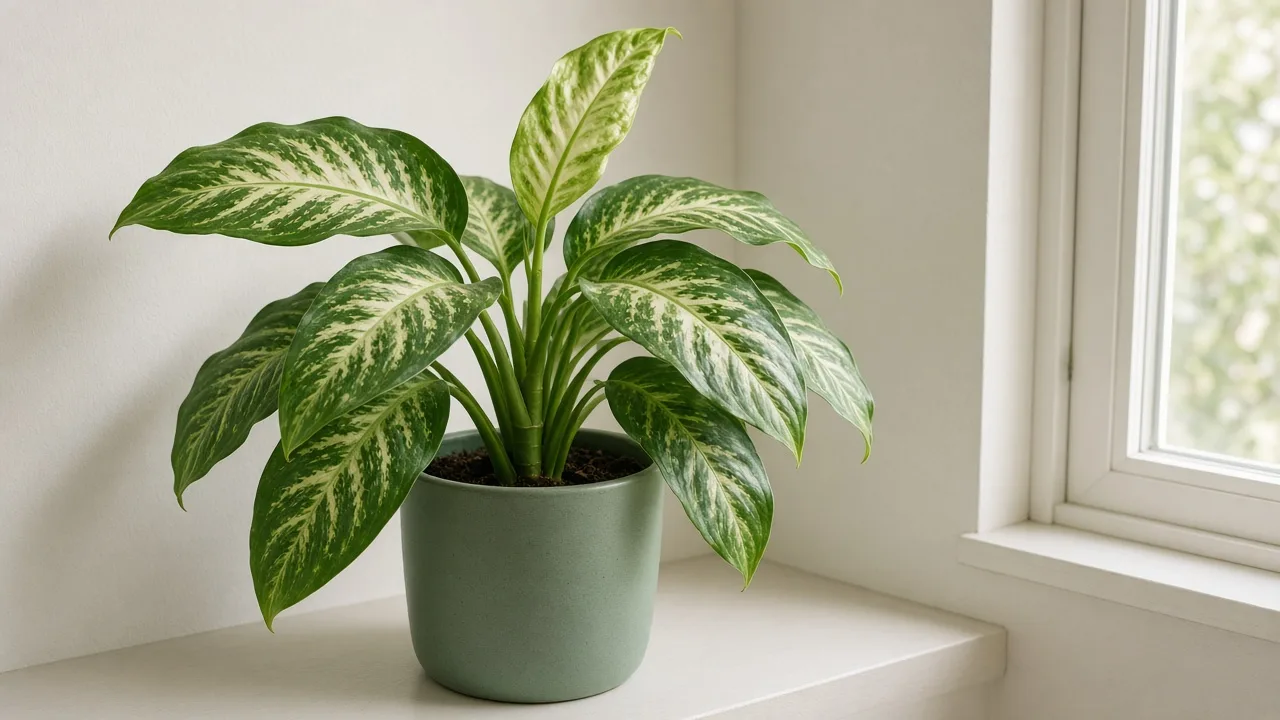
Distorted Leaves on Dieffenbachia: Causes, Checks & Fixes
This guide covers distorted leaves on Dieffenbachia. See also the general Distorted Leaves guide, watering, and light pages for this plant.
Distorted Leaves on Dieffenbachia: Causes, Checks & Fixes
Quick answer
Distorted leaves on Dieffenbachia (Dieffenbachia spp.—dumb cane, leopard lily) break the plant’s usual look: large, arching, often variegated blades on an upright cane. When new foliage emerges puckered, crinkled, cupped, twisted, or smaller than neighbors, something interfered while that leaf was forming—or sap feeders scarred tissue inside the crown.
For how crinkled and misshapen leaves develop on houseplants in general, see our distorted leaves hub. On dumb cane, the diagnostic zone is the cane tip—the next broad leaf unfurls from a tight roll at the top of the stem, and any pest hit or watering swing during that opening window locks distortion into the blade permanently.
First step: inspect the newest unfolding leaf at the cane crown under bright light, then shake it over white paper. Silvery scrape marks with black specks need pest treatment; rippled blades without insects after dry-then-flood watering point to watering rhythm—not repotting on day one.
When to use this page vs other Dieffenbachia guides
| Pattern | Start here | Or route to… |
|---|---|---|
| Silvery streaks, black frass, scarred crown tips | Thrips | This page when shape—not pest ID alone—is the main issue |
| Inward roll on established blades without twist | Curling leaves | — |
| Crinkled new leaf; firm cane; months without feed | Calcium deficiency | — |
| Brown tips only; blade otherwise flat | Brown tips | — |
| Yellow lower leaves, wet heavy pot | Overwatering | Root rot if stem softens |
| White cotton in axils | Mealybugs | — |
| Clustered soft insects on new growth | Aphids | — |
| Fine webbing on leaf undersides | Spider mites | — |
What distorted leaves look like on Dieffenbachia
Healthy Dieffenbachia carries broad, oblong leaves—often 8 to 14 inches long indoors—with cream, white, or yellow variegation on green. NC State notes loose, fertile mix, indirect light, moderate temperatures, and high humidity suit this tropical cane. Distortion means the blade lost its flat symmetry:
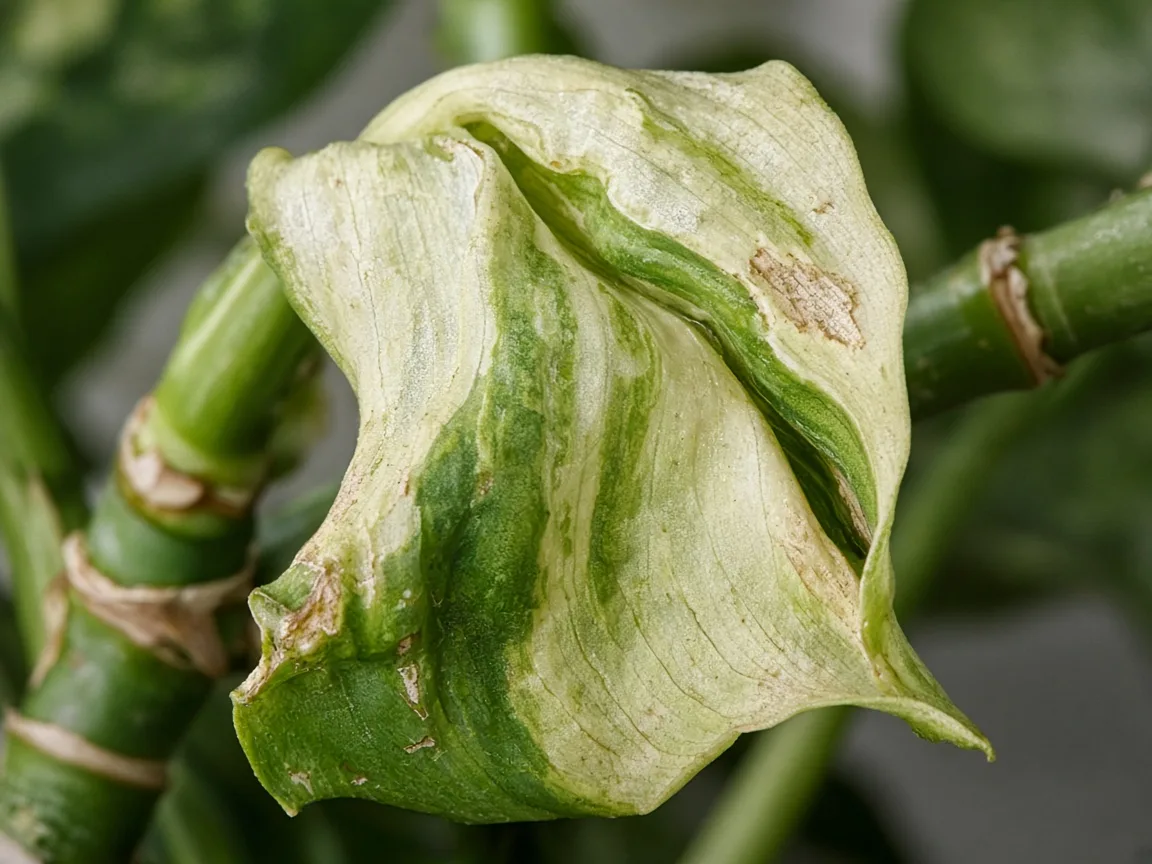
Twisted, undersized leaf at a dumb cane crown with silvery thrips scarring—compare with the flatter mature blade below on the same stem.
Thrips scarring — Silvery or bronze streaks along the leaf surface, tiny black varnish-like frass specks, and small twisted or rippled leaves still unfurling at the cane tip. UC IPM notes thrips feeding scars and distorts plant parts; damage often shows before you spot the insects. See thrips on Dieffenbachia.
Aphid distortion — Clustered soft-bodied insects on new crown growth, sticky honeydew, and cupped or curled young blades at the tip. Aphids pierce sap from tender tissue and can stunt blade expansion on fast spring flushes.
Mealybug or scale stunting — White cottony clumps or hard tan bumps along the stem and in leaf axils, sticky residue, and undersized or twisted new blades while older arching leaves look normal. UF/IFAS lists cottony masses on stems and leaf undersides as classic mealybug signs on dumb cane.
Stop-start watering crinkle — Leaves look creased or puckered without silver streaks or insects, often after the pot dried completely and was flooded, or watering paused during an active growth flush. RHS guidance on leaf deformation links crinkled or creased leaves to irregular watering when new tissue develops.
Edema puckering — Raised corky patches on leaf undersides or blistered tissue that later hardens—RHS describes oedema from excessive water uptake in stagnant, humid air. Heavy Dieffenbachia leaves in a crowded cachepot are prone when mix stays wet and airflow is poor.
Low-light narrowing — New blades emerge thin, undersized, and slightly wavy compared with prior growth—not always true distortion, but easy to confuse with pest scarring. See not enough light.
Draft or cold warp — Crispy distorted margins on blades facing a cold window; UF/IFAS notes temperatures below about 55°F (13°C) can cause drooping and leaf loss.
Cane-tip unfurl scarring on broad variegated blades (Dieffenbachia only)
Dieffenbachia pushes each new leaf from a tight cylinder at the cane apex—not from nodes along the stem like a rubber plant. The blade is softest while still rolled; thrips, mealybugs, or a dry crown while the leaf opens can scar the variegation map so white sectors pucker more visibly than green tissue. If only the topmost roll looks twisted but firm lower leaves are flat, the problem is almost always at the current unfurl, not chronic root failure—unless lower leaves are also yellowing on wet mix (overwatering).
Deep axil shelters vs a quick leaf scan (Dieffenbachia only)
Broad 8–14 inch leaves create deep petiole joints where the stalk meets the cane. Mealybugs and scale hide there while the upper leaf face looks clean—unlike narrow Dracaena straps where pests show along the crown cylinder. Distortion at the tip plus cotton or bumps in axils means lift every blade during inspection, not only the newest visible surface.
Soap sensitivity when treating pest-driven distortion (Dieffenbachia only)
Once you confirm live insects, many guides reach for insecticidal soap—but UConn IPM lists Dieffenbachia among houseplants that can spot or scorch from soap sprays, especially on variegated tissue under heat or drought stress. Prefer isolation, shake tests, alcohol swabs on colonies, and repeated lukewarm rinses before broad soap on the whole crown—details align with our aphids and mealybugs pages.
Why Dieffenbachia gets distorted leaves
Sap feeders target crown and axil tissue first. NC State lists aphids, scale, spider mites, and whiteflies to monitor on Dieffenbachia. Thrips scar leaves while they expand inside the crown roll, leaving permanent ripple on broad blades.
Fast spring flushes lock scars in place. Dumb cane can push large leaves quickly in warm, bright rooms. One thrips cohort at the cane tip can scar several unfurling blades before lower arching leaves show symptoms.
Irregular watering during active growth crinkles new leaves. Dieffenbachia prefers the top inch of mix to dry between drinks, but letting the whole pot go dust-dry and then soaking—or watering on a rigid calendar while growth speeds up—produces stop-start leaf development that looks like distortion rather than simple curling.
Edema and wet mix in humid corners. Tropical humidity helps Dieffenbachia, but soggy mix plus poor airflow can trigger oedema that puckers undersides while the crown still pushes new tissue.
Root stress from chronic wet mix — When roots cannot absorb water properly, new growth may emerge small and warped while lower leaves yellow. See overwatering and root rot if the cane softens or soil smells sour.
How to confirm the cause
Work through these checks in order:
- New vs old — Distortion only on the last one or two crown leaves → pests, unfurl stress, or recent care change. Warped leaves scattered on mature arching sections → past event or mechanical creasing.
- Shake test — Hold white paper under a suspect crown leaf and tap the blade. UC IPM recommends shaking foliage to dislodge thrips before treating.
- Surface scan — Silvery streaks and black frass → thrips. Sticky honeydew and clustered insects → aphids or mealybugs. Hard bumps on stems → scale insects. No pest signs → watering, edema, or environment.
- Axil check — Lift petiole bases along the cane; white cotton or waxy bumps explain twisted tips even when the upper blade face looks fine.
- Watering history — Dry-then-flood within the last two weeks while a new leaf was opening → crease without insects.
- Pot weight and smell — Heavy, wet mix with sour odor → root stress; distortion may be secondary to root rot.
First fix for Dieffenbachia
Isolate the plant and complete the cane-tip shake test over white paper. If thrips dislodge, treat pests before adjusting fertilizer or repotting—see thrips for dumb cane–safe steps. If the paper stays clean but the newest blade is creased after a dry spell, run one deep soak, then return to watering when the top inch dries—do not stack repot, prune, and pesticide the same day.
Wear gloves when handling cut or sap-exposed tissue; dumb cane sap contains calcium oxalate crystals that irritate skin.
Recovery timeline
Judge progress by flat new blades at the cane tip and firm stem tissue—not by older puckered leaves flattening. Mild pest cases often show clean unfurls within three to five weeks after treatment. Watering-related creases improve on the next leaf after two to three stable wet-dry cycles. Edema scars remain visible on affected blades but should not spread to new growth once airflow and watering improve.
What not to do
- Do not spray insecticidal soap on the whole plant without a spot test on one small variegated section—Dieffenbachia can react badly.
- Do not repot solely for distortion when roots are firm and pests are absent.
- Do not fertilize heavily to “push out” warped leaves; excess feed can worsen curl with brown edges on dumb cane.
- Do not prune every distorted leaf at once; each cut exposes sap—remove only heavily infested or shredded tissue.
How to prevent distorted leaves
Match light and soil to steady moderate growth, quarantine new purchases, keep temperatures above about 55°F (13°C), and maintain airflow around crowded leaves. Weekly cane-tip and axil checks during spring growth catch thrips before several broad leaves scar.
When to escalate
Escalate when:
- Fresh distortion appears on multiple Dieffenbachia within a week
- New leaves stall inside the roll or tear as they open
- Cane softens at the soil line with sour-smelling mix
- Thrips or mealybugs show on several dumb canes from one nursery batch
A single slightly crinkled lower leaf that has not changed in a month, with firm cane and clean new tips, is usually past stress—not an emergency.
Conclusion
Distorted leaves on Dieffenbachia mean something interrupted normal broad-blade development—usually sap feeders at the cane roll and axils, uneven watering during a flush, or edema on heavy leaves in wet, stagnant air. Read the newest unfurling leaf at the cane tip, shake-test for thrips, and trace watering before you repot or feed. Dumb cane recovers steadily once the cause stops; focus on flat new blades at the growing point.
Related Dieffenbachia guides
- Dieffenbachia overview — placement, cane habit, and toxicity
- Dieffenbachia watering — top-inch dry-down checks
- Dieffenbachia light — medium to bright indirect light
- Dieffenbachia soil — drainage that keeps roots healthy
- Thrips on Dieffenbachia — silvery scarring at crown tips
- Mealybugs on Dieffenbachia — cotton in axils
- Curling leaves — roll without permanent twist
- Dieffenbachia problems hub — all common issues on this species
Related tool
Use the Plant Problem Diagnosis Tool to narrow causes for distorted leaves on this plant before changing multiple variables at once.