Nitrogen Deficiency on Dieffenbachia: Causes, Checks & Fixes
Quick answer
Nitrogen deficiency on Dieffenbachia shows as uniform pale yellow-green on the oldest lower leaves along the upright cane, with smaller new blades at the growing tip and slower vertical push. First step: confirm even chlorosis on the lowest mature leaves—not green veins on yellow tissue or new-tip banding—then check whether the plant has gone months without complete fertilizer in leached perlite mix while roots stay firm.
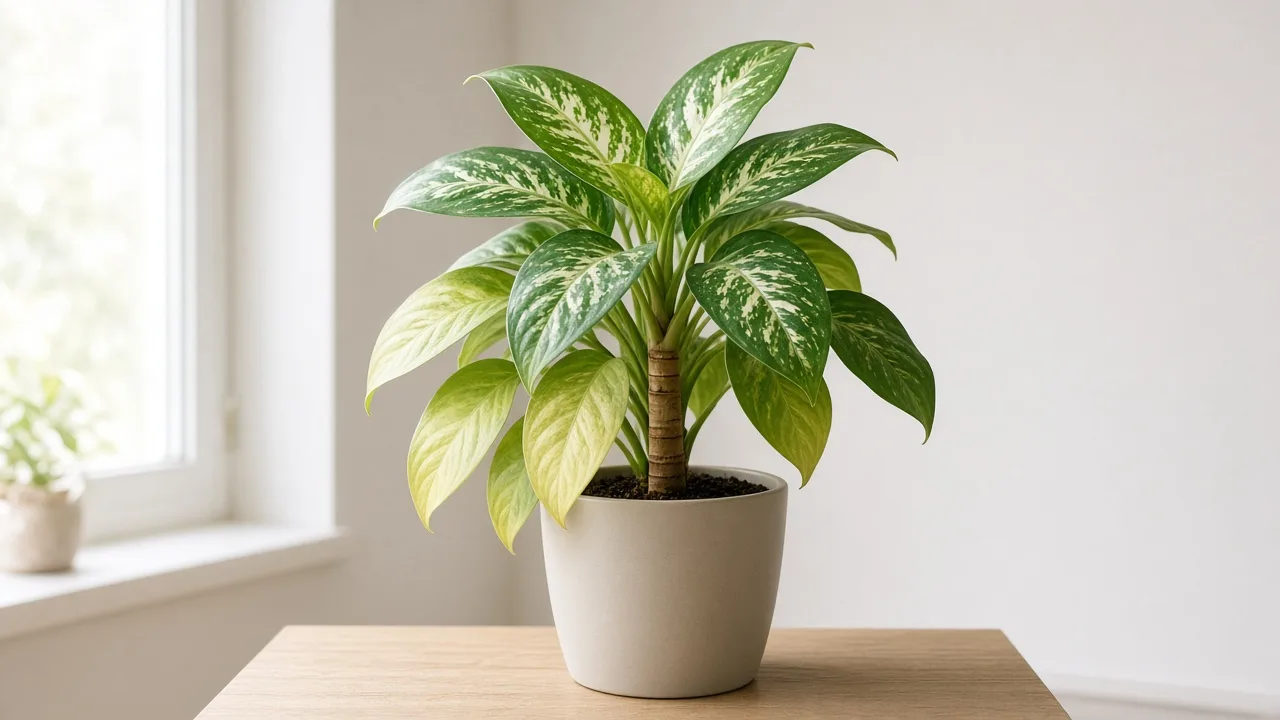
Nitrogen Deficiency on Dieffenbachia: Causes, Checks & Fixes
This guide covers nitrogen deficiency on Dieffenbachia. See also the general Nitrogen Deficiency guide, watering, and light pages for this plant.
Nitrogen Deficiency on Dieffenbachia: Causes, Checks & Fixes
Quick answer
Nitrogen deficiency on Dieffenbachia (Dieffenbachia spp., dumb cane) shows as uniform pale yellow-green on the oldest lower leaves along the upright cane, with smaller new blades and slower vertical growth at the tip. Nitrogen is mobile in the plant, so deficiency symptoms show up first on the lower leaves as a general yellowing—veins and tissue fade together, unlike magnesium deficiency (interveinal banding on old leaves) or iron deficiency (green veins on new tips).
See our nitrogen deficiency guide for general mobile-nutrient mechanics. On dumb cane, inspect the broad patterned blades closest to the soil line on the cane—even washout there, with the tip still pushing smaller leaves, is classic nitrogen starvation before wet-root failure or low-light pale leaves.
First step: confirm uniform pale color on the oldest lower leaves—not interveinal chlorosis or new-tip green veins—then check cane firmness, root health, and months without complete fertilizer in leached mix.
When to use this page vs other Dieffenbachia guides
| Pattern | Read next |
|---|---|
| Uniform pale oldest lower leaves, smaller new blades at cane tip | Nitrogen deficiency (this page) |
| Yellow between veins on oldest lower leaves | Magnesium deficiency |
| Yellow new leaves with green veins at cane tip | Iron deficiency |
| Washed-out green with long bare cane sections, no lower-leaf wave | Pale leaves or not enough light |
| Multiple soft yellow leaves on wet heavy pot | Overwatering |
| One bottom leaf only while tip pushes large green blade | Normal aging—yellow leaves |
| Slow vertical push without clear color shift | Slow growth |
What nitrogen deficiency looks like on Dieffenbachia
Healthy dumb cane holds large, patterned leaves at a slight upward angle from thick petioles along a firm upright cane. Nitrogen stress breaks that pattern on mature foliage lower on the stem, not with vein-retained banding.
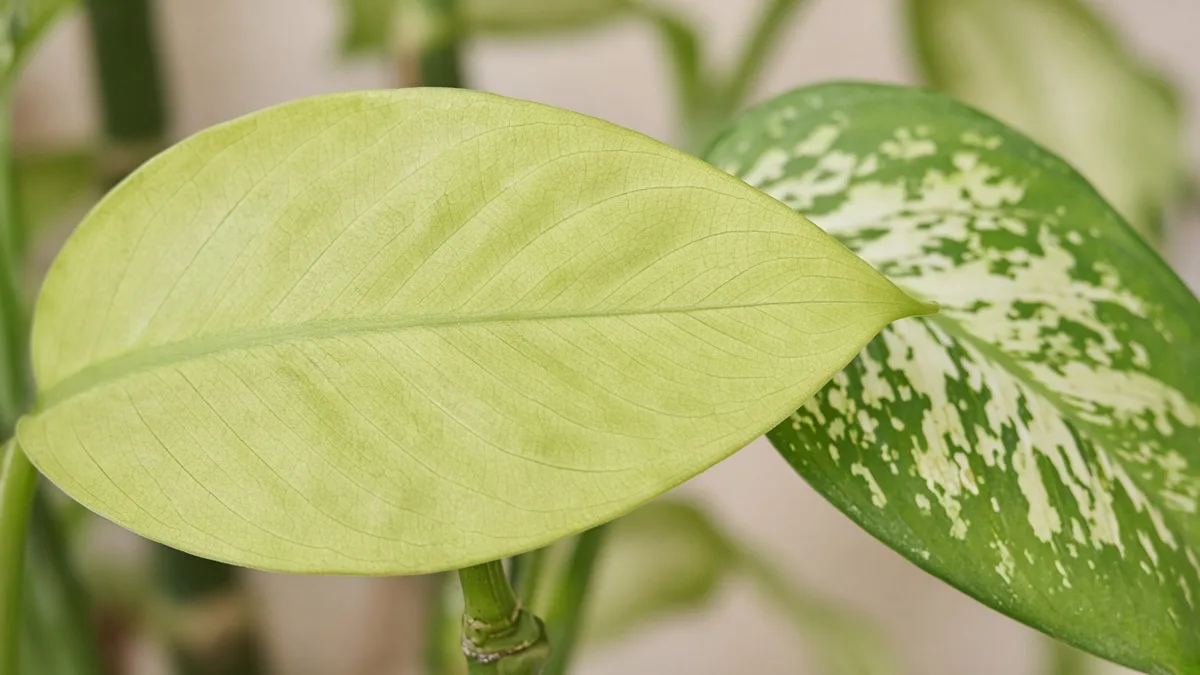
Uniform pale yellow-green on an older Dieffenbachia leaf along the cane—veins and tissue lighten together, unlike magnesium or iron chlorosis.
Typical signs:
- Uniform pale yellow-green on the oldest lower leaves—veins and tissue lose color together
- Progressive climb up the cane over weeks as the plant strips nitrogen from old tissue to fund new growth at the tip
- Smaller new blades at the growing tip and shorter petioles than earlier in the season
- Thin, papery feel on fully chlorotic lower leaves before they drop and expose more bare cane
- Firm cane unlike mushy overwatered Dieffenbachia on soggy mix
Not nitrogen deficiency:
- Yellow tissue between dark green veins on oldest lower leaves—magnesium deficiency (magnesium deficiency initially develops on lower or older foliage with interveinal chlorosis)
- Yellow new leaves with dark green veins at the unfurling tip—iron deficiency
- One bottom leaf yellow while a large green blade unfurls above—often normal senescence on a maturing cane; see yellow leaves
- All leaves yellow at once on persistently wet soil—overwatering or root rot
- Uniform washed-out green across the whole plant with long bare cane—not enough light before assuming starvation
UC IPM notes slow growth and uniform yellowing of older leaves as the first symptoms of nitrogen deficiency. On upright dumb cane, that older-leaf washout is easiest to read on the broad blades nearest the pot rim, not on the variegated tip leaf still expanding.
Why Dieffenbachia gets nitrogen deficiency
Dieffenbachia is a moderate-to-fast upright foliage plant in the Araceae family that pushes large leaves from a thick succulent cane. Nitrogen is a core component of chlorophyll, amino acids, and proteins—when soil reserves run low, the plant dismantles chlorophyll in older tissue and redirects nitrogen to new blades at the cane tip.
UConn guidance notes Dieffenbachias are considered heavy feeders during the active growing season when light and moisture support steady leaf production. Skipping feed while the cane keeps adding height is a common indoor setup for depletion.
Dieffenbachia-specific causes:
- Never fed or skipped winter without spring restart—Owners treat dumb cane as low-maintenance and skip fertilizer for a year while the cane adds leaves in a bright office.
- Leached perlite-heavy mix—Each deep watering through light well-draining Dieffenbachia soil flushes soluble nitrogen through drainage holes faster than owners replace it.
- Years in the same pot—A tall top-heavy cane stays in depleted peat-perlite while roots fill the container and lower leaves naturally drop, masking how many blades are actually starving.
- Blocked uptake from wet roots—Chronic saturation in a cachepot prevents absorption even when nitrogen is present; see overwatering before feeding a waterlogged plant.
- Variegated cultivars in strong light—Heavily white sectors on ‘Camille’ or ‘Tropic Snow’ types still need nitrogen for new tissue; pale lower leaves on firm cane with good light often mean depleted mix, not just variegation washout.
Do not diagnose nitrogen deficiency on sour wet soil with soft stems at the base—that is root failure until you confirm mostly white firm roots.
Uniform washout on the lowest leaves along the bare cane
Nitrogen deficiency on dumb cane shows on the oldest broad leaves closest to the soil line—a pattern that would be nonsense on a snake plant rosette or a fern crown. The large alternate blades make even, vein-free pale yellow highly visible: the whole surface lightens together, sometimes from the tip or margin inward, without the dark green vein rails of magnesium or iron chlorosis.
That lower-canopy locus distinguishes nitrogen from iron, which appears on the leaf still unfurling at the cane tip. It also differs from magnesium, which keeps veins relatively green while tissue between them yellows on older blades.
Because Dieffenbachia naturally sheds lower leaves as the cane elongates, check leaves still attached at the bottom of the green section. One uniformly pale lower blade—firm cane, normal watering rhythm per the Dieffenbachia watering guide—is enough to anchor your diagnosis before changing fertilizer, mix, or pot size.
Cane-tip leaf size when nitrogen runs low
Dieffenbachia invests the most new tissue at the growing tip of the upright cane. When nitrogen reserves drop, the plant keeps unfurling leaves but each new blade emerges smaller and the vertical push may slow compared with earlier-season growth.
Watch the second or third leaf down from the tip: in mild nitrogen stress, those may still look reasonably green while the lowest two mature leaves wash out uniformly. In moderate stress, even recent blades look lime and undersized while lower leaves drop and expose more naked cane. That size gradient along the stem—large old blades gone pale at the base, progressively smaller green-yellow blades toward the tip—is a dumb-cane starvation fingerprint you would not use on a trailing pothos vine.
If every new tip leaf shows green veins on yellow tissue, switch to the iron deficiency page instead.
Perlite mix, deep watering, and depleted nitrogen
The diagnostic trap on tall Dieffenbachia is a plant watered on schedule while nitrogen silently leaches out of airy perlite-amended mix.
Leaching in light mix: Each thorough drink flushes nitrate through drainage holes. Months of flushing without complete fertilizer—or with micronutrient-only products—leaves uniform pale lower leaves while the cane still grows.
Top-dry, core-starved: The top inch may dry on schedule while a dense root ball in two-year-old mix starves below. Even washout on lower canopy leaves with firm cane and normal watering rhythm often means depleted nitrogen, not thirst—cross-check with underwatering only if the whole pot is bone dry and leaves wilt.
Salt crust without nitrogen replacement: White rim buildup from hard water or excess feed can injure roots and block uptake, sometimes showing as brown tips before broad chlorosis. RHS notes nitrogen is easily washed out of soil by rain and watering—flush thoughtfully, then replace with measured complete feed rather than stacking more salts.
Lookalike symptoms
| Pattern | Check | Likely cause |
|---|---|---|
| Uniform pale oldest lower leaves | Feed history, mix age | Nitrogen deficiency (this page) |
| Interveinal yellow on oldest lower leaves | Vein pattern | Magnesium deficiency |
| New yellow leaves, green veins at tip | Wet mix, salt crust | Iron deficiency |
| Edge scorch on lower leaves | Feed type | Potassium deficiency |
| All yellow, wet heavy pot | Root smell, stem softness | Overwatering |
| One bottom leaf only | New tip green and large | Normal aging—yellow leaves |
| Washed-out uniform green, long bare cane | Light level | Pale leaves or not enough light |
How to confirm
- Color pattern on lower broad leaves—uniform pale yellow-green including veins, not interveinal banding.
- Magnesium vs nitrogen split—green veins with yellow between them on old leaves point to magnesium; even washout points here.
- Iron vs nitrogen split—new-tip green veins point to iron; oldest-leaf uniform pale points here.
- New leaf size—smaller blades and slower cane push support starvation when lower leaves pale first.
- Fertilizer label and timing—complete balanced feed vs months without any application per the Dieffenbachia fertilizer guide.
- Root check—white firm roots support nitrogen fixes; brown mush needs drainage first.
- Moisture cross-check—wet core in a heavy cachepot rules out simple starvation until roots recover.
- Pest check—mottled patches with webbing on new unfurling tissue rules out spider mites before assuming chlorosis.
First fix for Dieffenbachia
One half-strength dose of complete balanced liquid fertilizer on already-moist mix—only after confirming firm cane, firm roots, and uniform pale color on the oldest lower broad leaves.
Water normally first so roots are hydrated, then apply diluted feed until a small amount drains from the bottom per the Dieffenbachia fertilizer guide—complete fertilizer every four to six weeks during active growth is the baseline for container dumb cane.
Do not feed a waterlogged pot, a plant you repotted within the last month, or a cane with active pest damage on new tips. Fix the limiting stress first, then apply one measured nitrogen correction. Wear gloves when handling leaves or runoff—Dieffenbachia sap irritates skin.
Step-by-step recovery
- Apply one half-strength complete balanced feed on moist mix; avoid nitrogen-only products without micronutrients.
- Flush salts if white crust rings the pot rim—leach before stacking more fertilizer.
- Adjust watering so the top inch dries between drinks per Dieffenbachia watering—uptake fails in chronic wet mix.
- Repeat measured feed once after three to four weeks if lower chlorosis spreads but roots stay firm—do not feed weekly at full strength.
- Repot into fresh perlite-amended mix if roots fill the pot and pale lower leaves persist after two measured treatments—see Dieffenbachia repotting.
- Remove fully yellow lower leaves with gloves only when they pull away easily; do not strip half the canopy at once.
- Monitor the next two blades at the cane tip for larger size and deeper green color.
Mistakes to avoid
- Fertilizer before drainage—Feeding waterlogged roots worsens stress and will not fix chlorosis.
- Confusing iron, magnesium, and nitrogen—Vein patterns and leaf age tell them apart; read the lookalike table before drenches.
- Repot + feed + prune same week—Stack one change at a time on a tall stressed cane.
- Expecting old leaves to re-green—Judge recovery by fresh growth size and color, not by lower blades darkening again.
- Overfeeding after pale leaves appear—Full-strength repeated doses on stressed roots cause salt injury and brown tips; measured half-strength once is the first fix.
- Diagnosing nitrogen on dim, leggy canes—Not enough light washes out the whole plant and lengthens bare stem; fix placement before assuming starvation.
Recovery timeline
Correct nitrogen on healthy roots shows larger, greener new blades within three to five weeks. Older chlorotic leaves rarely return to full deep green; the plant slowly replaces them as the cane grows and lower leaves drop.
Full lower-canopy refresh on a tall specimen may take one growing season. Judge success by deeper green color and normal leaf size on fresh blades at the cane tip, not by old yellow leaves darkening again. If three successive new leaves stay small and pale after two measured treatments with firm roots, reassess light, iron lockout, and overlapping slow growth causes.
Prevention
- Feed lightly with complete balanced fertilizer spring through early fall per the Dieffenbachia fertilizer guide—pause in winter unless strong grow lights keep new leaves coming.
- Flush salts mid-season if you use hard tap water or feed frequently in bright indirect light.
- Refresh depleted perlite mix every one to two years on tall top-heavy plants at repotting.
- Match feed frequency to cane growth—a dumb cane in a sunny window depletes nitrogen faster than a slow specimen in a dim hall.
- Track whether oldest lower leaves wash out uniformly before new tips shrink; early pale lower leaves are easier to correct than a fully stunted cane.
Related Dieffenbachia guides
- Dieffenbachia overview — species baseline and care hub
- Dieffenbachia fertilizer — complete feed timing and dilution
- Dieffenbachia watering — dry-down checks that pair with nutrient uptake
- Dieffenbachia soil — perlite mix that drains fast but needs nitrogen replacement
- Dieffenbachia problems — full symptom index for this species
- Magnesium deficiency — when lower leaves band between veins
- Iron deficiency — when new tips yellow with green veins
- Yellow leaves — moisture-first diagnosis when color shifts broadly
- Potassium deficiency — edge scorch vs uniform lower-leaf washout
Conclusion
Uniform pale yellow-green on the oldest lower Dieffenbachia leaves, with smaller new blades at the cane tip, is a nitrogen signal—confirm the pattern is not interveinal or new-tip chlorosis, rule out wet roots, then apply one measured balanced feed on moist soil.
Related tool
Use the Fertilizer Dilution Calculator to narrow causes for nitrogen deficiency on this plant before changing multiple variables at once.