Iron Deficiency on Dracaena: Causes, Checks & Fixes
Quick answer
Iron deficiency on Dracaena shows as pale or yellow new strap leaves with dark green veins (interveinal chlorosis) at the cane crown while older blades lower on the trunk may stay normal. First step: confirm the pattern is on newest crown growth only, then test whether soil pH, fluoridated tap water, or chronically wet mix is blocking iron uptake before applying chelated iron.
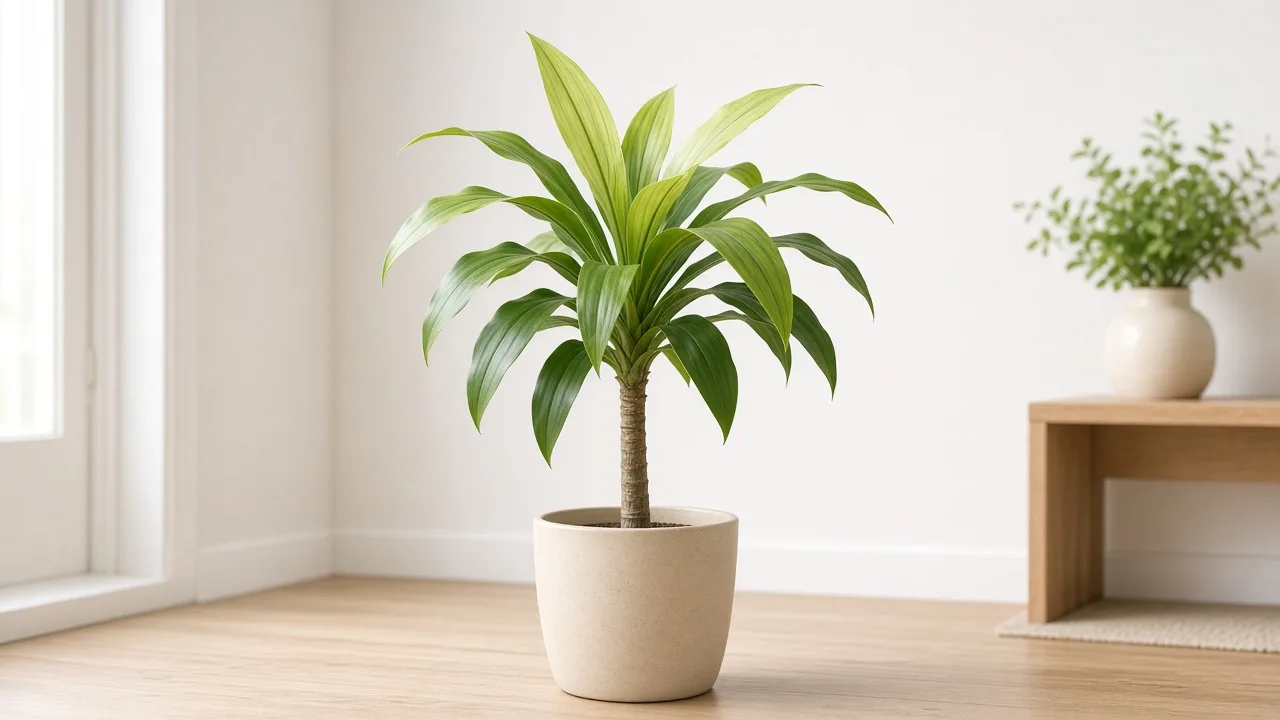
Iron Deficiency on Dracaena: Causes, Checks & Fixes
This guide covers iron deficiency on Dracaena. See also the general Iron Deficiency guide, watering, and light pages for this plant.
Iron Deficiency on Dracaena: Causes, Checks & Fixes
Quick answer
Iron deficiency on Dracaena—corn plant (Dracaena fragrans), dragon tree (Dracaena marginata), Janet Craig, Warneckii, and related cane types—shows as pale or yellow new strap leaves with dark green veins (interveinal chlorosis) at the cane crown, while older strap blades lower on the trunk may stay normal green. Iron is immobile in plants, so chlorosis appears on young expanding tissue first—not on the lowest old leaves the way nitrogen deficiency does.
See our iron deficiency guide for general chlorosis mechanics. On cane Dracaena, inspect the longest strap leaf still unfurling from the crown rosette—veins stay green while tissue between them yellows on the newest blade.
First step: confirm new-growth interveinal chlorosis with green veins, then check soil pH, water source, and whether mix stays too wet or nutrient-depleted before applying chelated iron.
When to use this page vs other Dracaena guides
| Pattern | Read next |
|---|---|
| New crown strap leaves yellow with green veins | Iron deficiency (this page) |
| Lowest strap leaves pale uniformly; crown leaves small | Nitrogen deficiency |
| Interveinal yellowing on older mid-cane straps | Magnesium deficiency |
| Scorched outer margins on older straps | Potassium deficiency |
| Tips brown only; mid-blade stays green | Brown tips from fluoride |
| Washed-out green across many straps in a dim corner | Pale leaves or not enough light |
| Yellow lower cluster, wet soil, soft cane | Overwatering or root rot |
What iron deficiency looks like on Dracaena
Healthy Dracaena pushes long strap-shaped leaves from a woody vertical cane topped by a crown rosette. Iron stress breaks that pattern at the active growing tip of the crown, not across every strap on the trunk at once.
Typical signs:
- Pale or yellow new strap leaves at the cane crown with veins remaining darker green
- Successively paler new crown leaves on the same cane if untreated—noticeable because Dracaena pushes new growth slowly
- Older strap leaves lower on the cane may stay green while only the newest crown blade looks chlorotic
- Smaller or narrower new straps when chlorosis is severe
- Firm cane at the soil line if roots are functional—soft mushy cane on wet mix points to overwatering instead
Not iron deficiency:
- Uniform pale lower strap leaves first — nitrogen deficiency
- Brown tips only without vein pattern — brown tips from fluoride
- Washed-out green across many straps with long internodes — pale leaves or not enough light
- Interveinal yellowing on oldest mid-cane straps — magnesium deficiency
- Fine stipples with webbing on undersides — spider mites before assuming chlorosis
- All straps yellow on persistently wet soil — root rot overlap
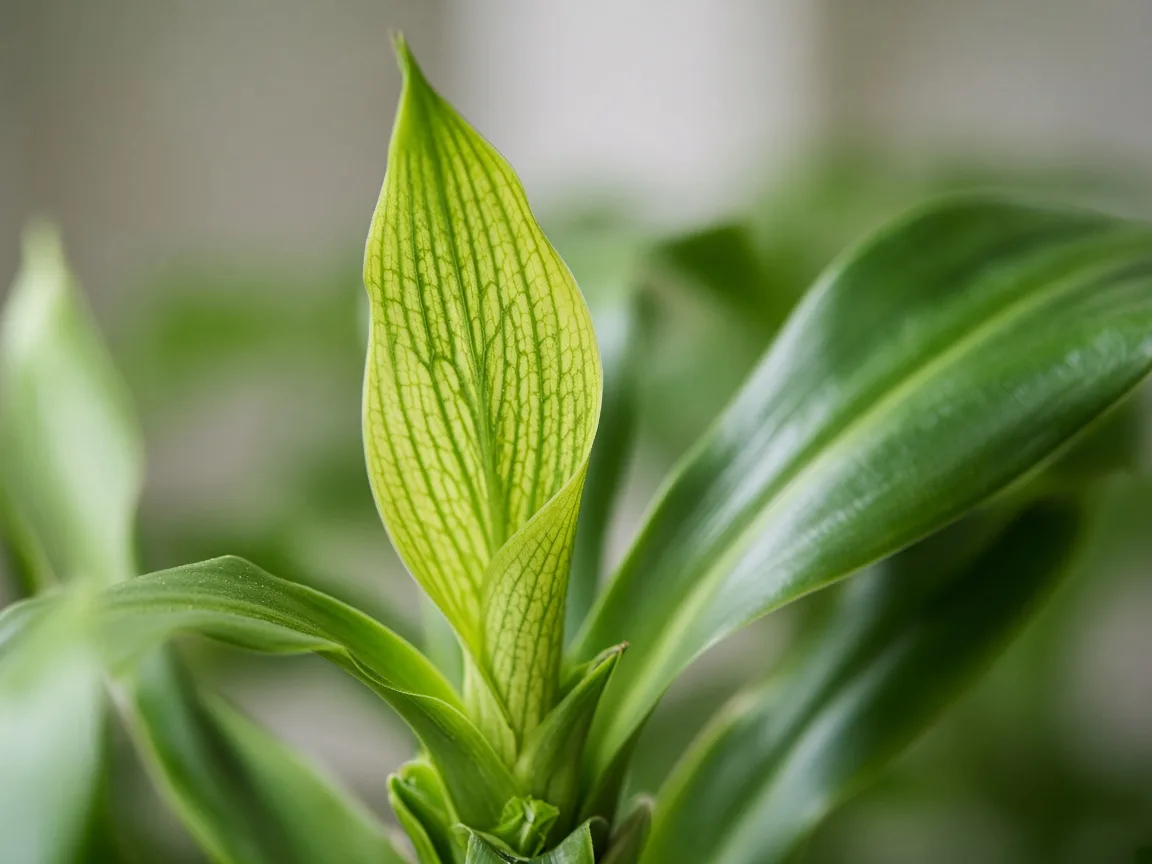
New strap leaf at a Dracaena cane crown: pale yellow tissue between dark green veins while older strap blades lower on the trunk stay normal—classic iron chlorosis on expanding crown foliage.
The classic symptom of iron deficiency is interveinal chlorosis where leaf tissue yellows while veins stay green. RHS notes iron deficiency affects the youngest leaves first, unlike manganese or magnesium problems that tend to start on older foliage. On a slow-growing cane plant, that pattern is easiest to read on the strap leaf still opening at the crown—not on mature lower blades that may simply be aging out.
Why Dracaena gets iron deficiency
Dracaena is a slow-growing tropical cane plant that tolerates lean indoor conditions but still needs iron for chlorophyll in every new strap leaf. Iron chlorosis often results when roots cannot absorb iron even when it is present in fertilizer—high pH, waterlogged mix, salt crust, or depleted potting soil block uptake while the crown keeps trying to unfurl new blades.
Dracaena-specific causes:
- Alkaline or fluoridated tap water — Many municipal sources inject fluorine at about 1 ppm. Repeated tap watering raises pot pH over time and locks iron chemically; high pH makes iron unavailable to plants even when you feed occasionally.
- Depleted mix in the same pot for years — Large corn plants in floor pots often go two or more years without repotting or micronutrient feeding; Dracaena pushes so few new crown leaves that owners miss gradual chlorosis until the second pale strap opens.
- Overwatering in winter — Wet mix reduces root oxygen and micronutrient uptake; symptoms worsen in poorly drained soils. D. fragrans is easily overwatered when growth slows in low light.
- Perlite-heavy potting mix — Dracaena is very sensitive to fluoride; perlite-containing blends can add fluoride while high pH blocks iron—a stacked nutrition problem common on tap-water corn plants.
- Skipped micronutrients — Complete fertilizer with iron was never applied during spring and summer active growth; see the Dracaena fertilizer guide.
- Misread nitrogen deficiency — Old strap leaves yellow first with nitrogen; iron hits the newest crown blade with green veins.
Do not diagnose iron deficiency on sour wet soil with a soft cane at the soil line—that is root failure from chronic saturation until you confirm mostly firm wood-like cane tissue.
Crown strap leaves: chlorosis on the newest unfurling blade
Dracaena shows iron stress on the long strap leaf still opening at the cane crown rosette—a pattern that would be nonsense on a pothos vine heart or snake plant rosette. Veins remain green while the expanding blade between them yellows before the strap fully hardens and arches downward along the trunk.
That crown-only chlorosis distinguishes iron from nitrogen, which starts on the lowest oldest straps spiraling down the cane. It also differs from normal juvenile color: a brand-new Dracaena strap is briefly lighter green for a few days, then deepens. Worry when every new crown strap stays yellow-green with dark veins for weeks after hardening.
Because Dracaena produces new crown leaves slowly—sometimes only one or two per growing season on a mature corn plant—compare two or three consecutive new crown straps on the same cane. One pale opener after repot stress may be transient; two or three in a row with green veins is a strong iron signal.
Fluoride tip burn vs interveinal chlorosis on corn plant
Corn plant owners often water with fluoridated tap and grow in perlite-blended mix—both raise the odds of fluoride tip burn alongside iron chlorosis. Dracaena deremensis and D. fragrans are very sensitive to fluoride toxicity; fluoride concentrates at leaf margins through the transpiration stream while iron starvation shows as veined yellowing across the newest crown strap.
The diagnostic split:
- Fluoride tip burn — narrow tan-to-brown band at the very tip or margin on multiple straps; mid-blade color stays relatively strong; often worse on older outer leaves. See brown tips on Dracaena.
- Iron chlorosis — yellow or pale tissue between green veins on the newest crown strap; tips may look fine while the mid-blade shows interveinal pattern.
Both problems can coexist on the same cane. Fixing water quality alone may stop tip burn without greening a chlorotic crown strap—you may need chelated iron after pH and drainage are corrected. Do not heavy-feed a fluoride-stressed plant; excess salts worsen margin burn per the fertilizer guide.
Cane rosette timing: why Dracaena shows iron stress slowly
Unlike fast-growing pothos, Dracaena stores height on a vertical woody cane and unfurls one long strap at a time from the crown. Iron cannot move from old tissue to fix new growth, so each new crown strap either opens with enough iron or emerges chlorotic—and stays that way once hardened.
That slow crown rhythm means iron deficiency can look mild for months: one pale strap among many green lower blades. By the time a second chlorotic crown leaf opens, roots may have been struggling with alkaline wet mix for a full growing season. Judge severity by successive crown straps, not by how many lower leaves still look fine.
Species watering differences matter for uptake. Pacific Northwest handbooks note D. deremensis types prefer evenly moist soil while D. fragrans should dry out between waterings—chronic saturation on corn plant blocks micronutrients even when iron is in the fertilizer bottle.
How to confirm the cause
Work through these checks in order. Dracaena responds slowly; one change at a time makes it easier to read the next crown strap over four to eight weeks.
- Leaf age pattern — interveinal chlorosis on the newest crown strap only; older straps green? Iron. Lowest straps pale uniformly? See nitrogen deficiency.
- Vein pattern — tissue between veins yellow while veins stay green confirms interveinal chlorosis; tip-only brown without vein pattern points to fluoride.
- Cane firmness — wood-like firm tissue at soil line; soft cane on wet mix means fix overwatering before iron drenches.
- Soil moisture rhythm — appropriate dry-down per the watering guide; chronically wet outer mix blocks uptake.
- Water source — fluoridated tap, softened water, or hard alkaline supply? Switch to filtered, distilled, or rainwater for one month and note crown response.
- Soil pH — PNW recommends keeping calcium levels up with pH 6.5 to 7 for fluoride-sensitive Dracaena; iron availability drops as pH rises above the 6.0–6.5 range Dracaena prefers—see the soil guide.
- Feeding history — months without complete fertilizer during spring and summer; white crust on pot rim suggests salt stress before adding iron.
- Light level — very dim corners slow growth and mask chlorosis; confirm medium to bright indirect light per the light guide.
The first fix to try
Test soil pH and switch to filtered or low-fluoride water for one full month while confirming the cane is firm and soil dries appropriately—not waterlogged.
Iron drenches on stressed, waterlogged roots waste product and can burn foliage. Correct the uptake environment first: appropriate watering, pH-friendly water, and drainage. If interveinal chlorosis persists on the next crown strap after those corrections, apply one chelated iron soil drench at label rate for houseplants—FeEDDHA forms work best in alkaline mix; avoid foliar sprays above 85°F (NMSU Extension).
Use the Fertilizer Dilution Calculator to halve strength if you are unsure of dose. Do not stack repotting, heavy pruning, and iron treatment on the same day.
Step-by-step recovery
- Confirm diagnosis — green-vein chlorosis on newest crown strap; rule out yellow leaves from moisture stress alone.
- Fix water — filtered, distilled, or rainwater; never softened water. Address brown tips and iron as separate tracks if both patterns appear.
- Correct watering — let top 2 inches dry before soaking; reduce winter frequency so mix is not saturated for weeks.
- Flush salts if white crust rings the pot—plain water at three times pot volume, draining fully.
- Apply chelated iron once on firm roots after steps 2–4, during active crown growth in spring or summer.
- Resume light feeding — half-strength balanced liquid with micronutrients per fertilizer guide after one month if new crown straps green up.
- Repot into fresh well-draining mix if chlorosis returns after two iron cycles and roots are compacted in depleted peat.
Recovery timeline
Dracaena grows slowly compared with pothos or philodendron. Expect four to eight weeks for the next crown strap to show greener tissue between veins after corrected water and one iron drench. A full growing season may pass before two consecutive crown leaves look normal.
Signs of improvement: darker green tissue between veins on the newest unfurling strap, normal strap width returning, firm cane, stable dry-down rhythm.
Signs the problem is worsening: each successive crown strap more chlorotic, soft cane on wet soil, widespread yellowing beyond the crown—stop iron and check root rot.
Chlorotic crown straps rarely re-green fully once hardened; judge success by new crown growth, not old strap color.
Mistakes to avoid
- Iron before drainage — chelated iron on waterlogged mix fails and can stress roots; firm cane and appropriate dry-down first.
- Treating every yellow strap as iron — one fading bottom strap on a firm cane is often normal aging; see yellow leaves.
- Confusing fluoride tips with crown chlorosis — tip burn and iron deficiency coexist on tap-water corn plants; fix water quality and feed micronutrients separately.
- Heavy fertilizer instead of iron — nitrogen push on chlorotic crown growth does not fix interveinal pattern and adds salt stress.
- Foliar iron in hot sun — NMSU warns foliar chelated iron can burn foliage above 85°F; soil drenches are safer for indoor Dracaena in summer window heat.
- Expecting old chlorotic straps to re-green — only new crown blades recover; trim only if fully dead and keep cuttings away from pets—Dracaena is toxic to cats and dogs.
Lookalike symptoms
| Pattern | Likely cause |
|---|---|
| New crown straps yellow with green veins | Iron deficiency (this page) |
| Lowest straps pale uniformly; crown leaves small | Nitrogen deficiency |
| Tips brown; mid-blade green | Brown tips |
| Yellow between veins on old mid-cane straps | Magnesium deficiency |
| Scorched outer margins on older straps | Potassium deficiency |
| Soft cane, wet soil | Overwatering |
| Washed-out straps, stretched cane | Not enough light |
Related Dracaena guides
- Dracaena overview — cane growth habit, fluoride sensitivity, and placement basics
- Dracaena problems hub — full symptom index for this genus
- Brown tips — fluoride tip burn vs crown interveinal chlorosis on this page
- Nitrogen deficiency — lower old strap pale first, not crown vein pattern
- Dracaena fertilizer — when and how to feed without salt buildup
- Dracaena watering — dry-down checks that protect iron uptake on slow-growing cane