Leaf Miners on Dracaena: Causes, Checks & Fixes
Quick answer
Leaf miners on Dracaena leave pale winding tunnels inside strap leaves, distinct from surface stippling or edge damage. First step: isolate the plant and prune off mined leaves with clean scissors—contact sprays rarely reach larvae feeding between leaf surfaces.

Leaf Miners on Dracaena: Causes, Checks & Fixes
This guide covers leaf miners on Dracaena. See also the general Leaf Miners guide, watering, and light pages for this plant.
Leaf Miners on Dracaena: Causes, Checks & Fixes
Quick answer
Leaf miners on Dracaena—corn plant (Dracaena fragrans), dragon tree (D. marginata), Janet Craig, and related cane types—are small fly larvae that feed between the upper and lower leaf surfaces, leaving pale winding tunnels visible when you hold a strap leaf to light. Contact sprays rarely reach larvae inside leaf blades—physical removal of mined tissue is the most reliable first fix on houseplants.
First step: isolate the plant and prune off mined leaves with clean scissors. Leaf miners are uncommon on indoor Dracaena compared to outdoor herbs and thin tropicals—confirm a true internal tunnel before treating. For genus-wide care context, see the Dracaena overview.
Why Dracaena gets leaf miners
Leaf miners are not a watering mistake—they are fly larvae whose adult females lay eggs inside leaf tissue. On Dracaena, infestations usually trace to outdoor exposure or nursery hitchhikers, not chronic indoor conditions.
Outdoor summer sessions. Dracaena moved to shaded patios in warm months can pick up leaf miner flies from nearby vegetables, citrus, or ornamental hosts. Inspect every strap leaf when the plant returns indoors.
Nursery stock. Miners occasionally arrive on new purchases, especially if the nursery grows Dracaena near outdoor beds. Quarantine new plants before placing beside established floor specimens.
Thick strap leaves vs. thin hosts. Dracaena’s relatively thick strap foliage is less preferred than chrysanthemum, citrus, or tomato leaves—indoor-only corn plants rarely develop miners unless exposed to outdoor fly populations.
Do not confuse with other damage. Silvery thrips scars sit on the leaf surface. Mite stippling shows as upper-surface dots. Miner tunnels run inside the blade with a visible frass line when backlit—see thrips and spider mites if surface damage dominates.
What leaf miners look like on Dracaena
On Dracaena strap foliage, leaf miner damage has a distinct internal pattern once you backlight the leaf.
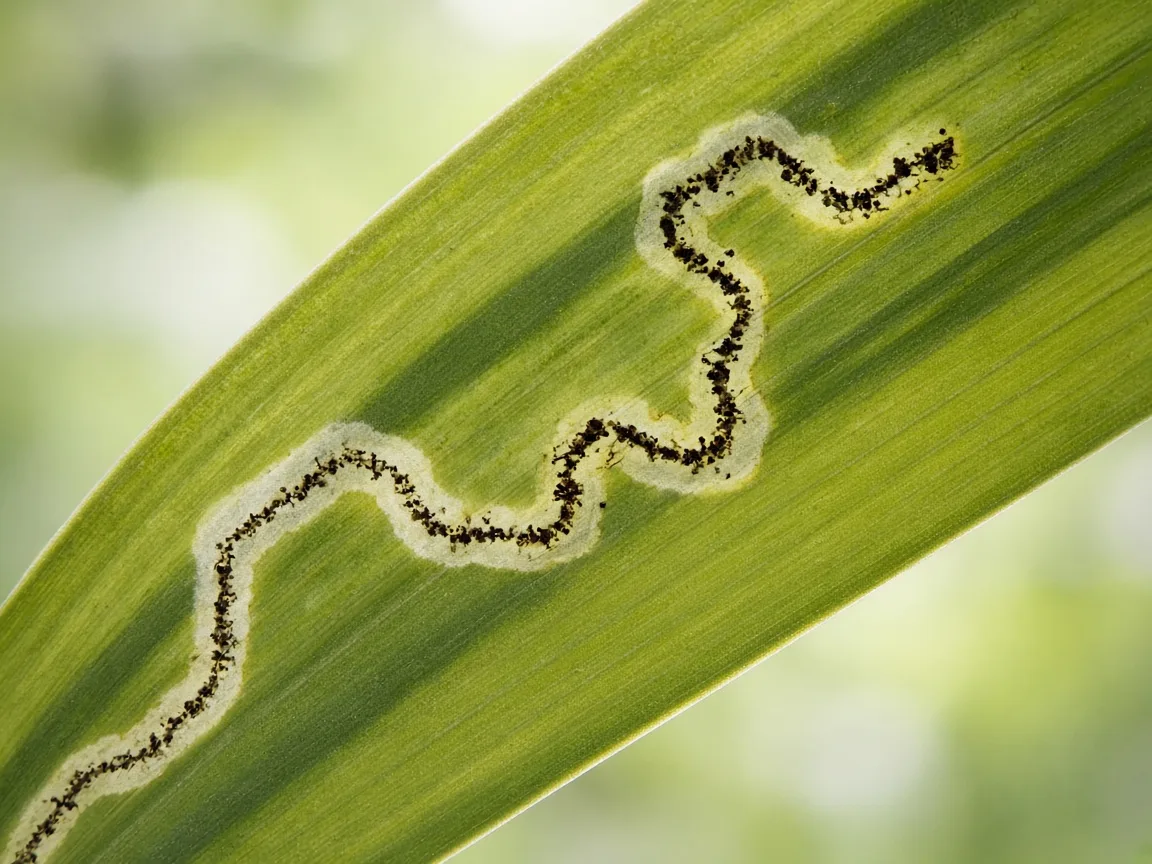
Pale bordered tunnel with dark frass line inside the strap leaf—hold to light to confirm internal mining, not surface scarring.
Classic leaf miner signature:
- Pale winding or blotch-shaped tunnel inside the strap leaf, visible when held to bright window light
- Dark frass line (larva waste) visible inside the tunnel
- Bordered trail that widens as the larva grows—early trails are narrow hairline paths
- Single leaf affected in early stages—multiple tunnels on one blade mean active feeding
- No surface scraping—unlike thrips silvery marks or mite stippling on the epidermis
On dragon tree (D. marginata): narrow blades show thin winding trails easier to miss without backlighting. On corn plant types: wide straps display longer serpentine tunnels visible from across the room when severe.
What leaf miner damage is not: silvery surface streaks (thrips); fine yellow stippling (spider mites); clean mechanical tears at margins; brown tip necrosis from fluoride (brown tips).
Lookalikes to rule out on Dracaena
| Pattern | Likely cause | First direction |
|---|---|---|
| Internal tunnel + frass line when backlit | Leaf miners | Isolate, prune mined leaves, monitor |
| Silvery surface streaks + black frass on epidermis | Thrips | Thrips guide |
| Fine stippling + webbing on surface | Spider mites | Spider mites guide |
| Clean torn edge, no internal trail | Mechanical damage | No pest treatment needed |
| Crispy tips only; no tunnel | Fluoride toxicity | Brown tips guide |
Old scars vs. active miners: A healed tan scar inside a strap leaf may look like a miner tunnel but has no active frass line and does not widen over weeks. Mark the leaf and recheck in seven days—active tunnels grow longer.
How to confirm the cause
- Backlight test. Hold the suspect strap leaf between your eyes and a bright window—a bordered pale tunnel with a dark line inside confirms mining.
- Check for surface damage. If silvery marks sit on the epidermis with no internal trail, suspect thrips instead.
- Track progression. Photograph the tunnel and recheck in five to seven days—active miners extend the trail; static scars do not.
- Review plant history. Outdoor time, open windows near vegetable gardens, or recent nursery purchase increases miner likelihood on indoor Dracaena.
- Inspect neighboring plants. Miners on outdoor-exposed pothos or herbs nearby suggest fly activity in the room.
- Rule out wet soil. Yellow lower leaves with wet mix and soft cane point to overwatering, not miners.
Confirmed active miners require pruning mined leaves. A single static scar on an indoor-only plant needs monitoring, not systemic pesticide.
First fix for Dracaena
Isolate the plant first—move it away from other houseplants, especially thin-leaved species miners prefer.
Prune mined leaves. Cut off every strap leaf showing an active, widening tunnel at the base where it meets the cane, using clean scissors wiped with 70% isopropyl alcohol between cuts. Contact sprays rarely reach larvae between leaf surfaces—removing mined tissue eliminates larvae before they pupate and emerge as adult flies.
Bag and discard pruned leaves. Do not compost mined foliage indoors—adult flies can emerge from pupae inside discarded blades.
Monitor new crown growth weekly. Fresh tunnels on new unfurling leaves mean active flies still present—repeat pruning and consider whether the plant recently returned from outdoors.
Systemic options only if pruning fails. For severe recurring miners on multiple cane sections after outdoor exposure, a systemic insecticide labeled for leaf miners on ornamentals is a last resort—follow label directions and keep treated plants away from pets. Dracaena is toxic to cats and dogs.
Step-by-step recovery
- Isolate before handling other plants.
- Backlight every strap leaf on all cane sections—mark active tunnels with tape on the petiole.
- Prune mined leaves at the base; sterilize scissors between cuts.
- Bag and discard pruned tissue in outdoor trash, not indoor compost.
- Monitor crown rosettes weekly for two to four weeks—new tunnels mean repeat pruning.
- Inspect neighboring pots if the Dracaena spent time outdoors or near vegetable gardens.
- Four clean weeks—no new tunnels on new growth—before declaring control.
Recovery timeline
Mined strap tissue does not heal. Success means no new tunnels on emerging crown leaves.
- After pruning: Active larvae in removed leaves are eliminated immediately—adult fly emergence stops for that generation.
- New crown leaves: Dracaena grows slowly—a clean replacement leaf may take four to twelve weeks depending on light and season.
- If tunnels reappear on new growth: Adult flies are still active—repeat pruning and review whether the plant needs to stay isolated longer or whether outdoor exposure introduced a persistent fly population.
If four consecutive weeks pass with no new tunnels on crown leaves, consider the infestation controlled.
What not to do
- Do not spray contact insecticide alone expecting it to reach larvae inside thick strap leaves—it rarely works on miners.
- Do not ignore a widening tunnel hoping it heals—larvae continue feeding until pupation, then adult flies lay new eggs.
- Do not compost mined leaves indoors—flies emerge from pupae inside blades.
- Do not confuse thrips scars with miners—thrips damage sits on the surface; miners tunnel inside.
- Do not overwater in response—miners are unrelated to soil moisture.
How to prevent leaf miners on Dracaena
- Inspect strap leaves after outdoor shade sessions—backlight before returning the plant to indoor displays.
- Quarantine new purchases for two to three weeks and check for tunnels on new crown growth.
- Keep Dracaena away from indoor vegetable gardens or citrus near open windows when leaf miner flies are active in summer.
- Prune mined leaves promptly before larvae pupate and emerge as adult flies.
- Avoid placing outdoor-miner-infested herbs beside indoor Dracaena on the same shelf.
When to worry
Treat as urgent when fresh tunnels appear on multiple new crown leaves within two weeks, miners spread to neighboring plants after shared outdoor time, or new growth fails to open because mining damage destroyed the blade before unfurling.
Lower urgency: a single static tunnel on one lower strap leaf on an indoor-only corn plant that has not been outdoors—prune the leaf, monitor four weeks, and skip systemic pesticide unless new tunnels appear.
Cultivar notes
Dragon tree (Dracaena marginata) has narrow blades where thin miner trails are easy to miss—backlight every new crown leaf after outdoor sessions. Corn plant (Dracaena fragrans) wide straps show longer serpentine tunnels when infestations occur—check lower arching leaves where flies may have laid eggs first.
Related Dracaena problems
- Dracaena overview — species differences and placement basics
- Thrips — surface silvery scarring lookalike
- Spider mites — surface stippling lookalike
- Holes in leaves — mechanical tears without internal tunnels
- Distorted leaves — crown distortion without mining
- Dracaena problems hub — full symptom index
Conclusion
Leaf miners on Dracaena are uncommon indoors but manageable when you backlight to confirm internal tunnels, prune mined strap leaves promptly, and monitor crown growth for four clean weeks. Contact sprays miss larvae inside thick blades—physical removal beats repeated foliar spraying on this slow-growing genus. Inspect plants after outdoor time and cross-check surface lookalikes before treating the wrong problem.
When to use this page vs other Dracaena guides
- Thrips on Dracaena — Use when silvery surface scarring dominates, not internal tunnels.
- Holes in leaves on Dracaena — Use for clean edge tears without frass lines inside the blade.
- Dracaena problems hub — Browse all common issues on this species.