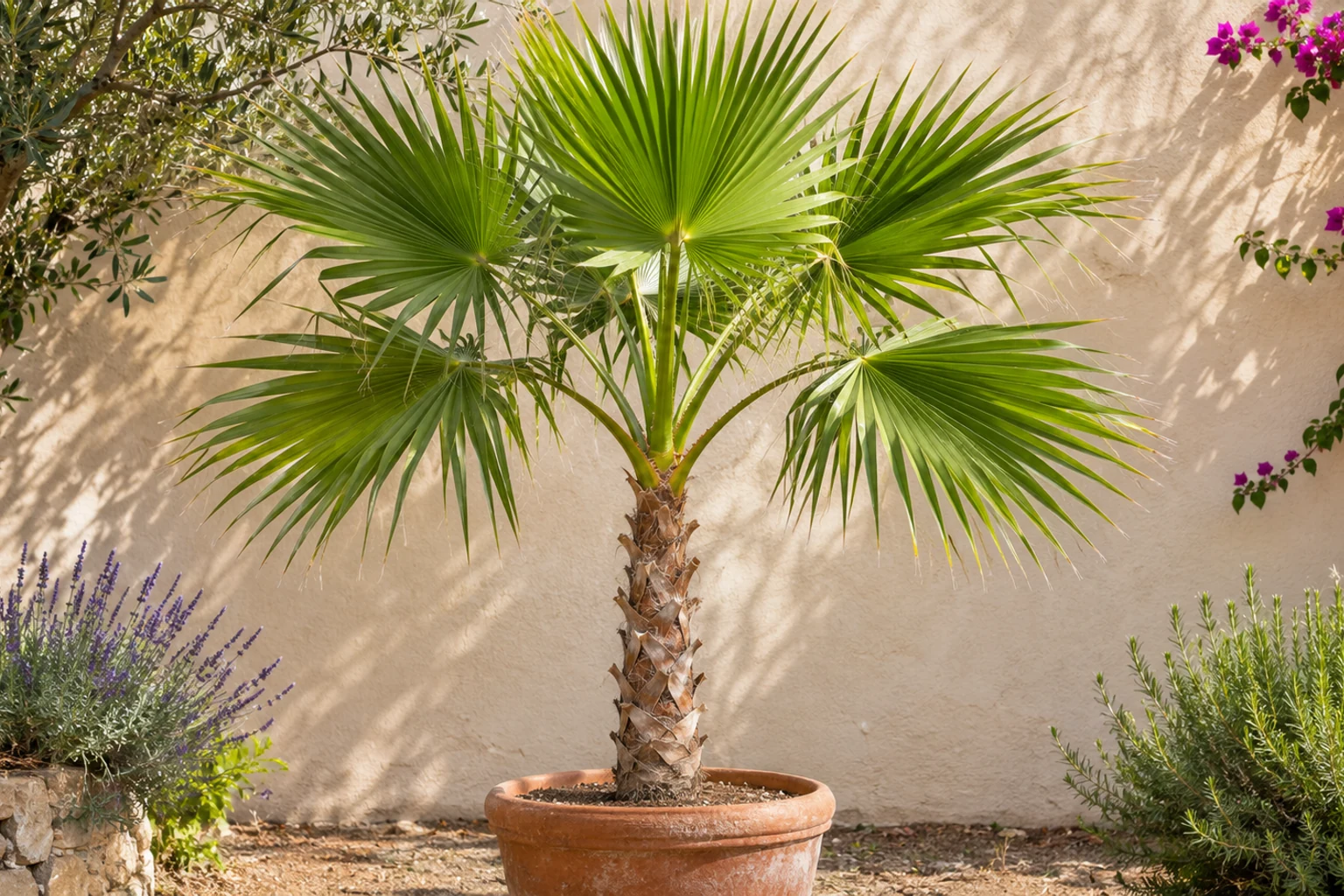
This guide uses the name for Washingtonia, especially California fan palm (W. filifera) and Mexican fan palm (W. robusta). Chinese fan palm and other Livistona palms belong to different groups, so check the botanical label before applying care details.
Does a Washingtonia fan palm need full sun?
Full sun is preferred outdoors; W. robusta can tolerate partial sun. A young indoor container palm needs the brightest natural light available and is likely to grow more slowly indoors.
Is a fan palm drought tolerant?
Established Washingtonia palms tolerate dry periods, but newly planted trees need deep water while they establish. Occasional irrigation during prolonged drought can support growth, and the soil must still drain freely.
How cold hardy is a Washingtonia fan palm?
Tolerance varies by species and exposure. NC State Extension notes that leaf damage to W. robusta can occur around 20°F (-6.7°C); a brief dip is not a guarantee of survival or damage-free foliage.
Can I keep a fan palm indoors?
A young specimen can grow in a bright, well-drained container for a time, but Washingtonia becomes a very tall landscape palm. Most homes cannot provide the light, height, and long-term root space it needs.
Are Washingtonia fan palms safe for pets?
A species-specific veterinary toxicity classification was not verified in the sources reviewed. Keep pets from chewing it, prevent contact with sharp leaf stalks and debris, and contact a veterinarian if any part is eaten.
How often should I water Fan Palm?
Water newly planted palms deeply while they establish. Established Washingtonia palms tolerate dry spells, but occasional deep irrigation during prolonged drought supports growth. For a container plant, water thoroughly when the top inch (2–3 cm) of mix has dried, then let the pot drain fully. Never keep the roots in standing water. In practice, water check container mix about weekly during warm active growth and water when its surface layer is dry. In the landscape, adjust irrigation to rainfall and establishment; mature trees need supplemental water mainly during extended dry periods. Feel the top inch (2–3 cm) of container mix; outdoors, check moisture around the root ball as well as the surrounding soil. Reduce container watering in cool weather as growth and evaporation slow. Newly planted outdoor palms still need monitoring through their first warm growing season, especially in dry weather.
Written by Sai AnanthLead content writer at LeafyPixels. B.Pharmacy graduate from Andhra University with a background in pharmacognosy, turned indoor gardening writer after a long-time plant hobby became a research-led resource for home growers.View Sai Ananth's profile · Reviewed by LeafyPixels Review Board
This Fan Palm problems problem guide was researched and written by Sai AnanthLead content writer at LeafyPixels. B.Pharmacy graduate from Andhra University with a background in pharmacognosy, turned indoor gardening writer after a long-time plant hobby became a research-led resource for home growers.View Sai Ananth's profile. Problems symptoms on Fan Palm, lookalike causes, and step-by-step fixes are cross-checked against extension pest, disease, and care references before publication.
We prioritize sources that hold up under scrutiny:
University cooperative extension bulletins and fact sheets (Penn State, Clemson, UMD, NC State, and similar programs)
Botanical garden and horticultural society publications
Peer-reviewed plant science and veterinary toxicology references where pet safety matters (including ASPCA Animal Poison Control)
Established reference works on indoor plant culture
The LeafyPixels editorial team then reviews the draft for clarity, step-by-step usefulness, and fit with real apartment and home conditions-not ideal greenhouse setups. When guidance changes materially, we update the page and note the revision date.
Epic Gardening (n.d.) Editorial profile of W. filifera, including its thick trunk, palmate leaves, sun exposure, drought tolerance, and landscape scale. [Online]. Available at: https://www.epicgardening.com/california-fan-palm/ (Accessed: 1 March 2024).
Fine Gardening (n.d.) Editorial comparison of California fan palm W. filifera and Mexican fan palm W. robusta, native range, size, and growing conditions. [Online]. Available at: https://www.finegardening.com/article/palms-for-southwest-gardens (Accessed: 1 March 2024).
Harvest to Table (n.d.) Editorial confirmation that Washingtonia is commonly called fan palm, genus scope, container limitations, light, and general care. [Online]. Available at: https://harvesttotable.com/how-to-grow-washingtonia-fan-palm/ (Accessed: 1 March 2024).
NC State Extension Plant Toolbox (n.d.) W. robusta taxonomy, sun and water tolerances, cold-related leaf damage, mature size, trunk and frond traits, and maintenance considerations. [Online]. Available at: https://plants.ces.ncsu.edu/plants/washingtonia-robusta/ (Accessed: 1 March 2024).
University of North Florida Botanical Garden (n.d.) Washingtonia species distinction, W. robusta origin and growth habit, full sun, established drought tolerance, drainage, and landscape size. [Online]. Available at: https://www.unf.edu/botanical-garden/plants/washingtonia-robusta.html (Accessed: 1 March 2024).