Leaf Miners on Fiddle Leaf Fig: Causes, Checks & Fixes
Quick answer
Leaf miners on fiddle leaf fig leave pale winding tunnels inside leaves, distinct from surface chew marks or edge damage. First step: isolate the plant and prune off mined leaves with clean scissors—contact sprays rarely reach larvae inside leaf blades.
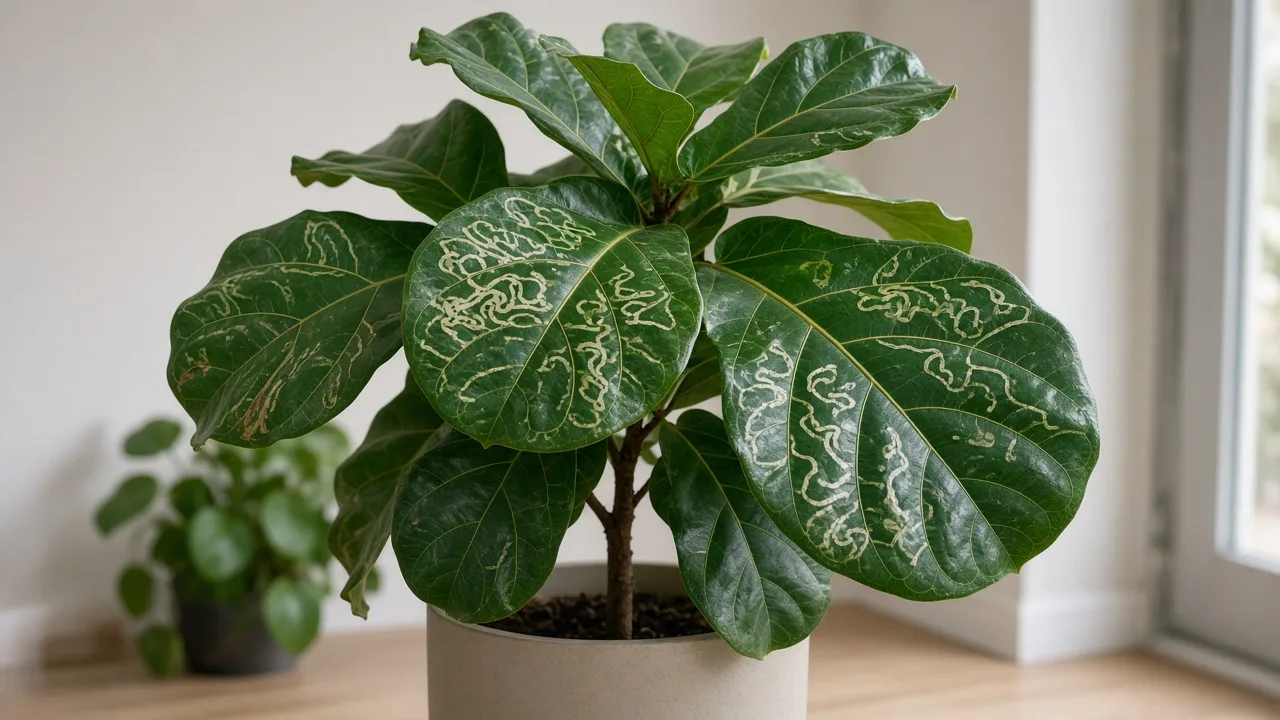
Leaf Miners on Fiddle Leaf Fig: Causes, Checks & Fixes
This guide covers leaf miners on Fiddle Leaf Fig. See also the general Leaf Miners guide, watering, and light pages for this plant.
Leaf Miners on Fiddle Leaf Fig: Causes, Checks & Fixes
Quick answer
Leaf miners on fiddle leaf fig (Ficus lyrata) are tiny fly larvae feeding between leaf surfaces, leaving winding pale tunnels visible when you hold a blade to light. Contact sprays rarely reach larvae protected inside thick violin-shaped tissue.
For general leaf miner biology and life cycle, see our leaf miners guide. On fiddle leaf fig, mines often appear on newest crown leaves and lower canopy blades where backlight inspection is easiest—but overlapping foliage on a six-foot floor tree hides tunnels until damage spreads.
First step: isolate the plant and prune off mined leaves with clean scissors—contact sprays rarely reach larvae inside leaf blades.
When to use this page vs other Fiddle Leaf Fig guides
| Pattern | Read next |
|---|---|
| Pale winding tunnels inside leaf tissue, dark frass line when backlit | This page |
| Ragged holes through leaf blades, pellet frass | Caterpillars |
| Silvery scrape marks on upper surface, black frass | Thrips |
| Fine stippling and webbing on undersides | Spider mites |
| Uniform yellow leaves, wet soil, no tunnels | Overwatering |
| Crispy brown tips only, no internal tunnels | Brown tips |
What leaf miners look like on fiddle leaf fig
Leaf miner damage is easy to miss on a tall floor tree because larvae feed between upper and lower leaf surfaces—the glossy upper side can look fine until you backlight the blade. On Ficus lyrata, the symptom signature is bordered pale serpentine tunnels inside stiff violin-shaped leaves—not ragged through-holes from caterpillars or silvery stippling from thrips.
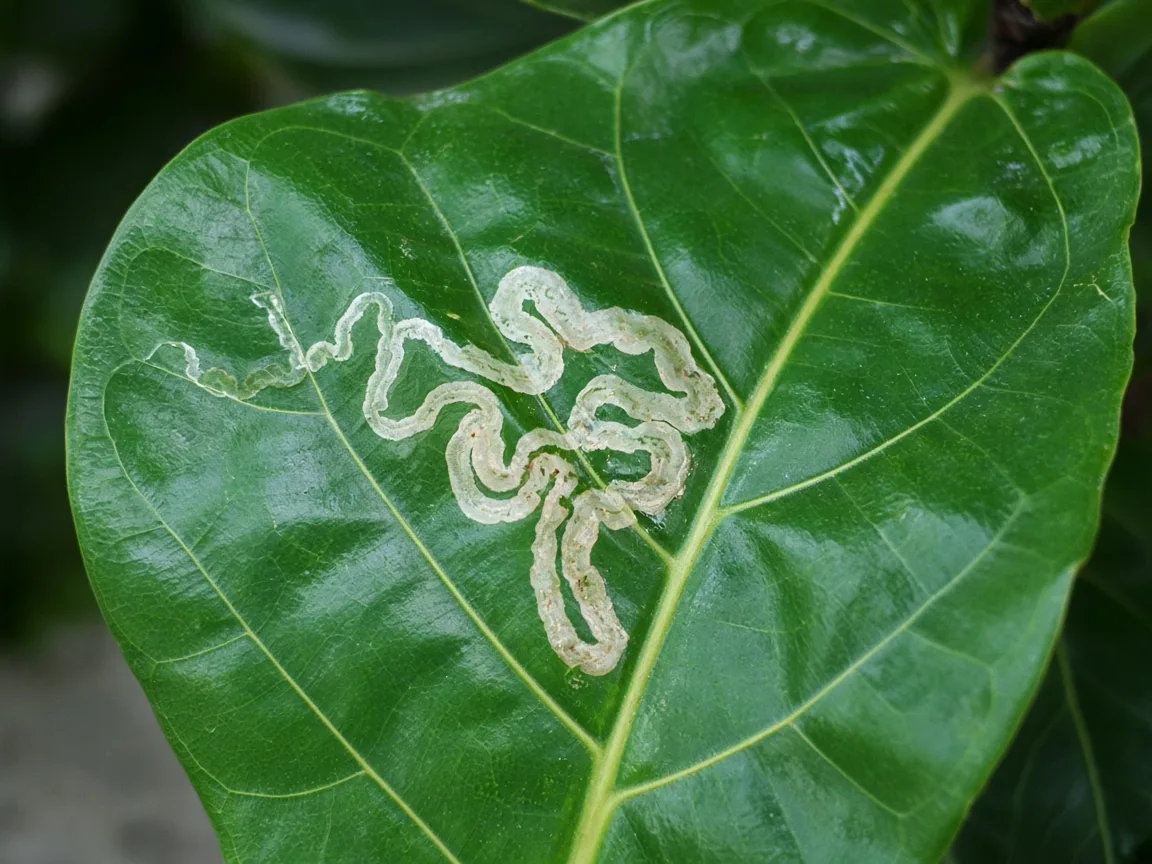
A bordered pale tunnel with a dark frass line inside a fiddle leaf fig blade—hold the leaf to light to confirm mining, not surface damage.
Internal tunnels and frass lines:
- Winding pale serpentine trails visible when you hold a leaf to light
- Dark frass line inside the bordered mine—the larva’s waste trail as it feeds between leaf layers
- Mines that expand over several days on active infestations across large violin-shaped blades
Adult fly signs (before mines appear):
- White stippling from adult females puncturing tissue to lay eggs—often on newest crown leaves
- Tiny adult flies caught on yellow sticky traps near the pot
- Brown seedlike pupae on soil surface or pot rim after larvae exit mined leaves
Growth impact on fiddle leaf fig:
- Distorted or thin areas on mined blades where tissue between surfaces is destroyed
- Premature leaf drop if heavy mining combines with stress—do not confuse relocation drop with miner damage unless tunnels are present
Unlike caterpillars, leaf miners do not chew through the blade—damage stays inside bordered tunnels. Unlike thrips, no silvery scrape marks appear on the upper surface.
Why fiddle leaf fig gets leaf miners
Leaf miners are less common on mature houseplant foliage than on vegetables, but fiddle leaf fig setups create conditions for repeat fly generations indoors:
Tender new crown growth. Ficus lyrata pushes new violin-shaped leaves from the crown growing point. Adult flies prefer soft tissue for egg-laying—mines often start on the highest unfurling blades before spreading to lower canopy foliage.
Thick leaf layers. Fiddle leaf fig blades have substantial tissue between upper and lower surfaces—larvae have protected feeding galleries that sprays cannot penetrate. Insecticides are not very effective against larvae inside mines.
Nursery hitchhikers. Leaf miners arrive on nursery stock with eggs already laid on leaf tissue. Warm indoor rooms let flies complete a life cycle in about two weeks in warm conditions.
Indoor warmth without predators. Indoor plants lack natural enemies that parasitize leaf miner larvae outdoors.
Overlapping lower canopy. Mines on lower blades hidden beneath overlapping foliage go weeks without detection on a tall upright specimen—backlight inspection requires lifting each petiole systematically.
Lookalike symptoms
| What you see | Likely cause | Key difference on fiddle leaf fig |
|---|---|---|
| Bordered internal tunnel + frass line when backlit | Leaf miners (this page) | Damage inside blade; no through-holes |
| Ragged holes + pellet frass | Caterpillars | Chewing through tissue; visible larvae on night inspection |
| Silvery streaks on upper surface | Thrips | Surface scrape marks; no internal tunnel |
| Pinhead dots + fine silk | Spider mites | Stippling on undersides; no bordered mine |
| Uniform yellow, wet mix | Overwatering | Base-up yellowing, sour soil—no tunnels |
| Pale patches on sun-facing side only | Sun scorch | Surface bleaching; no frass line inside tissue |
How to confirm the cause
Work through these checks before you spray:
- Isolate first — Isolate infested plants promptly before adult flies spread to neighboring pots.
- Backlight test — Hold suspect leaves to a window or lamp. A bordered pale tunnel with a dark line inside confirms mining—not surface stippling.
- Tunnel border check — Leaf miner trails have visible edges where larva fed between layers; random pale patches without borders suggest other damage.
- Crown priority — Examine newest unfurling leaves where adult flies lay eggs first.
- Frass line — Dark material inside the mine confirms active larval feeding—not empty old tunnels from a completed generation.
- Sticky traps — Yellow cards near the pot catch adult flies and show whether populations are active.
- Rule out caterpillars — Through-holes with pellet frass on the leaf surface point to caterpillars, not miners.
If bordered internal tunnels with frass lines appear on backlight, leaf miners are confirmed. If only silvery surface streaks show, switch to the thrips guide.
First fix for fiddle leaf fig
Isolate the plant and prune off mined leaves with clean scissors—contact sprays rarely reach larvae inside leaf blades.
Cut each mined leaf at the petiole base and seal clippings in a bag before disposal—larvae inside tissue can still pupate. Wear gloves because cut ficus stems ooze milky latex sap that irritates skin.
Remove only mined blades; avoid heavy crown pruning that triggers leaf drop across the whole specimen. This physical removal is your most effective control—do not rely on contact sprays alone. Do not stack heavy pruning, repotting, and relocation on the same day.
Step-by-step recovery
After the initial prune, follow severity:
Days 1–7: Physical removal (a few mines on one or two leaves)
- Inspect all reachable blades with a backlight every three to five days; prune new mines immediately
- Place yellow sticky traps near the pot to catch adult flies before they lay eggs on clean tissue
- Wipe dust from glossy leaf surfaces so new puncture stippling is visible early on crown leaves
Days 7–21: Monitoring and traps if mines return (moderate infestation)
- Continue pruning mined leaves as they appear—contact sprays rarely reach larvae inside thick Ficus lyrata tissue
- Replace sticky traps weekly; declining fly catch confirms population collapse
- Insecticides are not very effective against protected larvae—prioritize removal over spray schedules
Heavy infestation (mines on multiple branches, active flies on traps)
- Prune mined leaves branch by branch; bag all clippings before larvae pupate on soil
- Treat every plant on the same shelf, not just the worst-looking fiddle leaf fig
- Hold fertilizer until new growth emerges without fresh mines for two weeks
Recovery timeline
Judge recovery on tunnel-free new crown leaves, not old mined blades:
- 3–7 days after first prune: No new mines on backlight inspection; fewer flies on sticky traps
- 2–4 weeks: New violin-shaped leaves emerge without internal tunnels—this is your main success signal
- 6+ weeks on large floor plants: Several clean leaves and zero fly catch on traps confirm the population is broken; continue monthly crown checks
Mined leaves do not heal—the stiff glossy tissue stays marked even after the larva exits. Success means clean new growth, not repair of every foot-long blade on a six-foot tree.
Unfurling violin leaves: mines that scar before blades open
This is the Ficus lyrata pattern generic leaf miner pages miss. Damage follows tender tissue at the crown and newest expanding blades:
- Adult flies puncture tissue to lay eggs on soft new leaves—white stippling may appear before serpentine mines become visible
- Mines on unfurling blades widen as the violin shape expands—tunnels can look worse once the leaf fully opens
- For tall upright specimens, prioritize the top three reachable leaves and active growing point over random lower canopy samples
Because larvae feed between layers, a mine on a new crown leaf can destroy a large area of photosynthetic tissue before you notice anything wrong from the glossy upper surface alone.
Pruning mined leaves without triggering relocation shock
Fiddle leaf fig drops leaves easily under stress—balance miner removal with stability:
- Prune only mined blades, not healthy leaves “for airflow”—each unnecessary cut risks latex sap loss and stress drop
- Work in place at the plant’s current spot rather than moving a tall floor specimen to prune elsewhere
- Sterilize scissors between cuts if removing many mined leaves from one branch
- Expect some lower leaf drop after heavy pruning—judge recovery by clean new crown growth, not every shed lower leaf from relocation sensitivity
Unlike caterpillar holes, mined tissue cannot be spot-treated—removal is the only reliable fix for larvae inside the blade.
Mistakes to avoid
- Spraying contact insecticides as the primary fix. Insecticides are not very effective against larvae protected between leaf surfaces—prune mined blades first.
- Leaving mined leaves on the plant. Larvae complete development inside tissue, then pupate on soil or new leaves—each retained mine feeds the next generation.
- Confusing miners with caterpillars. Caterpillars chew through blades with pellet frass outside; miners leave bordered internal tunnels visible on backlight.
- Moving the plant unnecessarily. Relocation triggers leaf drop on Ficus lyrata—prune in place when possible.
- Ignoring sticky trap results. Rising fly catch after pruning means adults are still laying eggs on clean crown tissue—inspect and prune promptly.
- Heavy fertilizer while treating. Hold to the usual fertilizer rhythm only after tunnel-free new leaves appear.
Prevention
- Quarantine new fiddle leaf figs two to three weeks before placing them beside an established floor specimen
- Backlight new crown leaves during weekly watering checks—catch mines while still small
- Remove mined blades promptly before larvae exit to pupate on soil or pot rims
- Keep bright indirect light and stable care so stress leaf drop does not mask new mine formation
- Avoid crowding tall ficuses so crown and lower blades can be inspected from multiple angles
Related Fiddle Leaf Fig guides
Conclusion
Leaf miners on fiddle leaf fig are an inside-the-blade pest—bordered pale tunnels with frass lines mean backlight, isolate, and prune mined leaves because sprays cannot reach protected larvae. Judge recovery by tunnel-free new violin-shaped crown foliage, not repair of older mined blades.
Related tool
Use the Pest Identifier Tool to narrow causes for leaf miners on this plant before changing multiple variables at once.